
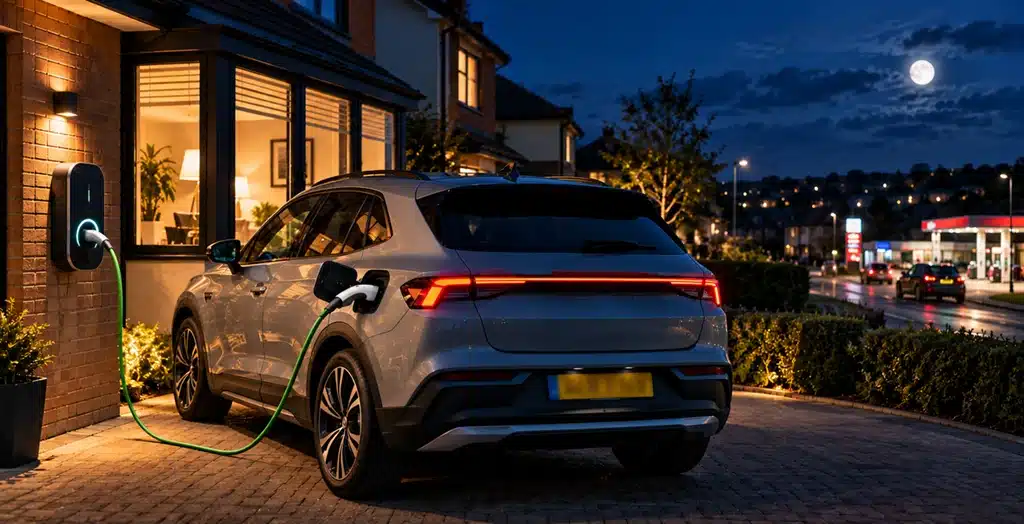
One of the most common questions prospective electric-car buyers ask is also one of the most important:
How much will it actually cost me to charge an EV?
The answer can vary enormously depending on where and when you plug in.
Charge regularly at an expensive public rapid charger and the savings compared with petrol or diesel can become much smaller. Plug the same car into a home charger overnight on a specialist off-peak EV electricity tariff and the calculation can look completely different.
Recent analysis by Carbon Brief estimated that an electric car charged using cheap off-peak electricity can cost approximately 2.3p per mile to drive.
By comparison, its figures put petrol at around 20.1p per mile and diesel at approximately 21p per mile.
That makes off-peak electric driving around nine times cheaper per mile than fuelling a comparable petrol or diesel car.
For drivers able to charge at home overnight, the difference can add up to hundreds – and potentially more than £1,000 – over the course of a year.
So how does it work, and are the savings really that large?
Why off-peak charging changes the EV calculation
Electricity doesn’t necessarily cost the same amount throughout the day.
Most households on an ordinary single-rate electricity tariff pay broadly the same unit rate whether they switch on an appliance at lunchtime or plug their car in at midnight.
Specialist EV tariffs work differently.
They typically provide a period of much cheaper electricity overnight, when overall demand on the electricity network is lower.
Instead of paying somewhere around the normal domestic electricity rate, an EV owner might be able to charge their car for around 8p per kWh during the discounted period, depending on the tariff and supplier.
That difference is substantial.
From October to December 2026, Ofgem’s average electricity unit rate under the domestic price cap is 26.32p per kWh for a Direct Debit customer.
An off-peak rate of 8p/kWh is therefore approximately 70% cheaper per unit of electricity.
For a household appliance using a small amount of electricity, saving 18p or so per kWh might not immediately sound dramatic.
An electric car is different because its battery might hold 50, 60, 70 or even 80kWh.
Charge thousands of miles each year at the lower rate and those pennies quickly turn into pounds.
What does 8p per kWh actually mean in a car?
Electric-car efficiency is normally expressed in miles per kilowatt-hour (miles/kWh).
Think of it as the EV equivalent of miles per gallon.
If an electric car achieves:
3.5 miles per kWh
and your electricity costs:
8p per kWh
then every 8p of electricity moves the car approximately 3.5 miles.
That works out at roughly:
2.3p per mile.
So a 100-mile journey would consume approximately £2.29 of electricity.
Travel 200 miles and the electricity would cost roughly £4.57.
Cover 10,000 miles and the theoretical electricity cost at the same efficiency and tariff would be around £229.
Those figures won’t apply exactly to every car or every journey, but they demonstrate why home charging – and particularly off-peak home charging – can have such a large effect on EV running costs.
What would 10,000 miles cost?
This is perhaps the easiest way to appreciate the difference.
Using Carbon Brief’s estimated running costs of approximately:
- 2.3p/mile – off-peak EV
- 7p/mile – EV charged at the standard domestic rate
- 20.1p/mile – petrol
- 21p/mile – diesel
a driver covering 10,000 miles would spend approximately:
| Energy source | Approx. cost per mile | Approx. cost over 10,000 miles |
|---|---|---|
| EV – off-peak home charging | 2.3p | £230 |
| EV – standard home electricity | 7p | £700 |
| Petrol | 20.1p | £2,010 |
| Diesel | 21p | £2,100 |
On those assumptions, the difference between charging an EV off-peak and fuelling a petrol car is approximately £1,780 over 10,000 miles.
Against diesel, it’s approximately £1,870.
That’s not a small difference in household expenditure.
It’s equivalent to roughly £150 a month compared with the petrol example.
Of course, this comparison is specifically about energy costs. It doesn’t include the purchase price, insurance, servicing, depreciation or finance costs of the vehicles.
But if you’re comparing what it costs simply to put energy into the vehicle and drive it, cheap overnight electricity can be extremely difficult for petrol or diesel to match.
Imagine paying £20 for petrol and getting the equivalent of £170
There is another way of looking at the figures.
Carbon Brief calculated that the electricity needed to travel the same distance as a litre of petrol could cost as little as approximately 20p when using cheap off-peak charging.
At the time of its analysis, petrol averaged £1.72 per litre.
Since then, RAC Fuel Watch reported average petrol at 174.71p per litre at the beginning of October, while diesel reached 200.01p per litre.
Obviously, electricity isn’t literally measured in litres. The comparison simply looks at the amount of energy required for an EV to travel the same distance as a conventional car.
But it illustrates the scale of the difference.
For a driver accustomed to watching £80, £90 or even £100 appear on a petrol-station display, plugging an EV in overnight and adding a substantial amount of range for a few pounds can initially seem surprisingly inexpensive.
What does it cost to put 200 miles into an EV overnight?
Let’s take a fairly efficient family EV averaging 3.5 miles/kWh.
To travel 200 miles it would need approximately:
57kWh of electricity.
At 8p/kWh, that electricity would cost about:
£4.57.
At the current Ofgem average price-cap rate of 26.32p/kWh, the same 57kWh would cost around:
£15.00.
That difference is purely the result of when the car is charged and which electricity tariff is being used.
The vehicle hasn’t changed.
The battery hasn’t changed.
The journey hasn’t changed.
Only the electricity price has changed.
This is why choosing an electricity tariff can be almost as important to EV running costs as choosing the car itself.
You don’t normally charge an EV from empty
There’s another misconception worth addressing.
Drivers sometimes calculate charging costs by multiplying the entire battery capacity by the electricity price.
For example:
“My EV has a 70kWh battery, therefore I need to buy 70kWh every night.”
You don’t.
Just as most motorists don’t completely empty a petrol tank every day, most EV owners don’t arrive home with a completely empty battery.
Suppose your normal commute and other journeys total 35 miles.
At 3.5 miles/kWh, you’ve used roughly:
10kWh.
Replacing that electricity at 8p/kWh costs approximately:
80p.
So rather than thinking about the cost of a “full tank”, it’s often more useful to think about replacing the electricity you’ve used that day.
For many drivers, the car simply gets plugged in when they arrive home and is ready again the following morning.
A home charger effectively turns your driveway into your filling station
This is one of the less obvious differences between owning an EV and owning a petrol or diesel vehicle.
With a conventional car, buying fuel is normally a separate task.
You drive to a filling station, stop the car, refuel and pay.
With an EV and off-street parking, the car can charge while you’re doing something else.
You arrive home.
Plug in.
Go indoors.
The charger or vehicle waits for the cheap electricity period.
By morning, the required energy has been added automatically.
For somebody who can do the majority of their charging this way, visits to public charging stations can become something primarily associated with longer journeys rather than everyday driving.
That distinction matters enormously when discussing the cost of owning an EV.
Why smart charging makes cheap electricity easier to use
An off-peak tariff doesn’t necessarily mean setting an alarm for midnight and going outside to plug the car in.
Modern EVs and smart chargers can schedule charging automatically.
For example, some specialist tariffs allow the driver to plug in when they arrive home, tell an app when the car needs to be ready and allow the charging system to decide when electricity should be supplied.
The car might physically be connected for ten hours but only draw significant power during the cheaper periods.
Some tariffs also provide cheap electricity to the rest of the home during a defined overnight window.
That can create additional opportunities to run appliances such as dishwashers or washing machines during the lower-rate period, provided this is done safely and appropriately.
For an EV owner, however, the car is usually where the largest potential saving lies.
How much can a typical overnight charging window add?
A common UK home charger operates at approximately 7kW.
If it charged continuously for six hours, the theoretical energy delivered would be around:
42kWh.
Allowing for charging losses, the amount reaching the battery will be somewhat lower.
But 42kWh from the supply gives us a useful illustration.
At an efficiency of 3.5 miles/kWh, that amount of electricity represents theoretically up to around:
147 miles of driving.
At 8p/kWh, the electricity drawn would cost approximately:
£3.36.
Most UK drivers don’t travel anything close to 147 miles every day.
This means a typical overnight cheap-rate window can potentially replenish considerably more than the energy used during an ordinary day’s driving.
What if your EV is less efficient?
Not every EV achieves 3.5 miles/kWh.
A small hatchback driven around town might comfortably exceed that figure.
A large electric SUV travelling quickly on a cold motorway could be considerably less efficient.
Suppose a large EV manages only 2.5 miles/kWh.
At an 8p off-peak rate, its energy cost is still only:
3.2p per mile.
At 10,000 miles per year, that’s approximately:
£320 of electricity.
Compare that with a particularly efficient EV achieving 4 miles/kWh:
2p per mile, or around £200 over 10,000 miles.
Efficiency therefore matters, but cheap electricity can make even a relatively thirsty EV inexpensive to power compared with petrol or diesel.
Winter will increase the cost
Real-world EV efficiency changes throughout the year.
Cold weather can increase energy consumption because the battery operates differently at low temperatures and energy is also required to heat the cabin.
Motorway speeds, rain, strong winds, roof boxes, heavy loads and driving style can all affect efficiency.
So an EV that averages 4 miles/kWh during mild summer driving might achieve significantly less during a cold motorway journey.
This is why calculations such as 2.3p per mile should be viewed as a useful illustration rather than a guaranteed figure for every EV owner.
But there’s an important point here.
Even if your EV’s efficiency falls from 3.5 to 3 miles/kWh, electricity costing 8p/kWh still equates to only about:
2.7p per mile.
The advantage of a very low electricity unit price remains substantial.
What about charging losses?
Not every kilowatt-hour drawn from your electricity meter ends up stored in the vehicle’s battery.
Some energy is lost during the charging process through conversion, battery conditioning and other electrical losses.
Consequently, calculations based purely on battery capacity can slightly underestimate the amount of electricity purchased from the grid.
Charging efficiency varies according to the vehicle, charger, temperature and charging conditions.
For household budgeting, the most accurate approach is therefore to look at the actual electricity consumed by your home charger or smart meter rather than simply relying on the number of kilowatt-hours added to the battery.
Even allowing for reasonable charging losses, however, low overnight electricity prices can still result in very low per-mile costs.
Isn’t electricity expensive at the moment?
This is where discussions about EV charging sometimes become confusing.
Electricity is relatively expensive on a normal domestic tariff.
From 1 October to 31 December 2026, Ofgem’s average capped electricity unit rate for a Direct Debit customer is 26.32p/kWh.
At 3.5 miles/kWh, that equates to approximately:
7.5p per mile.
That’s considerably more than 2.3p.
But it is still substantially below current petrol and diesel costs on the same broad comparison.
The much larger saving comes when an EV owner can move most vehicle charging onto a specialist overnight tariff.
That’s why asking “How much does electricity cost?” isn’t quite enough when calculating EV running costs.
The better question is:
“How much will the electricity I use to charge my car cost?”
Those can be two very different numbers.
Public rapid charging is a different calculation
There is an important caveat.
The extremely low figures in this article do not apply to public rapid charging.
Rapid and ultra-rapid charging networks have considerably higher costs. Operators need to pay for high-powered equipment, grid connections, maintenance, land, payment systems and other infrastructure.
The RAC’s Charge Watch calculations demonstrate that public rapid charging can be significantly more expensive than charging at home.
This means someone who lives in a flat without private parking and relies heavily on public rapid chargers will have a very different EV cost calculation from someone charging on a driveway at 8p/kWh.
This distinction is essential.
Saying simply “EVs cost 2.3p per mile” would be misleading.
A more accurate statement is:
An efficient EV charged predominantly at home on a cheap off-peak electricity tariff can cost around 2–3p per mile in electricity.
That is where the exceptional savings are found.
How often do EV drivers actually charge at home?
Home charging isn’t a niche behaviour.
Government estimates cited in Carbon Brief’s analysis suggest approximately 76% of EV charging sessions take place at home, with around 90% of electric-car drivers currently having access to domestic charging.
That helps explain why comparisons based entirely on public rapid-charging prices don’t represent the experience of many existing EV owners.
A driver might complete dozens of inexpensive overnight charges between visits to a motorway rapid charger.
The public charger is important for making longer journeys possible.
It doesn’t necessarily determine the vehicle’s everyday energy cost.
Could solar panels make EV charging even cheaper?
For households with solar panels, the calculation can become more interesting again.
Surplus solar generation can potentially be diverted into an electric vehicle rather than exported to the grid, depending on the household’s equipment, electricity tariff and charging setup.
In that situation, assigning an exact “cost per kWh” to the vehicle becomes more complicated because there is an opportunity cost associated with electricity that could otherwise have been exported.
Nevertheless, combining smart charging, solar generation and suitable tariffs gives households considerably more control over when and how they buy energy for transport.
A petrol or diesel driver has no equivalent option.
You cannot install a small oil refinery on the roof and fill the car from sunshine generated during the afternoon.
What about the proposed EV pay-per-mile charge?
EV taxation is also changing.
The government plans to introduce a mileage-based charge for electric vehicles from April 2028, currently proposed at 3p per mile.
That will need to be included when comparing future EV running costs.
If an EV charged off-peak currently costs around 2.3p per mile in electricity, adding 3p would take the combined electricity-and-mileage-tax figure to approximately:
5.3p per mile.
That would clearly reduce some of the financial advantage.
But compared with current petrol and diesel fuel costs of around 20p per mile, there would still be a substantial difference in energy-plus-mileage-tax costs, assuming electricity and fuel prices remained broadly comparable with today’s levels.
Of course, energy and fuel prices can change considerably before 2028, so today’s figures shouldn’t be treated as a forecast of what motorists will pay then.
The biggest saving may come from changing when you charge
When people consider reducing their motoring costs, they often think about changing cars.
With an EV, there is another lever available:
change when you buy the electricity.
Consider the same EV travelling 10,000 miles at 3.5 miles/kWh.
It needs roughly 2,857kWh of electricity for propulsion over the year, before allowing for charging losses.
At 26.32p/kWh, that electricity costs approximately:
£752.
At 8p/kWh:
£229.
That’s a difference of more than:
£520 per year.
Same car.
Same mileage.
Same efficiency.
The major difference is the electricity tariff and charging schedule.
This is why somebody buying an EV should investigate suitable home-energy tariffs at the same time as comparing battery capacities and charging speeds.
What should a first-time EV buyer check?
If you’re considering an electric car primarily because of its lower running costs, don’t rely on a generic “cost to charge” figure.
Check your own circumstances.
Can you charge at home?
If you have off-street parking, home charging will usually provide the greatest flexibility.
Can you access a specialist EV tariff?
Check the off-peak rate, peak rate, cheap-rate hours, smart-meter requirements and vehicle or charger compatibility.
How many miles do you drive each day?
This determines how much electricity you’ll actually need to replace overnight.
How efficient is the EV you’re considering?
Look for realistic miles/kWh figures rather than assuming every electric car consumes the same amount of electricity.
How often will you use public rapid chargers?
Someone making a 400-mile journey every week needs to factor public charging into their calculation. Someone travelling 30 miles a day and charging at home may use one only occasionally.
What does your whole household electricity bill look like?
A specialist EV tariff may have different peak electricity rates or other conditions. Compare the entire tariff rather than looking solely at the attractive overnight figure.
What This All Means for Drivers
The current difference between petrol, diesel and cheap overnight electricity illustrates one of the biggest potential financial advantages of electric-car ownership.
At current prices, Carbon Brief estimates an EV charged off-peak can travel for around 2.3p per mile, compared with approximately 20.1p for petrol and 21p for diesel.
For a 10,000-mile driver, that represents a potential difference approaching £1,800–£1,900 per year in energy costs.
But the key phrase is charged off-peak.
An EV isn’t automatically exceptionally cheap to run simply because it’s electric.
Where you charge, when you charge, your electricity tariff and the efficiency of the vehicle all matter.
For a driver who can plug into a home charger every evening and schedule most charging during a cheap overnight period, the economics can be particularly compelling.
A daily 35-mile commute might require only around 80p of off-peak electricity in an EV averaging 3.5 miles/kWh at an 8p tariff.
That is perhaps the most useful way for a prospective EV owner to think about home charging.
Instead of visiting a filling station and buying £70, £80 or £100 of fuel at once, you’re effectively topping the car back up each night for the cost of the electricity used during that day’s journeys.
And while petrol and diesel prices are displayed prominently on giant signs at filling stations, some of the cheapest motoring energy in Britain is available much less conspicuously – through a charging cable on the driveway, while you’re asleep.
Looking for a Charging Cable for Home EV Charging?
Taking advantage of cheap overnight electricity starts with being able to charge your EV conveniently at home.
Most modern electric cars sold in the UK use a Type 2 connection for AC charging, allowing them to charge from compatible home wallboxes and public AC charging stations.
We supply charging cables and portable charging equipment for a wide range of electric and plug-in hybrid vehicles.
You can browse our vehicle-specific charging cables, explore our Type 2 charging cables, or contact us if you’re unsure which charging equipment is suitable for your vehicle.
For drivers with access to off-peak electricity, having the right home charging setup can turn the hours when the car would otherwise simply be parked into the cheapest time to put the next day’s miles back into the battery.

