
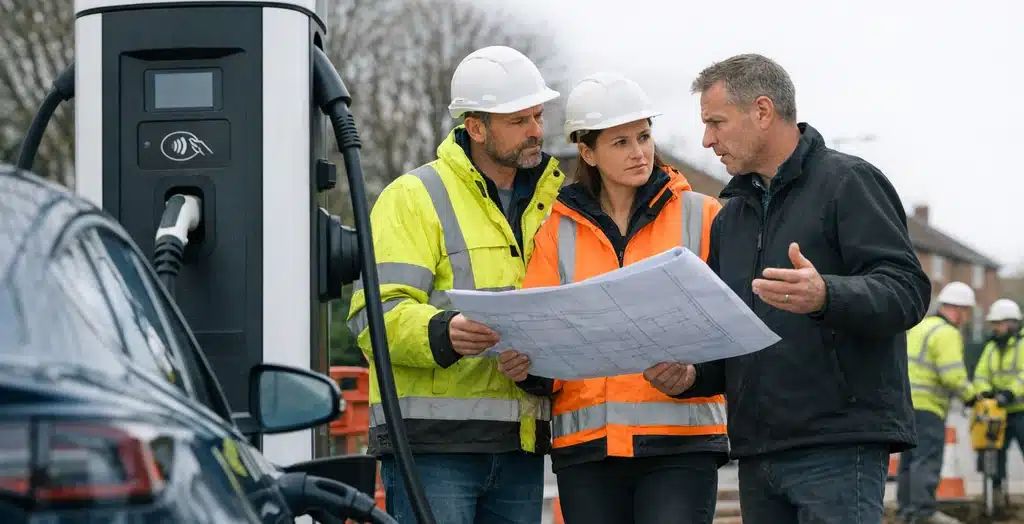
The UK has spent several years expanding its electric vehicle charging network, with new motorway charging hubs, residential chargepoints and destination chargers appearing across the country.
But the next stage of that expansion could depend on something less visible than charging equipment or electricity cables: confidence in the government’s long-term electric vehicle policy.
In August 2026, the government launched a review of the Zero Emission Vehicle (ZEV) Mandate, the legislation requiring vehicle manufacturers to increase the proportion of zero-emission cars and vans they sell.
The review comes at an important moment for the UK electric-car market.
More than two million electric vehicles are now registered on UK roads, according to government figures published in August, and the public charging network continues to expand.
However, charging infrastructure requires substantial investment, often years before the equipment begins generating a commercial return.
That raises an important question: could changes to the ZEV Mandate affect how quickly new charging stations are installed?
What is the ZEV Mandate?
The Zero Emission Vehicle Mandate was introduced in January 2024 to encourage manufacturers to increase the proportion of new zero-emission vehicles entering the UK market.
Rather than banning petrol and diesel cars immediately, the policy sets annual targets for manufacturers.
The targets increase progressively towards 2030.
For new cars, the current requirements are:
| Year | ZEV target |
|---|---|
| 2024 | 22% |
| 2025 | 28% |
| 2026 | 33% |
| 2027 | 38% |
| 2028 | 52% |
| 2029 | 66% |
| 2030 | 80% |
The requirements for vans follow a separate trajectory, reaching 70% by 2030.
These are manufacturer-level regulatory targets rather than a requirement for every individual dealership to achieve exactly the stated percentage.
Manufacturers can also use mechanisms such as trading, banking and borrowing allowances to comply with the legislation.
That distinction is important because the headline targets do not necessarily correspond exactly to the proportion of EVs sold in a particular year.
What changed in 2025?
The government had already introduced changes to the ZEV Mandate before announcing its latest review.
In April 2025, it confirmed that the phase-out of new cars powered solely by petrol or diesel would remain scheduled for 2030, while certain hybrid vehicles could continue to be sold until 2035.
Manufacturers were also given additional flexibility in how they meet the ZEV requirements.
These changes were intended to give the automotive industry more room to manage the transition while retaining the longer-term direction towards zero-emission vehicles.
For consumers, the important point is that the ZEV Mandate was not abolished.
The annual targets remained in place, but manufacturers gained additional options for meeting their obligations.
Why is the government reviewing the policy again?
On 14 August 2026, the Department for Transport launched a further consultation examining how the ZEV Mandate is operating.
The review considers several areas, including:
- The existing annual zero-emission vehicle targets.
- Whether the flexibility available to manufacturers is working as intended.
- Alternative approaches to addressing challenges in the transition.
- Potential technical changes to the regulations.
- How the phase-out of new cars relying solely on internal combustion engines should be defined.
The consultation closes on 23 October 2026.
Its findings could inform future changes to the legislation, although no particular outcome has been confirmed.
The government says the review is intended to support consumers, manufacturers and the wider automotive industry while maintaining progress towards zero-emission transport.
For charging operators, however, the significance extends beyond vehicle manufacturing.
The number of electric cars expected on UK roads is one of the factors determining where and when new charging infrastructure becomes commercially viable.
Why does the ZEV Mandate matter to charging companies?
Imagine a company considering a new motorway charging hub.
The project might require:
- Purchasing or leasing suitable land.
- Obtaining planning permission.
- Installing high-powered charging equipment.
- Arranging a suitable electricity connection.
- Installing transformers and other electrical infrastructure.
- Providing lighting, parking facilities and payment systems.
- Maintaining the equipment for many years.
The investment can be substantial.
A charging operator therefore needs to estimate how many electric vehicles will use the site over the next five, ten or even fifteen years.
If EV ownership grows rapidly, demand for charging services should generally increase.
If EV adoption grows more slowly than expected, some locations may take longer to become profitable.
The ZEV Mandate matters because it helps establish expectations about the future number of electric vehicles.
Changes to those expectations can influence investment decisions, even when the changes don’t directly affect charging infrastructure.
Could changes to the mandate slow charging investment?
Potentially, but the relationship is not straightforward.
Consider a hypothetical charging operator planning a £2 million installation.
Its financial projections assume that EV ownership in the surrounding area will increase steadily over the next decade.
If revised government policy leads the operator to expect slower EV adoption, it might reconsider the timing of the investment.
It could decide to install fewer chargers initially, delay construction or prioritise a location with stronger existing demand.
That doesn’t necessarily mean the project would be cancelled.
It might simply be developed in stages.
Equally, greater flexibility for manufacturers could help the vehicle market adjust to consumer demand and potentially support a more sustainable transition.
The important distinction is between changing the pace of infrastructure investment and stopping it altogether.
There is currently no basis for assuming that a review of the ZEV Mandate will automatically bring UK charging investment to a halt.
The UK already has more than 120,000 public chargers
One reason the situation is different from the early years of EV adoption is that the UK now has a substantial public charging network.
According to Department for Transport statistics, there were 121,171 publicly available EV chargers in the UK on 1 July 2026.
Of these, 28,887 were rated at 50kW or above, placing them in the rapid or ultra-rapid categories.
The figures also reveal how different types of charging are distributed across the network.
Approximately:
- 49% were standard chargers rated from 3kW to below 8kW.
- 27% were rated from 8kW to below 50kW.
- 12% were rapid chargers rated from 50kW to below 150kW.
- 12% were ultra-rapid chargers rated at 150kW or above.
These figures use the government’s newer charger-counting methodology, which measures individual charging outlets rather than simply counting physical charging devices.
They demonstrate that the UK charging network is already extensive, although availability varies considerably between regions.
The challenge is increasingly about ensuring that the right chargers are installed in the right locations.
More chargers doesn’t always mean better charging
For drivers, the total number of public chargers is useful, but it doesn’t tell the whole story.
A 7kW charger outside a supermarket and a 350kW charger at a motorway service station serve very different purposes.
One is designed for a vehicle parked for several hours.
The other is intended to deliver a substantial charge during a relatively short stop.
The Department for Transport’s July 2026 figures show that approximately 52% of public chargers were classified as destination chargers, while 33% were on-street chargers and 11% were en-route chargers.
That distinction matters when evaluating the adequacy of the charging network.
A town might have dozens of public chargers but relatively few suitable for drivers needing to recharge quickly during a journey.
Similarly, a motorway services location might have high-powered equipment but insufficient charging bays during busy holiday periods.
The next phase of infrastructure development therefore needs to consider capacity, location, reliability and accessibility, rather than charger numbers alone.
Why grid connections are becoming increasingly important
Installing a public EV charger isn’t always as simple as connecting it to an existing electricity supply.
A small number of 7kW chargers may be relatively straightforward to accommodate, depending on the site.
A large ultra-rapid charging hub is different.
Consider a location with ten chargers, each capable of delivering 300kW.
If every charger were operating at its maximum simultaneously, the theoretical combined demand would be:
10 × 300kW = 3,000kW, or 3MW.
That is a substantial electrical load.
In practice, charging hubs may use intelligent power sharing, battery storage and other techniques to manage demand.
Nevertheless, providing sufficient electrical capacity can require significant infrastructure work.
A new site may need upgraded cables, transformers or a higher-capacity connection to the local electricity distribution network.
Those requirements can affect both cost and construction times.
Consequently, even where a charging company is confident that EV demand will increase, obtaining an appropriate grid connection may influence when its chargers can open.
Could battery storage help charging hubs expand?
One increasingly interesting development is the use of stationary battery storage alongside high-powered charging equipment.
Instead of drawing every kilowatt directly from the electricity network at the moment a vehicle is charging, a site can store energy in a large battery.
That stored electricity can then supplement the grid supply when several vehicles require rapid charging simultaneously.
For example, a charging hub might use battery storage to reduce its peak grid demand during busy periods.
The technology doesn’t eliminate the need for a suitable electrical connection, and the battery must eventually be recharged.
However, it can provide additional flexibility when designing charging infrastructure.
As EV batteries become capable of accepting higher charging rates, managing electricity demand at busy charging locations could become increasingly important.
Why residential charging needs a different approach
Motorway charging hubs attract attention because they are large, visible developments.
But millions of drivers also need somewhere convenient to charge when they aren’t travelling long distances.
For motorists with private driveways, a domestic wallbox is often the simplest solution.
Drivers living in flats, terraced houses or properties without off-street parking face different challenges.
They may depend on:
- On-street charging points.
- Chargers installed in residential car parks.
- Workplace charging.
- Supermarket and retail charging.
- Local public charging hubs.
This is where local authority planning becomes particularly important.
The government’s £400 million Local Electric Vehicle Infrastructure (LEVI) Fund is intended to support the expansion of local charging provision, particularly for drivers without private parking.
In March 2026, the government said the programme was expected to support the delivery of more than 100,000 additional local public chargepoints.
The programme operates separately from the ZEV Mandate, although both contribute to the wider transition towards electric vehicles.
Why charging operators need confidence years in advance
Public charging infrastructure has a different investment cycle from many consumer products.
A vehicle manufacturer can adjust production schedules and model availability as market conditions change.
A charging operator may already have committed substantial funds before a new location opens.
Planning applications, land agreements and grid connections can all involve lengthy lead times.
Operators therefore need to consider not only today’s EV population but the likely demand several years into the future.
Stable long-term expectations can make it easier to justify investment in locations where demand is still developing.
However, certainty doesn’t necessarily mean regulations must remain unchanged.
Clear explanations of future requirements, adequate transition periods and predictable implementation can also help businesses plan.
For investors, understanding the direction and timing of policy may be as important as the precise wording of an individual target.
What happens if EV sales grow faster than charging infrastructure?
There is another side to the issue.
If electric vehicle registrations increase faster than the charging network can accommodate them, drivers may experience more congestion at popular locations.
This could be particularly noticeable at motorway services during bank holidays and other peak travel periods.
Charging queues are influenced by several factors:
- The number of available charging bays.
- How quickly individual vehicles can charge.
- Whether equipment is working correctly.
- How long drivers remain connected after charging.
- The number of vehicles arriving at the same time.
Faster-charging vehicles can help improve turnover.
For example, a vehicle that completes a charging session in 20 minutes potentially occupies a bay for less time than one requiring 45 minutes.
But charging speed alone cannot solve every capacity problem.
Infrastructure needs to expand in locations where demand is increasing.
The challenge for policymakers and operators is therefore to avoid a mismatch between vehicle adoption and charging availability.
What does this mean for somebody buying an EV in 2026?
For prospective EV buyers, the ZEV Mandate review is worth following, but it shouldn’t necessarily determine whether they purchase an electric car.
The current charging network already supports millions of EV journeys.
Whether it will suit your particular needs depends more directly on your driving habits, where you live and which charging facilities you can access.
Consider three examples.
Driver 1: Mostly charging at home
Someone travelling 30 miles each day and charging overnight on a driveway may rarely need public charging.
For this driver, the availability of a suitable home charger and electricity tariff could be much more important than the pace of motorway charging investment.
Driver 2: Regular motorway journeys
Someone driving 250 miles several times a week may depend heavily on rapid and ultra-rapid charging.
For this driver, the number, reliability and location of charging hubs along regular routes matter considerably.
Driver 3: No private parking
Someone living in a flat without access to a driveway may rely almost entirely on public charging.
For this driver, the availability and cost of convenient local charging can be a major consideration when deciding whether to buy an EV.
These examples illustrate why the future of charging infrastructure isn’t simply about installing more high-powered equipment.
Different drivers need different charging solutions.
Could policy changes affect EV prices?
The ZEV Mandate can also influence the vehicles available to UK buyers.
Manufacturers need to manage their new-car registrations in line with the regulations.
That can affect how they price and promote electric vehicles, although many other factors influence retail prices.
Greater flexibility in the mandate could change how manufacturers approach compliance.
Equally, maintaining progressively increasing targets provides a continuing incentive to supply zero-emission vehicles.
For consumers, the practical effects may include changes in manufacturer discounts, model availability and the balance between electric, hybrid and conventional vehicles offered by dealerships.
However, it would be premature to assume that the current review will necessarily make electric cars cheaper or more expensive.
The outcome of the consultation and any subsequent legislative changes will need to be considered alongside wider market conditions.
What should EV drivers watch over the next year?
Rather than focusing solely on the political debate surrounding the ZEV Mandate, there are several practical indicators worth following.
1. The outcome of the consultation
The government’s review closes on 23 October 2026. Any proposed changes to the annual targets or compliance arrangements will help clarify the direction of policy.
2. Actual EV registrations
The number of electric cars entering the market provides a useful indication of how quickly demand for charging infrastructure may increase.
3. New rapid-charging locations
For longer-distance drivers, the opening of additional motorway and strategic-road charging hubs can make a noticeable difference.
4. Local charging availability
Drivers without off-street parking should pay particular attention to local authority charging projects and residential infrastructure.
5. Charging reliability
A charger that is installed but frequently unavailable provides little practical benefit. Network reliability and maintenance remain important considerations.
What This Means for Drivers
The government’s review of the ZEV Mandate introduces questions about how the UK’s electric vehicle transition will develop over the next few years.
For charging companies, long-term expectations about EV ownership influence decisions about where to invest, how much capacity to install and when projects should proceed.
Changes to the mandate could therefore affect investment planning.
However, a review of the policy does not automatically mean charging infrastructure investment will stall.
The UK already has more than 120,000 public chargers, the government continues to support local charging projects, and the number of electric vehicles on British roads has passed two million.
The more important challenge is ensuring that charging infrastructure develops in step with demand.
For somebody considering an electric car today, the practical advice remains straightforward: assess the charging facilities you can actually use rather than relying solely on national charger totals or future policy promises.
A suitable home charger, reliable local charging facilities and convenient rapid chargers along regular routes are likely to matter more to everyday ownership than the precise details of the ZEV Mandate.