
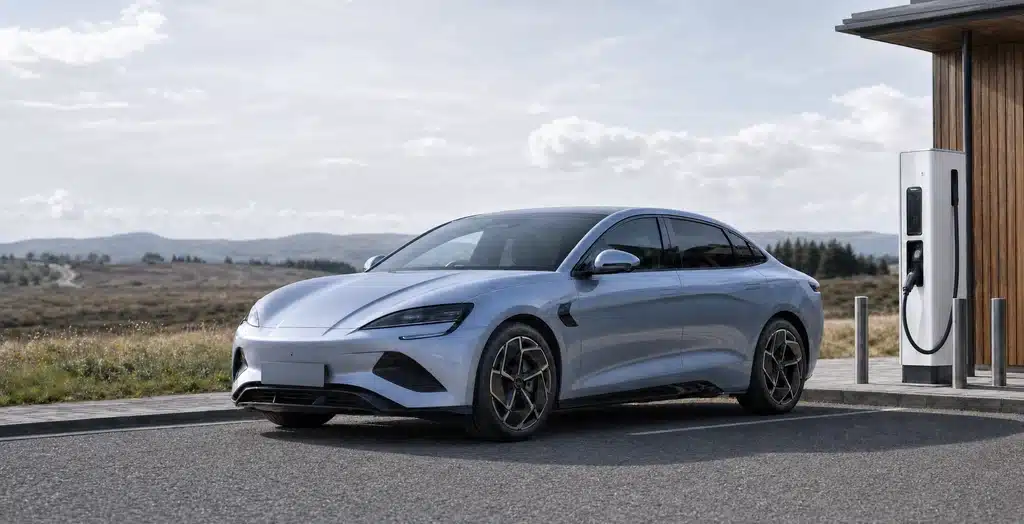
Electric-car battery technology has moved forward rapidly over the past few years, but BYD’s latest announcement suggests that charging an EV could eventually take little longer than stopping for petrol or diesel.
The Chinese manufacturer has unveiled its second-generation Blade Battery 2.0 alongside a new FLASH Charging system capable, in its Chinese-market specification, of delivering up to 1,500kW through a single charging connector.
BYD says a compatible Blade Battery 2.0 can be charged from 10% to 70% in as little as five minutes, or from 10% to 97% in nine minutes. Even at -30°C, the company claims a 20% to 97% charge can be completed in 12 minutes.
Those are striking figures, particularly when many current EVs still require around 20 to 40 minutes for a substantial rapid charge. But what do they actually mean for somebody buying an electric car in the UK?
What is BYD’s Blade Battery 2.0?
The Blade Battery 2.0 is the second generation of BYD’s lithium iron phosphate (LFP) battery technology.
LFP batteries have become increasingly common in electric cars because they avoid the use of nickel and cobalt in the cathode and can offer good durability and thermal stability. BYD already uses its original Blade Battery across cars including the BYD DOLPHIN, ATTO 3, SEAL and SEALION 7.
The new battery isn’t simply about charging more quickly. BYD says it has increased energy density by around 5% while simultaneously reducing the internal resistance that generates heat during very high-powered charging.
The manufacturer also claims overall capacity degradation has been reduced by 2.5% compared with the original Blade Battery.
That combination is potentially more important to ordinary EV owners than the headline 1,500kW charging figure. A battery that can store more energy in the same space, charge faster and retain more of its original capacity as it ages could improve several aspects of EV ownership at once.
Nine minutes to almost fully charge an EV?
This is understandably the part of BYD’s announcement attracting the most attention.
BYD says its new system can achieve:
- 10–70% in around 5 minutes
- 10–97% in around 9 minutes
- 20–97% in around 12 minutes at -30°C
- Charging power of up to 1,500kW
For comparison, a current UK-market BYD SEALION 7 Excellence AWD has a maximum DC charging rate of 230kW and can charge from 10% to 80% in approximately 24 minutes under suitable conditions.
The difference illustrates the potential scale of the technology rather well.
However, there is an important qualification: a 1,500kW charger is not something UK drivers can currently expect to find at their local motorway services.
The vehicle, battery and charging station all have to support these extremely high charging rates.
BYD says it had already installed 4,239 FLASH Charging stations in China by 5 March 2026, with a target of 20,000 by the end of 2026. The company has also confirmed plans for an international rollout, but the final specifications and availability of European installations have yet to be established.
The first European model due to receive Blade Battery 2.0 and FLASH Charging is expected to be the DENZA Z9GT, from BYD’s premium DENZA brand.
More than 600 miles from a battery?
BYD has also made a significant range claim.
The company says the 5% increase in battery energy density means ranges exceeding 1,000km – around 621 miles – are now possible.
There is an important caveat here too.
That figure is based on the Chinese CLTC efficiency test, rather than the WLTP test normally quoted for UK and European vehicles. The two figures should therefore not be compared directly.
For context, current UK BYD models have much more familiar WLTP figures. The BYD DOLPHIN offers up to approximately 265 miles, while the BYD SEAL can offer up to approximately 354 miles, depending on specification.
A future European car using Blade Battery 2.0 could therefore offer considerably greater range, but UK buyers should wait for an official WLTP figure before drawing conclusions from a Chinese-market range claim.
What battery claims usually tell you – and what they don’t
Battery announcements tend to concentrate on four headline numbers:
Driving range – how far the vehicle can theoretically travel between charges.
Maximum DC charging speed – the highest charging power the vehicle can accept from a suitable rapid charger.
Charging time – usually expressed as the time required to charge between two percentages, such as 10% to 80%.
Battery durability – how well the battery retains its usable capacity after years of charging and discharging.
All four are useful, but none tells the complete story.
A car advertised with a 300kW maximum charging speed, for example, won’t necessarily sit at 300kW throughout a charging session. Charging power normally rises and falls according to battery temperature and state of charge.
This behaviour is often described as the vehicle’s charging curve.
Consequently, a car capable of sustaining a relatively high charging rate for longer can sometimes complete a 10–80% charge more quickly than another car with a higher headline peak charging figure.
Don’t confuse rapid charging with home charging
This distinction is particularly important for first-time EV buyers.
BYD’s 1,500kW announcement concerns DC rapid charging. It doesn’t mean a future BYD will charge at anything remotely approaching 1,500kW on your driveway.
Home charging uses AC electricity and the maximum rate is determined largely by the vehicle’s onboard charger and the electrical supply available at the property.
A typical UK domestic wallbox operates at around 7kW, while some vehicles and suitable three-phase installations can support 11kW AC charging.
That means even if future cars can accept extraordinarily high DC charging rates at specialist public chargers, overnight home charging is likely to remain broadly similar.
For many drivers, that doesn’t matter. If you arrive home in the evening and the car is ready again the following morning, reducing an overnight charge from six hours to four hours offers little practical advantage.
The biggest benefit of technologies such as FLASH Charging would instead be long-distance journeys, where reducing a motorway charging stop from perhaps 25–30 minutes to around 10 minutes could noticeably change the experience.
Why this matters to first-time EV buyers
If you’re considering your first electric vehicle, developments such as Blade Battery 2.0 are encouraging – but they shouldn’t necessarily persuade you to postpone buying an EV that already suits your requirements.
Current electric cars can already cover the daily mileage of most UK motorists comfortably, and many offer more than 250 miles of WLTP range.
Consider two drivers.
One travels 25 miles each day and charges overnight at home. Whether their EV can rapid charge in nine minutes or 29 minutes may make virtually no difference during normal use.
Another regularly drives 300 miles between London and northern England. For that driver, charging speed, motorway charger availability and the vehicle’s real-world motorway range could be much more significant.
The specification that matters most therefore depends on how you actually use the car.
Why it matters to existing EV owners
Existing EV owners may look at nine-minute charging and wonder whether their current vehicle is suddenly becoming outdated.
In practical terms, probably not.
Battery technology will continue improving, just as fuel economy, engine performance and safety technology improved throughout the life of petrol and diesel vehicles.
A current EV doesn’t lose range because a newer battery has been announced.
But developments such as this do provide an indication of where the market is heading. When the time eventually comes to replace your existing vehicle, considerably faster charging and greater range may have moved from premium features to normal expectations.
There could also be wider benefits. If cars spend less time occupying rapid chargers, each charging bay can potentially serve more vehicles during busy periods.
What about battery life?
Charging speed tends to attract the headlines, but durability may prove just as important to buyers intending to keep an EV for many years or purchase one second-hand.
BYD says Blade Battery 2.0 has undergone demanding safety and durability testing, including 500 FLASH Charging cycles, and claims capacity degradation is reduced by 2.5% compared with its previous-generation battery.
How those results translate into long-term everyday use will become clearer as vehicles accumulate significant mileage.
For used-EV buyers in particular, battery health is likely to become an increasingly important consideration alongside mileage, service history and general vehicle condition.
What to check before believing an EV battery headline
When you see a new EV advertised with exceptional range or charging performance, look beyond the largest number.
Check:
- Is the range WLTP, CLTC, EPA or a manufacturer’s estimate?
- Is the charging figure a maximum peak or a sustained charging rate?
- What is the quoted 10–80% charging time?
- What charger power is required to achieve it?
- Can chargers delivering that power actually be found where you drive?
- How does temperature affect charging performance?
- What AC charging rate does the vehicle support at home?
- What battery warranty does the manufacturer provide?
- Does the vehicle’s real-world range suit your typical journeys?
These questions often tell you considerably more about what an EV will be like to own than its headline maximum charging rate.
What This Means for Drivers
BYD’s Blade Battery 2.0 and FLASH Charging technology is significant because it tackles two of the issues that continue to concern prospective EV buyers: how far the car will travel and how long it takes to recharge.
A genuine 10% to 97% charge in around nine minutes would bring an EV charging stop much closer to the time motorists are accustomed to spending at a petrol station.
But UK buyers shouldn’t shop based on the 1,500kW figure alone. The technology requires compatible vehicles and specialist charging infrastructure, and BYD’s 1,000km-plus range claim is based on China’s CLTC test rather than the WLTP standard used in the UK.
For an EV buyer today, the sensible approach remains to compare WLTP range, real-world efficiency, 10–80% rapid charging time and AC home-charging capability alongside price, practicality and comfort.
The most impressive battery isn’t necessarily the battery with the biggest number attached to it. It’s the one that makes charging fit naturally into the way you drive.
Looking for a Charging Cable for Your EV?
Whether your electric car can rapid charge at 150kW or a future 1,500kW, everyday AC charging still requires the correct equipment for the vehicle.
We supply charging cables for a wide range of battery-electric and plug-in hybrid vehicles, including model-specific charging solutions for BYD and many other manufacturers.
You can browse our vehicle-specific charging cables, explore our Type 2 charging cables and portable granny chargers, or contact us if you’re unsure which cable or charger is suitable for your vehicle.

