
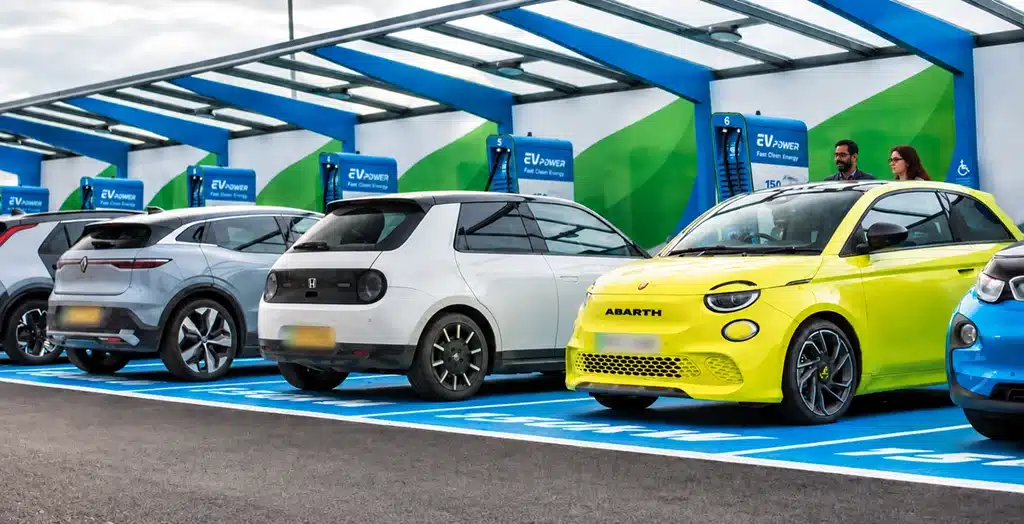
The UK Government is considering reducing the number of electric cars manufacturers must sell by 2030, potentially changing the pace of the country’s transition away from petrol and diesel vehicles.
At first glance, that might sound like a problem for car manufacturers and people planning to buy a new electric vehicle.
But the consequences could reach considerably further.
If fewer new electric cars enter the market than originally expected, what happens to the charging infrastructure that existing EV owners depend on? Could public charging become more expensive? And what does it mean for the growing number of drivers who already own plug-in hybrids?
Those questions have become increasingly relevant following reports that the Government could reduce its 2030 Zero Emission Vehicle (ZEV) Mandate target from 80% to approximately 60%.
The Government has not yet confirmed a change. Its consultation closed on 23 October 2026, and ministers are reviewing the responses, with an outcome expected before the end of the year.
Nevertheless, the possibility of lower targets has already prompted concerns from charging companies, electrical equipment manufacturers and environmental organisations, while car manufacturers argue that greater flexibility is needed to keep the transition affordable.
For motorists, the important question is what those competing arguments could mean in everyday ownership.
What exactly is the Government proposing?
The ZEV Mandate requires vehicle manufacturers to sell an increasing proportion of zero-emission cars each year.
Introduced in 2024, it was designed to provide a predictable transition towards electric motoring.
Under the current rules, the headline targets for new zero-emission car sales are:
| Year | Current target |
|---|---|
| 2026 | 33% |
| 2027 | 38% |
| 2028 | 52% |
| 2029 | 66% |
| 2030 | 80% |
| 2035 | 100% |
These targets apply to manufacturers, with various compliance mechanisms that mean the actual percentage of electric cars sold can be lower than the headline requirement.
The Government’s review has considered alternative trajectories, including reducing the 2030 target to 70%, 60% or 50%.
Recent reports suggest that a figure of around 60% is being considered, potentially accompanied by additional flexibility for manufacturers.
However, the existing rules remain in force until any changes are formally agreed and implemented.
The distinction matters because reducing the ZEV target is not the same thing as banning fewer vehicles from the road or preventing people from buying electric cars.
It would primarily change the obligations placed on manufacturers when deciding what proportion of their new-car sales must be zero-emission.
Why does the car industry want more flexibility?
Electric vehicle registrations are growing, but the industry argues that the pace of growth isn’t keeping up with the regulatory targets without substantial financial support.
Figures published by the Society of Motor Manufacturers and Traders (SMMT) illustrate the situation.
In October 2026, battery-electric vehicles accounted for 32% of new UK car registrations, with 48,858 electric cars registered during the month.
That was an increase of 32.7% compared with October 2025.
Across the first ten months of 2026, however, electric cars accounted for 26.6% of new registrations, below the year’s headline ZEV target of 33%.
The figures demonstrate that demand is increasing, but manufacturers are still relying on discounts, attractive finance packages and other incentives to encourage buyers to switch.
The SMMT argues that these incentives are expensive and cannot necessarily continue indefinitely.
Manufacturers also face significant costs developing new electric models, batteries, factories and supply chains.
Their argument is that a more flexible mandate could help them manage those investments without having to push electric vehicles into the market faster than consumers are prepared to buy them.
But there’s another side to that argument.
The discounts manufacturers are currently offering can make electric cars more affordable for buyers.
If the pressure to meet ZEV targets decreases, some of those incentives could become less generous.
That creates an interesting question for anyone considering a new EV.
Could new electric cars become more expensive?
Potentially, although the outcome isn’t straightforward.
Imagine a manufacturer needs electric vehicles to account for a substantially higher proportion of its sales.
If customer demand isn’t sufficient, it might offer discounts, subsidised finance or additional equipment to encourage more people to choose an EV.
Now imagine that its regulatory target is reduced.
The manufacturer may no longer need to offer quite the same level of incentives.
That could mean fewer discounts on certain models, making the actual transaction price higher even if the manufacturer’s advertised list price remains unchanged.
For example, a £35,000 electric car with a £4,000 manufacturer contribution effectively costs £31,000 before considering other finance terms.
If that contribution fell to £2,000, the same car would cost £33,000.
That’s a £2,000 difference without any change to the vehicle itself.
This is only an illustration, not a prediction of what manufacturers will do.
Greater flexibility could also help manufacturers reduce costs, avoid unsustainable discounting and introduce more affordable models.
Competition between brands, battery costs and new technology will continue to influence prices regardless of the mandate.
For prospective buyers, the practical advice is to compare actual purchase prices and finance costs, rather than assuming a reduced ZEV target will automatically make electric cars cheaper.
What about drivers who already own an EV?
This is where the proposed changes become particularly interesting.
If you already own a fully electric car, the Government reducing the ZEV Mandate would not change how your vehicle operates.
Your battery capacity would remain the same.
Your charging speed would remain the same.
You would still be able to charge at home and use compatible public charging stations.
There is no proposal to prevent existing electric cars from being driven.
However, the policy could have indirect consequences.
These include the pace of public charging investment, charging prices, used vehicle values and the future availability of charging services.
For some owners, particularly those without access to home charging, these longer-term effects could be more important than the headline sales target itself.
Could public charging infrastructure expand more slowly?
Public charging networks are built on expectations about how many electric vehicles will use them.
A company planning a new charging hub needs to consider how many vehicles are likely to visit the site over the coming years.
It may need to invest in land, planning permission, grid connections, transformers and expensive high-powered charging equipment long before the site begins earning revenue.
Suppose a charging operator plans to install ten ultra-rapid chargers at a motorway services location.
Its business case assumes that electric vehicle ownership will increase substantially over the next five years.
If the expected number of EVs on the road is revised downwards, the operator might reconsider how quickly it needs to install all ten chargers.
It could begin with six and expand later.
Alternatively, it might prioritise another location where demand is already stronger.
Neither outcome necessarily means charging infrastructure development stops.
But it illustrates why changes to the ZEV Mandate can affect investment decisions beyond the automotive industry.
Charging companies aren’t simply responding to the number of electric cars on the road today. They’re investing in the number they expect to be there tomorrow.
The potential impact could be substantial
The electrical industry trade association BEAMA has examined what a significant reduction in the ZEV Mandate could mean for home charging equipment.
Its analysis considered a scenario in which the 2030 zero-emission car target falls from 80% to 50%.
Under that scenario, BEAMA estimated that the UK could see up to 1.7 million fewer potential home chargepoint sales by 2034 than under the existing trajectory.
Using an average installation and equipment cost of approximately £900, that represents around £1.56 billion in home charging sales and installations potentially delayed.
The association also estimated that the reduction could mean up to 12GW less potential flexible charging capacity by 2034.
These are modelled scenarios rather than forecasts of what will definitely happen.
The figures also relate specifically to a reduction to 50%, not the 60% figure recently reported as a possible Government preference.
Nevertheless, they demonstrate why charging equipment manufacturers are paying close attention to the review.
Does that mean existing EV owners will face charging queues?
Not necessarily.
The UK already has a substantial public charging network.
Department for Transport figures recorded 121,171 publicly available EV chargers on 1 July 2026, including 28,887 rated at 50kW or above.
That infrastructure doesn’t disappear if the ZEV Mandate changes.
Existing charging operators will still have customers, and electric vehicle ownership will continue generating demand for charging services.
In fact, slower EV adoption could temporarily reduce pressure on some busy charging locations.
If fewer additional electric cars arrive on the road than expected, existing charging hubs may experience less growth in demand.
That could mean fewer queues at certain locations in the short term.
But the longer-term picture is more complicated.
If charging operators also reduce the pace of expansion, capacity could eventually become an issue again as electric vehicle ownership continues increasing.
The important factor is whether charging capacity grows in line with the number of vehicles using it.
Simply having fewer EVs than originally forecast doesn’t guarantee that charging will become easier.
Could public charging become more expensive?
This is another potential concern for existing owners.
Public charging prices are influenced by several factors, including electricity costs, equipment investment, maintenance, land costs, grid connections and how frequently chargers are used.
Imagine a charging operator has invested £1 million in a new site.
Some of its costs remain relatively fixed whether the chargers serve 50 vehicles per day or 150.
If fewer customers use the equipment than expected, those costs are spread across fewer charging sessions.
That could place pressure on the operator’s finances.
One possible response would be to increase charging prices.
Another might be to reduce expansion plans, seek lower operating costs or accept a longer period before the investment becomes profitable.
However, lower demand doesn’t automatically mean higher prices.
Competition between networks, electricity contracts and improvements in charging technology can all influence what motorists pay.
The Government has acknowledged the importance of assessing the potential effects of mandate changes on public charging costs, particularly for people without off-street parking.
For drivers who depend entirely on public charging, this is an area worth watching closely.
Why drivers without driveways could be affected most
Consider two electric-car owners.
The first has a driveway and a home charger.
They charge overnight on a specialist EV electricity tariff and rarely use public charging stations.
The second lives in a flat without private parking.
They depend on public charging for almost all their journeys.
Both drivers own electric cars, but their charging requirements are very different.
For the first driver, a slower rollout of motorway charging hubs might have little effect on everyday motoring.
For the second, the availability of reliable and reasonably priced local chargers is essential.
A delay in residential charging infrastructure could mean continuing to rely on more expensive charging facilities further from home.
This is why the debate shouldn’t focus solely on large motorway charging hubs.
On-street chargers, residential car parks, workplace charging and local destination chargers are equally important to making electric motoring accessible.
The Government has committed funding to local charging infrastructure, including the Local Electric Vehicle Infrastructure programme, which operates separately from the ZEV Mandate.
Those programmes could continue to support deployment even if the vehicle sales targets are reduced.
Could existing EVs lose value?
Used electric-car prices are another area where the effects are uncertain.
There are two possible influences working in different directions.
If manufacturers face less pressure to sell new EVs, they may offer fewer discounts.
Higher new-car transaction prices could, in turn, support used EV values because second-hand vehicles may become more attractive by comparison.
For an existing owner planning to sell or part-exchange their vehicle, that could be welcome news.
However, if reduced targets weaken confidence in the EV transition or lead to concerns about charging infrastructure, some buyers might become more hesitant.
That could affect demand for used electric cars.
Neither outcome is guaranteed.
Used-car values depend on many factors, including battery condition, mileage, age, model popularity, warranty cover, new-car discounts and general market conditions.
For an existing EV owner, there is no sound reason to assume that a lower ZEV Mandate target will automatically increase or decrease their car’s resale value.
What does this mean for plug-in hybrid owners?
Plug-in hybrids deserve particular attention because they sit between conventional petrol cars and fully electric vehicles.
A PHEV combines an internal combustion engine with a rechargeable battery.
Depending on the model, it may be capable of travelling several dozen miles using electricity alone before the petrol engine is required.
For drivers who regularly charge at home, this can allow much of their everyday motoring to be completed electrically while retaining the convenience of petrol for longer journeys.
Models such as the BMW 330e, Mercedes-Benz C 300e, Volkswagen Golf eHybrid and Volvo XC60 Recharge illustrate how plug-in hybrids can offer a combination of electric commuting and longer-distance flexibility.
But how might a reduction in the ZEV Mandate affect their owners?
Plug-in hybrids could remain an important part of the market for longer
Under the Government’s existing policy, new petrol and diesel cars powered solely by internal combustion engines are due to be phased out from 2030.
Qualifying hybrid and plug-in hybrid cars can continue to be sold until 2035.
That means the Government’s proposed ZEV target changes do not create an entirely new exemption for PHEVs.
They are already permitted during the 2030–2035 transition period.
However, reducing the required proportion of zero-emission vehicle sales could allow manufacturers greater flexibility in the balance of fully electric and hybrid vehicles they offer.
This might encourage some brands to retain or develop plug-in hybrid models for longer.
For existing PHEV owners, that could help maintain a wider market for similar vehicles when they eventually come to replace their current car.
It could also support continued demand for servicing expertise and replacement components.
However, manufacturers will still make their own decisions about which powertrains to develop and sell.
A lower ZEV target doesn’t guarantee that any particular PHEV model will remain available.
Could plug-in hybrid resale values improve?
If new PHEVs remain popular and buyers continue to value the combination of electric and petrol driving, demand for used plug-in hybrids could remain strong.
That could be positive for existing owners.
But the opposite is also possible for some models.
If manufacturers introduce more new PHEVs, greater availability could increase competition in the used market.
And as fully electric vehicles become more affordable and capable, some buyers may decide they no longer need a petrol engine at all.
For example, someone who bought a plug-in hybrid five years ago because they were concerned about EV range might now find that a modern electric car comfortably covers their journeys.
The effect on resale values will therefore vary by vehicle.
A change in the ZEV Mandate shouldn’t be treated as a reason to sell or retain a PHEV purely in anticipation of future prices.
PHEV owners also depend on charging infrastructure
One point often overlooked in discussions about EV policy is that plug-in hybrid owners use much of the same AC charging infrastructure as fully electric drivers.
Most modern UK PHEVs use a Type 2 charging connection.
They can charge at home, at work and at compatible public AC charging stations.
Some newer PHEVs also support DC rapid charging, although this isn’t universal.
If investment in local charging infrastructure slows, PHEV owners without convenient home charging could face similar difficulties to fully electric drivers.
In fact, convenient charging can be particularly important for making the most of a PHEV’s smaller battery.
A plug-in hybrid that isn’t charged regularly may spend much more time operating on petrol.
That can significantly reduce the financial and environmental benefits of choosing a plug-in model.
For someone who bought a PHEV specifically to complete daily journeys on electricity, access to convenient charging remains essential.
How much can a PHEV owner save by charging off-peak?
Let’s consider a plug-in hybrid capable of travelling 40 miles on electricity.
Suppose it consumes approximately 12kWh of battery energy to complete that journey.
At an illustrative off-peak electricity rate of 8p/kWh, the battery energy costs around:
96p.
Allowing for charging losses, the electricity purchased from the grid would cost slightly more.
Now imagine the same 40-mile journey completed entirely on petrol in a car averaging 45mpg.
At an illustrative petrol price of £1.50 per litre, the fuel would cost approximately:
£6.06.
That is a difference of more than £5 for the journey.
The precise saving depends on the PHEV’s electric efficiency, petrol consumption and electricity tariff.
Nevertheless, it demonstrates why convenient home charging matters to plug-in hybrid owners.
Even if the ZEV Mandate changes, the financial advantage of completing suitable journeys on inexpensive electricity remains.
For an existing PHEV owner, continuing to charge regularly may be considerably more important to everyday running costs than the regulatory target for new electric-car sales.
Could lower EV targets affect electricity tariffs?
There is another less obvious consideration.
As electric vehicle ownership increases, energy suppliers gain more customers who can shift substantial electricity demand into off-peak periods.
Smart charging allows vehicles to charge when electricity demand is lower or when renewable generation is plentiful.
That flexibility can benefit the electricity system.
BEAMA’s analysis suggests that a significantly slower EV transition could reduce the amount of potential smart-charging capacity available in future years.
In theory, that could affect the scale of opportunities for energy suppliers to develop flexible charging services.
However, it doesn’t mean existing EV tariffs will disappear.
Electricity suppliers already have commercial reasons to encourage customers to use energy outside peak demand periods.
For existing EV and PHEV owners, the sensible approach is to continue comparing tariffs based on actual charging needs, including overnight rates, daytime prices and any eligibility requirements.
Would existing charging cables become obsolete?
No. A reduction in the ZEV Mandate wouldn’t change the charging connectors already fitted to vehicles.
A BMW 330e using a Type 2 charging connection would continue to use compatible Type 2 charging equipment.
The same applies to fully electric vehicles such as the Volkswagen ID.4, Kia EV6 and Skoda Enyaq.
Most modern UK electric cars and plug-in hybrids use Type 2 for AC charging, while CCS is widely used for DC rapid charging.
Older vehicles may use different connections, including Type 1 and CHAdeMO.
Those compatibility requirements are determined by the vehicle and charging equipment, not by the percentage of new electric cars manufacturers are required to sell.
Owners therefore don’t need to replace perfectly serviceable charging cables simply because the Government is reviewing its EV sales targets.
Could fewer EV sales actually benefit existing drivers?
There are potential short-term advantages worth considering.
If the number of new EVs entering the market grows more slowly than previously expected, there may be less immediate competition for existing public charging facilities.
Some owners could experience shorter queues at busy locations.
Manufacturers might also devote more resources to supporting existing models and improving the affordability of the vehicles they sell.
And a more gradual transition could give electricity networks and local authorities additional time to complete infrastructure upgrades.
However, these benefits depend on what happens to investment.
If the rollout of new charging facilities slows at the same time, any reduction in demand growth could be offset by slower improvements in capacity.
The relationship between EV registrations and charging infrastructure is therefore more complicated than simply saying fewer electric cars will mean easier charging.
What happens to the 2030 petrol and diesel phase-out?
This is an important distinction because the ZEV Mandate is often confused with the separate rules governing the sale of new petrol and diesel vehicles.
The Government has maintained its commitment to ending sales of new cars powered solely by petrol or diesel from 2030.
Qualifying hybrid and plug-in hybrid cars can continue to be sold until 2035.
The Government also remains committed to making all new cars and vans zero-emission from 2035.
The current review concerns the route towards those objectives, including the annual targets and flexibility available to manufacturers.
Existing petrol, diesel, hybrid and electric cars can continue to be driven.
There is no general requirement for motorists to scrap their current vehicles when the new-car sales rules take effect.
What should buyers do while the Government decides?
For somebody planning to buy a new EV, there is little benefit in making a decision based solely on speculation about the mandate.
Instead, consider the factors that will affect ownership directly.
If you’re considering a fully electric vehicle, compare the actual purchase price, available discounts, real-world range, charging speed and battery warranty.
Check whether you can charge conveniently at home and whether suitable public chargers are available along your regular routes.
If you’re considering a plug-in hybrid, think carefully about how often you’ll charge it.
A PHEV can be a very economical choice when its electric range covers much of your daily driving and you can recharge regularly.
But if it spends most of its time running on petrol, the savings may be considerably smaller than expected.
And if you already own an EV or PHEV, there is no immediate technical change to your vehicle arising from the ZEV Mandate review.
The areas worth monitoring are public charging availability, charging prices and the effect of future manufacturer pricing on used-car values.
What This Means for Drivers
The proposed reduction in the ZEV Mandate could have consequences well beyond the number of new electric cars sold in 2030.
For new-car buyers, a lower target might give manufacturers greater flexibility, but could also reduce some of the discounts currently used to encourage EV purchases.
For existing EV owners, the most significant potential effect is on charging infrastructure.
If charging operators expect slower growth in electric vehicle ownership, some projects could be delayed, reduced in scale or developed in stages.
That could particularly affect drivers who depend on public charging rather than a private driveway.
For plug-in hybrid owners, a more gradual transition could help maintain a wider choice of hybrid vehicles, but convenient charging would remain essential for drivers wanting to maximise their electric mileage.
And for both groups, the implications for resale values and public charging prices are far from certain.
There is also an important counterargument: if the current targets require manufacturers to offer unsustainable discounts, adjusting the transition could help preserve investment in new vehicles and technologies.
The Government must weigh those competing considerations as it decides whether to change the rules.
For existing EV and PHEV owners, the key issue isn’t simply how many new electric cars manufacturers must sell. It’s whether the charging infrastructure, services and support available to motorists continue improving as the number of plug-in vehicles on UK roads grows.
Whatever the Government decides, drivers who can charge conveniently at home will continue to have an important advantage: the ability to use lower-cost electricity for much of their everyday motoring.
And for those who depend on public charging, the next few years will be an important test of whether infrastructure investment can keep pace with the vehicles already on the road.
Looking for a Charging Cable for Your EV or Plug-in Hybrid?
Whether you drive a fully electric vehicle or a plug-in hybrid, having the correct charging cable makes everyday charging more convenient.
EVChargingCableStore supplies charging cables and portable charging equipment for a wide range of electric and plug-in hybrid vehicles, including BMW, Mercedes-Benz, Volkswagen, Volvo, Kia, BYD, Tesla and Skoda models.
Most modern vehicles use Type 2 AC charging connections, although the correct cable specification depends on the vehicle’s onboard charger and the charging equipment being used.
You can browse our vehicle-specific charging cables, or contact us if you’re unsure which charging equipment is suitable for your vehicle.
Whatever happens to the ZEV Mandate, having the right charging setup at home, work or on the road remains one of the simplest ways to make the most of electric motoring.

