
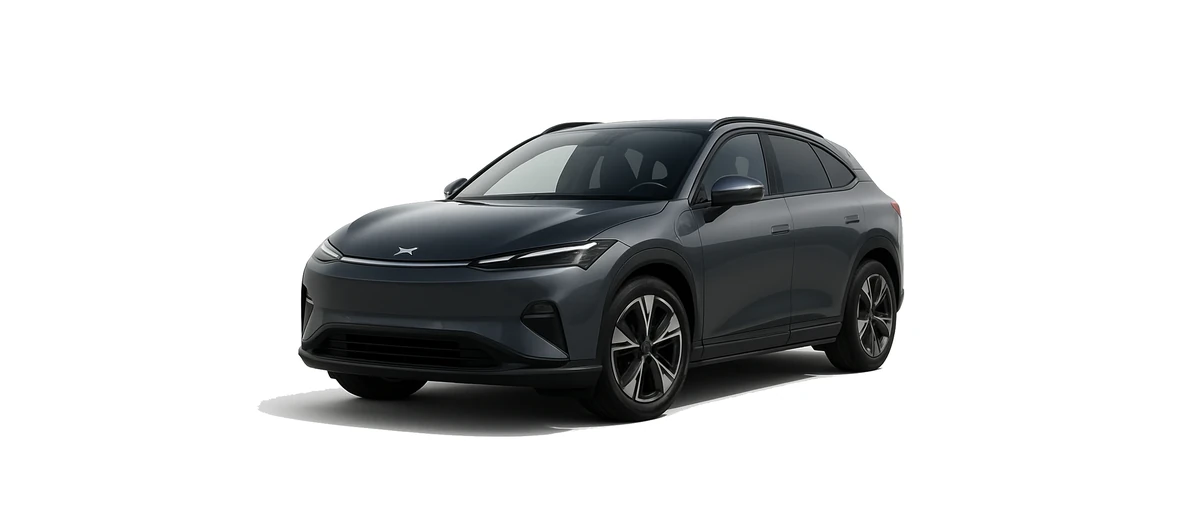
The Xpeng G6 is a mid-size electric coupe SUV and, for the current UK-market model covered here, it is a fully electric vehicle rather than a hybrid or plug-in hybrid. The New XPENG G6/MY25 is expected in the UK from 2026, with UK trims listed as RWD Standard Range, RWD Long Range and AWD Performance Black Edition.
Its main charging headline is ultra-fast DC capability on an 800V architecture, but the charging speed you actually see depends on the version, the charger, the battery temperature and the state of charge. At home, the G6 is much more straightforward: it uses a Type 2 AC connection and has an 11 kW onboard AC charger, although most UK homes will be limited to around 7.4 kW on a single-phase wallbox.
Xpeng G6 Battery and Charging Specifications
The current UK Xpeng G6 uses Type 2 AC charging and CCS Combo 2 DC rapid charging. EV Database UK lists the charging port as being on the right rear of the vehicle. For daily charging, most owners will use a home wallbox or a Type 2 public destination charger. For motorway and long-distance charging, the G6 uses CCS rapid and ultra-rapid chargers.
| Specification | Xpeng G6 UK MY25/2026 |
|---|---|
| Vehicle type | Battery-electric vehicle |
| AC charging connector | Type 2 |
| DC rapid charging connector | CCS Combo 2 |
| Onboard AC charger | Up to 11 kW |
| Typical UK home wallbox speed | Up to 7.4 kW on most single-phase supplies |
| Peak DC charging | Up to 382 kW on Standard Range; up to 451 kW on Long Range and AWD Performance |
| Platform context | SEPA 2.0 dedicated EV platform with 800V high-voltage architecture |
Battery Options
It is important not to mix the current UK MY25/2026 specifications with earlier European launch figures. The current UK line-up uses two battery sizes across three versions.
| Variant | Battery | WLTP range | Peak DC charging |
|---|---|---|---|
| RWD Standard Range | 68.5 kWh gross / 67.8 kWh usable LFP | 292 miles | Up to 382 kW |
| RWD Long Range | 80.8 kWh gross / 80.0 kWh usable LFP | 326 miles | Up to 451 kW |
| AWD Performance Black Edition | 80.8 kWh gross / 80.0 kWh usable LFP | Around 316 miles officially | Up to 451 kW |
Both battery packs are listed as LFP chemistry in the available UK data. The larger 80.8 kWh battery is used by the Long Range and AWD Performance versions, while the Standard Range uses the smaller 68.5 kWh gross pack.
AC Charging Speed
The Xpeng G6 has an 11 kW AC onboard charger. That figure is useful, but it needs to be understood in a UK context. An 11 kW AC charge normally requires a three-phase supply. Most UK homes have single-phase electricity, so a typical dedicated home wallbox will provide up to 7.4 kW rather than the car’s full 11 kW AC capability.
On a 7.4 kW home wallbox, EV Database UK indicates a full charge takes roughly 11 hours for the Standard Range and around 12 hours 45 minutes for the Long Range and AWD Performance versions. In real ownership, many drivers will not be charging from completely empty to completely full every time, so overnight top-ups are likely to be much shorter.
At workplaces, hotels, car parks and some homes with three-phase supply, an 11 kW Type 2 charger can make better use of the G6’s onboard AC charger. A 22 kW AC post or cable will not make the G6 charge at 22 kW, because the car’s onboard AC charger is limited to 11 kW.
DC Rapid Charging Speed
DC rapid charging is where the Xpeng G6 stands out. The Standard Range is listed at up to 382 kW DC, while the Long Range and AWD Performance are listed at up to 451 kW DC. XPENG also highlights 5C ultra-fast-charging battery technology for the new G6.
EV Database UK lists a 10-80% charging time of around 12 minutes for the current variants when using sufficiently powerful charging equipment. That is a best-case style figure rather than a guaranteed result. In the real world, charging speed depends on charger output, battery temperature, starting state of charge, traffic at the site, charging curve behaviour and whether the battery has been preconditioned.
On a 150 kW CCS charger, the G6 can still charge quickly, but it will be limited by the charger rather than the vehicle. On a 350 kW charger, the Standard Range may be able to make much better use of the available power, while the Long Range and AWD Performance can still exceed that level only if the charger and conditions allow. To approach the 451 kW headline figure, the Long Range or AWD Performance needs a very high-power CCS charger, typically in the 500 kW-class, and the battery must be in the right operating window.
For long journeys, plan around the 10-80% charging window rather than routinely charging to 100% at rapid chargers. Charging power usually falls significantly as the battery gets fuller, so stopping at around 80% and continuing the journey can often be faster overall.
Range and Efficiency
The longest official WLTP range in the current UK G6 line-up is 326 miles for the RWD Long Range. The Standard Range is listed at 292 miles WLTP, while the AWD Performance is listed at around 316 miles officially. EV Database UK estimates real-world range at about 235 miles for the Standard Range, 270 miles for the Long Range and 260 miles for the AWD Performance.
As with any EV, actual range will vary with temperature, speed, wheel and tyre choice, load, driving style and use of heating or air conditioning. Motorway driving in winter will usually reduce range compared with mixed driving in mild weather. The standard heat pump should help improve cabin heating efficiency in colder conditions, but it does not remove the normal seasonal range variation entirely.
Charging at Home
For most Xpeng G6 owners, the most convenient and cost-effective charging setup will be a dedicated Type 2 home wallbox and a suitable Type 2 charging cable where required. Scheduled overnight charging can help you take advantage of off-peak electricity tariffs, and it is gentler and easier to plan than relying on frequent rapid charging.
A 7.4 kW wallbox is the realistic maximum for many UK homes because most domestic supplies are single-phase. If your property has three-phase electricity, an 11 kW charger may allow the G6 to charge closer to its onboard AC limit. Before choosing a charger, it is worth checking your electrical supply, parking position and cable length requirement.
A 3-pin charger is generally best suited as a backup or occasional charging solution, but can be used regularly if a qualified electrician has confirmed the socket and electrical installation are suitable for sustained EV charging. Because the G6 has a relatively large battery, a 3-pin socket will be much slower than a proper wallbox and is not the most practical option for regular high-mileage use.
Public Charging
For public AC charging, the G6 uses a Type 2 connection. Many untethered public AC posts require you to bring your own cable, so keeping a Type 2 cable in the car is useful for workplaces, hotels, retail parks and town-centre chargers.
For rapid charging, the cable is normally tethered to the charger. You simply use the CCS connector on the rapid or ultra-rapid unit. The G6’s high DC charging capability means it is worth filtering route planners for high-power CCS chargers, especially on long motorway trips. However, do not assume that every public charger can deliver the headline 382 kW or 451 kW. Many UK rapid chargers are rated at 50 kW, 100 kW, 150 kW or 350 kW, and the site’s available power may vary.
Using the in-car navigation for charging stops is particularly useful because battery preconditioning is listed as standard and can prepare the pack before arrival where supported. A warm, well-preconditioned battery is more likely to accept high charging power than a cold battery arriving without preparation.
Vehicle-Specific Features
The current UK Xpeng G6 is based on XPENG’s SEPA 2.0 dedicated EV platform and uses an 800V high-voltage architecture. This is central to its ultra-fast charging capability, especially on the Long Range and AWD Performance versions with up to 451 kW DC charging.
A heat pump is confirmed as standard, which can improve heating efficiency in cooler weather. Battery preconditioning is also listed as standard and automatic via navigation, helping the battery reach a suitable temperature before a planned rapid charging stop.
The G6 also supports vehicle-to-load functionality. EV Database UK lists V2L at up to 3.3 kW AC, using a Type 2 adapter externally and with a UK BS1363 interior socket. This can be useful for powering compatible devices when parked. Vehicle-to-home and vehicle-to-grid support are not listed as available for the current UK model, so it should not be bought on the assumption that it can power a home or export energy to the grid.
Charging Tips
- Choose the right cable: A Type 2 cable is the key cable for home and public AC charging. A 22 kW-rated three-phase cable can be useful for compatibility with public posts, but the G6 itself will still be limited to 11 kW AC.
- Use home charging for routine use: Overnight AC charging is usually cheaper and more convenient than relying on rapid chargers.
- Plan rapid stops around 10-80%: This is usually the fastest part of the rapid charging session.
- Match the charger to the car: The Standard Range is capped at up to 382 kW DC, while the Long Range and AWD Performance are capped at up to 451 kW DC.
- Use navigation before rapid charging: This allows battery preconditioning to work where supported.
- Do not chase peak power every time: Ultra-rapid charging is valuable on long trips, but for day-to-day battery care and cost control, AC charging at home is normally the better routine.
Frequently Asked Questions
What charging cable does the Xpeng G6 use?
The Xpeng G6 uses a Type 2 connection for AC charging. For DC rapid charging, it uses CCS Combo 2, with the rapid charger’s own tethered cable.
Can the Xpeng G6 charge at 22 kW AC?
No. The current UK G6 is listed with an 11 kW AC onboard charger. A 22 kW AC post will not increase the car’s AC charging speed beyond its onboard limit.
Will I get 451 kW charging on every Xpeng G6?
No. The Standard Range is listed at up to 382 kW DC, while the Long Range and AWD Performance are listed at up to 451 kW DC. You also need a sufficiently powerful CCS charger and suitable battery conditions.
How long does the Xpeng G6 take to charge at home?
On a typical 7.4 kW UK home wallbox, EV Database UK indicates roughly 11 hours for the Standard Range and about 12 hours 45 minutes for the Long Range or AWD Performance from empty to full. Smaller daily top-ups will usually take much less time.
Is the Xpeng G6 a plug-in hybrid?
No. The UK-market Xpeng G6 covered here is a battery-electric vehicle with no petrol engine.
What This Means for Drivers
The Xpeng G6 is unusual because its rapid charging ability is far beyond what many UK public chargers can currently deliver. That does not make the headline figure irrelevant, but it does mean owners should think in layers: 7.4 kW for most home charging, 11 kW where three-phase AC is available, 150-350 kW for many high-power public stops, and 500 kW-class CCS charging if you want to get close to the fastest published 10-80% times on the Long Range and AWD Performance.
For everyday use, the simplest approach is to charge overnight at home, keep a Type 2 cable in the car for public AC posts, and save ultra-rapid CCS charging for longer journeys. The G6’s standard heat pump, battery preconditioning and V2L capability add useful flexibility, while its lack of V2H or V2G support means home energy export should not be assumed.
Looking for a Charging Cable for Xpeng G6?
We offer Xpeng G6 charging cables for home and public AC charging, helping you choose a suitable Type 2 cable for your charging setup and driving routine.
Please note that this information is intended as a guide. Charging specifications may change due to model and year of manufacture. For precise information, always refer to your vehicle user manual.

