
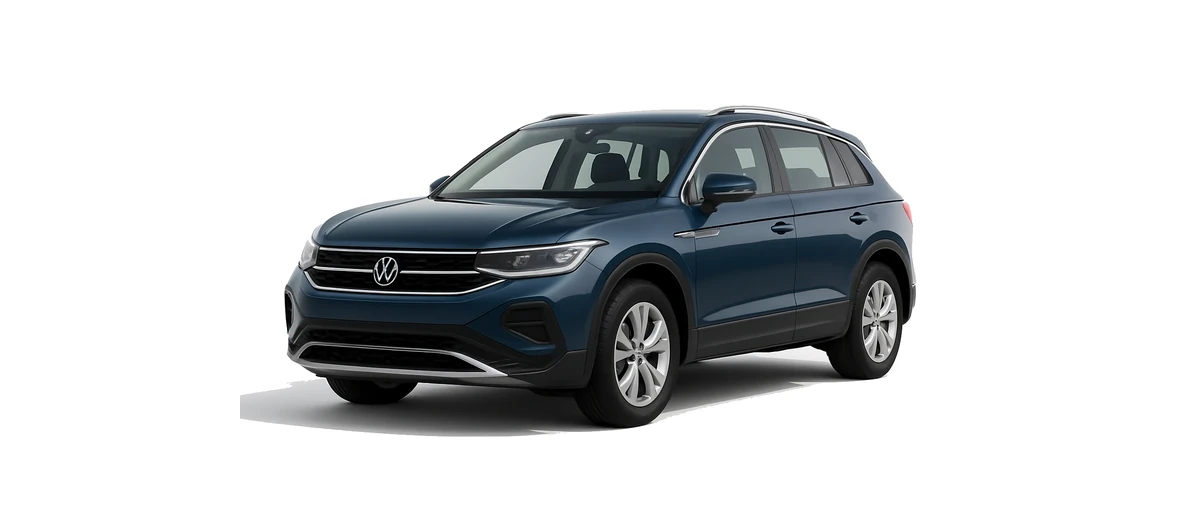
The VW Tayron eHybrid is the plug-in hybrid version of Volkswagen’s five-door family SUV. It is not a pure electric vehicle: it combines a 1.5 TSI petrol engine with an electric motor and a rechargeable traction battery, giving drivers the option of electric driving for many local journeys while retaining petrol flexibility for longer trips.
For UK buyers and owners, the Tayron eHybrid is particularly interesting because it offers stronger charging capability than many plug-in hybrids. Volkswagen UK technical data lists a 19.7 kWh usable battery, up to 11 kW AC charging and 50 kW DC charging, with VW quoting a 5-80% DC charge in 26 minutes. That makes it a PHEV that can be topped up quickly when the right infrastructure is available, although home and workplace AC charging will still be the most practical and cost-effective routine for most drivers.
This guide explains the key charging figures, how home and public charging work for the Tayron eHybrid, when rapid charging makes sense, and what to consider when choosing a charging cable.
View VW Tayron eHybrid Charging Cables
VW Tayron eHybrid Battery and Charging Specifications
Volkswagen UK data for the Tayron eHybrid confirms a usable battery capacity of 19.7 kWh. A gross figure of 25.7 kWh is reported by some secondary sources, but the usable figure is the more relevant number for owners because it reflects the energy available for driving and charging calculations.
UK Tayron eHybrid versions include 204 PS and 272 PS plug-in hybrid models, with Volkswagen Newsroom information describing both as front-wheel drive and paired with a six-speed eDSG transmission. UK trims shown in Volkswagen technical data include Match, Style and R-Line versions, with electric range varying slightly by specification.
For charging, Volkswagen UK lists 11 kW AC charging and 50 kW DC charging. The official AC 0-100% time is 2 hours 30 minutes at the maximum AC rate, while VW also lists 12 hours using a 2.3 kW domestic charging method. For DC charging, VW quotes 5-80% at the maximum charging power in 26 minutes.
The exact socket name is not explicitly stated in the checked Volkswagen UK technical-data page, although UK and European plug-in vehicles with these AC and DC capabilities would typically use Type 2 for AC and CCS Combo 2 for DC. Owners should confirm the inlet type visually, in the handbook or with a Volkswagen retailer before buying accessories.
Battery Options
The Tayron eHybrid’s plug-in hybrid battery is listed by Volkswagen UK at 19.7 kWh usable capacity across the checked 204 PS and 272 PS eHybrid versions. That is large for a PHEV and helps explain the car’s relatively long official electric range compared with many older plug-in hybrids.
Unlike a battery-electric SUV, the Tayron eHybrid does not need a very large battery because it also has a petrol engine. The practical advantage is that many daily trips can be completed on electric power if the battery is charged regularly, while longer journeys do not depend entirely on charging stops. The trade-off is that the PHEV version has different packaging from non-PHEV Tayron models. Volkswagen UK lists 705 litres of boot volume for the plug-in hybrid, compared with 850 litres for non-PHEV versions in comparable data.
AC Charging Speed
AC charging is the main charging method most Tayron eHybrid owners will use. Volkswagen UK lists a maximum AC charging rate of 11 kW and a 0-100% AC charging time of 2 hours 30 minutes. This is fast for a plug-in hybrid and means the car can be recharged during an evening at home, a workplace shift, a supermarket visit with a suitable destination charger, or a longer stop at a public AC post.
There is an important UK-specific point: many home wallboxes are single-phase 7.4 kW units. To use the full 11 kW AC capability, the property or charge point generally needs compatible three-phase AC infrastructure. On a normal single-phase home wallbox, the car will usually charge at the lower rate allowed by the wallbox and electrical supply. That is still likely to be more than adequate for overnight charging, especially given the Tayron eHybrid’s battery size.
For public AC charging and many untethered home wallboxes, a Mode 3 Type 2 cable is the usual cable type to consider. A 32 amp cable gives compatibility with common UK public AC posts and home wallboxes. If you want to make use of the Tayron eHybrid’s full 11 kW AC capability where supported, choose a three-phase-capable 32A Type 2 cable rather than a single-phase-only cable.
DC Rapid Charging Speed
The Tayron eHybrid is unusual among plug-in hybrids because Volkswagen UK lists DC charging capability. The UK technical data gives a maximum DC charging rate of 50 kW and states that a 5-80% DC charge can take 26 minutes at the maximum rate. It is important not to convert this into a 10-80% claim, because the official UK figure provided is specifically 5-80%.
In practice, DC charging can be useful when you have a long day of mixed driving and want to recover electric miles quickly. For example, topping up during a lunch stop or while shopping could let you complete more of the journey electrically. However, it should be viewed as a convenience feature rather than the main charging strategy. Public rapid charging is often more expensive than home electricity, and rapid chargers are primarily used by battery-electric vehicles that rely on them for long-distance travel.
Because the Tayron eHybrid has a petrol engine, drivers are unlikely to need DC charging in the same way a BEV driver might. If home or workplace charging is available, that will usually be cheaper, simpler and better suited to the car’s plug-in hybrid role.
Range and Efficiency
Volkswagen UK data shows WLTP combined electric range varying by trim, with figures of roughly 71-74 miles depending on the UK version. The headline figure of up to about 74 miles is impressive for a PHEV, but it should be treated as an official laboratory value rather than a guaranteed result on every journey.
Real-world electric range depends on speed, temperature, tyres, load, use of heating or air conditioning, terrain and driving style. An independent review context suggests around 95 km, or about 59 miles, may be a realistic guide in some conditions. Motorway driving, cold weather and a fully loaded family car will usually reduce electric-only mileage, while gentle town and suburban driving can be more favourable.
The best way to get strong efficiency from a PHEV is to charge it regularly. If the Tayron eHybrid is driven with an empty battery for long periods, it will behave more like a conventional petrol hybrid with extra weight, reducing the benefit of choosing the plug-in version.
Charging at Home
Home charging is where the Tayron eHybrid is likely to make the most sense. If you can plug in overnight, the car can start most days with a full battery, giving you the best chance of using electric power for commuting, school runs, shopping and local journeys.
A dedicated home wallbox is usually the most convenient option. It is safer and more robust than relying on a standard domestic socket, can be scheduled for off-peak tariffs where supported, and may provide useful monitoring features. Many UK wallboxes are rated at up to 7.4 kW on single phase, which should still comfortably recharge the Tayron eHybrid overnight even if it does not use the car’s full 11 kW AC capability.
A 3-pin charger is generally best suited as a backup or occasional charging solution, but can be used regularly if a qualified electrician has confirmed the socket and electrical installation are suitable for sustained EV charging. Volkswagen UK lists a 2.3 kW domestic charging time of 12 hours, so it is noticeably slower than a wallbox and less convenient if you regularly arrive home with a low battery.
If your home has three-phase electricity, or you are installing charging at a business premises, it may be worth considering whether an 11 kW AC installation is practical. For most households, however, reliable overnight charging matters more than achieving the absolute maximum AC rate.
Public Charging
Public charging for the Tayron eHybrid falls into two categories: AC destination charging and DC rapid charging. AC charging is typically found at car parks, hotels, workplaces, town centres and some supermarkets. These chargers are well matched to a PHEV because the car may be parked for an hour or more, allowing useful battery recovery without paying rapid-charging prices.
Many public AC posts are untethered, meaning you need to bring your own cable. For the Tayron eHybrid, a 32A Type 2 cable is the practical choice, with a three-phase-capable version recommended if you want access to the car’s full 11 kW AC potential on compatible charge points.
DC rapid charging is helpful when time matters, but it should be used selectively. If a rapid charger is busy, expensive or needed by BEV drivers, it may be better to continue on petrol and recharge later at home. Rapid charging makes most sense when you specifically want to maximise electric driving during a long day, when a charger is conveniently located, and when the tariff is acceptable.
Vehicle-Specific Features
The Tayron eHybrid sits on Volkswagen’s MQB evo architecture and is part of the wider Tayron SUV range. It is important to distinguish the eHybrid from other Tayron versions: not all Tayron models are plug-in hybrids, and the UK range also includes non-plug-in petrol, diesel and mild-hybrid options.
The eHybrid’s main charging-related strengths are its sizeable usable battery for a PHEV, its 11 kW AC capability, and the availability of 40 kW DC charging in UK data. Together, these features make it more flexible than many plug-in hybrids, especially for drivers who can charge at home but occasionally want a quick public top-up.
No confirmed UK data in the checked sources supports claims about heat pump fitment, battery preconditioning, V2L, V2G or V2H support, so those features should not be assumed when planning charging routines.
Charging Tips
- Charge little and often: A PHEV works best when the battery is topped up regularly rather than left empty.
- Use home or workplace AC charging as your default: It is normally cheaper and more convenient than rapid charging.
- Choose the right cable: A 32A Type 2 cable is suitable for common UK AC charging, and a three-phase-capable cable is best if you want to use 11 kW AC where available.
- Do not expect WLTP range every day: Cold weather, high speeds and heavy loads can reduce electric range.
- Use DC charging strategically: VW quotes 5-80% in 26 minutes at up to 40 kW, but public rapid charging may not always be the most economical option.
- Check the socket before buying accessories: The charging power is confirmed by Volkswagen UK, but the exact inlet naming should be verified on your vehicle, in the handbook or with a retailer.
Frequently Asked Questions
Is the VW Tayron eHybrid a fully electric car?
No. The Tayron eHybrid is a plug-in hybrid. It has a petrol engine, an electric motor and a battery that can be charged from an external power source.
How long does the Tayron eHybrid take to charge on AC?
Volkswagen UK lists a 0-100% AC charging time of 2 hours 30 minutes at up to 11 kW. On many UK single-phase home wallboxes, the available charging rate may be lower than 11 kW, although overnight charging should still be practical.
Can the Tayron eHybrid use rapid chargers?
Yes, UK technical data lists 50 kW DC charging, with Volkswagen quoting 5-80% in 26 minutes. Rapid charging is useful for occasional top-ups, but home and workplace AC charging will usually be the main charging method.
What cable should I use for public AC charging?
A 32A Type 2 Mode 3 cable is the sensible choice for UK public AC posts. Choose a three-phase-capable cable if you want to use the car’s full 11 kW AC capability on suitable three-phase charge points.
What electric range should I expect?
Volkswagen UK lists WLTP electric range of roughly 71-74 miles depending on trim. Real-world range may be lower, with around 59 miles a cautious reference point in some independent driving contexts.
What This Means for Drivers
The VW Tayron eHybrid is best understood as a family SUV that can cover many everyday journeys electrically when charged regularly, while still offering petrol-engine flexibility for longer trips. Its 19.7 kWh usable battery and strong AC charging capability make home and workplace charging especially valuable.
The availability of DC charging is a useful bonus, but it should not distract from the core ownership habit: plug in whenever convenient. If you can charge overnight and carry the right cable for public AC posts, the Tayron eHybrid can deliver much of its benefit without relying heavily on rapid chargers.
Looking for a Charging Cable for VW Tayron eHybrid?
We offer charging cables suitable for UK plug-in hybrid and electric vehicle owners, including options for drivers who want a practical Type 2 cable for home wallboxes and public AC charging. Always confirm your vehicle’s charging inlet and your required cable rating before ordering.
View VW Tayron eHybrid Charging Cables
Please note that this information is intended as a guide. Charging specifications may change due to model and year of manufacture. For precise information, always refer to your vehicle user manual.

