
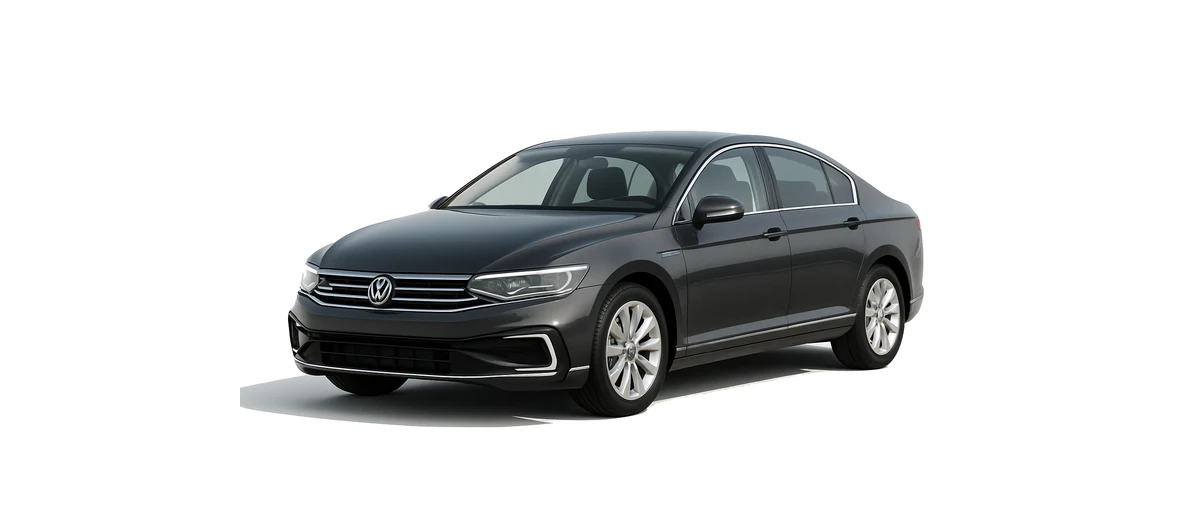
The VW Passat GTE is a plug-in hybrid, not a pure electric car. That distinction matters when choosing charging cables and planning how you will charge it day to day. The Passat GTE combines a petrol engine with an electric motor and a rechargeable battery, so the best ownership experience usually comes from regular short charging sessions rather than relying on long-distance rapid charging.
There is also some understandable confusion around the Passat plug-in hybrid line-up. The older UK-market Passat GTE was sold in saloon and estate/Variant forms, with early cars using a 9.9 kWh battery and facelift cars moving to a 13.0 kWh battery. Volkswagen now offers a newer Passat eHybrid in some markets and UK contexts, but that is not GTE-branded and has different charging capability. This guide focuses on the discontinued VW Passat GTE and explains what you need to know about home charging, public charging and cable selection.
View VW Passat GTE Charging Cables
VW Passat GTE Battery and Charging Specifications
For UK and European Passat GTE models, the key charging point is that the car uses Type 2 AC charging and is generally limited to around 3.6 kW by its onboard charger. A faster home charge point or public AC post will not make the older Passat GTE charge at 7 kW, 11 kW or 22 kW, because the vehicle itself controls the maximum AC charging rate it can accept.
The charging inlet is positioned at the front of the car in the grille area, while the petrol filler is separate. This layout can be convenient at some public AC bays, although cable length and parking position still matter. If you are buying a cable for an untethered home charger or public AC posts, a Type 2 cable is the relevant connector type for the Passat GTE.
Battery Options
Not all VW Passat GTE models have the same battery size, so it is worth separating the main versions:
- Early Passat GTE models, approximately 2015-2018: Volkswagen UK brochure data lists a lithium-ion battery energy capacity of 9.9 kWh. Official electric range was quoted at up to 31 miles / 50 km on the older NEDC test cycle.
- Facelift Passat GTE models, approximately 2019/2020-2022: Volkswagen increased the battery energy content to 13.0 kWh. UK brochure information for the facelift estate quoted up to 36 miles of electric-only range under WLTP conditions.
- Newer Passat eHybrid: This is a later, non-GTE model context with a much larger battery and different charging capability. Its figures should not be applied to an older Passat GTE cable guide.
Because official sources do not always describe the older GTE battery figures as gross or usable capacity, it is best to treat them as model-identification and range-planning figures rather than as a precise measure of usable energy.
AC Charging Speed
The VW Passat GTE charges on AC power at up to around 3.6 kW. Volkswagen’s earlier UK brochure information listed charging times of around 4 hours 15 minutes at 2.3 kW and around 2 hours 30 minutes at 3.6 kW for the 9.9 kWh car. For the later 13.0 kWh facelift GTE, a full charge from a 3.6 kW wallbox is commonly described as taking roughly 3 to 3.5 hours, depending on conditions and the starting state of charge.
This means a standard 7 kW home charger is more than adequate for the Passat GTE, even though the car will not use the full 7 kW. The same applies to many public AC charge points: you can plug into a faster AC post, but the vehicle will normally draw only what its onboard charger can accept.
For cable choice, many owners still choose a 7 kW-rated Type 2 cable because it is suitable for the Passat GTE and may also be useful with other EVs in the future. The important point is to understand that a higher-rated cable does not override the car’s onboard charging limit.
DC Rapid Charging Speed
The older VW Passat GTE does not support CCS or DC rapid charging. It is an AC-only plug-in hybrid, so you should not plan charging stops around motorway rapid chargers in the way you would with a pure electric car.
This is one of the main areas where confusion can arise. The newer Volkswagen Passat eHybrid is a different later model context and has different charging hardware, including DC charging capability. Those figures do not apply to the discontinued Passat GTE. If your car is badged Passat GTE from the B8/B8 facelift era, the practical charging solution is Type 2 AC charging at home, work or public AC posts.
Range and Efficiency
The official electric range depends on the version. Early 9.9 kWh cars were quoted at up to 31 miles on the older NEDC cycle, while facelift 13.0 kWh cars were quoted at up to about 36 miles WLTP. In everyday UK driving, the later 13.0 kWh Passat GTE is more realistically expected to deliver roughly 25-30 miles of electric driving in mixed use, with lower results possible in cold weather, at motorway speeds or when using more cabin heating.
As with any plug-in hybrid, efficiency depends heavily on how often you charge. If the battery is topped up frequently and most journeys are local, the Passat GTE can complete a large proportion of driving on electric power. If it is rarely charged, it behaves much more like a petrol hybrid carrying a larger battery, and fuel economy will be less impressive.
Charging at Home
Home charging is usually the most convenient way to run a Passat GTE. Because the battery is modest compared with a full battery electric vehicle, a complete charge can normally be achieved overnight, during the evening, or within a typical work-from-home day. For many owners, the routine is simple: plug in after the last journey of the day, start the next day with electric range available, and allow the petrol engine to cover longer journeys when needed.
A dedicated home charge point is the neatest long-term option. A tethered unit has the cable permanently attached, while an untethered unit requires you to use your own Type 2 cable. Untethered chargers are common in the UK and can be useful if you want to store the cable separately or use the same cable at public AC charge points.
A 3-pin portable charger is generally best suited as a backup or occasional charging solution, but can be used regularly if a qualified electrician has confirmed the socket and electrical installation are suitable for sustained EV charging. Household sockets were not all installed with repeated long-duration EV charging in mind, so it is sensible to have the socket, wiring and circuit checked before relying on this method.
Public Charging
For public charging, the VW Passat GTE is best matched with AC destination chargers rather than rapid chargers. These include workplace charge points, supermarket chargers, hotel chargers, town-centre posts and car park units. Many of these are untethered, meaning you need to bring your own Type 2 cable.
Because the Passat GTE’s maximum AC charging rate is around 3.6 kW, it is most useful to plug in when the car will be parked for a while. A short stop may add only a small amount of range, while a longer stay at work, the shops or a leisure venue can return a meaningful amount of electric driving. This is different from rapid-charging a BEV, where the aim is often to add a large amount of range in a short motorway stop.
If a public charger displays 7 kW, 11 kW or 22 kW, that describes the charger’s capability, not necessarily what your Passat GTE will draw. The car will still charge at its own AC limit.
Vehicle-Specific Features
The Passat GTE’s most important vehicle-specific feature for charging is its plug-in hybrid layout. It can be driven on electric power for shorter trips, while the petrol engine gives flexibility for longer journeys. Volkswagen also described driving modes that allow the driver to preserve battery charge for later urban or low-emission-zone-style driving, although rules and exemptions for city schemes should always be checked against current regulations.
The front-mounted charging inlet is another useful detail. When using public bays, it may help to park nose-in where possible, but bay design varies. If you regularly use public AC posts, consider a cable length that suits your usual parking arrangements without being unnecessarily bulky.
The car’s AC-only charging capability should guide expectations. The Passat GTE is at its best when charged little and often, not when treated like a long-range electric vehicle that needs rapid-charging stops.
Charging Tips
- Charge frequently: The more often you plug in, the more local mileage you can complete using electric power.
- Use a Type 2 cable: This is the practical choice for UK public AC posts and untethered home chargers.
- Do not overpay for speed you cannot use: The Passat GTE normally charges at up to about 3.6 kW, even on faster AC posts.
- Plan around dwell time: Public AC charging is worthwhile when you are parked for a few hours, not just a few minutes.
- Expect winter variation: Cold weather, heating use and higher speeds can reduce electric range.
- Check your exact model year: Early 9.9 kWh and facelift 13.0 kWh cars have different official range figures.
Frequently Asked Questions
Is the VW Passat GTE a fully electric car?
No. The VW Passat GTE is a plug-in hybrid. It has a petrol engine, an electric motor and a battery that can be charged from an external power source.
What charging cable does the VW Passat GTE use?
For UK and European use, the Passat GTE is associated with Type 2 AC charging. A Type 2 cable is the usual choice for untethered home charge points and public AC posts.
Can the VW Passat GTE use rapid chargers?
The older Passat GTE does not support CCS or DC rapid charging. It charges using AC power only, at up to around 3.6 kW.
Will a 7 kW cable charge the Passat GTE faster?
A 7 kW-rated Type 2 cable is suitable to use, but it will not make the car exceed its onboard AC charging limit. The Passat GTE will normally charge at up to about 3.6 kW.
How long does a full charge take?
As a guide, early 9.9 kWh cars were listed at around 2 hours 30 minutes from a 3.6 kW supply. Later 13.0 kWh facelift cars are commonly around 3 to 3.5 hours from a suitable wallbox, depending on conditions and starting charge level.
What This Means for Drivers
The VW Passat GTE is straightforward to charge once you separate it from the newer Passat eHybrid and from fully electric cars. It is a Type 2 AC plug-in hybrid with a modest battery, useful electric range for local driving and no DC rapid-charging capability. A dedicated home charge point or regular access to workplace/public AC charging will help you get the best from it.
For most owners, the right approach is to keep the battery topped up, use electric power for short journeys, and let the petrol engine handle longer trips. Cable choice should be practical rather than focused on chasing headline charging speeds: a good Type 2 cable for AC charging is the important item.
Looking for a Charging Cable for VW Passat GTE?
If you need a suitable Type 2 charging cable for home or public AC charging, choose one that matches how and where you normally park and charge your VW Passat GTE.
View VW Passat GTE Charging Cables
Please note that this information is intended as a guide. Charging specifications may change due to model and year of manufacture. For precise information, always refer to your vehicle user manual.

