
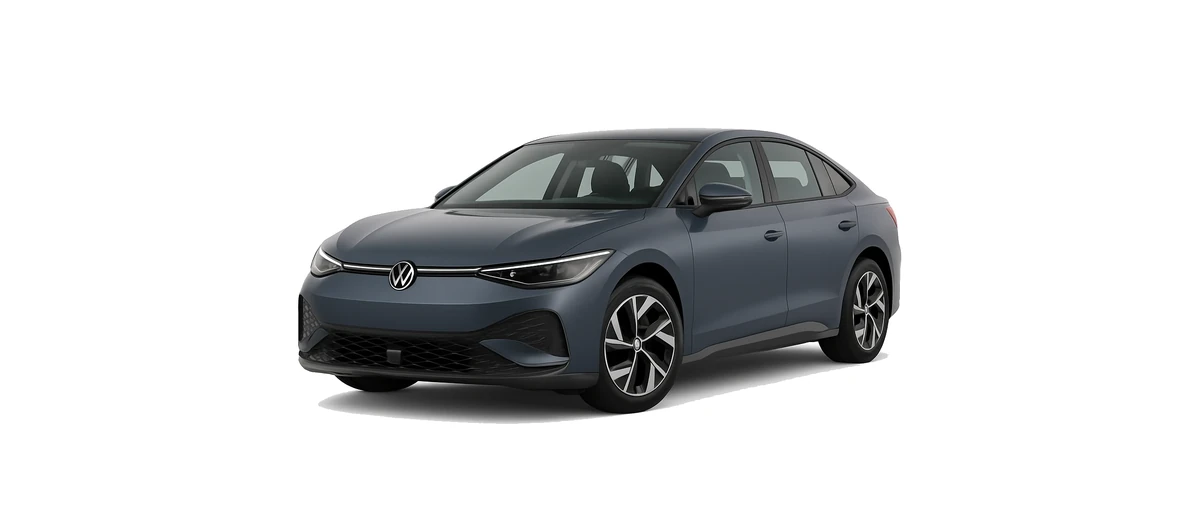
The VW ID.7 is Volkswagen’s long-range electric fastback, designed for drivers who want the comfort and motorway ability of an executive car with the lower running costs and convenience of an EV. In the UK, current ID.7 versions include 77 kWh and 86 kWh usable battery options, with charging figures that vary by trim and battery size.
For charging, the key point is simple: the VW ID.7 uses a Type 2 connection for AC charging at home and on many public posts, and CCS Combo 2 for DC rapid charging. It can accept up to 11 kW on AC, although most UK home wallboxes are single-phase and will charge at up to around 7.4 kW. On the right rapid charger, the ID.7 can charge much faster using CCS, with the 77 kWh version listed at up to around 185 kW and the 86 kWh versions at close to 200 kW when conditions allow.
VW ID.7 Battery and Charging Specifications
The VW ID.7 is a battery-electric vehicle, not a plug-in hybrid. It is based on the Volkswagen Group MEB electric platform and uses a 400 V-class electrical architecture. UK models are equipped with a Type 2 AC inlet and CCS Combo 2 DC rapid charging connection, which is the standard arrangement for modern European-market EVs.
| Item | VW ID.7 charging detail |
|---|---|
| Vehicle type | Battery-electric vehicle |
| AC charging connector | Type 2 |
| DC rapid charging connector | CCS Combo 2 |
| Maximum AC charging | Up to 11 kW |
| Typical UK home wallbox charging | Up to around 7.4 kW on single-phase supply |
| Maximum DC charging | About 185 kW for 77 kWh versions; about 199–200 kW for 86 kWh versions |
| Battery preconditioning | Confirmed |
| Heat pump | Available technology, but may be optional depending on specification |
Battery Options
Current UK ID.7 specifications are not all identical, so it is worth checking which battery is fitted to the car you are buying or already own. The main distinction is between the 77 kWh usable battery and the larger 86 kWh usable battery.
The ID.7 Pro Match Plus uses a 77 kWh usable battery, with a gross capacity of around 82 kWh. Volkswagen UK data lists a combined WLTP range of around 368 miles for this version, while independent database estimates place real-world driving range lower, as expected with any EV.
The ID.7 Pro S Match Plus uses the larger 86 kWh usable battery, with a gross capacity of around 91 kWh. This is the long-distance-focused version and Volkswagen UK lists up to 433 miles combined WLTP range for the Pro S Match Plus. That figure should not be applied to every ID.7, as it does not represent the 77 kWh model or the GTX.
The ID.7 GTX Plus 4MOTION also uses the 86 kWh usable battery, but adds dual-motor all-wheel drive. Volkswagen UK lists a lower combined WLTP figure than the Pro S Match Plus, at around 371 miles, reflecting the additional performance and drivetrain layout.
AC Charging Speed
The VW ID.7’s onboard AC charger is rated at up to 11 kW. This is useful on three-phase AC charge points, including some workplace and destination chargers. However, a car’s AC charging speed is limited by its onboard charger, so the ID.7 will not charge at 22 kW AC even if it is plugged into a 22 kW public post.
At home in the UK, many properties have single-phase electricity. With a standard 7.4 kW home wallbox, the ID.7 will usually charge at up to around 7.4 kW rather than the full 11 kW. That is still more than enough for most overnight charging routines, particularly if you plug in after the evening commute and use a smart tariff or scheduled charging window.
Volkswagen UK lists 0–100% AC charging times of around 8 hours for the 77 kWh version and around 9 hours for the 86 kWh version when using an 11 kW AC supply. On a 7.4 kW home wallbox, a full charge from very low to 100% will take longer, but most drivers rarely charge from completely empty to completely full in one session.
DC Rapid Charging Speed
For longer journeys, the VW ID.7 uses CCS rapid charging. The 77 kWh version is listed by Volkswagen UK at up to around 185 kW DC, while the 86 kWh Pro S and GTX versions are listed at around 199 kW, often rounded to 200 kW by some sources.
Volkswagen UK data indicates a 10–80% rapid charging time of around 27 minutes for the 77 kWh car and around 28 minutes for the 86 kWh cars. These figures depend on several conditions: the battery must be at a suitable temperature, the charger must be powerful enough, the car’s state of charge must be in the rapid part of the charging curve, and the charger must be operating correctly.
The ID.7’s battery preconditioning helps here. When the car prepares the battery ahead of a rapid charging stop, it can improve charging performance, especially in colder weather. Even so, charging above 80% will usually slow down noticeably, so on long motorway journeys it is often quicker to stop for shorter 10–80% sessions rather than waiting for a full charge.
Range and Efficiency
Range depends on the battery, trim, wheels, temperature, speed, load and driving style. The current UK headline figure of up to 433 miles applies to the Pro S Match Plus with the 86 kWh battery, not to the whole ID.7 range. The 77 kWh Pro Match Plus is listed at around 368 miles combined WLTP, while the GTX Plus 4MOTION is listed at around 371 miles.
In everyday UK use, real-world range will generally be below the official WLTP figure. For the 77 kWh ID.7, independent estimates suggest something around the high-200-mile range in mixed use. For the 86 kWh Pro S, a range around the low-to-mid 300s may be achievable in favourable conditions, while the GTX is likely to sit below the most efficient Pro S version. Cold weather, high motorway speeds and roof boxes can all reduce efficiency.
For many owners, the ID.7’s strength is not just maximum range, but how comfortably it covers longer trips. A large battery, efficient fastback shape and strong rapid charging performance make it well suited to motorway journeys, provided you plan charging stops sensibly.
Charging at Home
For most VW ID.7 owners, home charging will be the cheapest and most convenient option. A dedicated Type 2 wallbox is the usual recommendation because it is safer, faster and more convenient than using a domestic socket. If the wallbox is tethered, it will have its own Type 2 cable attached. If it is untethered, you will need a separate Type 2 to Type 2 charging cable.
A 7.4 kW single-phase wallbox is the common UK home charging setup. It will not use the ID.7’s full 11 kW AC capability, but it will still add a substantial amount of range overnight. Drivers with a compatible three-phase supply may be able to use the full 11 kW AC charging rate, but this is less common in domestic UK properties.
A 3-pin EV charger is generally best suited as a backup or occasional charging solution, but can be used regularly if a qualified electrician has confirmed the socket and electrical installation are suitable for sustained EV charging. Because the ID.7 has a large battery, charging from a normal plug will be much slower than using a wallbox and is not the most practical everyday solution for many owners.
Public Charging
When using public AC charge points, the VW ID.7 will normally require a Type 2 cable unless the post is tethered. Many public destination chargers are rated at 7 kW, 11 kW or 22 kW. The ID.7 can take up to 11 kW AC, so a 22 kW AC post will still be limited by the car’s onboard charger.
For rapid charging, use CCS chargers. The cable is attached to the rapid charger, so you do not use your own Type 2 cable for DC rapid charging. On high-power CCS units, the 77 kWh car can peak at around 185 kW and the 86 kWh cars at just under 200 kW when the battery and charger conditions are right.
Some current ID.7 data also lists Plug & Charge capability using ISO 15118-2 on compatible networks. Where supported, this can make public rapid charging easier by allowing the car and charger to authenticate automatically, though availability depends on the network, account setup and charger compatibility.
Vehicle-Specific Features
Battery preconditioning is an important ID.7 feature for rapid charging. By preparing the battery before a planned DC charging stop, the car can help achieve better charging speeds, especially when the weather is cold or the battery would otherwise be outside its ideal temperature window.
A heat pump is confirmed as available technology for the ID.7, but it should be treated as specification-dependent rather than assumed to be standard on every UK car. A heat pump can improve heating efficiency in cooler weather, but the exact equipment fitted should be checked against the individual vehicle’s build or current Volkswagen UK specification.
Vehicle-to-load is not listed as supported for the ID.7 variants checked, so owners should not assume the car can power external appliances in the way some EVs can. Vehicle-to-home or vehicle-to-grid capability should also be treated cautiously for UK drivers, as practical customer availability can depend on software, compatible hardware, tariffs and approved bidirectional chargers.
Charging Tips
- Choose the right cable: for untethered home wallboxes and many public AC posts, use a Type 2 to Type 2 cable.
- Do not expect 22 kW AC charging: the ID.7 is limited to 11 kW AC by its onboard charger.
- Use CCS for long journeys: rapid charging is fastest on suitable high-power CCS chargers.
- Precondition before rapid charging: if route planning supports it, let the car prepare the battery before a DC stop.
- Aim for 10–80% on road trips: charging above 80% is usually slower, so shorter stops can be more efficient.
- Check your variant: the 77 kWh, 86 kWh Pro S and 86 kWh GTX versions have different range and charging figures.
- Use scheduled charging: if you have a smart tariff, overnight charging can reduce running costs significantly.
Frequently Asked Questions
What charging cable does the VW ID.7 use?
The VW ID.7 uses a Type 2 connection for AC charging. For untethered home wallboxes and many public AC charge points, you will need a Type 2 to Type 2 cable. For DC rapid charging, the car uses CCS Combo 2 and the cable is attached to the charger.
Can the VW ID.7 charge at 22 kW AC?
No. The ID.7’s AC onboard charger is rated at up to 11 kW. If you plug into a 22 kW AC post, the car will still charge at a maximum of 11 kW, assuming the cable, charger and supply allow it.
How fast does the VW ID.7 charge at home?
On a typical UK single-phase home wallbox, expect up to around 7.4 kW. On a compatible three-phase AC supply, the ID.7 can charge at up to 11 kW.
How fast can the VW ID.7 rapid charge?
The 77 kWh version is listed at up to around 185 kW DC, while the 86 kWh Pro S and GTX versions are listed at around 199–200 kW. Around 10–80% can take roughly 27–28 minutes in favourable conditions.
Does every VW ID.7 have the same range?
No. Current UK figures vary by version. The Pro S Match Plus has the highest listed combined WLTP figure at up to 433 miles, while the 77 kWh Pro Match Plus and GTX Plus 4MOTION have lower listed WLTP figures.
What This Means for Drivers
The VW ID.7 is well suited to drivers who cover longer distances but still want the convenience of regular home charging. For daily use, a 7.4 kW Type 2 wallbox will be enough for many UK households, even though the car can accept up to 11 kW AC where three-phase charging is available. For motorway journeys, CCS rapid charging and battery preconditioning help the ID.7 make good use of high-power charging networks.
The most important practical advice is to match expectations to your specific model. The 77 kWh car, 86 kWh Pro S and 86 kWh GTX do not have identical range or rapid charging figures. Once you know your battery size and typical driving pattern, choosing the right Type 2 cable and charging routine becomes straightforward.
Looking for a Charging Cable for VW ID.7?
We offer VW ID.7 charging cables suitable for Type 2 home and public AC charging, including options for drivers using untethered wallboxes and destination charge points.
Please note that this information is intended as a guide. Charging specifications may change due to model and year of manufacture. For precise information, always refer to your vehicle user manual.

