
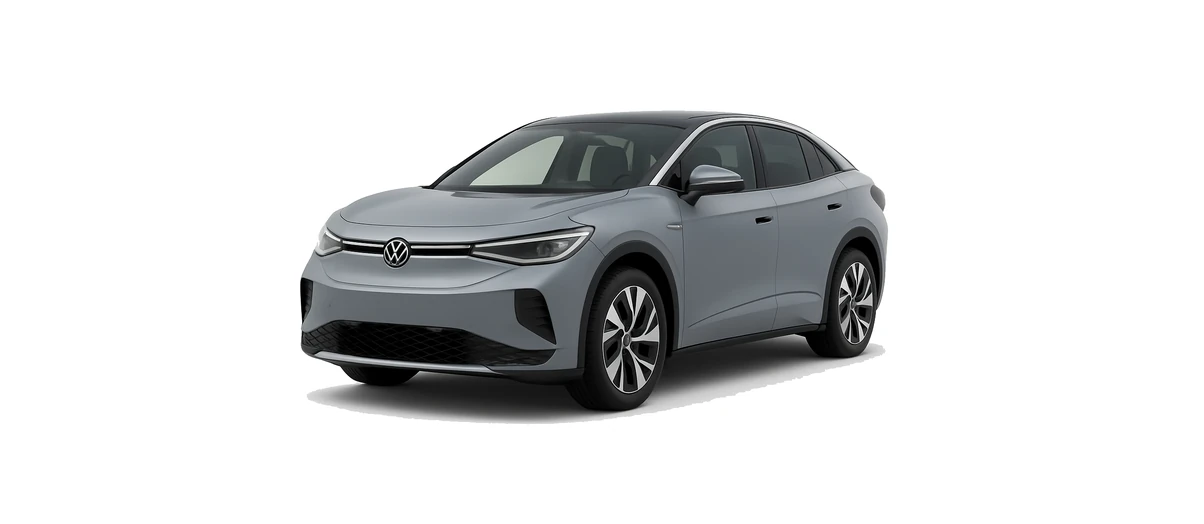
The VW ID.5 is Volkswagen’s fully electric 5-door coupe SUV, closely related to the ID.4 but with a more swept-back body style. For UK drivers, it uses the familiar European charging arrangement: a Type 2 connection for AC charging and a CCS Combo 2 connection for DC rapid charging. That makes cable choice straightforward, but charging speed depends heavily on the version of ID.5 you have.
This is particularly important because current UK ID.5 information is not identical across every source, and earlier 2022-2025 cars can differ from the latest factory-order models. A current Pure, Pro or GTX may have different battery capacity and DC charging capability, while older ID.5 models were commonly based around a 77 kWh usable battery with different rapid charging ratings. If you own a used ID.5, always check the exact model year, trim and software information before assuming the latest figures apply.
VW ID.5 Battery and Charging Specifications
The VW ID.5 is a battery-electric vehicle, not a plug-in hybrid. It sits on the Volkswagen Group MEB dedicated EV platform and uses a 400 V-class electrical architecture. In the UK, the latest ID.5 range is listed with Pure, Pro and GTX versions, although model-year and stock differences mean that specifications should be checked carefully against the individual car.
| Vehicle type | Battery-electric vehicle |
|---|---|
| Charging port | Type 2 for AC charging / CCS Combo 2 for DC rapid charging |
| AC charging capability | Up to 11 kW, where a suitable three-phase AC supply is available |
| Typical UK home charging | Usually up to 7.4 kW on a single-phase home wallbox |
| DC rapid charging | Varies by version: current sources list up to around 105 kW, 165 kW or 185 kW depending on variant |
| Charging cable for untethered AC points | Type 2 to Type 2 cable |
Battery Options
The key point with the ID.5 is that there is not one universal battery figure for every car. Current MY27-style sources list the Pure, Pro and GTX with different usable capacities, while earlier UK ID.5 cars were commonly sold with an 82 kWh gross / 77 kWh usable pack.
For the latest versions, current technical data and EV specification sources indicate approximately 61 kWh gross / 58 kWh usable for the ID.5 Pure, 84 kWh gross / 79 kWh usable for the ID.5 Pro, and 82 kWh gross / 77 kWh usable for the ID.5 GTX. Volkswagen UK material has also shown some differing battery labels in places, so if you are comparing a new factory-order car, dealer stock and a used car, check the vehicle’s specification sheet rather than relying on a single headline number.
For owners, this matters because battery size affects charging time. A larger battery can often travel further between charges, but it also takes more energy to refill from a low state of charge. That is why an 11 kW AC charge time for a Pure model should not be applied directly to a Pro or GTX, and why current high-power rapid charging figures should not be assumed for older cars.
AC Charging Speed
The VW ID.5’s on-board AC charger is listed at up to 11 kW. This is the maximum the car can accept from an AC supply, but it does not mean every UK home will charge at 11 kW. Most UK domestic properties are single-phase, and a typical installed home wallbox will provide up to 7.4 kW. To reach 11 kW AC, you normally need a suitable three-phase supply and compatible charge point.
Volkswagen UK lists 11 kW AC charge times of around 6 hours 30 minutes for Pure, around 8 hours 30 minutes for Pro and around 8 hours for GTX. On a typical 7.4 kW UK home charger, a full charge will take longer than those 11 kW figures, but many owners will not routinely charge from 0-100%. In everyday use, topping up from, for example, 30% to 80% overnight is usually more relevant than a complete empty-to-full charge.
For untethered home chargers and many public AC posts, the ID.5 uses a Type 2 to Type 2 charging cable. If you have a tethered home charger, the cable is permanently attached to the unit, but carrying a separate Type 2 cable is still useful for public destination chargers at workplaces, hotels, car parks and shopping centres.
DC Rapid Charging Speed
DC rapid charging is where the differences between ID.5 versions become especially important. Current sources list the ID.5 Pure at up to around 105 kW DC, the ID.5 Pro at up to around 165 kW DC, and the ID.5 GTX at up to around 185 kW DC. Older cars may have lower peak charging rates, so avoid assuming that every ID.5 can charge at the latest GTX figure.
Volkswagen UK quotes 10-80% rapid charging times of roughly 26 minutes for Pure, 29 minutes for Pro and 27 minutes for GTX, while independent typical estimates can vary by version and conditions. In practice, peak DC charging figures require a suitable high-power charger, an appropriate battery temperature and a favourable state of charge. The car will not hold its peak rate for the whole charging session; charging speed rises and falls according to the battery management system.
At motorway and high-power rapid charging stations, you do not use your own Type 2 cable. DC rapid chargers have tethered CCS cables attached to the charger. You simply plug the CCS connector into the ID.5’s charging port, start the session using the network’s app, card, contactless terminal or Plug & Charge where supported, and then unplug when the session is complete.
Range and Efficiency
Volkswagen UK lists a WLTP combined range headline of up to 345 miles for the current ID.5 range. As with all EVs, WLTP is a laboratory-based comparison figure rather than a guarantee of what every driver will see on the road. Real-world range will depend on the version, wheel size, weather, route, speed, load and driving style.
The ID.5’s coupe-SUV shape is designed to balance SUV practicality with improved aerodynamics compared with a more upright body. Even so, motorway speeds, winter temperatures, roof boxes, heavy loads and repeated rapid charging stops can all reduce efficiency. In colder weather, expect the car to use more energy for battery and cabin heating. A heat pump is listed as optional in current specification sources, so do not assume every ID.5 has one unless it is confirmed on the individual vehicle.
For daily driving, many owners will find it sensible to charge to around 80% for routine use and reserve 100% for longer journeys where the extra range is genuinely useful. This approach can reduce time spent at chargers and is generally kinder to the battery than repeatedly charging to full when it is not needed.
Charging at Home
Home charging is usually the cheapest and most convenient way to run an ID.5 in the UK. If you have off-street parking, a dedicated 7.4 kW wallbox is normally the most practical choice for a single-phase household. It will be slower than an 11 kW three-phase unit, but it is still well suited to overnight charging and daily top-ups.
Using the car’s scheduled charging settings can help you make use of off-peak electricity tariffs. Set a departure time, choose a target charge level and let the car charge when electricity is cheaper. For many drivers, this is more useful than chasing maximum speed every night.
A 3-pin charger is generally best suited as a backup or occasional charging solution, but can be used regularly if a qualified electrician has confirmed the socket and electrical installation are suitable for sustained EV charging. Standard domestic sockets were not originally designed for repeated high-load EV charging over many hours, so professional checks are important if you intend to rely on one.
Public Charging
For public charging, it helps to separate AC destination charging from DC rapid charging. AC posts are common in car parks, town centres, hotels, workplaces and leisure destinations. Many of these are untethered, so you will need your own Type 2 cable. Charging speed will depend on the post and the ID.5’s 11 kW AC limit. On a 7 kW public post, charging will be similar to a typical home wallbox; on an 11 kW three-phase post, the car can make use of the higher AC rate.
DC rapid and ultra-rapid chargers are designed for longer journeys. These use tethered CCS cables and can add a significant amount of range during a short stop, particularly if the battery is warm and at a low-to-mid state of charge. The fastest part of a rapid charge is usually below 80%, so it is often quicker on a journey to stop at around 80% and continue driving rather than waiting for the final 20% to fill slowly.
Vehicle-Specific Features
Current ID.5 information includes several charging-related features, but their availability can depend on version, model year, software and optional equipment. Battery preconditioning is listed for current versions, and Volkswagen has described the ability to pre-condition the battery before DC charging stops. Where supported, entering a rapid charger as the navigation destination can help the car prepare the battery for faster charging.
Plug & Charge is listed as supported on some MY27 ID.5 versions using ISO 15118-2. This can allow compatible charging networks to recognise the car automatically after setup, reducing the need to start every session manually through an app or card.
Vehicle-to-load capability is now reported for updated UK ID.4 and ID.5 models via the charging port using an optional adapter, with sources listing up to 3.6 kW AC output. Bidirectional V2H or V2G capability is also referenced in Volkswagen and EV specification information, but it should not be treated as a simple home-backup feature for every owner. Real-world use depends on the specific car, software, compatible bidirectional equipment and UK installation arrangements.
Charging Tips
- Identify your version first: Pure, Pro and GTX versions can have different battery sizes and DC rapid charging limits.
- Use a Type 2 cable for AC charging: This is the correct cable for untethered UK and European AC charge points.
- Do not expect 11 kW at every home: Most UK homes are single-phase and commonly charge at up to 7.4 kW.
- Set an everyday limit: Around 80% is often suitable for daily use where your range needs allow.
- Precondition before rapid charging: Where your vehicle software supports it, navigate to the rapid charger so the car can prepare the battery.
- Use 100% strategically: A full charge is useful before a long trip, but it is rarely necessary for short daily journeys.
Frequently Asked Questions
What charging cable does the VW ID.5 use?
The VW ID.5 uses a Type 2 connection for AC charging. For untethered home and public AC charge points, you need a Type 2 to Type 2 cable. DC rapid chargers use tethered CCS cables attached to the charger.
Can the VW ID.5 charge at 22 kW AC?
No current source used for this guide lists a 22 kW AC on-board charger. The ID.5 is listed at up to 11 kW AC, although many UK homes will charge at up to 7.4 kW due to single-phase supply limits.
Does every VW ID.5 rapid charge at 185 kW?
No. Current sources list up to around 185 kW for the GTX, around 165 kW for the Pro and around 105 kW for the Pure. Older ID.5 models may differ, so check the exact car.
Is the VW ID.5 a plug-in hybrid?
No. The UK-market VW ID.5 is a fully electric battery-electric vehicle. There is no UK plug-in hybrid ID.5 variant in the research used for this guide.
Where is the charging port?
The charging port is on the right rear side of the vehicle. It combines the Type 2 AC inlet with the lower CCS DC rapid charging pins.
What This Means for Drivers
The VW ID.5 is straightforward to charge once you know which version you have. For everyday UK ownership, the most useful setup is usually a 7.4 kW home wallbox, a Type 2 cable for untethered AC public charging, and occasional use of CCS rapid chargers on longer trips. The important detail is not to treat all ID.5 models as identical: Pure, Pro, GTX and earlier used cars can differ in battery capacity and DC charging performance.
If you are buying new, check the latest UK specification sheet for your chosen trim. If you are buying used, look closely at the model year, battery size, software version and charging specification. Once those details are clear, planning home charging, public charging and cable choice becomes much simpler.
Looking for a Charging Cable for VW ID.5?
We offer Type 2 charging cables suitable for VW ID.5 AC charging at home and at untethered public charge points. Choose a cable that matches your charging setup, cable length preference and whether you want single-phase or three-phase capability.
Please note that this information is intended as a guide. Charging specifications may change due to model and year of manufacture. For precise information, always refer to your vehicle user manual.

