
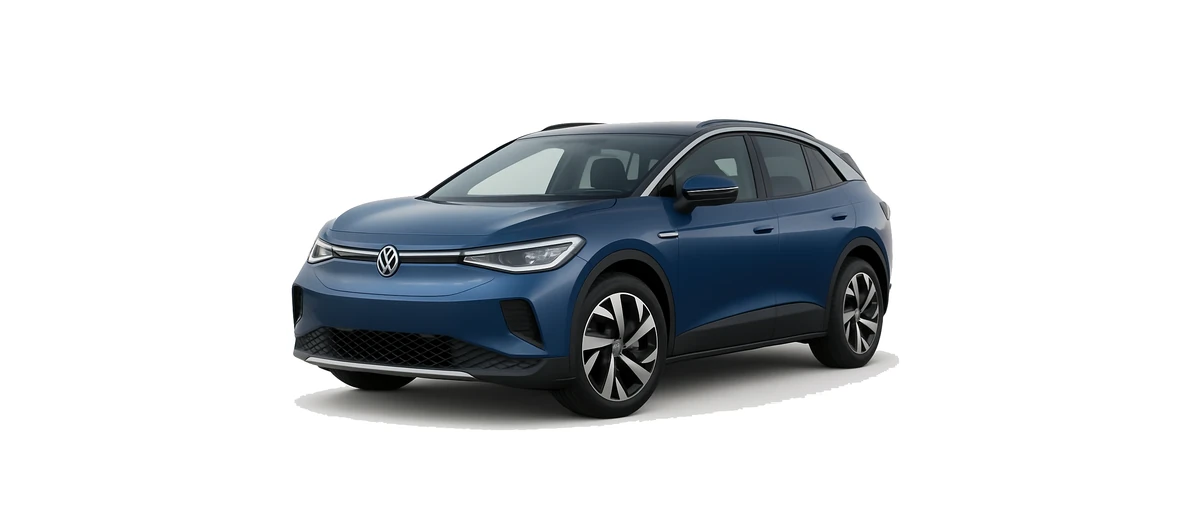
The VW ID.4 is Volkswagen’s all-electric SUV, built on the Volkswagen Group MEB dedicated EV platform. For UK drivers, it is a practical family EV with Type 2 AC charging for home and public destination charging, plus CCS DC rapid charging for longer journeys.
One of the most important things to understand is that not every ID.4 has the same battery or rapid-charging capability. Current UK-market versions include Pure, Pro, Pro 4MOTION and GTX models, while earlier used examples may have different battery sizes, including older Pure cars with a 52 kWh usable battery. This guide explains how to identify the key charging differences, why the same Type 2 cable is still the right AC charging cable choice, and what to expect from home and public charging in the UK.
VW ID.4 Battery and Charging Specifications
The VW ID.4 is a battery-electric vehicle, not a plug-in hybrid. UK cars use a Type 2 connector for AC charging and a CCS connector for DC rapid charging. The charge port is positioned on the rear right side of the vehicle.
| Vehicle type | Battery-electric SUV |
|---|---|
| AC charging connector | Type 2 |
| DC rapid charging connector | CCS |
| Charge port location | Rear right side |
| Maximum AC charging | Up to 11 kW, where a suitable three-phase AC supply is available |
| Typical UK home charging | Up to around 7.4 kW on many single-phase home wallboxes |
| Maximum DC rapid charging | Variant dependent: up to 105 kW, 165 kW or 185 kW |
For most owners, the key cable decision is straightforward: a 32 amp Type 2 charging cable is the most suitable choice for public AC charging. It will work with common 7 kW and 22 kW public AC charge points and is appropriate for the ID.4’s AC capability.
Battery Options
The current UK ID.4 range has several battery and drivetrain combinations. Figures can vary by model year, so used buyers should check the exact version, registration year and vehicle documentation before relying on a single battery figure.
| Current UK ID.4 version | Battery size | Drivetrain | Typical rapid-charging peak |
|---|---|---|---|
| Pure Essential / Pure Match | 61 kWh gross / 58 kWh usable | Rear-wheel drive | Up to 105 kW |
| Pro Essential / Pro Match / Pro Black Edition | 84 kWh gross / 79 kWh usable | Rear-wheel drive | Up to 165 kW |
| Pro Match 4MOTION / Pro Black Edition 4MOTION | 82 kWh gross / 77 kWh usable | All-wheel drive | Up to 165 kW |
| GTX Edition | 82 kWh gross / 77 kWh usable | All-wheel drive | Up to 185 kW |
Older ID.4 models can be different. In particular, some earlier Pure versions used a 52 kWh usable battery, rather than the current 58 kWh usable Pure battery listed in current detailed UK data. If you own or are buying a used ID.4, it is worth checking the exact variant rather than assuming current figures apply.
AC Charging Speed
Current UK ID.4 models support up to 11 kW AC charging. However, this figure normally requires a suitable three-phase AC supply. Most UK homes are single-phase, so many ID.4 owners will charge at up to around 7.4 kW from a dedicated home wallbox.
At 11 kW, current ID.4 versions can charge from 0-100% in roughly 6.25 to 8.5 hours, depending on battery size. On a typical 7.4 kW UK home wallbox, a full 0-100% charge is more likely to take around 9.25 to 12.75 hours, again depending on the exact battery. In real use, most drivers do not charge from completely empty to completely full every day, so overnight charging is usually more than enough for regular mileage.
For public AC charging, use a Type 2 cable. A 32 A Type 2 cable is a neat recommendation because it is compatible with the ID.4’s AC charging requirements and common UK public AC posts. If the public charger is a 22 kW AC unit, the ID.4 will still only draw what the car and supply can accept; the charger’s higher rating does not force extra power into the vehicle.
DC Rapid Charging Speed
For long journeys, the VW ID.4 uses CCS rapid chargers. These chargers normally have their own tethered cable, so you do not need to buy a separate DC charging cable.
Rapid-charging performance depends heavily on the exact ID.4 variant. Current Pure models are listed at up to 105 kW DC, Pro and Pro 4MOTION models at up to 165 kW DC, and the GTX at up to 185 kW DC. Volkswagen’s UK figures and EV Database estimates put typical 10-80% charging stops at around 26-30 minutes, depending on the variant and conditions.
It is important not to expect the peak charging figure for the whole session. Like most EVs, the ID.4 charges fastest when the battery is at a lower state of charge and slows down as the battery fills. On motorway trips, it is usually quicker to plan shorter 10-80% rapid-charging stops than to wait for the car to reach 100% at a rapid charger.
Range and Efficiency
Volkswagen’s current UK ID.4 range has a broad spread of official WLTP figures depending on battery, drivetrain, wheels and specification. Volkswagen’s headline UK range reaches up to around 351 miles, while detailed current figures span a much wider range across specifications.
Real-world range will normally be lower than the official WLTP figure, especially in cold weather, at motorway speeds, with a full load, or when using roof boxes or other accessories. EV Database estimates combined real-world range at around 210 miles for the current Pure, around 285 miles for the Pro RWD, around 270 miles for the Pro 4MOTION and around 260 miles for the GTX. These are useful planning estimates rather than guarantees.
Efficiency will depend on driving style and conditions. Smooth acceleration, moderate motorway speeds, correct tyre pressures and pre-planning charging stops can all help you get more predictable range from the ID.4.
Charging at Home
For most UK ID.4 owners, a dedicated Type 2 home wallbox is the most convenient charging option. You can plug in when you get home, schedule charging for cheaper overnight electricity if your tariff supports it, and start most days with the battery level you need.
A tethered wallbox has a cable permanently attached, which is convenient if you charge the ID.4 in the same place every day. An untethered wallbox has a socket instead, so you use your own Type 2 cable. Untethered units can look tidier and may be more flexible if you have more than one EV with different cable preferences.
Although the ID.4 can accept up to 11 kW AC, many UK homes will be limited to around 7.4 kW because they have single-phase electricity. If you have a suitable three-phase supply, faster AC charging may be possible, but installation should always be assessed by a qualified installer.
A 3-pin charger is generally best suited as a backup or occasional charging solution, but can be used regularly if a qualified electrician has confirmed the socket and electrical installation are suitable for sustained EV charging. A domestic socket charges much more slowly than a wallbox, so it is not usually the most practical option for a large-battery electric SUV.
Public Charging
Public charging falls into two main categories: AC destination charging and DC rapid charging. AC destination chargers are often found in car parks, hotels, workplaces and town centres. These usually require you to bring your own Type 2 cable unless the unit is tethered.
DC rapid and ultra-rapid chargers are designed for longer journeys and quick top-ups. With the ID.4, you use the CCS connector, and the charger’s cable is normally already attached to the unit. The car and charger communicate to decide the safe charging rate.
If you are choosing a public AC cable for the ID.4, a 32 A Type 2 cable is the most practical option. It gives you compatibility with common UK AC charging infrastructure and means the cable is not the limiting factor when using suitable AC posts.
Vehicle-Specific Features
Current ID.4 versions are listed with battery preconditioning. This can help the battery reach a more suitable temperature for rapid charging, particularly when a rapid charger is set as a navigation destination. In colder weather, preconditioning can make rapid-charging performance more consistent.
A heat pump is listed as available on the ID.4, but it should not be assumed to be standard across every UK version. If this matters to you, check the exact specification of the car you are buying.
Vehicle-to-load capability is listed as supported, with EV Database noting up to 3.6 kW AC via a Type 2 adapter. This can allow the car to power suitable external devices, subject to equipment compatibility and vehicle settings. Vehicle-to-grid or vehicle-to-home capability should not be treated as confirmed for normal customer use in the UK ID.4 range.
Plug & Charge support is also listed for compatible networks using ISO 15118-2. Where supported by the charging network and your account, this can simplify payment and authentication at public chargers.
Charging Tips
- Check which ID.4 you have. Battery size and DC charging rate vary by variant and model year.
- Use Type 2 for AC charging. This applies at home wallboxes and most public destination chargers.
- Choose a 32 A Type 2 cable for public AC charging. It is a sensible match for the ID.4 and UK charging posts.
- Use CCS for rapid charging. Rapid chargers are normally tethered, so no separate DC cable is required.
- Plan rapid stops around 10-80%. Charging to 100% on a rapid charger is usually slower and less efficient on a journey.
- Set rapid chargers in the navigation when possible. This can help battery preconditioning work as intended.
- Do not assume 11 kW at home. Most UK homes are single-phase and commonly charge at up to around 7.4 kW.
Frequently Asked Questions
What charging cable does the VW ID.4 use?
The VW ID.4 uses a Type 2 connector for AC charging. For public AC charge points, a 32 A Type 2 cable is the recommended choice. DC rapid charging uses CCS, and the cable is normally attached to the rapid charger.
Can the VW ID.4 charge at 11 kW at home?
The car can accept up to 11 kW AC, but this usually requires a suitable three-phase supply. Many UK homes are single-phase, so a typical home wallbox will charge the ID.4 at up to around 7.4 kW.
How long does it take to charge a VW ID.4?
It depends on the battery and charger. Current models take roughly 6.25-8.5 hours from 0-100% at 11 kW AC, or around 9.25-12.75 hours at 7.4 kW. On DC rapid charging, current variants are typically around 26-30 minutes for a 10-80% charge in suitable conditions.
Do all VW ID.4 models have the same battery?
No. Current UK models include 58 kWh, 79 kWh and 77 kWh usable battery options depending on variant. Older ID.4 models may differ, including earlier Pure cars with a 52 kWh usable battery.
Is the VW ID.4 a plug-in hybrid?
No. The VW ID.4 is a battery-electric vehicle. It has no petrol or diesel engine and is charged from the mains or public charging network.
What This Means for Drivers
The VW ID.4 is straightforward to charge once you separate AC cable choice from rapid-charging performance. For AC charging, the answer is simple: use Type 2, and choose a 32 A Type 2 cable for public charging. That applies whether you drive a Pure, Pro, Pro 4MOTION or GTX.
The bigger differences are battery size, range and DC rapid-charging speed. A current Pure will not rapid charge at the same peak rate as a GTX, and an older 52 kWh Pure will not match the figures for the current 58 kWh usable Pure. If you are buying used, check the exact model year and specification so your range and charging expectations are realistic.
At home, most UK owners will charge at up to around 7.4 kW from a dedicated wallbox, even though the car can accept up to 11 kW AC where three-phase supply is available. On the road, CCS rapid charging is best used for planned 10-80% stops rather than waiting for a full battery.
Looking for a Charging Cable for VW ID.4?
We offer Type 2 charging cables suitable for the VW ID.4, including options for drivers who want a practical cable for UK public AC charge points and untethered home wallboxes.
Please note that this information is intended as a guide. Charging specifications may change due to model and year of manufacture. For precise information, always refer to your vehicle user manual.

