
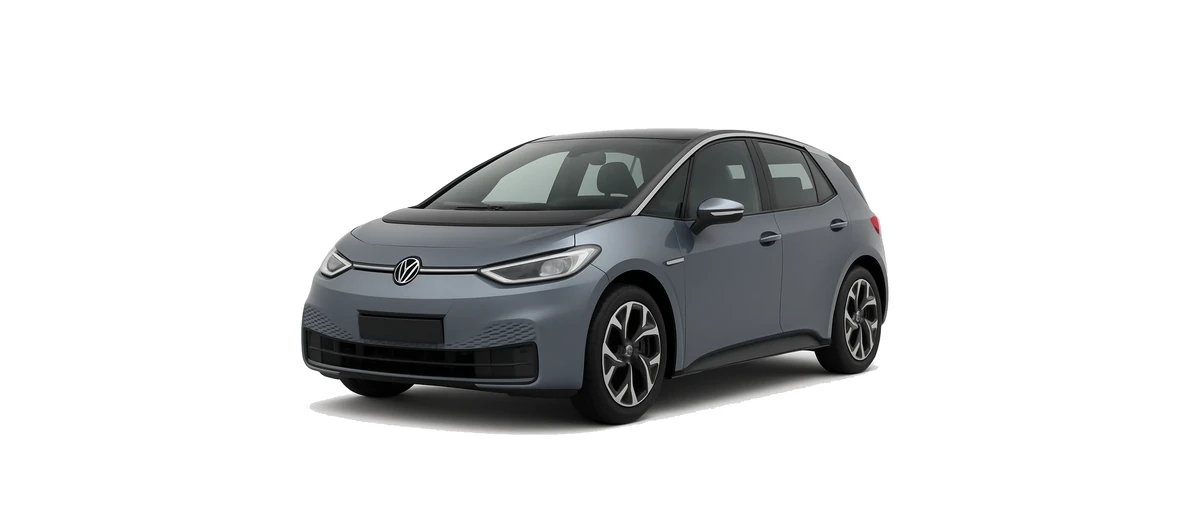
The VW ID.3 is Volkswagen’s pure-electric 5-door hatchback, built on the MEB platform and designed as a practical everyday EV for UK drivers. It is not a plug-in hybrid: every journey is powered by the battery, so understanding how charging works is central to ownership.
One important point with the ID.3 is that charging capability depends on the version you own. Current UK-listed cars use 52 kWh, 59 kWh or 79 kWh battery packs, and these differ in AC charging speed, DC rapid charging peak and expected range. Earlier used ID.3 models may also have different battery descriptions, so it is worth checking your exact trim, battery capacity or vehicle documents before comparing charging times.
This guide explains what VW ID.3 owners need to know about home charging, public charging, rapid charging and cable selection in the UK.
VW ID.3 Battery and Charging Specifications
The VW ID.3 uses a Type 2 inlet for AC charging and a CCS Combo 2 inlet for DC rapid charging. The charging port is positioned on the right-side rear flank, which is useful to remember when parking at public charge points or rapid chargers with short cables.
For AC charging, the ID.3 is either limited to around 7.2 kW or can accept up to 11 kW depending on variant. For DC rapid charging, current UK technical data lists peak rates of up to 145 kW, 165 kW or 185 kW depending on battery size. Those peak figures are not held for the whole session, but they do indicate which versions are likely to charge fastest on suitable rapid and ultra-rapid chargers.
| VW ID.3 version / battery | Usable battery capacity | AC charging | DC rapid charging peak | Typical 10-80% rapid charge |
|---|---|---|---|---|
| Pure / Pure Essential / Pure Match | About 52 kWh usable | Up to 7.2 kW | Up to 145 kW | About 25 minutes in current VW UK data |
| Pro / Pro Essential / Pro Match | About 59 kWh usable | Up to 11 kW where supported | Up to 165 kW | About 24 minutes in current VW UK data |
| Pro S / Pro S Essential / Pro S Match | About 79 kWh usable | Up to 11 kW where supported | Up to 185 kW | About 26 minutes in current VW UK data |
| GTX Performance | About 79 kWh usable | Up to 11 kW where supported | Up to 185 kW | Similar to 79 kWh versions where conditions allow |
Availability can change by trim and model year. Volkswagen UK has continued to list the ID.3 range, stock and current offers, while some independent data sources have marked certain MY24-26 variants as available only until April 2026. If you are buying new, check whether the specific trim is factory-orderable, in stock, or part of a transition to a successor version.
Battery Options
The key to understanding ID.3 charging is identifying which battery you have. For current UK-listed cars, the smaller-battery Pure versions are listed at 52 kWh usable capacity, the Pro versions at 59 kWh usable capacity, and the Pro S or GTX Performance versions at 79 kWh usable capacity.
The 52 kWh Pure models are well suited to daily commuting, school runs and regular local use. Their smaller battery usually means less energy to replenish at home, but they also have a lower AC charging limit and a lower DC peak than larger-battery models.
The 59 kWh Pro models sit in the middle of the range. They offer a useful increase in driving range and a higher AC charging capability where a compatible supply is available. The 79 kWh Pro S and GTX Performance models are the long-range options, with the highest current UK-listed DC peak charging rates.
If you are unsure which version you own, check the trim name, vehicle specification sheet, infotainment vehicle information, purchase paperwork or registration-linked vehicle data. On used cars, be cautious with older descriptions such as 58 kWh or 77 kWh, because they may refer to earlier ID.3 model years rather than the current UK-listed battery naming.
AC Charging Speed
AC charging is what you use at most home charge points, many workplace chargers and some destination chargers. The VW ID.3 uses a Type 2 connection for AC charging.
The 52 kWh Pure variants are listed with AC charging up to 7.2 kW. This aligns well with the typical UK single-phase home charger, often described as 7 kW or 7.4 kW. Volkswagen UK technical data lists a 0-100% AC charging time of around 8 hours 30 minutes for 52 kWh Pure versions.
The 59 kWh Pro and 79 kWh Pro S or GTX versions are listed with AC charging up to 11 kW. However, this does not mean every UK owner will see 11 kW at home. An 11 kW AC charge requires a suitable 3-phase supply and a compatible charge point. Many UK homes are single-phase, so these versions will commonly charge at around 7.4 kW on a normal home wallbox.
If you plug an 11 kW-capable ID.3 into a 22 kW public AC post, the car will not charge at 22 kW. The onboard charger sets the limit, so the vehicle will typically charge at up to 11 kW on a suitable 3-phase AC post, or less if the charger, cable or site conditions restrict output.
DC Rapid Charging Speed
For long journeys, the ID.3 uses CCS Combo 2 rapid charging. UK motorway and major-route rapid chargers are normally tethered, so you use the cable attached to the charger rather than your own Type 2 cable.
Current UK technical data lists DC charging peaks of up to 145 kW for the 52 kWh battery, up to 165 kW for the 59 kWh battery, and up to 185 kW for 79 kWh variants. In practical terms, a 10-80% charge is the most efficient rapid-charging window. Charging above 80% usually slows noticeably, so it is often quicker on a long trip to stop again later rather than wait for a near-full battery.
Volkswagen UK data suggests around 25 minutes for the 52 kWh car, around 24 minutes for the 59 kWh car and around 26 minutes for the 79 kWh car when charging from 10-80% under favourable conditions. Actual charging time depends on charger output, battery temperature, state of charge, traffic at the charging site and whether the charger is sharing power with other vehicles.
Range and Efficiency
Current UK-listed WLTP combined range figures span roughly 240 to 371 miles depending on version. The 52 kWh Pure variants are around 240-241 miles WLTP, the 59 kWh Pro versions are around 269 miles WLTP, and 79 kWh Pro S versions are around 352-353 miles WLTP. The GTX Performance is listed with a WLTP figure of about 371 miles in the current UK technical data.
Real-world range is usually lower than WLTP, especially in winter, at motorway speeds, with roof bars or when carrying heavy loads. Independent estimates place current-generation ID.3 variants at roughly 200 miles for the 52 kWh car, about 225 miles for the 59 kWh car and up to around 295 miles for the 79 kWh Pro S, with the GTX Performance estimated slightly lower than the longest-range Pro S despite its strong WLTP figure.
Efficiency will vary with driving style and conditions. Smooth acceleration, moderate motorway speeds, correct tyre pressures and effective use of cabin heating can all help preserve range. Volkswagen offers an optional heat pump on the ID.3, which is designed to improve heating efficiency in colder weather, although availability may depend on trim and specification.
Charging at Home
For most ID.3 drivers, home charging is the simplest and cheapest way to run the car. A dedicated home wallbox is usually the best everyday solution because it is designed for repeated EV charging, can be installed on a suitable circuit, and may support scheduled charging for cheaper overnight tariffs.
A 32A single-phase Type 2 cable is suitable for most UK home chargers and will allow the car to charge at the maximum rate available from a typical 7 kW/7.4 kW single-phase wallbox. If you have a 59 kWh or 79 kWh ID.3 and access to a 3-phase 11 kW charge point, a suitable 3-phase Type 2 cable is needed to make use of the higher AC capability.
A 3-pin charger is generally best suited as a backup or occasional charging solution, but can be used regularly if a qualified electrician has confirmed the socket and electrical installation are suitable for sustained EV charging. Standard domestic sockets were not originally designed for repeated high-load EV charging over many hours, so professional electrical advice is important.
For daily use, many owners set a regular charge limit rather than charging to 100% every night. Charging to full is useful before a long journey, but for routine driving a lower limit can reduce time spent at high state of charge. Always follow the guidance in the vehicle handbook and infotainment charging settings.
Public Charging
Public AC charging is useful at workplaces, hotels, car parks, retail parks and town centres. These chargers may be tethered or untethered. If the post is untethered, you will need your own Type 2 cable. A 5 metre cable is a popular length for everyday use, while a longer cable can be helpful where parking layouts are awkward.
For rapid and ultra-rapid charging, the ID.3 uses the CCS section of its charging port. These chargers are normally tethered, so cable selection is not required. Instead, focus on choosing a charger that can comfortably exceed your car’s peak rate. For example, a 150 kW charger is sufficient for most of the 52 kWh car’s peak capability, while 79 kWh variants may benefit from chargers rated above 150 kW when the battery is at a suitable temperature and state of charge.
The ID.3 is listed as supporting Plug & Charge on current-generation entries using ISO 15118-2. Where the charging network, account and vehicle setup support it, Plug & Charge can simplify authentication by allowing the car and charger to communicate automatically. In practice, it is still sensible to keep charging apps, contactless cards or RFID cards available as a backup.
Vehicle-Specific Features
Battery preconditioning is listed for current-generation ID.3 entries and can operate automatically via navigation where supported. This helps prepare the battery for faster rapid charging by bringing it closer to an ideal temperature before you arrive at the charger. For best results on a long trip, route to the rapid charger using the car’s navigation rather than only using a phone app.
V2L is not supported on the current Pure, Pro, Pro S and GTX entries checked, so the ID.3 should not be treated as a mobile power source for external appliances. Vehicle-to-grid or vehicle-to-home capability should also be treated cautiously for UK owners, as broad commercial availability across ID.3 models is not clearly established. If this feature matters to you, confirm the exact vehicle, software, charger compatibility and UK service availability before relying on it.
Charging Tips
- Know your battery: 52, 59 and 79 kWh versions have different AC limits, DC peaks and realistic charging times.
- Use Type 2 for AC charging: This applies to home wallboxes, many workplace chargers and untethered destination chargers.
- Do not expect 22 kW AC: Even on a 22 kW public post, the ID.3 is limited by its onboard charger.
- Use CCS for rapid charging: Rapid and ultra-rapid chargers are normally tethered, so you do not need your own DC cable.
- Aim for 10-80% on road trips: This is usually the most time-efficient rapid-charging range.
- Use navigation before rapid stops: Where supported, this helps battery preconditioning prepare the pack.
- Check the port position: The charge port is on the right-side rear flank, which can affect how you park at chargers.
Frequently Asked Questions
What charging cable does the VW ID.3 use?
The VW ID.3 uses a Type 2 cable for AC charging. For DC rapid charging it uses CCS Combo 2, and rapid chargers normally have their own tethered cable.
Can every VW ID.3 charge at 11 kW AC?
No. Current UK data lists 52 kWh Pure trims at up to 7.2 kW AC. The 59 kWh and 79 kWh variants are listed at up to 11 kW AC, but 11 kW requires a suitable 3-phase supply and compatible charge point.
How fast can the VW ID.3 rapid charge?
It depends on the battery. Current UK technical data lists up to 145 kW for 52 kWh versions, up to 165 kW for 59 kWh versions and up to 185 kW for 79 kWh versions.
How long does a 10-80% rapid charge take?
Under favourable conditions, Volkswagen UK data suggests roughly 24-26 minutes depending on version. Real-world results vary with charger power, battery temperature and state of charge.
Is the VW ID.3 a plug-in hybrid?
No. The ID.3 is a battery-electric vehicle. It has no petrol or diesel engine and must be charged from an external power source.
What This Means for Drivers
The VW ID.3 is straightforward to charge once you know which version you have. For most UK owners, a 7 kW/7.4 kW home wallbox and a Type 2 cable will cover everyday charging. Larger-battery cars can make use of 11 kW AC only where a 3-phase supply is available, while rapid charging uses the car’s CCS inlet and the tethered cable on the public charger.
The main takeaway is that the ID.3 should not be treated as one single specification. Battery size affects range, AC speed and DC peak rate, so checking whether you have the 52, 59 or 79 kWh version will give you a much more accurate idea of charging times and cable requirements.
Looking for a Charging Cable for VW ID.3?
If you need a Type 2 cable for home, workplace or public AC charging, choose one that matches how you charge your VW ID.3 most often, including whether you use a typical single-phase UK home charger or have access to 3-phase AC charging.
Please note that this information is intended as a guide. Charging specifications may change due to model and year of manufacture. For precise information, always refer to your vehicle user manual.

