
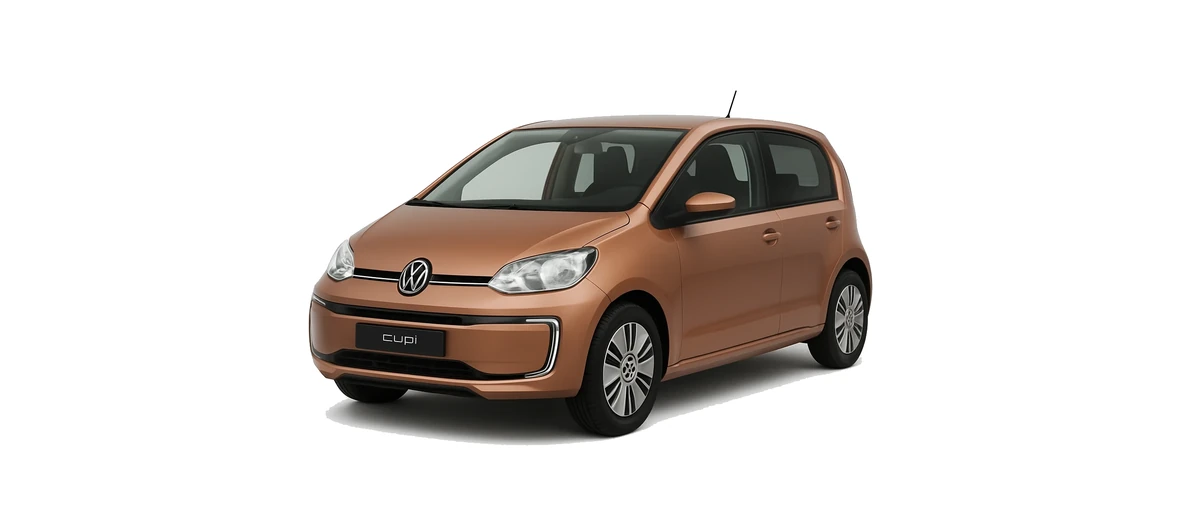
The VW e-Up is a compact, fully electric city hatchback based on the Volkswagen up!. It is now discontinued in the UK, but it remains a popular used EV thanks to its small footprint, simple driving experience and low running costs. For charging, however, the e-Up needs a little more explanation than many newer electric cars because specifications vary significantly by age.
The key question is: which e-Up do you have? Earlier pre-2020 cars used a smaller 18.7 kWh gross battery and lower AC charging capability. The upgraded 2020-on version received a much larger 36.8 kWh gross battery and a higher quoted AC charging rate, but there is an important UK charging caveat: the later car’s headline 7.2 kW AC figure may not be achieved from many ordinary single-phase home charge points.
This guide explains the main VW e-Up battery versions, the difference between AC and DC charging, what cable you are likely to need, and what to expect when charging at home or on the public network.
VW e-Up Battery and Charging Specifications
The VW e-Up is a battery-electric vehicle, not a plug-in hybrid or range-extender. It uses a Type 2 connection for AC charging and CCS Combo 2 for DC rapid charging on the versions covered by Volkswagen UK and EV Database information. The charging flap is positioned at the right-rear/offside-rear of the car, where a fuel filler would normally be expected on a petrol model.
For most UK drivers, the most important figures are the battery size, AC charging rate and realistic range. These vary depending on whether the car is an earlier pre-2020 model or the upgraded 2020-on version. Before buying charging accessories or estimating charging times, check the car’s registration year, build year and exact charging equipment, especially if you are looking at an older used example.
Battery Options
There are two main VW e-Up battery generations to be aware of:
- 2014-2019 / pre-2020 VW e-Up: these earlier cars used an 18.7 kWh gross battery. EV Database lists an estimated usable capacity of around 16.0 kWh for the 2016-2019 UK e-Up. Real-world range is much shorter than the later car, with EV Database giving around 60 miles in typical use and 83 miles WLTP for the relevant later pre-facelift data.
- 2020-on upgraded VW e-Up: the facelifted/upgraded version used a 36.8 kWh gross battery with around 32.3 kWh usable capacity. Volkswagen UK brochure data quoted up to 159 miles WLTP, while EV Database gives a typical real-world estimate of about 125 miles.
This difference is large enough that charging and range advice should never be treated as universal for all e-Up models. A charging time that makes sense for the smaller-battery car will not necessarily apply to the later version, and the later car’s official WLTP range should not be applied to older 18.7 kWh cars.
AC Charging Speed
AC charging is what you use at home, at many workplaces and on many slower public charging posts. The VW e-Up uses a Type 2 connection for AC charging, so owners generally need a Type 2 charging cable for untethered public chargers and some workplace charge points. If your home charger is tethered, it will already have the cable attached.
For pre-2020 VW e-Up models, AC charging is typically listed at 3.7 kW. This means a full charge can take several hours even though the battery is relatively small. In practical terms, these earlier cars are well suited to overnight home charging and short daily trips.
The 2020-on upgraded e-Up is more nuanced. Volkswagen and EV Database list a 7.2 kW AC onboard charger for the later car, but EV Database’s charging information indicates that this 7.2 kW figure is achieved using 2 x 16 A on a three-phase supply. On many typical UK single-phase 7.4 kW home charge points, the car may draw closer to around 3.6 kW. That is not a fault with the home charger; it reflects how the car’s onboard charger is configured.
For this reason, owners of later e-Up models should be cautious when estimating home charging times. A public AC post with suitable multi-phase supply may deliver a higher rate than a domestic single-phase installation, but the result depends on the charger, cable and the vehicle’s exact specification.
DC Rapid Charging Speed
For longer journeys, the VW e-Up can use CCS Combo 2 rapid chargers, where the cable is always tethered to the charging unit. You do not use your own Type 2 cable for DC rapid charging.
Rapid charging on the e-Up is modest by modern EV standards. The upgraded 2020-on version is commonly listed at around 37-40 kW DC maximum, with Volkswagen Newsroom referencing 40 kW DC charging and EV Database listing similar real-world rapid charging data. A 10-80% rapid charge on the larger-battery model is typically around 50 minutes.
That is useful for occasional longer trips, but it is not the same experience as newer EVs that can accept much higher rapid charging rates. The e-Up is best thought of as a city and local-journey EV that can rapid charge when needed, rather than a car optimised for repeated high-speed motorway charging stops.
Range and Efficiency
The e-Up’s compact size helps efficiency, especially in urban driving. The earlier 18.7 kWh gross battery cars have a much shorter range, so they are best suited to drivers with predictable local mileage and easy access to charging. EV Database gives around 60 miles of real-world range for the 2016-2019 version, although actual range will vary with temperature, speed, tyre condition, load and driving style.
The 2020-on car is far more flexible. Volkswagen UK quoted up to 159 miles WLTP, and EV Database gives about 125 miles as a typical real-world figure. In city use and mild weather, drivers may do well; in winter, at motorway speeds or with heavy use of cabin heating, range will usually be lower.
Because the e-Up is a small EV, charging little and often can be more convenient than running the battery very low. For many owners, plugging in at home several times a week is enough to keep the car ready without needing frequent public charging.
Charging at Home
Home charging is usually the most convenient way to run a VW e-Up. A dedicated home charge point provides a safer, neater and more controllable setup than relying on a domestic socket, and it can often be scheduled to take advantage of off-peak electricity tariffs.
If you own an earlier e-Up with 3.7 kW AC charging, a home wallbox will not make the car charge faster than the car can accept, but it still provides a suitable dedicated charging solution. If you own a 2020-on e-Up, be aware that a standard UK single-phase home charger may still only supply the car at around 3.6 kW in many cases, despite the car’s quoted 7.2 kW AC capability.
A 3-pin EV charger is generally best suited as a backup or occasional charging solution, but can be used regularly if a qualified electrician has confirmed the socket and electrical installation are suitable for sustained EV charging. EV charging places a long-duration load on a socket, so it should not be treated like plugging in an ordinary household appliance.
For regular home use, most owners will find a dedicated charger easier and more reliable. If your unit is untethered, you will need a suitable Type 2 cable. If it is tethered, check that the attached connector is Type 2, which is the correct AC connector type for the e-Up.
Public Charging
On public AC chargers, the VW e-Up uses a Type 2 cable. Many destination chargers at supermarkets, car parks, hotels and workplaces are untethered, so carrying your own cable is strongly recommended. A cable also gives you flexibility if you move between different charging networks.
For DC rapid charging, choose a CCS charger and use the connector attached to the charging unit. The e-Up’s right-rear charging flap means you may need to think about bay positioning, particularly where cables are short or chargers are placed awkwardly.
Because the e-Up’s DC charging rate is around 37-40 kW rather than the much higher rates found on newer EVs, using an ultra-rapid charger will not make the car charge at ultra-rapid speeds. The charger and car communicate, and the car will only take the power it can accept. In many cases, a 50 kW CCS rapid charger is entirely adequate for the e-Up.
Vehicle-Specific Features
The VW e-Up is simple compared with many newer EVs, but it has a few charging-related characteristics worth knowing:
- Model year matters: the pre-2020 and 2020-on cars have very different battery capacities and charging expectations.
- Type 2 and CCS charging: AC charging uses Type 2, while rapid charging uses CCS Combo 2.
- Rear charging flap: the port is located on the right-rear side, so parking position can affect cable reach.
- Selectable recuperation: the e-Up offers selectable regenerative braking levels, which can help recover energy in urban driving.
- Public charging simplicity: EV Database does not list Plug & Charge or Autocharge support for the 2021-2022 version, so expect to start public charging with an app, RFID card or contactless payment depending on the network.
Charging Tips
- Identify your version first: do not rely on generic e-Up charging figures without checking whether the car is pre-2020 or 2020-on.
- Carry a Type 2 cable: it is the most useful cable for public AC charging and untethered home or workplace chargers.
- Do not assume 7.2 kW at home: later e-Up models may be limited to around 3.6 kW on many UK single-phase home chargers.
- Use CCS for rapid charging: you do not need your own cable for DC rapid charging because the rapid charger has a tethered connector.
- Plan longer trips conservatively: allow roughly 50 minutes for a 10-80% rapid charge on the larger-battery version and remember that range falls in cold weather and at higher speeds.
- Confirm older-car equipment: if buying an early e-Up, check the exact charging specification and connector arrangement before purchasing accessories.
Frequently Asked Questions
What charging cable does the VW e-Up use?
The VW e-Up uses a Type 2 cable for AC charging. For DC rapid charging, it uses a CCS Combo 2 connector attached to the rapid charger.
Does every VW e-Up have the same battery?
No. Earlier pre-2020 cars used an 18.7 kWh gross battery, while the upgraded 2020-on version used a 36.8 kWh gross battery with around 32.3 kWh usable capacity.
Will a 2020-on VW e-Up charge at 7.2 kW from my home charger?
Not necessarily. Although the later e-Up is listed with 7.2 kW AC charging, available data indicates this is achieved using 2 x 16 A on a three-phase supply. On many UK single-phase home charge points, it may charge at around 3.6 kW.
How long does rapid charging take?
For the larger-battery 2020-on e-Up, a 10-80% DC rapid charge is typically around 50 minutes. This is useful, but slower than many newer EVs.
Is the VW e-Up still sold new in the UK?
No. The Volkswagen up! and e-up! are discontinued, with production ending in Q4 2023 according to Volkswagen’s statement reported by Autocar.
What This Means for Drivers
The VW e-Up is straightforward to live with once you understand which version you own. The earlier car is a short-range city EV with modest AC charging, while the 2020-on model offers a much more usable battery and a WLTP range of up to 159 miles. However, the later car’s AC charging behaviour is unusual in the UK, because the quoted 7.2 kW rate may not be available from a typical single-phase home charger.
For most owners, the best approach is to use a dedicated home charge point where possible, carry a Type 2 cable for public AC charging, and treat CCS rapid charging as helpful for occasional longer journeys rather than as the main charging method. Above all, check your car’s age and specification before assuming charging speeds or buying accessories.
Looking for a Charging Cable for VW e-Up?
If you need a suitable Type 2 cable for home, work or public AC charging, choose a cable that matches how you charge and the equipment your VW e-Up can use. We offer VW e-Up charging cables to help you connect to compatible Type 2 AC charging points.
Please note that this information is intended as a guide. Charging specifications may change due to model and year of manufacture. For precise information, always refer to your vehicle user manual.

