
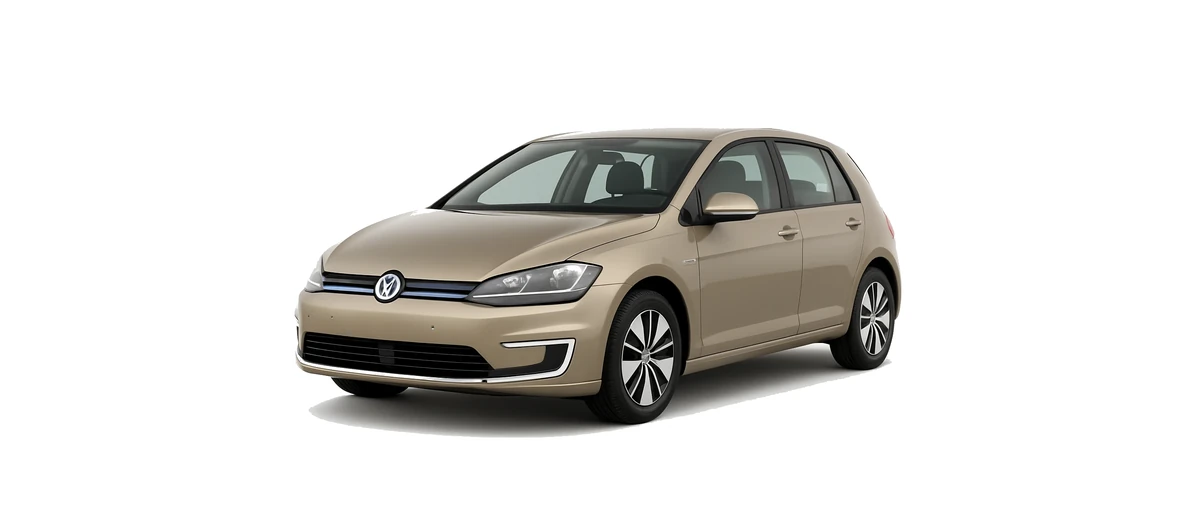
The VW e-Golf is a pure battery electric version of the Volkswagen Golf, sold in the UK before Volkswagen moved towards the ID.3. It is not the Golf GTE plug-in hybrid; the e-Golf has no petrol engine and must be charged from the mains or from public EV chargers.
For used buyers and owners, the most important point is that not all e-Golfs are the same. UK cars broadly fall into two main technical generations: the original 2014-2016 model with a 24.2 kWh gross battery, and the facelifted 2017-2020 model with a larger 35.8 kWh gross battery. Charging speeds also differ, especially on AC charging at home and on public Type 2 posts.
This guide explains the VW e-Golf charging set-up, how to identify the practical differences between the two generations, what cable you need for UK public charging, and why a standard 7 kW home wallbox is enough for most later e-Golf owners.
View VW e-Golf Charging Cables
VW e-Golf Battery and Charging Specifications
The VW e-Golf uses a Type 2 inlet for AC charging and CCS Combo 2 for DC rapid charging in UK and European specification. The charge inlet is positioned on the right-side rear panel, in the same general area where a fuel filler would be on a petrol or diesel Golf.
On AC power, the car is limited by its on-board charger. This means that plugging into a faster public AC post does not necessarily mean the car will charge faster. On DC rapid charging, the charger bypasses the car’s AC on-board charger and feeds the battery directly through the CCS connector.
| VW e-Golf version | Battery | AC charging | DC rapid charging | Typical range context |
|---|---|---|---|---|
| 2014-2016 e-Golf | 24.2 kWh gross / around 20.5 kWh usable | Up to about 3.7 kW Type 2 AC | CCS rapid charging may be present; check the inlet on early used cars | EV Database estimates around 75 miles real-world range |
| 2017-2020 facelift e-Golf | 35.8 kWh gross / around 32.0 kWh usable | Up to about 7.2 kW Type 2 AC | Around 40 kW CCS DC | 144 miles WLTP; EV Database estimates around 115 miles real-world range |
Battery Options
The early VW e-Golf, sold from around 2014 to 2016, uses a 24.2 kWh gross battery. EV Database lists the usable capacity at about 20.5 kWh. Period figures were often quoted using the older NEDC test cycle, so they can look optimistic compared with modern WLTP figures and real-world expectations.
The facelifted 2017-2020 e-Golf is the more common reference point for many charging guides. It gained a 35.8 kWh gross lithium-ion battery, with EV Database listing around 32.0 kWh usable. Volkswagen also confirmed the 35.8 kWh battery for the later model. This version offers noticeably more range and a faster AC charging capability than the earlier car.
Because the e-Golf is now discontinued, checking the exact year, battery size and charging hardware is important when buying used. A 2015 e-Golf and a 2019 e-Golf may look very similar from the outside, but their charging behaviour and day-to-day range expectations are different.
AC Charging Speed
AC charging is what you use at home, at many workplace chargers and at untethered public charging posts. For the VW e-Golf, AC charging is through the upper Type 2 part of the inlet.
For the 2017-2020 e-Golf, the Type 2 AC charging rate is listed at up to 7.2 kW. In practical UK terms, this makes a standard 7 kW home wallbox a very good match. EV Database lists an empty-to-full AC charging time of about 5 hours 15 minutes for the later car, although real charging sessions are often shorter because drivers usually plug in before the battery is completely empty.
The 2014-2016 e-Golf is slower on AC. EV Database lists this version at about 3.7 kW, with an empty-to-full AC charging time of roughly 6 hours 45 minutes. That is still suitable for overnight home charging, but it means the early e-Golf will not make full use of a 7 kW wallbox or a higher-powered public AC post.
A 22 kW public AC charger will not make either e-Golf charge at 22 kW. The car’s on-board charger sets the limit, so the later version will remain around its 7.2 kW maximum and the earlier version around its lower AC limit.
DC Rapid Charging Speed
DC rapid charging uses the CCS Combo 2 connector. On a CCS-equipped e-Golf, the plug uses the Type 2 upper section plus two larger DC pins below. Rapid chargers are normally tethered, so you use the cable attached to the charging unit rather than your own Type 2 cable.
For the 2017-2020 e-Golf, rapid charging is modest by modern EV standards. EV Database lists DC charging at around 40 kW, with a 10-80% rapid charge taking about 36 minutes. Volkswagen’s own material also refers to 40 kW DC charging for the later e-Golf.
This means a 50 kW CCS charger is generally sufficient for the e-Golf. Plugging into a 150 kW or 350 kW ultra-rapid charger will not make the car charge at those higher speeds, because the vehicle itself cannot accept that level of power.
For early used e-Golfs, it is sensible to check the actual charge inlet before relying on rapid charging. Early official Volkswagen material described CCS rapid charging as optional in some markets and specifications, while some databases list CCS for UK cars. A CCS inlet has the Type 2 section at the top and two larger DC pins beneath it. If those lower pins are not present, the car cannot use CCS rapid chargers.
Range and Efficiency
The later 2017-2020 VW e-Golf has a WLTP range of 144 miles, with EV Database estimating real-world range at around 115 miles. As with all EVs, actual range depends on speed, temperature, tyres, driving style, use of heating and how much of the battery you are comfortable using.
The earlier 2014-2016 car has a smaller battery and is best thought of as a shorter-range EV. EV Database estimates around 75 miles of real-world range for that version. For many urban commutes and local journeys, that can still be enough, but it requires more planning for longer trips.
The e-Golf’s strength is its familiar Golf shape and efficient everyday driving. It is less well suited to frequent long-distance motorway travel than newer EVs with larger batteries and faster rapid charging. For drivers who can charge at home and mostly cover local or regional mileage, however, the e-Golf can still be a very usable used electric hatchback.
Charging at Home
Home charging is usually the easiest and cheapest way to run a VW e-Golf. For the later 2017-2020 car, a 7 kW wallbox is well matched to the car’s 7.2 kW AC limit. If you plug in overnight, it is usually possible to start each day with the level of charge you need.
For the 2014-2016 model, a 7 kW wallbox is still useful, but the car may only draw around 3.7 kW. That means the wallbox has spare capacity that the car cannot use. In practice, the smaller battery means overnight charging remains realistic for many owners.
For home wallboxes with an untethered socket, you will need a Type 2-to-Type 2 charging cable. A 32 amp single-phase Type 2 cable is the usual match for the later e-Golf’s 7.2 kW AC charging capability. An early e-Golf with lower AC charging capability can still use a suitable Type 2 cable, but it will only draw what the car can accept.
A 3-pin portable charger is generally best suited as a backup or occasional charging solution, but can be used regularly if a qualified electrician has confirmed the socket and electrical installation are suitable for sustained EV charging. Standard domestic sockets were not primarily designed for long, repeated high-load charging sessions, so professional electrical advice is important.
Public Charging
For public AC charging, the VW e-Golf uses a Type 2-to-Type 2 cable at untethered posts. These are common in town centres, car parks, supermarkets, hotels and workplaces. Some public AC chargers are tethered, in which case you simply use the attached cable if it has the correct Type 2 connector.
When using AC public charging, remember that the posted charger speed is only part of the story. A 22 kW AC post may be useful because it is available and convenient, but it will not overcome the e-Golf’s on-board AC charging limit. Later cars charge at up to about 7.2 kW, while earlier cars are slower.
For longer trips, use CCS rapid chargers where your car has the full CCS inlet. Plan stops around 10-80% rather than 0-100%, because charging usually slows as the battery fills. On the later car, the 10-80% time is listed at about 36 minutes. The early car may take fewer minutes to add a percentage of charge because the battery is smaller, but it also adds fewer miles.
Vehicle-Specific Features
The e-Golf is based on Volkswagen’s MQB platform rather than a dedicated EV-only platform. That is one reason it feels familiar to anyone used to a conventional Golf, with a normal hatchback body style and restrained exterior design.
The later 2017-2020 model brought several important improvements, including the larger 35.8 kWh gross battery, a 100 kW motor and faster 7.2 kW AC charging compared with the earlier generation. These changes make the facelifted car the more flexible choice for many used buyers.
A heat pump was offered as an option and can help efficiency in cold weather by reducing the energy used for cabin heating. However, it should not be assumed that every used e-Golf has one. If winter range matters to you, check the individual car’s specification.
Battery preconditioning for rapid charging is not listed as available for the e-Golf in the research data, and V2L, V2H and V2G support are not supported. In simple terms, the e-Golf should be treated as a conventional earlier-generation EV rather than a modern vehicle with power export features.
Charging Tips
- Identify your generation first: 2014-2016 and 2017-2020 e-Golfs have different battery sizes and AC charging speeds.
- Use Type 2 for AC charging: A Type 2-to-Type 2 cable is the correct choice for untethered UK home and public AC charging points.
- Check for CCS pins on early cars: Look for the two larger DC pins below the Type 2 section if rapid charging is important to you.
- Do not overpay for AC speed you cannot use: A 22 kW AC post will not make the e-Golf charge at 22 kW.
- Use 50 kW CCS chargers confidently: For the later e-Golf, around 40 kW DC charging means a 50 kW rapid charger is usually enough.
- Plan winter journeys with margin: Cold temperatures and cabin heating can reduce range, especially if the car does not have the optional heat pump.
Frequently Asked Questions
Is the VW e-Golf a plug-in hybrid?
No. The VW e-Golf is a pure battery electric vehicle. The Volkswagen Golf GTE is the plug-in hybrid model.
What charging cable does the VW e-Golf need?
For AC charging at untethered home and public chargers, the VW e-Golf uses a Type 2-to-Type 2 cable. DC rapid chargers use a tethered CCS connector, so you normally do not need to bring your own cable for rapid charging.
Does every VW e-Golf charge at 7.2 kW?
No. The 2017-2020 facelift model is listed at up to 7.2 kW AC, while the 2014-2016 e-Golf is listed at about 3.7 kW AC. This is one of the key differences between the two generations.
Can the VW e-Golf use ultra-rapid chargers?
If the charger has a CCS connector and the car has the CCS inlet, the e-Golf may be able to connect, but it will not charge at ultra-rapid speeds. The later car is around 40 kW DC, so a 50 kW rapid charger is already well matched.
How long does the later VW e-Golf take to charge?
For the 2017-2020 e-Golf, EV Database lists around 5 hours 15 minutes for an empty-to-full AC charge at 7.2 kW, and about 36 minutes for a 10-80% DC rapid charge. Real sessions vary depending on starting charge, temperature and charger performance.
What This Means for Drivers
The VW e-Golf remains a practical used EV for drivers who want familiar Golf packaging, straightforward home charging and modest running costs. Its limitations are also clear: range is relatively short by current standards, and rapid charging is not especially fast.
If you own or are buying a later 2017-2020 e-Golf, a 7 kW home wallbox and a suitable Type 2 cable are a strong everyday charging set-up. If you are considering an early 2014-2016 car, expect slower AC charging and check carefully whether the car has CCS rapid-charging pins before planning longer journeys around rapid chargers.
In short, the e-Golf is at its best as an efficient commuter, local family car or urban hatchback that can be charged regularly at home. With the right expectations and the correct cable, it remains a simple and likeable electric Golf.
Looking for a Charging Cable for VW e-Golf?
We offer VW e-Golf charging cables for UK home and public AC charging, including Type 2 options suitable for the e-Golf’s charging set-up.
View VW e-Golf Charging Cables
Please note that this information is intended as a guide. Charging specifications may change due to model and year of manufacture. For precise information, always refer to your vehicle user manual.

