
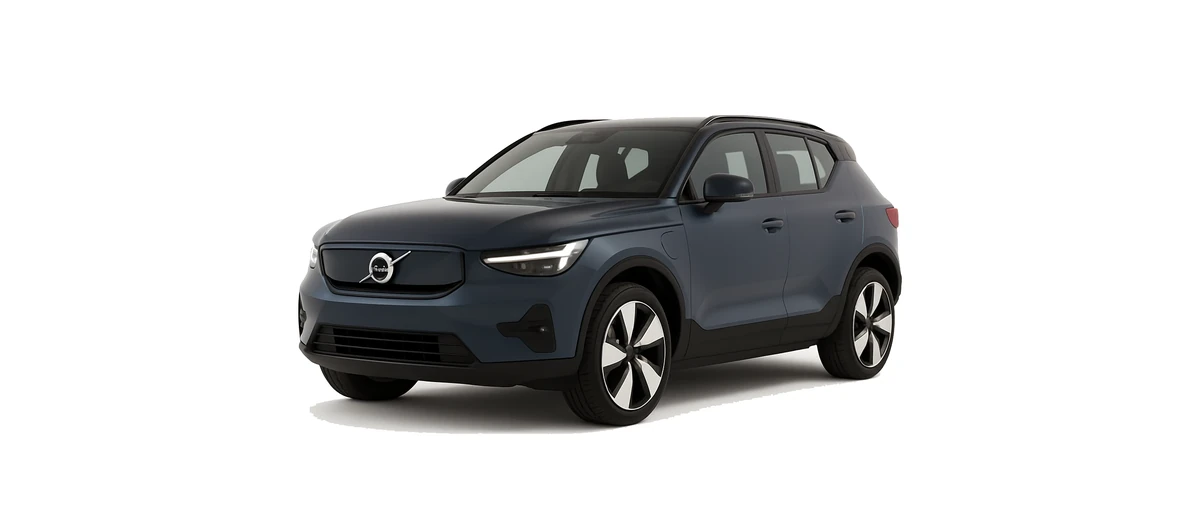
The Volvo XC40 Recharge name needs a little care, because Volvo used “Recharge” for both full-electric and plug-in hybrid XC40 models. This guide focuses on the Volvo XC40 Recharge Pure Electric, the battery-electric compact SUV now closely related to the EX40 name. If you own an XC40 Recharge plug-in hybrid, your charging requirements are different: the PHEV is AC-only and does not use CCS DC rapid charging in the same way as the Pure Electric model.
For UK XC40 Recharge Pure Electric owners, the key points are straightforward. The car uses a Type 2 connector for AC charging and a CCS Combo 2 connector for DC rapid charging. At home, most drivers will charge from a 7.4 kW wallbox, even though the car’s onboard AC charger can accept up to 11 kW where three-phase power is available. On longer journeys, rapid charging is handled by tethered CCS chargers, so you normally do not use your own cable for DC charging.
View Volvo XC40 Recharge Charging Cables
Volvo XC40 Recharge Battery and Charging Specifications
The XC40 Recharge Pure Electric was sold in several versions and model years in the UK, so there is no single battery size or rapid-charging figure that applies to every car. Early Twin Motor/P8 cars, later Single Motor versions and later Twin Motor versions can have different battery capacities and DC charging peaks.
As a general guide for UK and European XC40 Recharge Pure Electric models:
- AC charging connector: Type 2
- DC rapid charging connector: CCS Combo 2
- Charging port location: left rear side of the vehicle
- Maximum AC charging: up to 11 kW, depending on supply
- Typical UK home charging: usually up to 7.4 kW on a single-phase wallbox
- DC charging: varies by battery generation and model year, from around 136 kW to around 200 kW in favourable conditions
Volvo announced in February 2024 that the pure-electric XC40 Recharge would be renamed EX40. As a result, owners may see similar charging information listed under either XC40 Recharge Pure Electric or EX40, depending on the model year and source.
Battery Options
The battery fitted to a Volvo XC40 Recharge Pure Electric depends on the age and version of the car. If you are comparing charging times or range figures, it is worth checking your exact model year and variant rather than relying on a single headline figure.
- 69 kWh battery pack: used on some Single Motor / Pure Electric versions across later XC40 Recharge model years. EV Database UK lists usable capacity in the mid-60 kWh range depending on model year, with real-world range estimates commonly around the high-100s to low-200s miles.
- 78 kWh battery pack: used on earlier Twin Motor / P8 AWD versions. EV Database UK lists around 75 kWh usable capacity for a MY22 Twin Pure Electric, with an estimated real-world range of about 205 miles.
- 82 kWh battery pack: used on later Twin Motor and some EX40-related versions. EV Database UK lists around 79 kWh usable capacity for a MY24 Twin Motor, with a higher range estimate than earlier versions.
These differences matter because they affect how long the car takes to charge and how far it can travel between charging stops. They also explain why two XC40 Recharge Pure Electric owners may report different rapid-charging speeds even when using similar public chargers.
AC Charging Speed
The XC40 Recharge Pure Electric has an AC charging limit of up to 11 kW through its Type 2 socket. This is the maximum the onboard charger can accept, so connecting to a 22 kW AC public post will not make the car charge at 22 kW.
In the UK, most homes have a single-phase electricity supply. With a typical dedicated home wallbox, the practical charging rate is usually up to 7.4 kW. At that speed, a full charge from empty can take roughly overnight, with the exact time depending on the battery fitted and the starting state of charge. Volvo and independent data suggest that 0–100% AC charging can be around 7 hours 15 minutes to 8 hours 30 minutes at 11 kW, or roughly 10 hours 30 minutes to 12 hours 45 minutes at 7.4 kW, depending on battery size and model year.
For cable choice, most UK home and destination charging is best served by a Type 2 to Type 2 cable. A 32 amp single-phase Type 2 cable is suitable for the typical 7.4 kW UK wallbox or untethered public AC post. A 32 amp three-phase Type 2 cable is also compatible and can be useful if you regularly use 11 kW three-phase AC charging, although the XC40 Recharge Pure Electric will still be limited by its 11 kW onboard AC charger.
DC Rapid Charging Speed
DC rapid charging is where the main differences between XC40 Recharge Pure Electric versions become more noticeable. The car uses the CCS Combo 2 part of its charging port for DC rapid charging, and rapid chargers in the UK are normally tethered, meaning the cable is attached to the charger.
Approximate rapid-charging capability varies by battery generation:
- 69 kWh Single Motor versions: often listed at around 136 kW peak DC charging, with 10–80% charging around the mid-to-high 20 minute range on a suitable charger.
- 78 kWh early Twin Motor / P8 versions: commonly listed at around 150 kW peak DC charging, with 10–80% charging around 34–35 minutes in suitable conditions.
- 82 kWh later Twin Motor versions: can reach around 200 kW in favourable conditions, with 10–80% charging figures commonly listed around 28–32 minutes depending on source and conditions.
These are not guaranteed session-long speeds. DC charging normally starts quickly when the battery is warm and at a low-to-medium state of charge, then tapers as the battery fills. For long journeys, it is usually more efficient to plan rapid-charging stops around the 10–80% window rather than waiting for 100% at every stop.
Range and Efficiency
Because the XC40 Recharge Pure Electric spans several model years and battery configurations, range varies significantly. WLTP figures for relevant UK models range from the mid-200s miles to more than 300 miles on some later versions, while real-world estimates are usually lower and depend heavily on speed, weather, wheels, tyres, driving style and load.
As a compact SUV, the XC40 Recharge offers a practical driving position and useful space, but motorway speed and winter temperatures can reduce efficiency. Owners covering mostly town and suburban driving may see better results than those doing frequent high-speed motorway trips. In colder weather, using preconditioning before rapid charging and setting off with a warm cabin while plugged in can help reduce unnecessary energy use.
Charging at Home
For most UK owners, home charging is the simplest and cheapest way to run an XC40 Recharge Pure Electric. A dedicated 7.4 kW wallbox can add a substantial amount of range overnight and allows you to take advantage of off-peak electricity tariffs if your energy plan supports them.
If your wallbox is tethered, the cable is built in, so you may only need a separate Type 2 cable for public AC charging. If your wallbox is untethered, you will need your own Type 2 to Type 2 cable each time you charge. Many drivers keep one cable in the car so it is available for workplaces, hotels, supermarkets and destination chargers.
A 3-pin charger is generally best suited as a backup or occasional charging solution, but can be used regularly if a qualified electrician has confirmed the socket and electrical installation are suitable for sustained EV charging. Standard domestic sockets were not designed primarily for repeated high-load EV charging, so it is important to use suitable equipment and avoid extension leads unless the manufacturer and electrician confirm the arrangement is safe.
Public Charging
Public charging for the XC40 Recharge Pure Electric falls into two main types: AC destination charging and DC rapid charging.
AC destination charging is commonly found at workplaces, hotels, car parks, leisure centres and some supermarkets. Many of these chargers are untethered, so you use your own Type 2 cable. The car can take up to 11 kW AC where three-phase supply is available, but on many UK AC posts it may charge at 7 kW or thereabouts.
DC rapid charging is used for longer journeys and motorway stops. These chargers use a tethered CCS cable, so you do not need to bring your own rapid-charging cable. The exact speed you see will depend on your XC40’s battery version, the charger’s output, battery temperature, state of charge and whether the charger is sharing power with other vehicles.
For the best chance of a strong rapid charge, navigate to the rapid charger using the car’s built-in Google Maps system where supported. Volvo support materials confirm battery preconditioning for fast charging when a rapid charger is set as the destination, helping the battery reach a more suitable temperature before arrival.
Vehicle-Specific Features
The XC40 Recharge Pure Electric has a few charging-related details that are useful for owners to understand:
- Renamed EX40: from 2024, the pure-electric XC40 Recharge name was replaced by EX40, so charging references may appear under either name.
- Type 2 and CCS Combo 2: UK and European BEV models use Type 2 for AC charging and CCS Combo 2 for DC rapid charging.
- 11 kW AC cap: even if you plug into a 22 kW AC post, the car will not exceed its onboard AC charging limit.
- Battery preconditioning: supported for rapid charging when a compatible rapid charger is entered as the navigation destination.
- Heat pump: available on some versions, but not something to assume across every UK XC40 Recharge Pure Electric without checking the exact trim and model year.
- No V2L or V2G/V2H support: these features are not generally listed as supported for the XC40 Recharge Pure Electric.
Charging Tips
- Confirm which XC40 Recharge you own. Pure Electric BEV and plug-in hybrid Recharge models have different charging requirements.
- Choose the right Type 2 cable. For most UK owners, a 32 amp Type 2 to Type 2 cable is the practical choice for untethered home and public AC charging.
- Do not expect 22 kW AC charging. The car’s AC charging limit is up to 11 kW, even on faster AC posts.
- Use CCS rapid chargers for long trips. Public DC rapid chargers are normally tethered, so your own Type 2 cable is not used for rapid charging.
- Plan rapid stops around 10–80%. Charging usually slows at higher states of charge, so topping up to 100% on a rapid charger is often inefficient unless you need the extra range.
- Use navigation preconditioning. When heading to a rapid charger, set it as the destination in the car’s navigation system where possible.
Frequently Asked Questions
Does the Volvo XC40 Recharge use a Type 2 charging cable?
Yes, the XC40 Recharge Pure Electric uses Type 2 for AC charging. For untethered home wallboxes and many public AC chargers, you will need a Type 2 to Type 2 cable.
Is the XC40 Recharge Pure Electric the same as the XC40 Recharge plug-in hybrid?
No. Volvo used the Recharge name for both full-electric and plug-in hybrid models. The Pure Electric version is a BEV with Type 2 AC and CCS DC rapid charging. The plug-in hybrid version has different charging requirements and does not use BEV-style DC rapid charging.
Can the Volvo XC40 Recharge charge at 22 kW AC?
No. The XC40 Recharge Pure Electric’s onboard AC charging capability is up to 11 kW. A 22 kW AC post can still be used, but the car will not charge faster than its own AC limit.
How long does the XC40 Recharge take to charge at home?
On a typical UK 7.4 kW home wallbox, a full charge is generally an overnight job. Depending on battery size and model year, published examples suggest roughly 10.5 to 12.75 hours from empty to full at 7.4 kW. Most daily top-ups are much shorter because drivers rarely arrive home at 0%.
Do I need my own cable for rapid charging?
Usually not. UK DC rapid chargers use tethered CCS cables. Your own Type 2 cable is mainly for AC charging at home, work and destination chargers.
What This Means for Drivers
The Volvo XC40 Recharge Pure Electric is easy to live with once you understand which version you have. For daily use, a 7.4 kW home wallbox and a suitable Type 2 cable will cover most charging needs. For long journeys, the car’s CCS rapid-charging capability is useful, but the exact peak speed depends on the battery generation and conditions.
The most important practical advice is to avoid treating all XC40 Recharge models as identical. Check whether your car is the Pure Electric BEV or a plug-in hybrid, confirm your model year if you are comparing battery and rapid-charging figures, and remember that a 22 kW AC post will not override the car’s 11 kW AC charging limit.
Looking for a Charging Cable for Volvo XC40 Recharge?
We offer Volvo XC40 Recharge charging cables for UK owners who need a Type 2 cable for home, workplace or public AC charging; always confirm whether your vehicle is the Pure Electric BEV or the plug-in hybrid before choosing a cable.
View Volvo XC40 Recharge Charging Cables
Please note that this information is intended as a guide. Charging specifications may change due to model and year of manufacture. For precise information, always refer to your vehicle user manual.

