
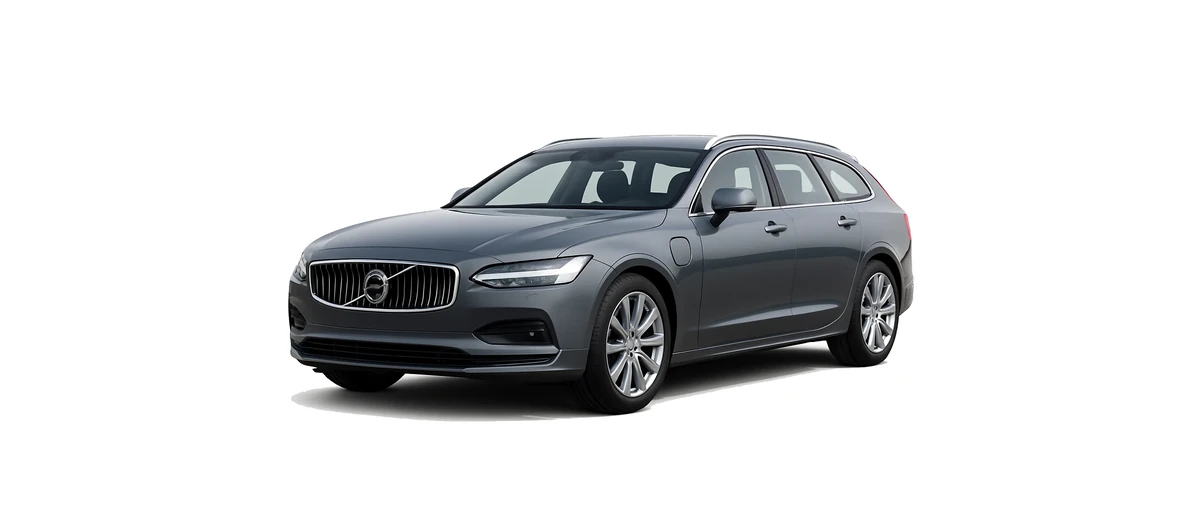
The Volvo V90 PHEV is a premium plug-in hybrid estate, combining petrol power with a rechargeable battery and an electric rear axle. It is important to treat it as a plug-in hybrid rather than a full battery-electric vehicle: regular charging is central to getting the best fuel economy, but the car is not designed around motorway rapid-charging stops in the way a BEV is.
For UK buyers and owners, the main point to understand is that not all Volvo V90 plug-in hybrid models are the same. Later Model Year 2024 and Model Year 2025 cars use a larger 18.8 kWh nominal battery, while older V90 Recharge and Twin Engine versions can have a smaller 11.6 kWh battery. That affects electric range expectations and charging times, although cable selection remains centred on Type 2 AC charging.
View Volvo V90 PHEV Charging Cables
Volvo V90 PHEV Battery and Charging Specifications
The Volvo V90 plug-in hybrid uses a Type 2 AC charging connection. On later UK specification data, the charge port is located on the nearside front wing. Volvo’s Model Year 2025 UK specification lists a 2-phase on-board charger rated at up to 6.4 kW, but that figure needs context for UK homes: on a typical single-phase domestic supply, Volvo lists home charging as limited to around 3.7 kW.
The V90 PHEV does not have a confirmed CCS/DC rapid charging specification in the UK data used for this guide. In practical terms, owners should plan around home, workplace and destination AC charging rather than 10–80% rapid charging sessions.
- Vehicle type: Petrol plug-in hybrid estate
- Charging connector: Type 2 AC
- Latest UK battery figure: 18.8 kWh nominal / 14.7 kWh usable for MY2025 T6 and T8 plug-in hybrid models
- Older UK battery figure: 11.6 kWh for some earlier V90 Recharge plug-in hybrid models
- Latest AC charging capability: Up to 6.4 kW where supported, with single-phase home charging typically limited to about 3.7 kW
- DC rapid charging: No confirmed DC rapid charging support in the UK data reviewed
Battery Options
This is the area where used buyers need to be especially careful. Volvo has used several names and specifications across the V90 plug-in hybrid’s life, including Recharge and earlier plug-in hybrid branding. Volvo has confirmed that V90 Recharge and V90 plug-in hybrid naming can refer to the same broad type of car, but the battery fitted depends on the model year and exact version.
For Model Year 2025 UK cars, Volvo listed V90 T6 Plug-in Hybrid AWD and V90 T8 Plug-in Hybrid AWD versions with an 18.8 kWh nominal battery and 14.7 kWh usable capacity. These later cars have the longest official electric range figures, with WLTP EAER up to 54.1 miles for the T6 and up to 52.2 miles for the T8, depending on specification and options.
By contrast, older UK Model Year 2021 V90 Recharge T6 Plug-in Hybrid AWD data lists an 11.6 kWh lithium-ion battery and WLTP EAER of 31.7 to 35.4 miles. That is a meaningful difference, so it is best not to assume that a used V90 PHEV has the later battery simply because it is badged Recharge.
| Version / period | Battery information | Official electric range context |
|---|---|---|
| MY2025 V90 T6/T8 Plug-in Hybrid AWD | 18.8 kWh nominal / 14.7 kWh usable | Up to 54.1 miles EAER for T6; up to 52.2 miles EAER for T8 |
| MY2021 V90 Recharge T6 Plug-in Hybrid AWD | 11.6 kWh battery listed | 31.7 to 35.4 miles EAER |
AC Charging Speed
AC charging is the normal charging method for the Volvo V90 PHEV. The car uses a Type 2 connection, so a Type 2 to Type 2 cable is the main cable needed for home wallboxes, workplace chargers and many public AC charging posts.
For later MY2025 cars, Volvo lists a 2-phase on-board charger rated at 6.4 kW. However, many UK homes are single-phase, and Volvo’s UK specification indicates that single-phase home charging is limited to around 3.7 kW. That means a typical 7 kW UK home wallbox may not charge the V90 PHEV at the full 7 kW rate; the car’s own charger and supply arrangement determine the actual speed.
Volvo Support examples for compatible AC charging show approximately 3 hours for 0–100% at 16A on a suitable AC charging station or home charge point, around 5 hours at 16A from a 200–240 V household or single-phase supply, and around 7 hours at 10A. Real charging time will vary with the car, cable, supply, battery temperature, starting charge level and any charging limits set in the vehicle or charger.
DC Rapid Charging Speed
There is no reliable UK specification in the research data confirming CCS or DC rapid charging for the Volvo V90 PHEV. The supported charging information found for the car centres on Type 2 AC charging, and no 10–80% rapid charging time should be quoted for this model.
This matters because it changes how you should use the car. A full electric vehicle might rely on high-power DC charging during long motorway journeys. The V90 PHEV is different: on longer trips, it can continue using its petrol engine once the usable electric range has been depleted. The main benefit of plugging in is therefore to start local and regular journeys with a charged battery, reducing petrol use where the car can run electrically.
Range and Efficiency
The latest UK MY2025 V90 PHEV figures list WLTP EAER of up to 54.1 miles for the T6 and up to 52.2 miles for the T8, depending on specification and options. Older 11.6 kWh cars have lower official electric range figures, with MY2021 data listing 31.7 to 35.4 miles EAER.
WLTP figures are useful for comparison, but they should not be treated as guaranteed real-world range. Electric range in a plug-in hybrid can be affected by temperature, speed, wheel and tyre specification, cabin heating or cooling, route profile, payload and driving style. Short urban journeys in mild conditions are more likely to make good use of the electric system than high-speed winter motorway use.
For many owners, the key efficiency habit is simple: plug in frequently. If the V90 PHEV is regularly driven with a depleted battery, it becomes much closer in use to a conventional petrol estate, which reduces the benefit of choosing the plug-in hybrid version in the first place.
Charging at Home
Home charging is the most convenient charging method for most Volvo V90 PHEV owners. Because the battery is much smaller than a full EV battery, it is realistic to top it up overnight or in a few hours, depending on the charger, supply and model year. A dedicated home wallbox is usually the neatest solution because it is designed for regular EV charging, can be installed in a suitable location, and commonly supports scheduled charging to make use of off-peak tariffs.
For a later 18.8 kWh V90 PHEV on a normal UK single-phase installation, expect the car to charge at around the single-phase limit stated by Volvo rather than at the full rating of a 7 kW wallbox. That is not usually a problem for a PHEV, because the usable battery capacity is modest compared with a BEV and the car can be replenished during typical parking periods.
A 3-pin charger is generally best suited as a backup or occasional charging solution, but can be used regularly if a qualified electrician has confirmed the socket and electrical installation are suitable for sustained EV charging. Avoid using old, damaged or unsuitable extension leads, and stop charging if a plug, socket or cable becomes unusually warm.
Public Charging
Public charging can be useful for the Volvo V90 PHEV, but mainly when the car is parked for a while. A Type 2 public AC post at a supermarket, hotel, workplace, railway station or town-centre car park can add useful electric range while you are doing something else. For this, you will normally need a Type 2 to Type 2 charging cable unless the post has a tethered lead.
Because DC rapid charging is not confirmed for this car, it is better to think of public charging as a destination top-up rather than a long-distance refuelling strategy. If you are travelling a long way, the V90 PHEV’s petrol engine provides the long-range flexibility, while charging before departure and whenever convenient helps reduce petrol use for local sections of the journey.
Vehicle-Specific Features
The Volvo V90 PHEV is based on Volvo’s SPA platform and is positioned as a long-distance premium estate rather than a compact urban plug-in. Its charging arrangement reflects that role. The Type 2 AC port on later cars is located on the nearside front wing, which is worth remembering when choosing where to park relative to a home charger or public post.
Volvo’s MY2025 UK specification indicates that the car was supplied with both a 6 metre 3-phase 16A Type 2 Mode 3 cable and a 7 metre 10A 3-pin cable. Used cars may not still have their original cables, so buyers should check what is included and whether the cable condition, length and rating suit their charging routine.
The V90 is no longer available for new UK configurations on Volvo’s current UK page, although stock cars may still exist and used examples remain on the market. For that reason, confirming the exact model year and version is especially important before relying on published battery, range or charge time information.
Charging Tips
- Identify your exact car first: Check the model year, trim and documentation so you know whether you have an earlier 11.6 kWh car or a later 18.8 kWh nominal battery version.
- Use a Type 2 cable for routine charging: A Type 2 to Type 2 cable is the key cable for untethered home wallboxes and public AC posts.
- Do not expect BEV-style rapid charging: Plan around AC charging and petrol range rather than DC rapid charging stops.
- Charge little and often: Plugging in at home or work keeps the battery ready for short electric journeys.
- Be realistic about charging speed: Later cars may list up to 6.4 kW AC capability, but many UK homes will charge at around the single-phase figure instead.
- Check cable length: The nearside front wing charging port may influence whether a 5 metre, 7 metre or longer cable is most convenient for your parking position.
Frequently Asked Questions
Is the Volvo V90 PHEV a fully electric car?
No. The Volvo V90 PHEV is a petrol plug-in hybrid estate. It can drive on electric power for local journeys when charged, but it also has a petrol engine and is not a battery-electric vehicle.
What charging cable does the Volvo V90 PHEV use?
The Volvo V90 PHEV uses a Type 2 AC charging connection. For most public AC posts and untethered home wallboxes, you will need a Type 2 to Type 2 charging cable.
Can the Volvo V90 PHEV rapid charge?
DC rapid charging is not confirmed in the UK charging information reviewed for this model. The V90 PHEV should be treated as a Type 2 AC charging vehicle rather than a CCS rapid-charging EV.
How long does it take to charge a Volvo V90 PHEV?
Charging time depends on the model year, battery size and power supply. Volvo Support examples indicate around 3 hours at 16A on a suitable AC charging station or home charge point, around 5 hours at 16A from a 200–240 V household or single-phase supply, and around 7 hours at 10A. Older smaller-battery cars may differ.
Do all Volvo V90 PHEV models have the same battery?
No. Later UK MY2025 V90 T6 and T8 plug-in hybrid models list an 18.8 kWh nominal / 14.7 kWh usable battery, while some earlier V90 Recharge models list an 11.6 kWh battery. Always check the exact car rather than relying on one universal figure.
What This Means for Drivers
The Volvo V90 PHEV makes most sense when it is charged regularly and used as a plug-in hybrid, not simply as a petrol estate carrying extra battery hardware. If your daily mileage fits within the car’s electric range, especially in a later 18.8 kWh version, a home wallbox and the right Type 2 cable can make electric running a normal part of ownership.
For used buyers, the most important step is identifying which V90 PHEV you have. Battery size, official electric range and charging expectations vary significantly between early and later cars. Once that is clear, the charging routine is straightforward: use Type 2 AC charging at home, work or destinations, avoid assuming DC rapid charging support, and keep the battery topped up whenever practical.
Looking for a Charging Cable for Volvo V90 PHEV?
We offer Volvo V90 PHEV charging cables suitable for Type 2 AC charging, helping owners replace missing used-car cables or choose a practical cable length for home and public charging.
View Volvo V90 PHEV Charging Cables
Please note that this information is intended as a guide. Charging specifications may change due to model and year of manufacture. For precise information, always refer to your vehicle user manual.

