
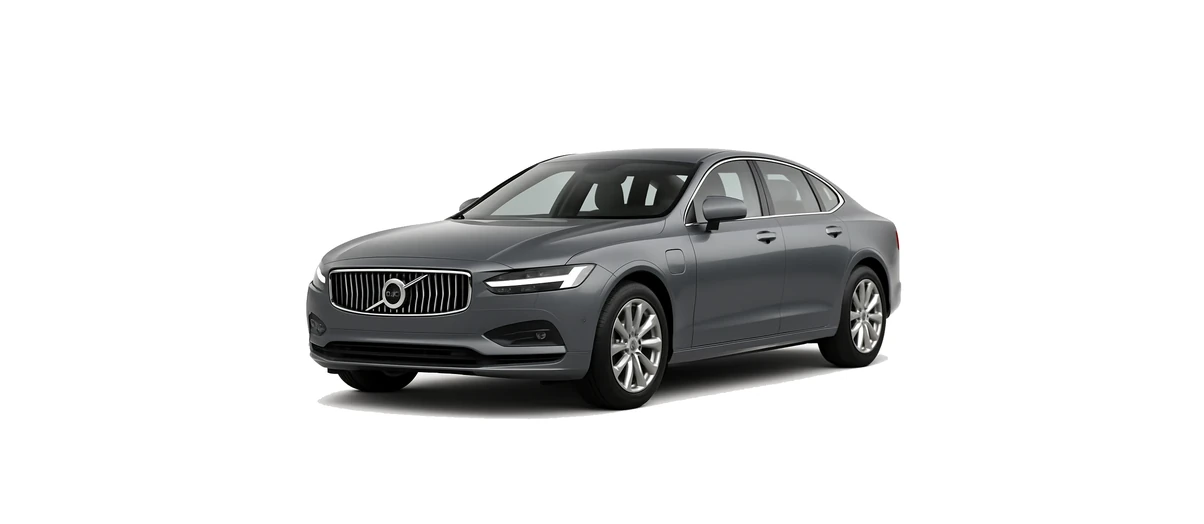
The Volvo S90 PHEV is an executive saloon that combines a petrol engine with a plug-in hybrid battery. It is not a fully electric car, and that matters when you are planning how to charge it. Rather than thinking in terms of motorway rapid charging and large battery top-ups, S90 plug-in hybrid ownership is usually about charging little and often at home, at work or on public AC posts.
UK-market S90 plug-in hybrid models were sold under names including T8, Twin Engine and Recharge T8 AWD. Volvo UK now indicates that the S90 has been discontinued in the UK, so most buyers and owners will be dealing with used examples. The most important first step is to identify which battery version you have: earlier cars around 2020-2021 may use an 11.6 kWh battery, while later S90 Recharge T8 AWD versions used a larger 18.8 kWh nominal battery.
View Volvo S90 PHEV Charging Cables
Volvo S90 PHEV Battery and Charging Specifications
The Volvo S90 PHEV uses a Type 2 AC charging inlet. This is the standard connector used for most UK home charge points and many untethered public AC chargers. Volvo support information identifies the car’s charging compatibility as AC Type 2, so the practical cable choice for most owners is a Type 2 charging cable.
The later 18.8 kWh S90 Recharge T8 AWD is listed in Volvo UK technical data with a maximum AC charging rate of about 3.6 kW, equivalent to 16A single-phase charging. A 7.4 kW home wallbox can still be very convenient, especially if it is already installed or will be used by other EVs in future, but the S90 PHEV will only draw what its onboard charger can accept.
Because this is a plug-in hybrid rather than a battery electric vehicle, its charging needs are modest compared with a long-range EV. A full charge can often be completed during a workday, an evening at home, or overnight.
Battery Options
There is not one universal Volvo S90 PHEV battery size across all UK used examples. This is one of the key points to check before comparing charge times or electric range.
- Earlier S90 T8 / Twin Engine / Recharged PHEV models: around 2020-2021 UK-market examples may have an 11.6 kWh battery. Volvo UK 2020 technical data lists charging times of around 3 hours at 16A, 4 hours at 10A and 8 hours at 6A.
- Later S90 Recharge T8 AWD models: later support and specification data lists a larger 18.8 kWh nominal battery. Volvo UK 2023 technical data gives charging times of around 5 hours at 16A, 8 hours at 10A and 13 hours at 6A.
The usable battery capacity is not clearly confirmed from the official UK data reviewed, so it is best to treat the kWh figures above as nominal or gross battery content rather than assuming the full amount is usable for electric driving.
AC Charging Speed
The S90 PHEV is at its best on simple AC charging. Later 18.8 kWh models are shown with an AC charging limit of about 3.6 kW. That means a 7.4 kW, 11 kW or 22 kW AC post will not make the car charge faster than its onboard charger allows. The charger may be more powerful, but the car controls the actual charging rate.
For cable selection, a Type 2 to Type 2 cable is the usual choice for untethered home wallboxes and public AC posts. A 16A Type 2 cable is sufficient for the S90 PHEV’s approximate 3.6 kW maximum draw, although many owners choose a 32A Type 2 cable because it can also be used with future vehicles that may charge at 7.4 kW on single-phase AC.
Approximate AC charging times are:
- Earlier 11.6 kWh battery: about 3 hours at 16A, around 4 hours at 10A, and around 8 hours at 6A.
- Later 18.8 kWh battery: about 5 hours at 16A, around 8 hours at 10A, and around 13 hours at 6A.
These figures should be treated as guide times. State of charge, temperature, cable rating, charge point settings and the vehicle’s own charging management can all affect the result.
DC Rapid Charging Speed
The Volvo S90 PHEV should not be treated like a CCS rapid-charging electric car. The UK information reviewed identifies the S90 Recharge plug-in hybrid charging compatibility as AC Type 2, and there is no reliable UK basis for quoting a CCS rapid-charging rate or a 10-80% DC charging time for this vehicle.
In everyday use, that is not a major drawback. The S90 PHEV has a relatively small plug-in hybrid battery, so it is designed around home, workplace and destination AC charging rather than high-power motorway charging. If you are planning a long journey, the petrol engine provides the long-distance flexibility, while charging remains useful when the car is parked for a few hours.
Range and Efficiency
Later S90 Recharge T8 AWD models with the 18.8 kWh battery were quoted with a WLTP electric range of up to around 74-90 km, or approximately 46-56 miles, depending on specification. This figure should not be read as a guaranteed real-world range.
Actual electric range can vary significantly with driving style, outside temperature, speed, terrain, tyre condition, passenger load and use of heating or air conditioning. Short urban and suburban journeys are where the S90 PHEV is most likely to make strong use of electric driving. Higher-speed motorway use will generally reduce electric range more quickly.
For earlier 11.6 kWh cars, the expected electric range will usually be lower than the later larger-battery version, so used-car buyers should avoid comparing all S90 PHEVs as if they have the same battery.
Charging at Home
Home charging is the most convenient way to run a Volvo S90 PHEV. If you can plug in overnight or whenever the car is parked, you can start many local journeys with useful electric range available. This is also where a PHEV often makes the most financial and practical sense: short trips can be completed with less petrol use, while the combustion engine remains available for longer journeys.
A dedicated home charge point is generally preferable for regular charging. Even though the S90 PHEV may only draw around 3.6 kW, a properly installed wallbox is designed for sustained EV charging and is usually more convenient than using a domestic socket.
A 3-pin charger is generally best suited as a backup or occasional charging solution, but can be used regularly if a qualified electrician has confirmed the socket and electrical installation are suitable for sustained EV charging. Volvo support information also advises that household-socket charging is more appropriate for occasional use rather than regular charging.
If your wallbox is untethered, you will need a Type 2 cable. If it is tethered, the cable is already attached, but carrying your own Type 2 cable is still useful for public AC charging.
Public Charging
Public charging for the Volvo S90 PHEV is mainly about AC destination charging. Examples include supermarket chargers, hotel chargers, workplace posts, council car parks and town-centre AC points. These can be useful when the car is parked for two to five hours, especially with the later larger-battery version.
Untethered public AC posts usually require you to bring your own Type 2 cable. Tethered AC units have a cable attached, but many slower or destination-style posts do not. A cable stored in the boot makes the car easier to charge whenever a compatible AC post is available.
Because the S90 PHEV is limited by its onboard AC charger, choosing a 22 kW public AC post will not give 22 kW charging. The post can offer that power, but the vehicle will charge at its own supported rate. For this reason, public charging is most useful when it fits naturally into your parking time, rather than as a quick stop solely to add electric range.
Vehicle-Specific Features
The S90 PHEV’s charging flap is reported by UK reviews as being on the nearside front wing, which can make charger positioning worth thinking about when parking. At home, this may influence where you place a wallbox or how you route the cable across the driveway.
Volvo support information also refers to preconditioning functions that can help reduce energy used to heat the car and battery. For a plug-in hybrid, this is best understood as climate and battery conditioning for comfort and efficiency, rather than the kind of DC rapid-charge battery preconditioning associated with some fully electric cars.
Regenerative braking can recover some energy during driving, but it is not a substitute for plugging in. To get the main benefit of the S90 PHEV, the battery needs to be charged from an external supply on a regular basis.
Charging Tips
- Check your battery version: an 11.6 kWh S90 PHEV and an 18.8 kWh S90 Recharge T8 AWD have different charge times and likely electric range.
- Use the right cable: a Type 2 cable is the key accessory for untethered home wallboxes and public AC posts.
- Do not chase higher AC numbers: a 7.4 kW, 11 kW or 22 kW post will not override the car’s onboard charging limit.
- Charge little and often: regular top-ups are usually more useful than waiting until the battery is empty.
- Plan public charging around parking: AC charging works best when you are stopping for work, shopping, a meal or an overnight stay.
- Keep the cable accessible: do not bury it under luggage if you expect to use public AC chargers during the day.
Frequently Asked Questions
What charging cable does the Volvo S90 PHEV use?
The Volvo S90 PHEV uses a Type 2 AC connection. For untethered wallboxes and public AC charging posts, you will normally need a Type 2 to Type 2 charging cable.
How fast does the Volvo S90 PHEV charge?
Later 18.8 kWh S90 Recharge T8 AWD models are listed with charging of about 3.6 kW at 16A, taking roughly 5 hours for a full charge. Earlier 11.6 kWh models are quicker, with Volvo UK data indicating around 3 hours at 16A.
Can the Volvo S90 PHEV use rapid chargers?
The S90 PHEV should be planned around AC Type 2 charging. Reliable UK data reviewed for this guide does not provide a CCS rapid-charging rate or 10-80% DC charging time for the car.
Is a 32A cable worth buying for a car that charges at around 16A?
A 16A Type 2 cable is sufficient for the S90 PHEV’s approximate maximum AC draw. However, some owners choose a 32A cable because it offers broader compatibility with future EVs or plug-in hybrids that may charge faster on single-phase AC.
Is the Volvo S90 PHEV still available new in the UK?
Volvo UK indicates that the S90 has been discontinued in the UK, so most interest is now likely to come from used-car buyers and existing owners.
What This Means for Drivers
For most Volvo S90 PHEV owners, the ideal charging setup is straightforward: a dedicated home charge point, a suitable Type 2 cable, and a routine of plugging in whenever the car is parked. The car’s modest AC charging rate means you do not need to focus on the highest-powered public chargers. Instead, the biggest benefit comes from convenience and consistency.
If you are buying used, identify whether the car has the earlier 11.6 kWh battery or the later 18.8 kWh battery before relying on any quoted charge time or electric range. Once you know which version you have, the S90 PHEV is easy to fit into a normal charging routine: charge overnight, top up at work or on destination AC posts, and let the petrol engine handle journeys beyond the electric range.
Looking for a Charging Cable for Volvo S90 PHEV?
We offer charging cables for the Volvo S90 PHEV, including Type 2 options suitable for home wallboxes and untethered public AC charging points.
View Volvo S90 PHEV Charging Cables
Please note that this information is intended as a guide. Charging specifications may change due to model and year of manufacture. For precise information, always refer to your vehicle user manual.

