
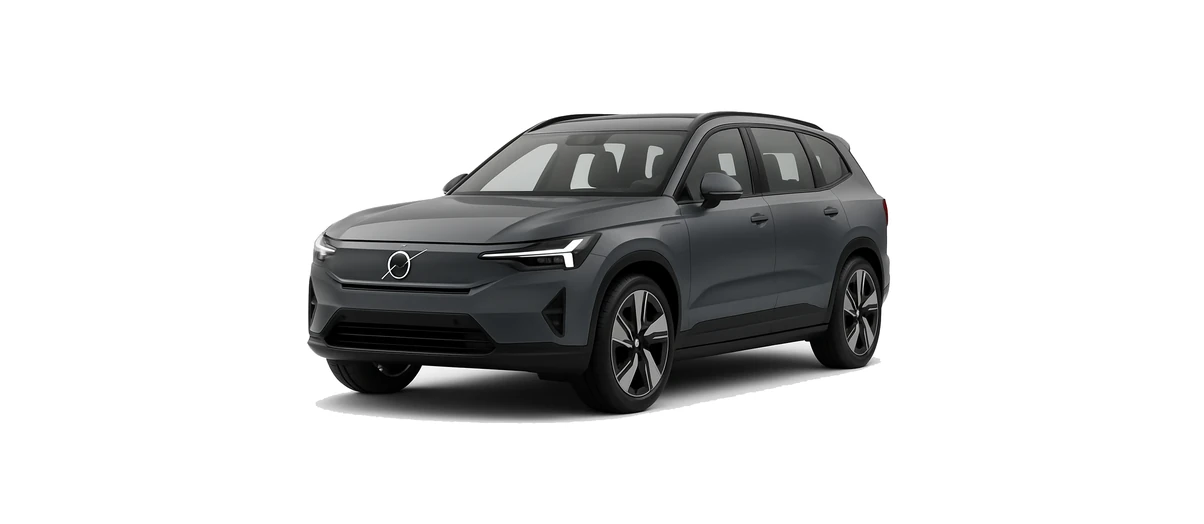
The Volvo EX90 is a large, fully electric seven-seat SUV, offered in the UK as an electric-only model. For drivers moving from a smaller EV or a plug-in hybrid, the EX90’s charging requirements are worth understanding because its battery is large, its current UK specifications differ from some earlier EX90 figures found online, and its fastest charging depends heavily on using the right type of charger.
This guide focuses on the current UK Volvo EX90 model year 2026 information. Volvo UK lists three powertrains: Single Motor rear-wheel drive, Twin Motor all-wheel drive and Twin Motor Performance all-wheel drive. Current UK specifications show a 92 kWh nominal battery for the Single Motor and a 106 kWh nominal battery for the Twin Motor models, with an 800 V electrical system. That matters because some older MY2025 EX90 information quoted different battery and charging figures, so it is important not to mix older data with the current UK car.
View Volvo EX90 Charging Cables
Volvo EX90 Battery and Charging Specifications
The Volvo EX90 uses a Type 2 connector for AC charging and CCS Combo 2 for DC rapid charging in the UK and Europe. Type 2 is the standard connection used for home wallboxes and many destination chargers, while CCS is used for high-power public rapid and ultra-rapid chargers.
| Specification | Volvo EX90 current UK information |
|---|---|
| Vehicle type | Battery-electric vehicle, not a plug-in hybrid |
| Body style | Large 7-seat SUV |
| AC charging connection | Type 2 |
| DC rapid charging connection | CCS Combo 2 |
| Maximum AC charging | Up to 11 kW, depending on supply |
| DC charging reference | Volvo quotes 10-80% in 22 minutes on a 350 kW DC charger |
| Electrical system | 800 V listed in current UK specifications |
| Charge port location | Reported as rear-left by EV data sources |
The key practical point is that the EX90 can make good use of faster infrastructure, but the speed you see in everyday use will depend on the charger, the battery temperature, the state of charge, the charging curve and the condition of the vehicle and equipment.
Battery Options
Current UK Volvo EX90 specifications list different battery sizes depending on the powertrain. The Single Motor has a 92 kWh nominal battery. Independent EV data sources estimate around 88 kWh usable capacity for this version. Volvo lists up to 351.1 miles WLTP combined range for the Single Motor.
The Twin Motor and Twin Motor Performance versions use a 106 kWh nominal battery. EV Database UK estimates around 102 kWh usable capacity for these variants. The highest current UK WLTP figure belongs to the Twin Motor, at up to 383.4 miles combined. The Twin Motor Performance is listed at up to 376.6 miles WLTP combined, reflecting the fact that the Performance model trades a little range for extra power.
This is where the MY25 versus MY26 issue becomes important. You may see older UK EX90 material online showing a different battery capacity and a lower rapid-charging headline for some Twin models. For a current UK buying or charging guide, use the latest MY26 figures from Volvo UK and avoid blending them with earlier data.
AC Charging Speed
For AC charging, the Volvo EX90 is listed at up to 11 kW. Volvo UK quotes AC 0-100% times using a three-phase 16 A supply: around 10 hours for the Single Motor, 11 hours for the Twin Motor and 10 hours for the Twin Motor Performance.
However, many UK homes have single-phase electricity and a typical dedicated home wallbox will charge at up to 7.4 kW rather than 11 kW. On that type of supply, charging a large-battery EX90 from empty to full will take longer than Volvo’s three-phase figures. EV Database indicates that a 106 kWh EX90 on a 7.4 kW home charge point may take roughly 16 hours from empty to full. In real use, most owners will not arrive home at 0% or need to charge to 100% every night, so overnight top-ups are usually much more manageable than the empty-to-full figure suggests.
If you have access to three-phase power at home or at work, an 11 kW charging point can reduce AC charging times. For most domestic UK owners, though, the practical setup is a Type 2 cable and a 7.4 kW single-phase wallbox.
DC Rapid Charging Speed
For long journeys, the Volvo EX90 uses CCS rapid charging. Current Volvo UK information quotes a 10-80% DC charging time of 22 minutes when using a 350 kW DC charger. EV Database lists a 350 kW maximum DC figure for the MY26 Twin Motor versions and estimates a similar 10-80% time of around 23 minutes. For the Single Motor, BEV Database estimates a lower peak of around 310 kW, so it is sensible to describe the EX90 as able to benefit from very high-power charging rather than assuming every variant has an identical peak.
The current EX90’s 800 V electrical system is significant because it is designed to work well with high-power charging hardware. To approach the quoted rapid-charging times, you will need a compatible ultra-rapid charger, a suitably low starting state of charge, a battery at the right temperature and a charger capable of delivering the required voltage and current. A 150 kW or older rapid charger can still be useful, but it will not deliver the fastest 10-80% session.
As with most EVs, charging speed usually tapers as the battery fills. For motorway travel, it is normally quicker to stop at around 10-20% and charge to about 70-80% than to wait for a full 100% charge at a rapid charger.
Range and Efficiency
Volvo UK lists up to 351.1 miles WLTP combined range for the Single Motor, up to 383.4 miles for the Twin Motor and up to 376.6 miles for the Twin Motor Performance. WLTP figures are useful for comparison, but real-world range varies with speed, weather, passenger load, wheel size, route profile and heating or air-conditioning use.
EV Database UK estimates around 295 miles of real-world range for the MY26 Twin Motor and around 285 miles for the Twin Motor Performance. These estimates are not official Volvo figures, but they give a more practical expectation for mixed driving. As a large seven-seat SUV, the EX90 will use more energy at motorway speeds than in gentle urban or suburban driving, particularly in cold, wet or windy conditions.
The EX90 is listed by EV data sources as having a standard heat pump, which can help improve efficiency in cooler weather compared with relying solely on resistive cabin heating. Battery preconditioning is also listed as standard by EV data sources. When available and correctly used, preconditioning can help prepare the battery for faster charging before a rapid-charge stop.
Charging at Home
Home charging will be the simplest and most cost-effective way to run a Volvo EX90 for many UK drivers. A dedicated wallbox is strongly recommended for regular charging. It provides better safety, convenience and charging speed than a domestic socket and can often be paired with smart tariffs, solar integration or scheduled overnight charging.
For home charging, you need a Type 2 charging cable if your wallbox is untethered. A tethered wallbox has its own attached cable, but many owners still keep a separate Type 2 cable in the car for public AC charging at hotels, car parks, workplaces and supermarkets.
A 7.4 kW single-phase wallbox will be enough for most UK households, even though the EX90 can accept up to 11 kW AC on a suitable three-phase supply. Because the EX90 has a large battery, it is best to think in terms of overnight top-ups rather than always charging from empty to full. For example, adding back the energy used on a typical commute may only take a few hours.
A 3-pin charger is generally best suited as a backup or occasional charging solution, but can be used regularly if a qualified electrician has confirmed the socket and electrical installation are suitable for sustained EV charging. With a large-battery vehicle like the EX90, a domestic socket will be very slow and should not be treated as the main solution unless the electrical setup has been properly assessed.
Public Charging
Public charging for the Volvo EX90 falls into two main categories: AC destination charging and DC rapid charging. AC destination chargers normally use a Type 2 connection and are useful when the car will be parked for several hours. These are common at hotels, workplaces, shopping centres and long-stay car parks. Charging speed will depend on the charger output and whether the supply is single-phase or three-phase.
For long-distance travel, use CCS rapid or ultra-rapid chargers. The current MY26 EX90 is best matched with high-power 800 V-compatible chargers when you want the shortest stops, but it can still use lower-power CCS chargers when needed. The charging session will simply take longer.
Some EV data sources list Plug & Charge support for EX90 variants. Where supported by the charging network and set up correctly, Plug & Charge can simplify payment and authentication. Availability and compatibility can vary by network, so it is still sensible to keep charging apps, RFID cards or contactless payment options ready when travelling.
Vehicle-Specific Features
The EX90’s most important charging-related feature is its current UK 800 V electrical architecture. This places it among EVs designed to take advantage of the latest ultra-rapid charging infrastructure. It does not mean every public charger will deliver the headline rate, but it gives the vehicle the potential for very fast charging when conditions are right.
Heat pump and battery preconditioning are listed as standard by EV data sources. For UK owners, these features are especially relevant in colder months, when battery temperature can have a noticeable effect on charging speed and efficiency.
Volvo Support UK identifies the charging connections as AC Type 2 and DC CCS Combo 2. There is no need to look for a UK NACS or Tesla-style vehicle socket. The EX90 can use compatible public charging networks via the appropriate Type 2 or CCS hardware.
Bidirectional functions such as V2L, V2G or V2H should be treated cautiously in the UK context. The checked UK sources did not clearly confirm live UK availability, so they should not be assumed when choosing charging equipment.
Charging Tips
- Choose the right cable: for UK and European AC charging, the Volvo EX90 uses a Type 2 cable.
- Do not rely on older EX90 figures: current UK MY26 data differs from earlier MY2025 information found online.
- Plan rapid stops around 10-80%: this is usually the fastest and most efficient charging window on long journeys.
- Use high-power CCS chargers when time matters: the EX90 benefits most from modern ultra-rapid chargers, particularly those suitable for 800 V vehicles.
- Expect slower home charging on single-phase power: a 7.4 kW wallbox is common in UK homes and will not match the 11 kW three-phase AC figures.
- Keep a cable in the car: even if you have a tethered wallbox at home, a separate Type 2 cable is useful for destination charging.
- Use scheduled charging: overnight charging can help make use of lower-cost electricity tariffs where available.
Frequently Asked Questions
Is the Volvo EX90 a plug-in hybrid?
No. The Volvo EX90 is a battery-electric vehicle. It does not use petrol or diesel power and is not a plug-in hybrid or range-extender.
What charging cable does the Volvo EX90 use?
For AC charging, the Volvo EX90 uses a Type 2 connection. For DC rapid charging, it uses CCS Combo 2. In most cases, you only need to carry a Type 2 cable, as rapid chargers have their own tethered CCS cables.
Can the Volvo EX90 charge at 11 kW at home?
The car can accept up to 11 kW AC where a suitable three-phase supply and compatible charge point are available. Many UK homes have single-phase power, so a 7.4 kW wallbox is more common.
How long does rapid charging take?
Volvo UK quotes 10-80% in 22 minutes using a 350 kW DC charger. Real-world charging time depends on the charger, battery temperature, starting state of charge and vehicle conditions.
Which EX90 has the longest range?
In current UK figures, the Twin Motor has the highest quoted WLTP combined range at up to 383.4 miles. The Twin Motor Performance has slightly less quoted range but more performance.
What This Means for Drivers
The Volvo EX90 is a large, long-range electric SUV with charging hardware suited to both home use and high-power public charging. For everyday UK ownership, the most important setup is a reliable Type 2 home charging arrangement, usually through a 7.4 kW single-phase wallbox. For longer journeys, the EX90’s CCS rapid charging and 800 V architecture can make motorway stops short, provided you use a suitable ultra-rapid charger and charge in the most efficient part of the battery range.
The main caution is to use current UK MY26 information when comparing specifications. Older EX90 figures are still easy to find online, but the present UK specification lists the 92 kWh and 106 kWh nominal battery options, an 800 V electrical system and Volvo’s 22-minute 10-80% charging reference on a 350 kW charger.
Looking for a Charging Cable for Volvo EX90?
If you need a compatible Type 2 cable for home, workplace or destination charging, choose a cable suitable for the Volvo EX90’s UK Type 2 AC charging connection and your charging setup.
View Volvo EX90 Charging Cables
Please note that this information is intended as a guide. Charging specifications may change due to model and year of manufacture. For precise information, always refer to your vehicle user manual.

