
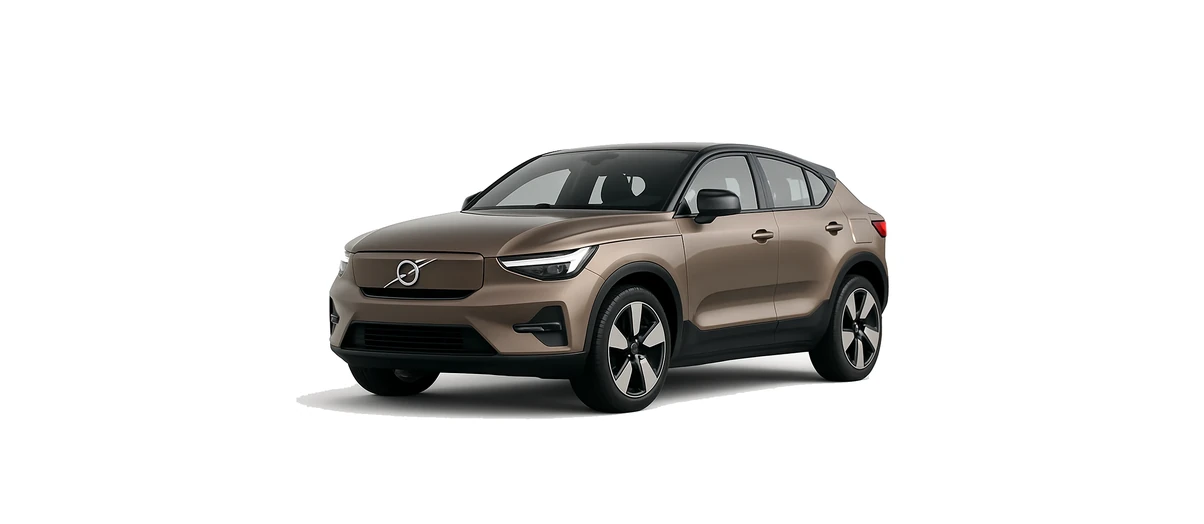
The Volvo EC40 is Volvo’s fully electric coupe-style crossover, previously known as the C40 Recharge before Volvo updated its electric naming structure. In current UK form it is a battery electric vehicle only, with no plug-in hybrid EC40 version. That makes charging simpler in one sense: the car uses a Type 2 connection for AC charging and CCS Combo 2 for DC rapid charging.
The important question for owners is not really whether the EC40 needs a special cable, but which EC40 you have. Current UK versions include the Single Motor, Single Motor Extended Range, Twin Motor and Twin Motor Performance. The entry Single Motor has a smaller 70 kWh nominal battery, while the Extended Range and Twin Motor models use an 82 kWh nominal battery. That affects range, charging time and what you should expect from home, workplace and rapid charging.
View Volvo EC40 Charging Cables
Volvo EC40 Battery and Charging Specifications
The Volvo EC40 uses a Type 2 inlet for AC charging and a CCS Combo 2 inlet for DC rapid charging. The charge port is positioned on the left rear side of the vehicle. For UK drivers, this means the EC40 is compatible with the standard public AC charging infrastructure used across the UK and Europe, and with CCS rapid and ultra-rapid chargers for longer journeys.
The onboard AC charger is rated at up to 11 kW on three-phase AC. However, many UK homes are single-phase, so a typical home wallbox will usually charge at up to 7.4 kW rather than the car’s full 11 kW AC capability. At public or workplace AC posts with three-phase supply, the EC40 can make use of up to 11 kW, provided the charger, cable and vehicle conditions allow it.
For DC rapid charging, the strongest figures apply mainly to the larger 82 kWh variants. Public data indicates DC peak charging of around 205-207 kW for those versions, with a typical 10-80% rapid charge time of about 28 minutes in suitable conditions. The 70 kWh Single Motor is commonly listed with a lower rapid-charging peak, and published charging times vary by source and model-year context, so it is best not to treat one DC figure as universal across all EC40 versions.
Battery Options
The current UK EC40 range is split between a 70 kWh nominal battery and an 82 kWh nominal battery. The Single Motor version uses the 70 kWh pack, with public data indicating around 67 kWh usable capacity. Volvo lists a WLTP combined range of up to about 300 miles for this version, depending on specification and conditions.
The Single Motor Extended Range, Twin Motor and Twin Motor Performance versions use the larger 82 kWh nominal pack, with public data indicating around 79 kWh usable capacity. The Single Motor Extended Range has the highest official WLTP figure in the current UK range, at up to 358.5 miles. The Twin Motor and Twin Motor Performance versions have lower WLTP figures, around the mid-330-mile range, because their dual-motor performance and drivetrain setup use more energy.
This difference matters when planning charging. A larger battery can cover more miles between charges, but it also takes longer to refill on AC if starting from a low state of charge. Two EC40s plugged into the same 7.4 kW home charger may therefore have noticeably different charging times if one has the 70 kWh battery and the other has the 82 kWh battery.
AC Charging Speed
The Volvo EC40’s maximum AC charging rate is 11 kW. This is a useful rating for three-phase charging at workplaces, destination chargers and some public AC posts. On an 11 kW three-phase supply, Volvo quotes approximately 7 hours for a 0-100% charge on the 70 kWh Single Motor and around 8 hours for the 82 kWh versions, although real-world charging time can vary.
At home in the UK, many drivers will be using a single-phase 7.4 kW wallbox. At this rate, a full charge from very low to 100% may take roughly 10-11 hours for the 70 kWh car and around 12-13 hours for the 82 kWh cars. In everyday use, most owners will not be charging from empty to full. Shorter overnight top-ups are usually enough to replace the miles used during the day.
For cable selection, a Type 2 to Type 2 cable is the key item for untethered home chargers and public AC posts. A 22 kW three-phase Type 2 cable will not make the EC40 charge faster than its 11 kW onboard AC limit, but it can still be a strong, future-proof choice for public charging and for use with other vehicles that may support higher AC rates.
DC Rapid Charging Speed
For longer journeys, the EC40 uses CCS rapid charging. DC rapid chargers have tethered cables, so you do not need to bring your own cable for CCS charging. You simply connect the charger’s CCS plug to the car.
The larger 82 kWh versions are commonly associated with a 10-80% rapid charge time of about 28 minutes when using a suitable high-power charger and when the battery is at the right temperature. The 70 kWh Single Motor has a smaller battery and may show different official or estimated figures depending on the source, charger power and model-year assumptions. In practice, treat rapid-charging times as a guide rather than a promise.
As with most EVs, charging beyond 80% on a rapid charger will usually slow down significantly. For motorway journeys, it is often quicker to arrive at a charger with a lower state of charge, charge to around 70-80%, and continue driving rather than waiting for the final 20%.
Range and Efficiency
The highest current UK WLTP range figure for the Volvo EC40 is up to 358.5 miles for the Single Motor Extended Range. This should not be applied to every EC40. The 70 kWh Single Motor is listed at up to about 300 miles WLTP, while the Twin Motor and Twin Motor Performance versions are lower than the Extended Range model despite having the same nominal battery size.
Real-world range will depend on temperature, speed, wheel size, driving style, elevation, load and use of heating or air conditioning. Independent public data suggests that the 82 kWh Single Motor Extended Range may achieve around 260 miles in mixed real-world conditions, while dual-motor versions may be slightly lower. In winter motorway driving, range can be lower again, as with most electric vehicles.
For daily ownership, it is useful to think in terms of usable range rather than the full WLTP number. If your commute is 40 miles per day, even the smaller-battery EC40 can often be kept comfortably topped up with regular home charging. For frequent long-distance driving, the Extended Range version gives the greatest margin between stops.
Charging at Home
A dedicated home wallbox is usually the most convenient way to charge a Volvo EC40. If your property has a typical single-phase domestic supply, you will normally be charging at up to 7.4 kW. This is slower than the car’s 11 kW AC capability, but still suitable for overnight charging in most routines.
If you have access to a three-phase supply, an 11 kW home or workplace charger may allow the EC40 to use its full AC charging rate. Three-phase domestic supplies are less common in the UK, so it is worth checking your electrical setup before assuming 11 kW home charging is available.
A 3-pin EV charger is generally best suited as a backup or occasional charging solution, but can be used regularly if a qualified electrician has confirmed the socket and electrical installation are suitable for sustained EV charging. Because the EC40 has a relatively large battery, a 3-pin connection will be slow compared with a dedicated wallbox, so it is better viewed as a fallback rather than the main charging method for most drivers.
Public Charging
For public AC charging, the Volvo EC40 uses a Type 2 to Type 2 cable. Many slower and destination-style posts are untethered, meaning you need to bring your own cable. These chargers are useful at car parks, hotels, leisure centres and workplaces where the car may be parked for several hours.
On a 7 kW public AC post, the EC40 will charge at broadly similar speeds to a typical home wallbox. On an 11 kW or 22 kW AC post, the car can charge at up to 11 kW, provided you are using a suitable cable. A 22 kW post does not mean the EC40 will charge at 22 kW, because the vehicle’s onboard AC charger sets the limit.
For motorway and A-road journeys, CCS rapid charging is the better option. Use route planning to choose chargers with enough power and allow for busy sites, broken units or weather-related reductions in charging speed. Where possible, arriving with a warm battery and a lower state of charge can help rapid charging performance.
Vehicle-Specific Features
The EC40 is built on Volvo’s CMA platform and was designed as a fully electric model. Current UK models include rear-wheel-drive Single Motor versions and all-wheel-drive Twin Motor versions. The car also includes Google built-in services, which are particularly useful for EV route planning.
Volvo support information indicates that when a fast charger is set as the destination in Google Maps, the car can precondition the battery before arrival. This helps prepare the battery for better rapid-charging performance. Battery temperature is one of the reasons two charging sessions at the same charger can produce different results.
Current public MY26 data indicates that heat pump equipment and battery preconditioning are present, although buyers of older C40 Recharge or earlier EC40 examples should check the exact model year and trim. Public data for current models does not indicate V2L, V2H or V2G support, so the EC40 should not be assumed to offer bidirectional power features.
Charging Tips
- Know your battery size: the 70 kWh Single Motor and 82 kWh EC40 versions have different charging expectations.
- Use Type 2 for AC charging: this is the cable you need for untethered home, workplace and public AC posts.
- Remember the 11 kW AC limit: a 22 kW cable or post will not override the car’s onboard charger.
- Use CCS for long trips: rapid chargers are tethered, so no separate DC cable is required.
- Aim for 10-80% on rapid chargers: this is usually the most time-efficient charging window.
- Route to a fast charger in Google Maps: where supported, this can trigger battery preconditioning before arrival.
- Allow for conditions: cold weather, high speed and heavy loads can reduce range and affect charging speed.
Frequently Asked Questions
What charging cable does the Volvo EC40 use?
The Volvo EC40 uses a Type 2 connection for AC charging. For untethered home wallboxes and public AC charging posts, you will normally use a Type 2 to Type 2 cable. For DC rapid charging, the EC40 uses CCS Combo 2, and the rapid charger provides the cable.
Can the Volvo EC40 charge at 22 kW AC?
No. The EC40’s onboard AC charging limit is 11 kW. It can be plugged into a 22 kW AC post with a suitable Type 2 cable, but the car will only draw up to its own AC limit.
How long does the Volvo EC40 take to charge at home?
On a typical UK 7.4 kW home wallbox, the 70 kWh Single Motor may take roughly 10-11 hours from very low to full, while 82 kWh versions may take around 12-13 hours. Everyday top-ups are usually much shorter.
Is the Volvo EC40 a plug-in hybrid?
No. In current UK form, the Volvo EC40 is a fully electric vehicle. It does not have a petrol or diesel engine and is not a plug-in hybrid.
Which EC40 has the longest range?
The current UK Single Motor Extended Range has the highest listed WLTP range, at up to 358.5 miles. Other EC40 versions have different range figures, so it is worth checking the exact powertrain.
What This Means for Drivers
The Volvo EC40 is straightforward to charge once you understand the difference between AC and DC charging. For daily use, a 7.4 kW home wallbox and a Type 2 cable will suit many UK owners. For faster AC charging at workplaces or three-phase public posts, the car can use up to 11 kW. For longer journeys, CCS rapid charging is the right tool, especially when used in the 10-80% range.
The main ownership point is to avoid treating all EC40 versions as identical. The smaller-battery Single Motor, larger-battery Extended Range and dual-motor versions differ in range and charging behaviour. If you plan around your exact model, typical journeys and home charging setup, the EC40 should be easy to integrate into daily driving.
Looking for a Charging Cable for Volvo EC40?
We provide Volvo EC40 charging cable options for home, workplace and public AC charging, including Type 2 cables suitable for the EC40’s 11 kW onboard AC charging capability.
View Volvo EC40 Charging Cables
Please note that this information is intended as a guide. Charging specifications may change due to model and year of manufacture. For precise information, always refer to your vehicle user manual.

