
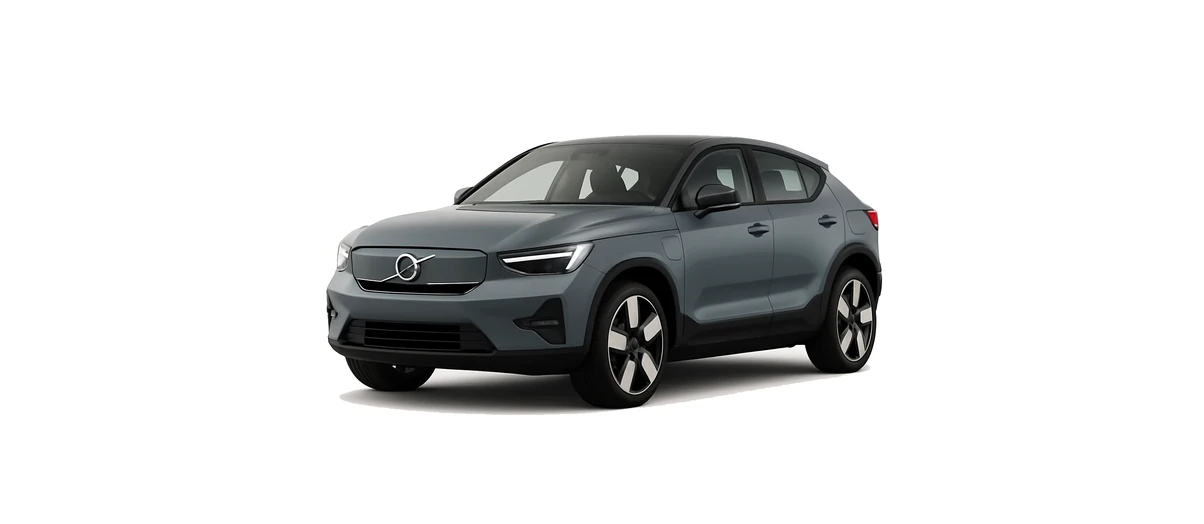
The Volvo C40 Recharge is a pure-electric coupé-SUV, closely related to the XC40 Recharge and later renamed EC40 in the UK in February 2024. That means most UK buyers looking at a C40 Recharge today are either existing owners or used-car shoppers comparing different model years.
For charging, the good news is simple: UK and European Volvo C40 Recharge models use a Type 2 connection for AC charging and CCS Combo 2 for DC rapid charging. The cable choice is therefore straightforward. The more important question is which version of the car you have, because early and later C40 Recharge models differ in battery size, driving range and rapid-charging capability.
View Volvo C40 Recharge Charging Cables
Volvo C40 Recharge Battery and Charging Specifications
The C40 Recharge is battery-electric only. Although Volvo also used the Recharge name on some plug-in hybrid models elsewhere in its range, the C40 Recharge itself is not a plug-in hybrid and does not use petrol or diesel power.
All UK-relevant C40 Recharge BEV versions use an 11 kW AC onboard charger with a Type 2 inlet. For rapid charging, the same charging port also accepts CCS Combo 2 DC charging. The maximum DC charging rate depends heavily on the battery and model year, so it is worth checking the exact version before setting expectations for motorway charging stops.
| Item | Volvo C40 Recharge detail |
|---|---|
| Vehicle type | Pure electric coupé-SUV / crossover |
| UK name status | C40 Recharge name discontinued; renamed EC40 in 2024 |
| AC charging connector | Type 2 |
| DC rapid charging connector | CCS Combo 2 |
| Maximum AC charging | 11 kW, where a suitable three-phase supply is available |
| Typical UK home charging | Usually up to 7.4 kW on a single-phase wallbox |
| Battery sizes | 69 kWh, 78 kWh or 82 kWh gross, depending on model year and variant |
| DC rapid charging | Typically around 136 kW on 69 kWh cars; up to around 200 kW on the MY24 Twin Motor |
Battery Options
Battery identification is the key used-buyer checkpoint for the Volvo C40 Recharge. The charging cable does not change, but range and rapid-charging performance do.
Early MY22 and MY23 Single Motor models used a 69 kWh gross battery, with EV Database UK listing around 67 kWh usable capacity. These earlier Single Motor cars were front-wheel drive. Early Twin Motor AWD cars used a larger 78 kWh gross battery, with around 75 kWh usable capacity often quoted in independent data.
For the MY24 update, Volvo changed the powertrain line-up. The UK Single Motor became rear-wheel drive and continued with a 69 kWh gross battery, listed by EV Database UK as around 66 kWh usable. The UK MY24 Twin Motor AWD moved to a larger 82 kWh gross battery, with Volvo UK and EV Database UK both referencing around 79 kWh usable capacity.
There was also an 82 kWh Single Motor Extended Range version in some European contexts, but Volvo UK stated at the MY24 launch that this powertrain was not available in the UK. If you are viewing a used import or a later EC40 rather than a UK-market C40 Recharge, check the registration details, VIN information and original specification rather than assuming it matches the usual UK line-up.
AC Charging Speed
The Volvo C40 Recharge has an 11 kW AC onboard charger. This is useful at some workplace, destination and three-phase home installations, but most UK homes have single-phase electricity. In practice, that means many UK owners will charge at up to 7.4 kW from a dedicated Type 2 home wallbox.
At 7.4 kW, a full 0-100% charge will typically take roughly 10.5 to 12.75 hours depending on battery size, charge losses, temperature and the starting state of charge. That makes overnight charging very practical for most drivers. On an 11 kW three-phase AC charger, a full charge can be quicker, roughly in the region of 7.25 to 8.5 hours depending on variant.
For most daily use, you will not regularly charge from empty to full. A more common routine is to plug in at home after work and add back the miles used during the day. Many owners set a charging schedule to take advantage of off-peak electricity tariffs, where available.
DC Rapid Charging Speed
DC rapid charging is where the biggest differences appear between C40 Recharge variants. The 69 kWh models are generally listed with a maximum DC rate of around 136 kW. That is fast enough for efficient long-distance travel, but it will not take full advantage of the very highest-power public chargers.
The updated MY24 Twin Motor AWD is the strongest rapid-charging version in the UK C40 Recharge range. Volvo UK stated that the 82 kWh Twin Motor can charge at up to about 200 kW and quoted a 10-80% time of 28 minutes on a suitable 200 kW DC rapid charger. EV Database UK lists a very similar peak power figure, around 207 kW, but estimates a longer typical 10-80% session of around 35 minutes. That difference is a useful reminder that a published peak speed is not the same as the speed you will see throughout the whole session.
On the road, plan rapid charging around 10-80% rather than 0-100%. Charging is usually fastest when the battery is warm and at a lower state of charge, then slows significantly as it approaches 80% and beyond. If you need to continue a long journey, it is often quicker to make two shorter rapid-charging stops than to wait for the final 20%.
Range and Efficiency
Official WLTP range figures vary by model year, wheel size, trim and powertrain. For the revised MY24 UK models, Volvo UK quoted up to around 297 miles WLTP for the Single Motor and up to 342 miles WLTP for the Twin Motor. Real-world range is usually lower than WLTP, especially in cold weather or at sustained motorway speeds.
As a broad guide, EV Database UK estimates around 220 miles of real-world range for the MY24 Single Motor and around 245 miles for the MY24 Twin Motor. Earlier cars may differ, so used buyers should avoid relying on a single headline figure from an advert. A 69 kWh early front-wheel-drive car, a 78 kWh early Twin Motor and an 82 kWh MY24 Twin Motor can all be described as a C40 Recharge, but they are not identical for charging and range planning.
Efficiency will also depend on temperature, route, tyres, driving style and use of heating or air conditioning. A heat pump was available on some trims or model years, but it should not be assumed to be fitted to every C40 Recharge. If winter efficiency is important to you, confirm the specification of the exact car.
Charging at Home
For UK home charging, a dedicated 7 kW Type 2 wallbox is the most practical everyday solution for most Volvo C40 Recharge owners. You can choose a tethered unit with a cable attached, or an untethered unit where you use your own Type 2 charging cable. The car can accept 11 kW AC, but unless your property has a suitable three-phase supply and compatible charger, a 7.4 kW single-phase wallbox is the realistic home limit.
A 32 amp Type 2 cable is a sensible match for an untethered home charger and public AC posts. If you regularly use 11 kW three-phase AC points, choose a three-phase Type 2 cable rather than a single-phase cable, as the cable can otherwise limit the charging speed.
A 3-pin charger is generally best suited as a backup or occasional charging solution, but can be used regularly if a qualified electrician has confirmed the socket and electrical installation are suitable for sustained EV charging. Standard domestic sockets were not designed with repeated high-load EV charging in mind, so professional inspection is important before relying on one for regular use.
Public Charging
Public AC charging uses the same Type 2 connection as home charging. Many public AC posts are untethered, so you will need your own Type 2 cable. These chargers are common in town centres, hotels, car parks, supermarkets and workplaces, and are useful when the car will be parked for several hours.
For motorway and A-road journeys, you will normally use DC rapid chargers. These are usually tethered, meaning the cable is attached to the charger. For the C40 Recharge, you plug the CCS connector into the lower part of the car’s combined charging port. You do not need to bring your own DC rapid-charging cable.
When planning a trip, choose chargers that suit your variant. A 69 kWh car with a maximum around 136 kW does not need an ultra-rapid 350 kW charger to reach its peak, although it can still use one if available and compatible. The MY24 Twin Motor can make better use of higher-power rapid chargers, but actual speed still depends on charger output, battery temperature, battery state of charge and site conditions.
Vehicle-Specific Features
The C40 Recharge uses Volvo’s CMA platform and shares much of its electric hardware context with the XC40 Recharge. It is not generally described as a dedicated EV-only platform, but the charging set-up is conventional and well matched to UK and European infrastructure.
Battery preconditioning is an important feature for rapid charging. Volvo support information indicates that using Google Maps route planning and setting a fast charger as the destination can allow the car to prepare the battery before arrival. This can help the car reach better charging speeds, particularly in colder conditions.
Vehicle-to-load, vehicle-to-grid and vehicle-to-home capability should not be assumed for the C40 Recharge. The data reviewed does not confirm these functions for UK C40 Recharge models, and independent listings mark V2L, V2G and V2H as not supported.
Charging Tips
- Check the exact model year. Early MY22/MY23 cars and updated MY24 cars can have different battery sizes and charging speeds.
- Do not rely only on the advert headline. Ask whether the car is a 69 kWh, 78 kWh or 82 kWh version.
- Use a Type 2 cable for AC charging. The C40 Recharge uses Type 2 for home, workplace and destination AC charging.
- Use CCS rapid chargers for long journeys. DC rapid chargers are normally tethered, so you do not need to carry a separate rapid-charging cable.
- Plan rapid stops from around 10-80%. Charging beyond 80% is usually much slower.
- Set the rapid charger as your navigation destination. This allows battery preconditioning to work where conditions and software support it.
- Choose the right cable rating. A three-phase Type 2 cable is useful if you want to access the car’s full 11 kW AC capability on compatible chargers.
Frequently Asked Questions
Is the Volvo C40 Recharge a plug-in hybrid?
No. The Volvo C40 Recharge is a pure battery-electric vehicle. The Recharge badge was used more widely by Volvo, including on some plug-in hybrids, but the C40 Recharge itself is BEV only.
What charging cable does the Volvo C40 Recharge use?
It uses a Type 2 cable for AC charging. For DC rapid charging, it uses the CCS Combo 2 connector, and public rapid chargers normally have the cable attached.
Can the Volvo C40 Recharge charge at 11 kW at home?
The car can accept up to 11 kW AC, but most UK homes are single-phase and normally charge at up to 7.4 kW from a suitable wallbox. 11 kW home charging usually requires a compatible three-phase supply and installation.
How long does it take to charge?
At a typical 7.4 kW UK home wallbox, a full charge is usually in the region of 10.5 to 12.75 hours depending on the battery version. On rapid charging, a 10-80% stop can be around half an hour in favourable conditions, but the exact time depends on variant, temperature, state of charge and charger output.
Do all Volvo C40 Recharge models have the 82 kWh battery?
No. Many UK C40 Recharge cars use a 69 kWh battery, and early Twin Motor cars used a 78 kWh gross battery. The 82 kWh battery is particularly associated with the updated MY24 Twin Motor AWD in the UK C40 Recharge range.
Does the C40 Recharge support vehicle-to-load or vehicle-to-grid?
V2L, V2G and V2H support should not be assumed. The reviewed data does not confirm these functions for UK C40 Recharge models.
What This Means for Drivers
The Volvo C40 Recharge is straightforward to cable for: it needs Type 2 for AC charging and uses CCS Combo 2 for rapid charging. For most UK owners, the ideal everyday set-up is a 7 kW home wallbox and a suitable Type 2 cable for untethered home or public AC charging.
The more important ownership point is identifying the exact version of the car. A used C40 Recharge could be an early 69 kWh Single Motor, an early 78 kWh Twin Motor, a later MY24 69 kWh rear-wheel-drive Single Motor or a later MY24 82 kWh Twin Motor. Those differences affect range and public rapid-charging expectations much more than they affect cable choice.
Looking for a Charging Cable for Volvo C40 Recharge?
If you need a Type 2 cable for home, workplace or public AC charging, choose a cable that matches how you charge: a 32 amp Type 2 cable for typical UK charging, or a three-phase Type 2 cable if you want to make use of compatible 11 kW AC charge points.
View Volvo C40 Recharge Charging Cables
Please note that this information is intended as a guide. Charging specifications may change due to model and year of manufacture. For precise information, always refer to your vehicle user manual.

