
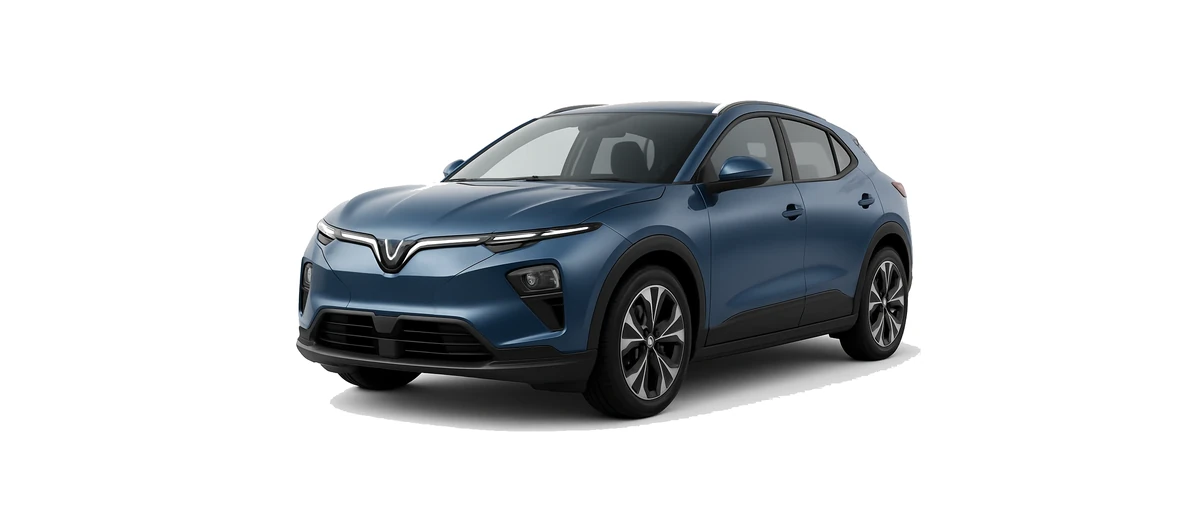
The Vinfast VF 6 is an all-electric compact SUV listed in Europe in Eco and Plus trims. It uses familiar European EV charging hardware: a Type 2 connection for AC charging and CCS Combo 2 for DC rapid charging. That means the VF 6 should be straightforward to charge on most UK and European public charging infrastructure, provided the vehicle itself is correctly specified for the market in which it is being used.
There is an important UK caveat. Current European information lists the VF 6 in selected European markets, while reliable UK trade reporting has stated that VinFast cancelled its UK launch plans. EV Database also lists the VF 6 as not available in the UK. For UK drivers, this guide should therefore be treated as an ownership and charging explainer for a Europe-market vehicle, particularly relevant to anyone considering an imported or used example. Before buying charging equipment, confirm the exact trim, charging port, and onboard AC charger specification of the individual car.
View Vinfast VF 6 Charging Cables
Vinfast VF 6 Battery and Charging Specifications
European data for the Vinfast VF 6 shows a pure battery-electric vehicle with no petrol engine, plug-in hybrid version or range extender. Both Eco and Plus versions are listed with the same usable battery capacity, while charging speed differs by specification.
| Vehicle | Vinfast VF 6 |
|---|---|
| Body style | Compact SUV / B-segment electric SUV |
| Battery | 59.6 kWh usable in European Eco and Plus data |
| AC charging connection | Type 2 |
| DC rapid charging connection | CCS Combo 2 |
| AC charging power | 7.4 kW or 11 kW depending on trim and onboard charger |
| DC rapid charging power | Up to 100 kW in EV Database data |
| Estimated 10-80% DC charging time | About 29 minutes on a suitable CCS charger |
Battery Options
For the current European VF 6 information available, the Eco and Plus trims are both listed with a 62.0 kWh nominal battery and a 59.6 kWh usable capacity. VinFast’s European page also lists 59.6 kWh battery capacity for the VF 6.
The Eco and Plus versions differ more in motor output, trim level, wheel specification and charging capability than in battery size. This is useful from a charging perspective because day-to-day energy requirements should be broadly similar between trims, although the Plus may use slightly more energy depending on driving style, wheel size, tyres, weather and road conditions.
As with any imported or non-UK-market EV, it is sensible to check the vehicle’s documents, infotainment charging settings and VIN-linked specification before relying on a generic figure. Market specifications can vary, and VinFast’s own European information notes that specification may differ by country.
AC Charging Speed
AC charging is where VF 6 buyers need to pay close attention. The European Type 2 port is straightforward, but the onboard charger specification is not necessarily the same for every version.
EV Database lists the VF 6 Eco with 7.4 kW AC charging as standard, with an optional 11.0 kW onboard charger shown in the detailed charging information. The VF 6 Plus is listed with 11 kW AC charging. Because UK retail availability is not confirmed, anyone buying or importing a VF 6 should verify the actual onboard charger fitted to that specific car.
In practical UK home charging terms, many households use a single-phase 7 kW wallbox. On such a charger, a VF 6 with a 7.4 kW onboard charger is already close to the typical home-charging limit. A car fitted with an 11 kW onboard charger will not charge at 11 kW from a normal single-phase 7 kW wallbox; it would need a compatible three-phase supply and an appropriate three-phase charge point.
For cable choice, a 32A single-phase Type 2 cable is suitable for common UK 7 kW charging. If the vehicle has the 11 kW onboard charger and the driver wants better compatibility with European or three-phase AC posts, a three-phase 11 kW or 22 kW-rated Type 2 cable may be the more flexible choice.
DC Rapid Charging Speed
For public rapid charging, the VF 6 uses the CCS Combo 2 standard in European data. EV Database lists a peak DC rapid charging rate of up to 100 kW and estimates a 10-80% charge time of about 29 minutes on a sufficiently powerful charger.
To make use of the VF 6’s peak DC capability, look for CCS rapid chargers rated at 100 kW or above. A higher-rated charger will not force the car to charge above its own limit; the car and charger communicate to set the safe charging rate. If you connect to a 150 kW or 350 kW charger, the VF 6 would still be expected to charge within its own maximum capability.
Real charging speeds vary. Battery temperature, state of charge, charger load, weather, software, and battery protection limits can all affect the speed you see at the charger. As with most EVs, the fastest charging is usually achieved at lower states of charge, and the rate normally tapers as the battery fills, especially beyond around 80%.
Range and Efficiency
Current VinFast European information lists WLTP estimated range at up to 410 km for the VF 6 Eco and 379 km for the VF 6 Plus. In miles, that is approximately 255 miles for the Eco and around 235 miles for the Plus. These figures are laboratory-based WLTP estimates and are useful for comparing vehicles, but they should not be treated as a guaranteed everyday range.
EV Database estimates real-world range at around 315 km, or about 196 miles, for the Eco, and around 310 km, or about 193 miles, for the Plus. Real-world range will depend on speed, outside temperature, elevation, load, tyre choice and how much motorway driving you do.
For UK use, drivers should expect better efficiency in mild weather and urban or mixed driving, and lower efficiency during winter motorway journeys. Planning long trips around realistic range, rather than the highest WLTP number, will make charging stops easier and less stressful.
Charging at Home
For most EV owners, home charging is the cheapest and most convenient way to run the car. If you have off-street parking, a dedicated 7 kW home wallbox will usually be the best fit for a VF 6 in the UK. It provides faster, safer and more convenient charging than a domestic socket, and it can often be paired with an off-peak electricity tariff.
Using the 59.6 kWh usable battery figure as a guide, a full charge from empty to 100% on a 7 kW wallbox would take roughly nine hours in ideal conditions. In real use, most drivers will not charge from completely empty. A typical overnight top-up from 20% to 80% should be comfortably achievable on a home wallbox.
A 3-pin charger is generally best suited as a backup or occasional charging solution, but can be used regularly if a qualified electrician has confirmed the socket and electrical installation are suitable for sustained EV charging. Domestic sockets were not primarily designed for repeated high-load EV charging over many hours, so professional checks are important.
If your VF 6 is fitted with an 11 kW onboard charger and you have access to a three-phase supply, an 11 kW AC wallbox could reduce charging times. However, three-phase domestic supplies are uncommon in many UK homes, so most UK drivers should plan around 7 kW home charging unless their property and vehicle specification support more.
Public Charging
On public AC charge points, the VF 6 will use a Type 2 cable. Many UK destination chargers, workplace chargers and kerbside posts require you to bring your own cable, so keeping the correct Type 2 cable in the car is important.
For rapid and ultra-rapid charging, CCS chargers usually have a tethered cable attached to the charger, so you do not normally need to provide your own DC cable. You simply connect the CCS plug to the car and start the session using the network’s app, contactless payment, RFID card or plug-and-charge method where supported by the operator.
For longer journeys, it is worth choosing rapid chargers with a rating of at least 100 kW where possible. This gives the VF 6 the opportunity to reach its stated peak charging rate, although actual speed will depend on the conditions at the time. For the quickest stop, arrive with a lower state of charge and avoid waiting for the last 10-20% unless you need it to reach your destination.
Vehicle-Specific Features
The VF 6 is listed as being developed on a dedicated EV-only platform, with European data showing a 400 V electrical architecture. From a charging point of view, the most important practical feature is its use of the Type 2 and CCS Combo 2 standards, which are widely supported across the UK and Europe.
Some features that buyers may expect on newer EVs should not be assumed. EV Database lists the VF 6 without heat pump availability, and does not list vehicle-to-load, vehicle-to-home or vehicle-to-grid support. If these functions matter to you, check the exact market specification before purchase rather than relying on assumptions from other VinFast models or other markets.
The main VF 6-specific charging point is the trim-dependent AC charging speed. Do not assume every VF 6 has 11 kW AC charging. The Eco and Plus specifications differ, and optional equipment may affect what the vehicle can actually accept.
Charging Tips
- Confirm the car’s specification first: UK availability is uncertain, so check the exact imported or used vehicle specification before buying a cable or wallbox.
- Choose the right Type 2 cable: A 32A single-phase Type 2 cable suits typical UK 7 kW charging, while a three-phase cable gives better compatibility if the car and charger support 11 kW AC.
- Use CCS for long-distance charging: For motorway trips, look for CCS rapid chargers rated at 100 kW or above.
- Do not chase 100% on rapid chargers: Charging usually slows at higher battery percentages, so 10-80% is often the most efficient rapid-charging window.
- Plan winter journeys conservatively: Cold weather, rain, headwinds and motorway speeds can reduce range noticeably.
- Keep a cable in the car: Many public AC posts are untethered, especially at workplaces, hotels, car parks and residential charging locations.
Frequently Asked Questions
Is the Vinfast VF 6 sold in the UK?
Current information should be treated with caution. European pages list the VF 6 in selected markets, but EV Database lists it as not available in the UK, and Fleet News reported that VinFast cancelled its UK launch plans. This guide is therefore framed for Europe-market vehicles and possible imports rather than a confirmed UK retail model.
What charging cable does the Vinfast VF 6 use?
The European VF 6 uses a Type 2 connection for AC charging. For UK home and public AC charging, a Type 2 to Type 2 cable is the relevant cable type. CCS rapid chargers use a tethered DC cable at the charger.
Does every Vinfast VF 6 charge at 11 kW AC?
No. Available European data suggests the VF 6 Plus is listed with 11 kW AC charging, while the Eco is listed with 7.4 kW as standard and 11 kW as an option. Check the exact vehicle before assuming 11 kW capability.
How fast can the Vinfast VF 6 rapid charge?
EV Database lists a peak DC rapid charging rate of up to 100 kW, with an estimated 10-80% time of about 29 minutes on a suitable CCS charger. Actual charging speed will vary with battery state of charge, temperature and charger conditions.
Is a 7 kW home charger enough for the Vinfast VF 6?
For many UK drivers, yes. A 7 kW home wallbox is likely to be the practical limit for many homes and should allow convenient overnight charging. An 11 kW charger only helps if the vehicle has the 11 kW onboard charger and the property has a compatible three-phase electrical supply.
What This Means for Drivers
The Vinfast VF 6 should be simple to charge from a hardware perspective because it uses the European Type 2 and CCS standards. For everyday UK use, a 7 kW home wallbox and a suitable Type 2 cable would cover most charging needs, while CCS rapid charging at up to 100 kW supports longer trips.
The key issue is not the plug type; it is specification certainty. UK availability is not confirmed, and the VF 6 should not be treated as a normal UK-market model without checking the individual vehicle. Before choosing a cable, confirm whether the car is an Eco or Plus, whether it has the 7.4 kW or 11 kW onboard AC charger, and whether you need single-phase or three-phase charging compatibility.
Looking for a Charging Cable for Vinfast VF 6?
If you are running a Vinfast VF 6 in the UK or bringing in a Europe-market car, We offer compatible Type 2 charging cable options to suit home, workplace and public AC charging, with cable choice depending on your vehicle’s onboard charger and the charge points you expect to use.
View Vinfast VF 6 Charging Cables
Please note that this information is intended as a guide. Charging specifications may change due to model and year of manufacture. For precise information, always refer to your vehicle user manual.

