
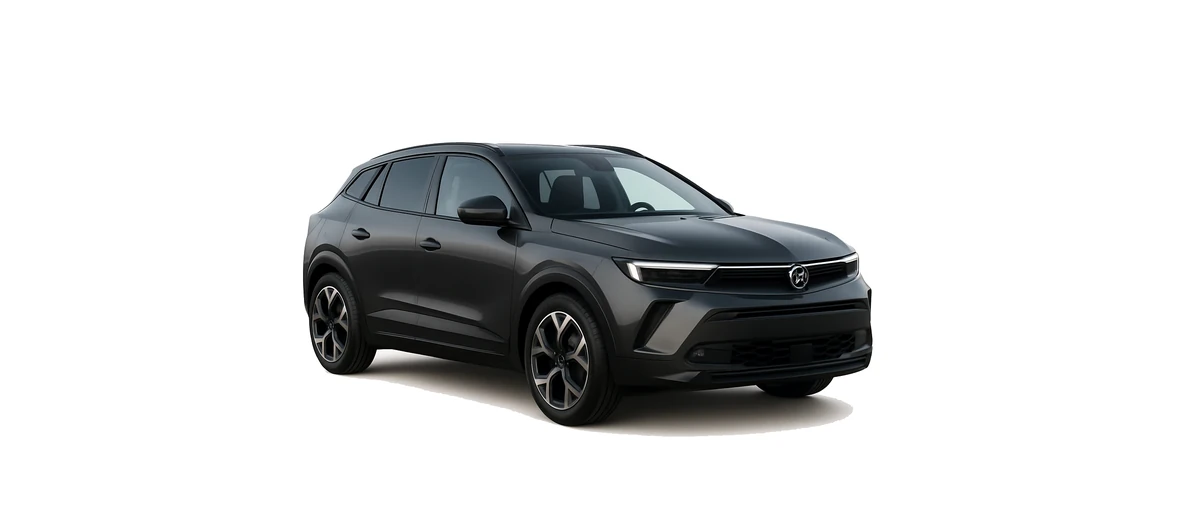
The Vauxhall Grandland Electric is the battery-electric version of Vauxhall’s family SUV, built for drivers who want a practical everyday electric car with the space and driving position of a larger crossover. It is important to be precise with the name, because the wider Grandland range also includes hybrid and plug-in hybrid models. This guide focuses on the full battery-electric Grandland Electric, not the older Grandland X Plug-in Hybrid or the current Grandland Plug-in Hybrid.
For UK drivers, the key charging points are straightforward: the current 73kWh Grandland Electric uses a Type 2 connection for AC charging and a CCS Combo 2 connection for DC rapid charging. It can charge at up to 11kW on AC where the supply supports it, and up to 160kW on a compatible DC rapid charger. Most UK home charging will be at around 7kW to 7.4kW because most homes are single-phase, while some workplaces and public AC chargers may allow the car to use its full 11kW AC capability.
View Vauxhall Grandland Electric Charging Cables
Vauxhall Grandland Electric Battery and Charging Specifications
The current UK Grandland Electric data centres on 73kWh versions, including a single-motor front-wheel-drive model and an all-wheel-drive model. Both use a Type 2 inlet for AC charging and CCS Combo 2 for rapid charging. Vauxhall price-guide information lists an 11kW on-board charger, while independent data from EV Database also supports 11kW AC charging and up to 160kW DC rapid charging for the 73kWh models.
| Specification | Vauxhall Grandland Electric 73kWh |
|---|---|
| Vehicle type | Battery-electric SUV |
| Charging port | Type 2 / CCS Combo 2 |
| AC charging | Up to 11kW |
| Typical UK home charging | Around 7kW to 7.4kW on many single-phase wallboxes |
| DC rapid charging | Up to 160kW |
| Official DC charge window | 20-80% quoted at around 30 minutes in Vauxhall price-guide data |
| Typical rapid estimate | 10-80% in about 36 minutes according to EV Database |
| Heat pump | Listed as standard in the available data |
Battery Options
At the time covered by the available UK data, the confirmed Grandland Electric models use a 73kWh battery. EV Database estimates the nominal capacity at 77kWh and usable capacity at 73kWh, while Vauxhall price-guide material refers to 73kWh battery capacity. This is the figure most UK owners and buyers are likely to encounter for current front-wheel-drive and all-wheel-drive versions.
The single-motor front-wheel-drive 73kWh Grandland Electric is the main version associated with the headline WLTP figure of up to 323 miles in Vauxhall price-guide snippets. The 73kWh AWD model adds a rear motor and is quoted at a lower range, with figures around 306 to 311 miles depending on source and date. The AWD version is also notable as Vauxhall’s first fully electric all-wheel-drive model.
Vauxhall has also referenced a longer-range Grandland Electric model coming in 2026, with public messaging mentioning up to 425 miles. Earlier Stellantis material referred to the STLA Medium platform allowing a 98kWh battery and up to 435 miles. Until that version is confirmed in the current UK price guide or configurator, it should be treated separately from the present 73kWh models. If you are choosing a charging cable, the charging connector is still expected to be Type 2 / CCS for UK use, but range, charge times and detailed specification should be checked against the exact car.
AC Charging Speed
AC charging is the type of charging used at home wallboxes, many workplace charge points and many destination chargers. The Vauxhall Grandland Electric’s 11kW on-board charger means it can take advantage of faster three-phase AC charging where available. However, most UK homes have single-phase electricity, so a typical home wallbox is more likely to deliver around 7kW or 7.4kW rather than the car’s full 11kW AC capability.
Vauxhall price-guide data quotes 20-80% AC charging times of approximately 6 hours 45 minutes from a 7kW wallbox and around 4 hours 30 minutes from an 11kW three-phase supply. EV Database estimates a full 0-100% charge at about 8 hours on 11kW AC and around 11 hours 45 minutes on a typical 7.4kW single-phase wallbox. Real charging times vary with battery temperature, starting state of charge, charger output, and whether the charger is sharing power with other vehicles or household loads.
For daily use, AC charging is usually the most convenient and cost-effective option. Many owners will plug in overnight or during cheaper tariff periods, then start the next day with enough charge for commuting, school runs and local journeys.
DC Rapid Charging Speed
For longer journeys, the Grandland Electric uses the CCS part of its charging port for DC rapid charging. Current data gives a peak DC charging rate of up to 160kW. Vauxhall’s own price-guide data quotes a 20-80% rapid charge in around 30 minutes, while EV Database estimates a typical 10-80% session at about 36 minutes. These figures are not directly contradictory because they use different charge windows and assumptions.
As with most electric cars, the fastest charging usually happens when the battery is relatively low and in a suitable temperature range. Charging speed then tapers as the battery fills, especially above roughly 80%. For motorway travel, it is usually quicker to stop for shorter sessions between about 10% and 80% than to wait for the final 20% unless you specifically need the extra range to reach your destination.
Range and Efficiency
The current 73kWh front-wheel-drive Grandland Electric is listed at up to 323 miles WLTP in Vauxhall price-guide snippets. The all-wheel-drive version is quoted lower, around 306 to 311 miles depending on source and exact test reference. WLTP figures are useful for comparing vehicles, but they are not a guarantee of what every driver will see in UK use.
EV Database estimates real-world range at around 225 miles for the 73kWh front-wheel-drive model and around 220 miles for the AWD model. Your own range can be higher or lower depending on speed, weather, wheel and tyre specification, load, terrain and cabin heating use. Motorway driving in winter is usually more demanding than urban driving in mild weather.
The Grandland Electric is listed with a heat pump as standard, which can help reduce the energy demand of cabin heating in cooler conditions. Even so, good EV habits still matter: pre-set the cabin temperature while plugged in where possible, keep tyres correctly inflated, and avoid carrying unnecessary weight.
Charging at Home
For most UK owners, a dedicated Type 2 home wallbox is the best day-to-day charging solution. It is convenient, safer and faster than relying on a domestic socket, and it allows you to schedule charging around off-peak electricity tariffs if your charger, vehicle or energy supplier supports this.
On a typical single-phase UK home supply, expect the Grandland Electric to charge at around 7kW to 7.4kW from a suitable wallbox. This is below the car’s 11kW AC maximum, but it is still more than adequate for overnight charging in most routines. If your property has three-phase power and a compatible 11kW charger, the Grandland Electric can make use of the higher AC rate.
A 3-pin charger is generally best suited as a backup or occasional charging solution, but can be used regularly if a qualified electrician has confirmed the socket and electrical installation are suitable for sustained EV charging. Vauxhall price-guide data quotes a 20-80% charge from a 2.3kW domestic socket at around 22 hours 55 minutes, so it is much slower than a wallbox and should be approached with care.
Public Charging
Public charging for the Grandland Electric falls into two main categories: AC destination charging and DC rapid charging. AC destination chargers are common at hotels, car parks, workplaces, gyms and shopping locations. These usually use a Type 2 socket, so you will often need your own Type 2 charging cable. If the post is single-phase, charging may be around 7kW; if it is three-phase and supports 11kW or more, the Grandland Electric can use up to 11kW.
DC rapid chargers are more common on motorways and major routes. These chargers almost always have a tethered CCS cable attached, so you do not normally use your own cable for rapid charging. For road trips, plan charging stops using live charger availability and consider arriving with a lower state of charge to access faster charging speeds. If you are travelling in cold weather or with a full car, allow a sensible range buffer.
Vehicle-Specific Features
The Grandland Electric is based on the Stellantis STLA Medium platform and is listed by EV Database as using a 400V architecture. Current 73kWh versions use the familiar European Type 2 / CCS Combo 2 charging arrangement, making them compatible with the UK’s standard home, destination and rapid charging infrastructure.
Battery preconditioning is not listed as available in the research data used for this guide, so drivers should not assume the car will automatically prepare the battery for the fastest possible rapid charging session in the same way some other EVs do. Rapid charging performance can therefore be more dependent on recent driving, outside temperature and battery condition.
Vehicle-to-grid and vehicle-to-home support should not be assumed for the Grandland Electric. The available independent data does not list V2G or V2H support for the 73kWh models. If this feature is important to you, check the latest Vauxhall UK specification for the exact trim and model year before ordering.
Charging Tips
- Choose the right cable: For UK AC charging, the Grandland Electric uses a Type 2 cable. A 32A cable is a sensible choice for home and public AC use.
- Know your electricity supply: Most UK homes are single-phase, so even though the car can accept 11kW AC, many home installations will charge at around 7kW to 7.4kW.
- Use three-phase AC where available: At compatible workplaces or public chargers, the Grandland Electric can use up to 11kW AC.
- Rapid charge in the efficient window: On long trips, plan around roughly 10-80% rather than waiting for 100% at a rapid charger.
- Separate the versions: Do not mix up the current 73kWh Grandland Electric with the announced long-range model or plug-in hybrid Grandland variants.
- Check the exact car: Range and charging details can vary by model year, drivetrain, trim, wheel size and software updates.
Frequently Asked Questions
What charging cable does the Vauxhall Grandland Electric use?
For AC charging, the Vauxhall Grandland Electric uses a Type 2 connection. For DC rapid charging, it uses CCS Combo 2. Most rapid chargers have their own tethered CCS cable, while many AC public charge points require you to bring your own Type 2 cable.
Can the Grandland Electric charge at 22kW AC?
The car’s on-board AC charger is listed at up to 11kW. Even if you connect to a 22kW AC post, the car will usually be limited by its own 11kW AC capability.
How long does home charging take?
Vauxhall data quotes around 6 hours 45 minutes for a 20-80% charge from a 7kW wallbox. A full charge from low to 100% will take longer, with EV Database estimating around 11 hours 45 minutes on a typical 7.4kW single-phase home charger.
How fast is rapid charging?
The 73kWh Grandland Electric supports up to 160kW DC charging. Vauxhall quotes around 30 minutes for 20-80% in the available price-guide data, while EV Database estimates about 36 minutes for 10-80%.
Is the 425-mile Grandland Electric the same as the current 73kWh model?
No. The 425-mile long-range version has been referenced by Vauxhall as a model coming in 2026. Current 73kWh UK figures are lower, with up to 323 miles WLTP for the front-wheel-drive version in the available data.
What This Means for Drivers
The Vauxhall Grandland Electric should be straightforward to live with if you match your charging setup to the version you own. For the current 73kWh models, a Type 2 home wallbox will cover most everyday needs, while the 160kW CCS capability makes longer journeys practical when you plan rapid charging stops sensibly. The most important point is to avoid confusing the full electric Grandland with hybrid or plug-in hybrid versions, and to treat the upcoming long-range model as a separate specification until it is fully confirmed in current UK ordering data.
Looking for a Charging Cable for Vauxhall Grandland Electric?
We offer Type 2 charging cables suitable for AC home, workplace and public charging, helping Vauxhall Grandland Electric drivers choose a cable that matches UK charging infrastructure and the car’s charging capability.
View Vauxhall Grandland Electric Charging Cables
Please note that this information is intended as a guide. Charging specifications may change due to model and year of manufacture. For precise information, always refer to your vehicle user manual.

