
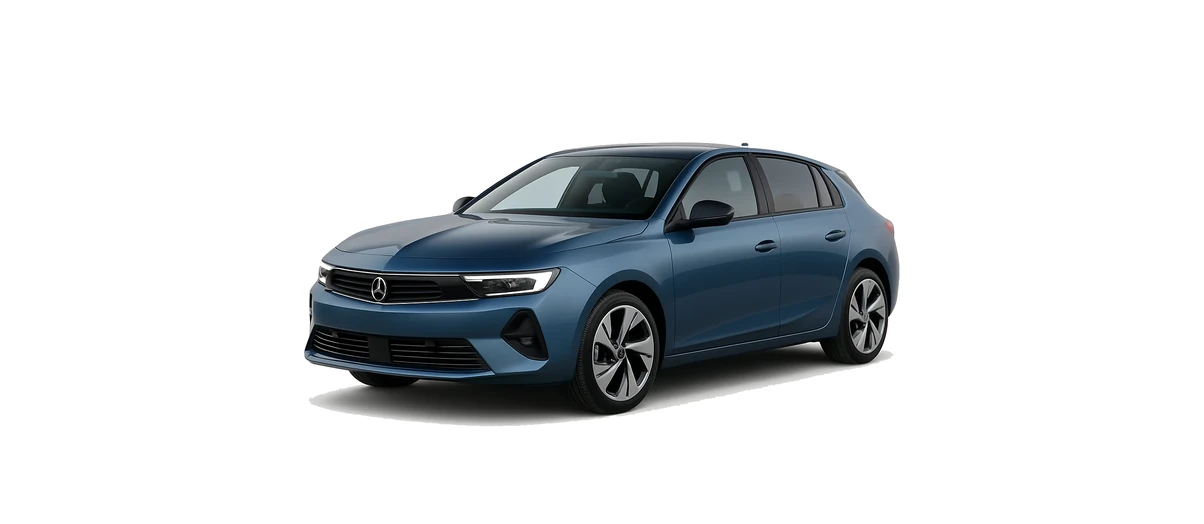
The Vauxhall Astra E name can be slightly confusing in the UK because Vauxhall originally previewed the full-electric Astra as the Astra-e, while current retail and press material generally uses the name Astra Electric. There is also an Astra Plug-in Hybrid, which is a different petrol-electric model with different charging habits and a much smaller battery. This guide focuses on the full-electric Vauxhall Astra E / Astra Electric battery-electric vehicle.
For cable selection, the key point is straightforward: both the earlier 54kWh Astra Electric and the newer MY26 58.3kWh Astra Electric use a Type 2 connection for AC charging and CCS Combo 2 for DC rapid charging. The model-year differences matter more for range, battery size and features such as vehicle-to-load and battery preconditioning, so it is worth checking whether you have an MY23-25 car or the refreshed MY26 model.
View Vauxhall Astra E Charging Cables
Vauxhall Astra E Battery and Charging Specifications
The Vauxhall Astra Electric is a battery-electric version of the Astra family, offered as a 5-door hatchback, with the Sports Tourer estate also offered for the current Astra Electric. It uses the Stellantis EMP2 platform rather than a dedicated EV-only platform.
UK specifications have changed over time. The earlier MY23-25 Astra Electric used a 54kWh gross battery, while the refreshed MY26 Astra Electric uses a larger 58.3kWh gross battery. Both use the same broad charging layout: Type 2 AC charging for home and public slow/fast charging, plus CCS DC rapid charging for longer journeys.
- AC charging port: Type 2
- DC rapid charging port: CCS Combo 2
- On-board AC charger: 11kW
- DC rapid charging capability: up to around 100kW
- Typical UK home wallbox power: around 7.4kW on a single-phase supply
Battery Options
The battery fitted depends on the model year. If you are buying a used Astra Electric or choosing a cable for an existing car, it is worth confirming which version you have from the registration date, handbook, vehicle documents or infotainment/charging information.
MY26 Astra Electric hatchback and Sports Tourer Electric: Vauxhall states that the refreshed model uses a 58.3kWh gross battery, with 55.4kWh net/usable capacity. The hatchback is quoted at up to 281 miles WLTP, while the Sports Tourer Electric is quoted at up to 276 miles WLTP. These figures are useful for comparison, but real-world range will vary with speed, temperature, road conditions and load.
MY23-25 Astra Electric hatchback: the earlier version used a 54kWh gross battery, with EV Database listing around 50.8kWh usable capacity. Vauxhall quoted up to around 258 miles WLTP, while EV Database lists WLTP figures around 260 miles depending on test conditions. This earlier car still uses Type 2 AC and CCS DC charging, but some of the newer MY26 feature claims should not automatically be applied to it.
AC Charging Speed
The Astra Electric has an 11kW on-board AC charger. This is useful because it means the car can make use of three-phase AC charging where available. However, most UK homes have a single-phase electrical supply, so a typical home wallbox will usually deliver up to around 7.4kW, even though the car itself can accept more on AC.
For the current MY26 58.3kWh model, Vauxhall quotes a 20-80% charge in around 3 hours 20 minutes from an 11kW AC charger, or around 5 hours from a normal 7.4kW home charger. EV Database estimates a full 0-100% AC charge at roughly 6 hours on 11kW three-phase and around 9 hours on 7.4kW single-phase. These are guide figures, as charging time depends on the starting percentage, temperature and charging equipment.
For the earlier 54kWh Astra Electric, Vauxhall quoted around 8 hours on a 7kW charger and about 5 hours 45 minutes on 11kW AC. Again, these are best treated as practical estimates rather than fixed guarantees.
DC Rapid Charging Speed
For longer journeys, the Astra Electric uses the CCS connector on public rapid and ultra-rapid chargers. The vehicle’s DC charging limit is around 100kW. This means you can plug into a 150kW or 350kW public charger if it has the correct CCS connector, but the car will not charge above its own maximum rate.
For the MY26 model, Vauxhall quotes a 20-80% DC charge in about 32 minutes, while EV Database estimates around 33 minutes for 10-80% on a suitable charger. The earlier 54kWh Astra Electric was also quoted with 100kW rapid charging, with Vauxhall referring to a 10-80% charge time of around 30 minutes.
As with most electric cars, charging is fastest at lower and mid battery percentages. Once the battery passes roughly 80%, the car will usually reduce charging speed to protect the battery. On a long journey, it is normally quicker to make a shorter stop from around 10-80% than to wait for 100% unless you specifically need the extra range.
Range and Efficiency
The official WLTP range for the Astra Electric depends on body style and model year. The current MY26 hatchback is quoted at up to 281 miles WLTP, while the Sports Tourer Electric is quoted at up to 276 miles WLTP. The earlier MY23-25 Astra Electric hatchback was quoted at around 258-260 miles WLTP.
Real-world range is usually lower than the official figure, especially in cold weather or at motorway speeds. EV Database lists the MY26 58kWh Astra Electric with an estimated real-world range of around 210 miles. That should be seen as a practical benchmark rather than a promise, because your own results will depend on driving style, outside temperature, tyre condition, cabin heating use and route profile.
For daily commuting and local use, many owners will not need to charge every day. For motorway journeys, it is sensible to plan around realistic range rather than the highest WLTP figure, especially in winter or when travelling with passengers and luggage.
Charging at Home
For most UK Astra Electric drivers, home charging is the most convenient and cost-effective option. A dedicated 7.4kW Type 2 wallbox is the usual choice for a single-phase UK home. You can choose either a tethered unit, where the cable is permanently attached, or an untethered unit, where you use your own Type 2 to Type 2 charging cable.
If you use an untethered wallbox, you will need a Type 2 charging cable. Because the Astra Electric has an 11kW on-board charger, a three-phase 11kW-capable Type 2 cable can be useful if you regularly use compatible three-phase public AC chargers. For home use on a normal single-phase wallbox, charging will generally be limited to around 7.4kW.
A 3-pin domestic charging lead can be useful in some situations, but it is much slower than a wallbox. A 3-pin charger is generally best suited as a backup or occasional charging solution, but can be used regularly if a qualified electrician has confirmed the socket and electrical installation are suitable for sustained EV charging.
Public Charging
Public charging falls into two main categories: AC destination charging and DC rapid charging. For AC public posts, such as those found in car parks, hotels, workplaces and town centres, you normally use your own Type 2 to Type 2 cable. The Astra Electric can accept up to 11kW AC, so it can benefit from an 11kW three-phase post. If you plug into a 22kW AC post, the car will still be limited by its on-board charger to 11kW.
For rapid charging, you use a CCS charger. These rapid and ultra-rapid chargers have a tethered cable attached to the unit, so you do not use your own Type 2 cable. The Astra Electric’s limit is around 100kW DC, so choosing a charger rated at 100kW or above is usually sufficient to access the car’s peak rate, assuming the charger, battery temperature and state of charge allow it.
Current Astra Electric information also indicates Plug & Charge support for the MY26 model according to EV Database, while the earlier MY23-25 car is listed as not supporting it. If this feature matters to you, check the exact model year and charging network compatibility.
Vehicle-Specific Features
The MY26 Astra Electric has several useful EV-specific features, but it is important not to assume every feature applies to every Astra Electric on the used market.
- Heat pump: EV Database lists a heat pump as standard for the Astra Electric. A heat pump can help reduce energy use for cabin heating compared with less efficient heating systems, particularly in cooler weather.
- Battery preconditioning: Vauxhall press information lists battery preconditioning as standard for the MY26 Astra Electric. This can help the battery reach a more suitable temperature before rapid charging, improving charging consistency in some conditions.
- Vehicle-to-load: V2L is listed as standard on the MY26 Astra Electric, allowing the car to power certain external electrical devices where supported and with suitable equipment.
- V2G and V2H: vehicle-to-grid and vehicle-to-home capability should not be assumed. EV Database lists V2G and V2H as not supported for the MY26 Astra Electric.
If you own an MY23-25 Astra Electric, be cautious with feature claims made for the refreshed MY26 model. Battery size, range and some software or charging-related functions may differ.
Charging Tips
- Choose Type 2 for AC charging: the Astra Electric uses Type 2 for home wallboxes and public AC posts.
- Use CCS for rapid charging: motorway and long-distance charging will generally be through tethered CCS rapid chargers.
- Do not chase unnecessary charger power: a 150kW or 350kW charger will not make the Astra Electric charge above around 100kW.
- Plan rapid stops around 10-80%: this is usually the most time-efficient part of the charging curve.
- Check your model year: MY23-25 and MY26 cars have different battery sizes and range figures.
- Use scheduled charging where possible: if your tariff offers cheaper overnight electricity, scheduled home charging can reduce running costs.
- Allow more margin in winter: cold weather, wet roads and motorway speeds can reduce practical range.
Frequently Asked Questions
What charging cable does the Vauxhall Astra E use?
The Vauxhall Astra E / Astra Electric uses a Type 2 cable for AC charging. For DC rapid charging, it uses the CCS Combo 2 connector, with the cable attached to the rapid charger.
Is the Vauxhall Astra E the same as the Astra Plug-in Hybrid?
No. The Astra Electric is a full battery-electric vehicle. The Astra Plug-in Hybrid is a separate petrol-electric plug-in model with a smaller battery and different charging behaviour. Always confirm which Astra version you have before choosing charging accessories or comparing range figures.
Can the Astra Electric charge at 22kW AC?
No, not at the full 22kW. The Astra Electric has an 11kW on-board AC charger. It can plug into a 22kW AC post, but charging will be limited by the car to around 11kW.
How fast can the Astra Electric rapid charge?
The Astra Electric can rapid charge at up to around 100kW DC. The MY26 model is quoted at roughly 32-33 minutes for a typical rapid-charge session in the 20-80% or 10-80% region, depending on the source and test basis.
Do I need a three-phase cable?
For normal UK home charging, a single-phase 7.4kW setup is common. However, because the car can accept 11kW AC, a three-phase Type 2 cable may be useful if you often use 11kW or 22kW public AC posts and want the car to access its full AC capability.
What This Means for Drivers
The Vauxhall Astra E / Astra Electric is relatively simple from a charging-cable point of view: use Type 2 for AC charging and CCS for rapid charging. The main detail is model-year awareness. Earlier MY23-25 cars have the 54kWh battery and lower quoted range, while the MY26 model has a larger 58.3kWh gross battery, revised range figures and additional features such as standard V2L and battery preconditioning according to Vauxhall information.
For most UK drivers, a 7.4kW home wallbox and a good Type 2 cable will cover day-to-day charging. On longer journeys, plan CCS rapid-charging stops around the most efficient part of the battery window and remember that the car’s peak DC rate is around 100kW, regardless of whether the charger itself is rated higher.
Looking for a Charging Cable for Vauxhall Astra E?
We offer charging cables for the Vauxhall Astra E / Astra Electric, including Type 2 options for home wallboxes and public AC charging.
View Vauxhall Astra E Charging Cables
Please note that this information is intended as a guide. Charging specifications may change due to model and year of manufacture. For precise information, always refer to your vehicle user manual.

