
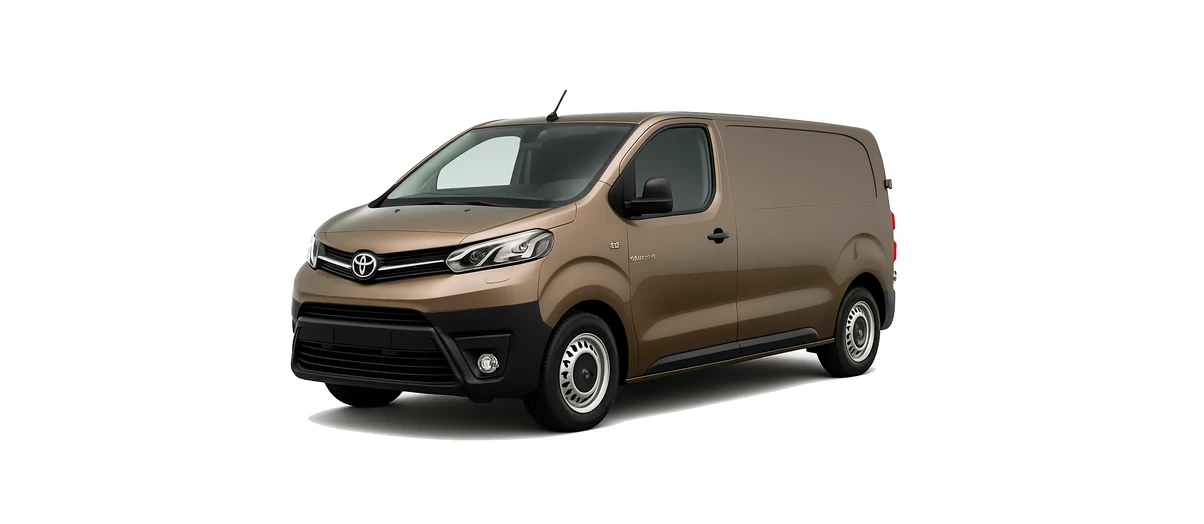
The Toyota Proace Electric, also referred to in current material as the Proace EV, is the battery-electric version of Toyota’s medium van. This guide is for the electric Proace only, not the diesel Proace, the smaller Proace City, or the Proace Verso people carrier.
For UK drivers and fleet operators, the most important charging point is that not every Proace Electric has the same battery or AC charging capability. Current Toyota UK information lists 50 kWh and 75 kWh battery options, while AC charging can depend on whether the van has a 7 kW/7.4 kW or 11 kW onboard charger. That matters when choosing a cable, planning depot charging or estimating overnight turnaround time.
View Toyota Proace Electric / Proace EV Charging Cables
Toyota Proace Electric / Proace EV Battery and Charging Specifications
The Proace Electric is a battery-electric van with a front-mounted 100 kW electric motor. In the UK, current Toyota data shows two main battery choices: a 50 kWh marketing pack and a 75 kWh pack. Toyota’s latest brochure lists usable battery capacities of approximately 42 kWh for the 50 kWh version and 69 kWh for the 75 kWh version.
For AC charging, the Proace Electric uses a Type 2 connection, so a Type 2 to Type 2 Mode 3 cable is the normal cable for untethered home, workplace and public AC charge points. For DC rapid charging, the van uses the rapid charger’s tethered connector, so your own Type 2 cable is not used for rapid charging.
Toyota’s current guide refers to 7 kW or 11 kW onboard charger availability. Older UK launch information described a 7.4 kW single-phase onboard charger as standard, with an optional 11 kW three-phase onboard charger. If you are buying a used van or managing a mixed fleet, check the vehicle’s exact model year, battery size and onboard charger specification before assuming its maximum AC charging speed.
Battery Options
The 50 kWh version is the smaller-battery Proace Electric. Current Toyota UK brochure data lists it as a 49 kWh gross battery with 42 kWh usable capacity. Toyota quotes a combined WLTP range of 134.22 miles for this version in the current brochure, although some older reviews and earlier Toyota material quoted figures around 142 to 143 miles. If you are comparing new and used vans, use the figures that match the exact vehicle, body and model year.
The 75 kWh version is intended for drivers and fleets that need more range between charging stops. Toyota’s current brochure lists 75 kWh gross and 69 kWh usable capacity. Depending on body, trim and configuration, current Toyota data gives combined WLTP figures from around 130.49 miles up to 218.1 miles. Older sources often quote up to 205 miles, so again it is sensible to verify against the specific van rather than relying on a single universal range figure.
Both battery sizes use the same 100 kW / 136 hp electric motor. Practical range, payload and efficiency can vary with body length, load weight, weather, driving speed and auxiliary use.
AC Charging Speed
AC charging is the main day-to-day charging method for most Proace Electric drivers. It is the charging you use at a home wallbox, many workplace charge points, depot chargers and untethered public destination chargers.
The cable to look for is a Type 2 to Type 2 Mode 3 cable. The cable does not force the van to charge faster; the charging speed is controlled by the charge point, electrical supply and the van’s onboard charger. A 22 kW-rated three-phase Type 2 cable can be physically compatible, but it will not make the Proace Electric charge at 22 kW. The onboard charger is the limiting factor, generally around 7 kW/7.4 kW or 11 kW depending on the vehicle.
For most UK homes, single-phase wallbox charging is usually limited to about 7.4 kW. Even if the van has the 11 kW onboard charger, it will normally only charge at the rate the single-phase home supply and wallbox can provide. The 11 kW AC capability is mainly useful at depots, workplaces or commercial sites with three-phase power, provided the individual van is equipped with the compatible 11 kW onboard charger.
Toyota’s current brochure lists AC charging times of about 6.7 hours for the 50 kWh pack and about 11.3 hours for the 75 kWh pack. Treat these as Toyota reference figures rather than guaranteed times in every setting, as real charging duration depends on starting state of charge, charger output, temperature and the exact onboard charger.
DC Rapid Charging Speed
DC rapid charging is used when you need to add range quickly during the working day or on longer journeys. Current Toyota data lists up to 100 kW DC rapid charging for the Proace Electric.
For rapid charging, you do not use your own Type 2 AC cable. Rapid chargers have a tethered DC cable attached to the unit. You park, open the charging flap, plug in the rapid charger’s connector and follow the network’s payment or authentication process.
Toyota’s current figures quote around 32 minutes for the 50 kWh battery and around 45 minutes for the 75 kWh battery for a rapid-charge session to around 80%. Older sources often quote about 30 to 32 minutes for the smaller battery and around 48 minutes for the larger battery. As with range figures, the best reference is the exact model-year documentation for the van you are using.
Range and Efficiency
Range is one of the biggest planning factors for any electric van, especially where payload, motorway use and winter temperatures are involved. The Proace Electric’s official WLTP figures should be treated as a comparison standard rather than a guaranteed working-day outcome.
The 50 kWh version is likely to suit lower-mileage local work, urban routes, service calls and predictable depot-based use. The 75 kWh version gives more flexibility, particularly where routes are longer or where there is less opportunity to recharge during the day.
Real-world range will vary according to speed, route type, load, tyre condition, temperature and use of heating or air conditioning. Heavier payloads and sustained motorway speeds will generally reduce efficiency. For fleet use, it is worth building route plans around a sensible buffer rather than planning to use the full WLTP figure every day.
Charging at Home
For owner-drivers, home charging is often the most convenient way to run a Proace Electric. A dedicated home wallbox is usually the preferred option because it is safer, faster and more convenient than relying on a domestic socket.
Most UK home wallboxes use single-phase power and provide up to around 7.4 kW. That is well matched to Proace Electric vans with the 7 kW or 7.4 kW onboard charger. If your van has the 11 kW onboard charger, a normal single-phase home wallbox will still usually limit charging to around 7.4 kW.
A 3-pin charger is generally best suited as a backup or occasional charging solution, but can be used regularly if a qualified electrician has confirmed the socket and electrical installation are suitable for sustained EV charging. This is especially important for a van, because the battery may require long charging sessions and a heavily used socket must be safe for continuous load.
For fleets, the decision is often between simple 7 kW depot charging and a more powerful three-phase setup. An 11 kW depot charger only provides a benefit if the site has three-phase capability and the individual Proace Electric has the 11 kW onboard charger. Otherwise, the van will simply charge at the lower rate it can accept.
Public Charging
Public AC charging is useful for topping up while parked at a job, hotel, town centre, supermarket or workplace. Many public AC charge points are untethered, so you need to carry your own Type 2 cable. For van drivers, choosing a cable length that suits real parking situations can be helpful, as charging bays are not always laid out with commercial vehicles in mind.
Public DC rapid charging is different. The charger has its own cable, and the session is controlled by the charging network. Rapid charging is useful when the van needs to get back on the road quickly, but regular depot or home AC charging is usually cheaper and gentler on day-to-day scheduling.
If you operate several vans, make sure drivers understand the difference between AC and DC charging. A Type 2 cable is for AC charging only; it is not used with a DC rapid charger.
Vehicle-Specific Features
Toyota’s brochure states that the powertrain pre-heats the battery for faster, more efficient charging. This can help the battery reach a more suitable temperature for charging, although charging speed will still vary with conditions and state of charge.
Toyota UK launch material places the charging flap on the nearside/front-left wing area. For depot planning, that port location can influence bay layout, charger positioning and cable length choice. If vans are parked nose-in or side-by-side, it is worth checking whether your chosen cable reaches comfortably without being stretched across walkways or work areas.
The Proace Electric shares its broad van family with Stellantis-related medium electric vans such as the Citroën ë-Dispatch, Peugeot e-Expert and Vauxhall Vivaro Electric. However, always use Toyota-specific or VIN-specific information when confirming battery, onboard charger and derivative details.
Charging Tips
- Identify the exact battery: 50 kWh and 75 kWh versions have different range expectations and charging times.
- Check the onboard charger: older and current information refers to 7 kW/7.4 kW and 11 kW AC capability, so do not assume every van is the same.
- Use the right AC cable: for most UK AC charge points, choose a Type 2 to Type 2 Mode 3 cable.
- Do not expect 22 kW AC charging: a 22 kW-rated cable may be suitable, but the Proace Electric will only draw what its onboard charger can accept.
- Plan depot charging around dwell time: if vans return overnight, 7 kW charging may be sufficient; if turnaround is shorter, three-phase 11 kW charging may be worth exploring where compatible.
- Use rapid charging strategically: DC charging is ideal for longer days, but routine AC charging is usually simpler for predictable routes.
- Keep a cable in the van: many public AC chargers are untethered, so carrying a Type 2 cable avoids missed charging opportunities.
Frequently Asked Questions
What charging cable does the Toyota Proace Electric use?
For AC charging, the Proace Electric uses a Type 2 connection. A Type 2 to Type 2 Mode 3 cable is the usual choice for untethered home, workplace and public AC charge points.
Can the Toyota Proace Electric charge at 22 kW AC?
No current Toyota UK information supports 22 kW AC charging for the Proace Electric. A 22 kW-rated Type 2 cable may be compatible as a cable, but it will not make the van charge at 22 kW. The onboard charger, typically 7 kW/7.4 kW or 11 kW depending on specification, sets the limit.
Does 11 kW charging work at home?
Usually not at full 11 kW in a typical UK home, because most domestic supplies are single-phase and wallbox charging is normally around 7.4 kW. To use 11 kW AC, you normally need three-phase power, a compatible charger and a Proace Electric with the 11 kW onboard charger.
How fast can the Proace Electric rapid charge?
Toyota quotes up to 100 kW DC rapid charging. Current Toyota figures give around 32 minutes for the 50 kWh battery and around 45 minutes for the 75 kWh battery to charge to around 80%, depending on conditions.
Is the Toyota Proace Electric the same as a plug-in hybrid?
No. The Proace Electric / Proace EV is a battery-electric van. The wider Proace range also includes diesel models, so make sure you are looking at the electric version when choosing charging equipment.
What This Means for Drivers
The Toyota Proace Electric is straightforward to charge once you know the specification of the individual van. For most drivers, the essential cable is a Type 2 to Type 2 Mode 3 cable for AC charging. For rapid charging, use the tethered cable attached to the DC charger.
The main fleet lesson is to avoid assuming that every Proace Electric charges at the same AC rate. A three-phase 11 kW depot setup is only useful where the site and vehicle both support it. For many owner-drivers and small businesses, a 7.4 kW home or workplace wallbox will be the practical daily charging solution.
Looking for a Charging Cable for Toyota Proace Electric / Proace EV?
Choose a Type 2 charging cable that matches how and where your Proace Electric is charged, taking into account cable length, single-phase or three-phase use, and the van’s onboard charger specification.
View Toyota Proace Electric / Proace EV Charging Cables
Please note that this information is intended as a guide. Charging specifications may change due to model and year of manufacture. For precise information, always refer to your vehicle user manual.

