
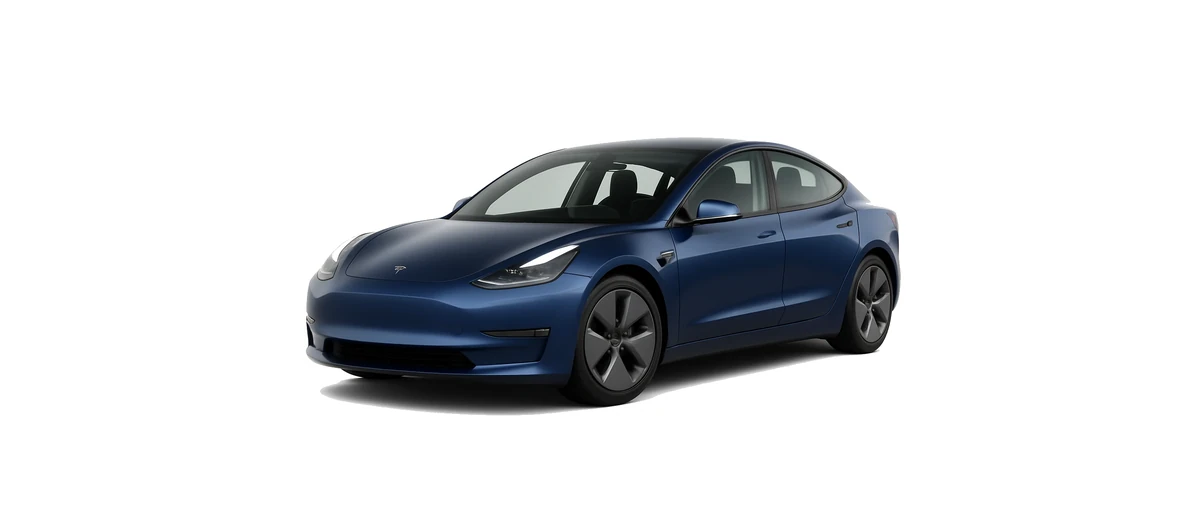
The Tesla Model 3 is one of the UK’s best-known electric saloons, but charging details vary more than many owners expect. The current UK range includes Rear-Wheel Drive, Premium Long Range Rear-Wheel Drive, Premium Long Range All-Wheel Drive and Performance versions, with different battery packs, range figures and DC rapid charging limits.
This guide focuses on current UK Model 3 variants checked against Tesla UK and EV Database UK information in June 2026. It is especially useful if you are trying to identify which Model 3 you own, what cable you need for AC charging, and why the car’s 11 kW onboard charger does not always mean 11 kW charging at home. Older used Model 3 versions can have materially different batteries and charging rates, so always check your exact vehicle if it is not a current UK model.
View Tesla Model 3 Charging Cables
Tesla Model 3 Battery and Charging Specifications
The UK Tesla Model 3 is a battery-electric vehicle only. There is no plug-in hybrid, hybrid or range-extender Model 3 for the UK market. For charging, current UK and European Model 3 cars use a Type 2 inlet for AC charging and CCS Combo 2 for DC rapid charging. The charge port is positioned at the left rear of the car, integrated into the rear light area behind a powered charge-port door.
All current UK variants are listed with an 11 kW AC onboard charger on a suitable three-phase supply. However, most UK domestic installations are single-phase, where a typical home wallbox provides up to 7.4 kW. For rapid charging, the current Rear-Wheel Drive version is listed at up to 175 kW DC, while current Long Range and Performance versions are listed at up to 250 kW DC under suitable conditions.
| Model 3 variant | Battery information | AC charging | DC rapid charging |
|---|---|---|---|
| Rear-Wheel Drive | Approx. 64 kWh gross / 60 kWh usable LFP pack | Type 2, up to 11 kW on three-phase | Up to 175 kW peak |
| Premium Long Range RWD | Approx. 82 kWh gross / 79 kWh usable NMC pack | Type 2, up to 11 kW on three-phase | Up to 250 kW peak |
| Premium Long Range AWD | Approx. 82 kWh gross / 79 kWh usable NMC pack | Type 2, up to 11 kW on three-phase | Up to 250 kW peak |
| Performance | Approx. 82 kWh gross / 79 kWh usable NMC pack | Type 2, up to 11 kW on three-phase | Up to 250 kW peak |
Battery Options
The current Model 3 range is best understood by separating the Rear-Wheel Drive car from the Long Range and Performance versions. The Rear-Wheel Drive version uses an LFP battery pack, listed by EV Database UK at around 64 kWh gross and 60 kWh usable. Tesla UK gives this version a WLTP range of 332 miles, while EV Database estimates a real-world range of around 275 miles.
The Premium Long Range Rear-Wheel Drive, Premium Long Range All-Wheel Drive and Performance variants use a larger NMC battery pack, listed at around 82 kWh gross and 79 kWh usable. Official WLTP figures vary by variant and wheel choice: the Premium Long Range RWD is shown by Tesla UK at up to 466 miles on 18-inch wheels or 429 miles on 19-inch wheels. The Premium Long Range AWD is shown at 410 miles on Tesla UK, while EV Database also lists 445 miles TEL / 410 miles TEH. The Performance is listed by Tesla UK at 354 miles WLTP.
These differences matter for charging planning. The larger-battery cars can usually travel further between stops, but they also take longer to charge from low to full on AC. The RWD’s LFP pack also has different owner charging habits from the NMC cars, so drivers should follow Tesla’s in-car recommendations for daily and full charging limits.
AC Charging Speed
For AC charging, the Model 3 uses a Type 2 connection. All current UK variants are listed with 11 kW AC capability when connected to a suitable three-phase AC supply. This is common at some workplace, destination and public AC charge points, but it is not the normal maximum for most UK homes.
At home, many owners will use a single-phase 7.4 kW wallbox. On this type of charger, EV Database indicates a practical empty-to-full charging time of about 9 hours 45 minutes for the current RWD and about 12 hours 45 minutes for the larger 79 kWh usable battery variants. In everyday use, most owners will not charge from completely empty to full; topping up from, for example, 30% to 80% will take significantly less time.
For cable selection, a 32 amp Type 2 cable is the right general starting point for common 7.4 kW single-phase charging. If you regularly use three-phase AC charging, choose a cable that supports 11 kW three-phase use. An untethered home charger or untethered public AC post requires you to supply your own Type 2 cable. DC rapid chargers and Tesla Superchargers have tethered cables, so you do not need to buy a separate DC cable.
DC Rapid Charging Speed
The Model 3 uses CCS Combo 2 for DC rapid charging in the UK and Europe. It also has native access to the Tesla Supercharger network, which is one of the main practical advantages of owning a Tesla. However, it is important not to assume that every Model 3 charges at the same peak power.
EV Database lists the current Rear-Wheel Drive version at up to 175 kW DC, with around 110 kW average from 10% to 80% and a typical 10-80% time of about 24 minutes in suitable conditions. The Premium Long Range RWD, Premium Long Range AWD and Performance variants are listed at up to 250 kW DC, with around 125 kW average from 10% to 80%. The Long Range versions are listed at about 28 minutes for 10-80%, while the Performance is shown at around 28-30 minutes depending on the source wording.
Peak charging figures are not guaranteed at every stop. Battery temperature, state of charge, charger capability, congestion, route planning and weather all affect charging speed. For longer journeys, it is usually more efficient to arrive at a rapid charger with a lower state of charge and charge to around 80%, rather than waiting for the final 20%, which is normally slower.
Range and Efficiency
Range depends on variant, battery size, wheel choice, speed, temperature and driving style. The current Model 3 RWD is officially rated at 332 miles WLTP, with EV Database estimating around 275 miles in real-world use. The Premium Long Range RWD offers the highest official range in the current UK line-up, with Tesla UK listing up to 466 miles on 18-inch wheels or 429 miles on 19-inch wheels. EV Database estimates around 360 miles real-world range for that version.
The Premium Long Range AWD is listed at 410 miles WLTP by Tesla UK, with EV Database showing a 445 / 410 mile TEL/TEH WLTP spread and around 340 miles real-world range. The Performance is rated at 354 miles WLTP by Tesla UK, with EV Database estimating around 320 miles real-world range.
In practice, motorway speed, cold weather and larger wheels can reduce range. The Model 3’s standard heat pump helps efficiency in cooler conditions, but drivers should still expect winter consumption to be higher than in mild weather.
Charging at Home
Home charging is usually the most convenient way to run a Model 3. A dedicated wallbox allows the car to charge overnight, often using a cheaper off-peak electricity tariff if your energy supplier offers one. Most UK homes will charge the Model 3 at up to 7.4 kW on single-phase power, even though the car itself can accept up to 11 kW AC where three-phase charging is available.
If you have an untethered wallbox, you will need a Type 2 charging cable. A 32 amp single-phase Type 2 cable suits the common 7.4 kW UK home setup. If you want one cable that can also make use of 11 kW three-phase AC posts, choose an appropriate three-phase Type 2 cable.
A 3-pin charger is generally best suited as a backup or occasional charging solution, but can be used regularly if a qualified electrician has confirmed the socket and electrical installation are suitable for sustained EV charging. A normal domestic socket charges much more slowly than a wallbox and should not be treated as a substitute for a properly installed EV charge point unless the installation has been checked for the intended use.
Public Charging
Public charging for the Model 3 falls into two main categories: AC destination charging and DC rapid charging. AC posts at supermarkets, hotels, car parks and workplaces often require your own Type 2 cable, especially if they are untethered. These are useful when the car will be parked for several hours.
For motorway and long-distance travel, DC rapid charging is normally the better option. Tesla Superchargers and other CCS rapid chargers use tethered CCS Combo 2 cables, so you simply connect the charger’s cable to the car. Tesla’s in-car navigation can plan charging stops and, when navigating to a Tesla charging location, can precondition the high-voltage battery before arrival to help reduce charging time.
For best results on a long journey, use the car’s navigation rather than simply driving to a charger manually. Preconditioning is most useful when the battery needs warming or preparing before a high-power charging session.
Vehicle-Specific Features
Current UK Model 3 variants are listed with a standard heat pump and battery preconditioning. Both are relevant to charging and efficiency: the heat pump can help reduce energy use in cooler weather, while preconditioning can improve rapid charging performance when used with route planning.
The Model 3 is based on Tesla’s dedicated 3/Y electric platform and is listed by EV Database as using a 400 V architecture. For UK owners, the practical connector information is simple: Type 2 for AC and CCS Combo 2 for DC. Do not use North American NACS information when buying a cable or planning UK charging for a UK/EU Model 3.
Current UK Model 3 variants are not listed as supporting V2L, V2H or V2G. In other words, they should not be treated as portable power sources for external appliances or as home/grid backup batteries.
Charging Tips
- Identify your variant first. RWD, Long Range and Performance cars have different battery sizes, range figures and DC charging limits.
- Buy for your AC use case. A 32 amp Type 2 cable is suitable for common 7.4 kW single-phase charging; choose an 11 kW-capable three-phase cable if you use three-phase AC posts.
- Use CCS for rapid charging. DC rapid chargers have tethered cables, so a separate rapid charging cable is not required.
- Plan around 10-80% on long trips. This is usually faster than charging close to 100% at a rapid charger.
- Use Tesla navigation before rapid charging. Trip Planner can precondition the battery before arrival at suitable Tesla charging locations.
- Do not assume 250 kW charging. Current RWD is listed at 175 kW peak; the larger-battery Long Range and Performance versions are listed at 250 kW peak.
Frequently Asked Questions
What charging cable does a Tesla Model 3 need in the UK?
For AC charging, a UK Tesla Model 3 uses a Type 2 cable. This is the cable used with untethered home wallboxes and many public AC charging posts.
Does the Tesla Model 3 need a CCS cable for rapid charging?
No. The car uses CCS Combo 2 for DC rapid charging, but rapid chargers and Tesla Superchargers have tethered cables. You do not need to buy a separate DC cable.
Can the Model 3 charge at 11 kW at home?
The car can accept up to 11 kW AC on a suitable three-phase supply, but most UK homes are single-phase and typically charge at up to 7.4 kW with a dedicated wallbox.
Do all Tesla Model 3 versions charge at 250 kW?
No. Current UK Long Range and Performance variants are listed at up to 250 kW DC, but the current Rear-Wheel Drive version is listed at up to 175 kW DC. Older used cars may differ.
Does the Model 3 have vehicle-to-load or vehicle-to-grid capability?
Current UK Model 3 variants are listed as not supporting V2L, V2H or V2G.
What This Means for Drivers
For most UK Model 3 owners, the key point is simple: use Type 2 for AC charging and CCS Combo 2 for rapid charging. At home, expect 7.4 kW unless you have access to a suitable three-phase supply. On longer journeys, use Tesla navigation and plan around fast 10-80% charging stops rather than aiming for 100% at every charger.
The right cable depends on how you charge. A 32 amp Type 2 cable covers the common UK home and public AC scenario, while a three-phase-capable Type 2 cable is worthwhile if you frequently use 11 kW AC charging. Rapid charging does not require a separate cable because the charger provides it.
Looking for a Charging Cable for Tesla Model 3?
If you need a Type 2 cable for home, workplace or public AC charging, choose one that matches your usual charging setup and allows for the way you use your Model 3.
View Tesla Model 3 Charging Cables
Please note that this information is intended as a guide. Charging specifications may change due to model and year of manufacture. For precise information, always refer to your vehicle user manual.

