
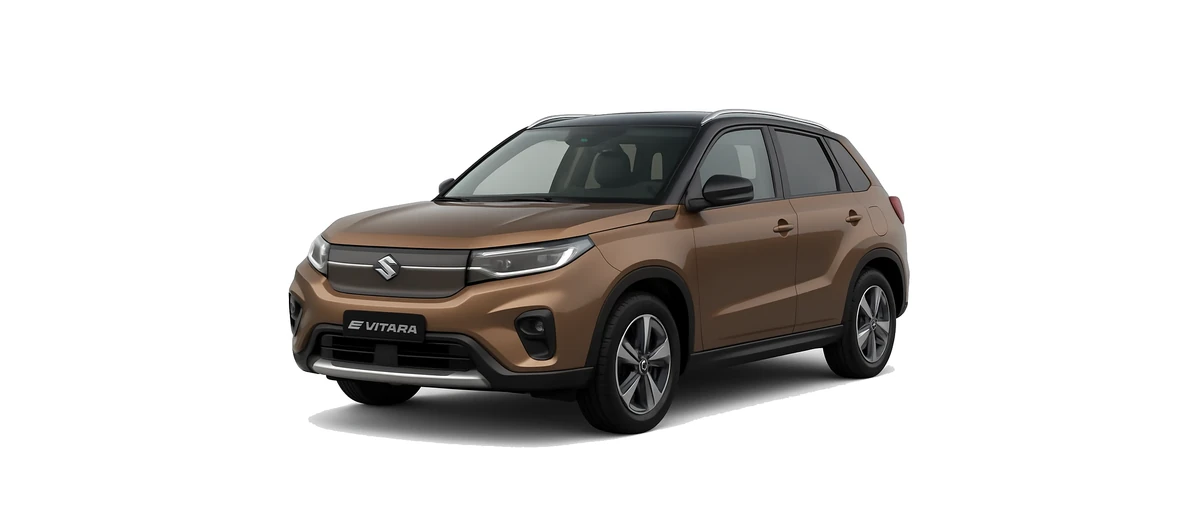
The Suzuki e Vitara is Suzuki’s battery-electric compact SUV for the UK market. It should not be confused with the petrol or hybrid Vitara models: the e Vitara is a full electric vehicle, charged from mains electricity using a Type 2 AC connection or a CCS Combo 2 rapid charging connection.
For UK drivers, the most important charging points are straightforward. The e Vitara uses the same Type 2 and CCS2 charging inlet arrangement across the range, so cable compatibility is simple. However, charging expectations vary by battery size and drivetrain. The 49 kWh 2WD model has a shorter official range than the 61 kWh versions, and independent data suggests the 49 kWh model may have a lower DC peak charging rate than the larger-battery cars. At home, most owners will charge from a 7 kW single-phase wallbox rather than using the car’s full 11 kW AC capability.
View Suzuki e Vitara Charging Cables
Suzuki e Vitara Battery and Charging Specifications
The UK Suzuki e Vitara line-up includes a 49 kWh 2WD Motion model, 61 kWh 2WD Motion and Ultra models, and 61 kWh ALLGRIP-e 4WD Motion and Ultra models. All versions are battery-electric and use a Type 2 AC inlet for home and public destination charging, plus a CCS Combo 2 inlet for DC rapid charging.
All UK versions are listed with an 11 kW AC onboard charger. This means the car can accept up to 11 kW from a suitable three-phase AC charging point. In typical UK domestic use, however, a home wallbox will usually be single-phase and rated at around 7 kW, so this is the more relevant figure for most owners’ day-to-day charging.
For rapid charging, Suzuki quotes a 10-80% charging time of about 45 minutes when using a suitable DC rapid charger. Public rapid charging performance will depend on the model, charger output, battery temperature, starting state of charge and how busy or limited the charging site is.
Battery Options
The e Vitara is offered with two battery sizes in the UK. Suzuki markets the smaller pack as a 49 kWh lithium iron battery. EV Database lists this version at approximately 48.8 kWh nominal capacity and 47.8 kWh usable capacity. It is available as a 2WD Motion model and has an official WLTP range of around 213 miles.
The larger battery is marketed by Suzuki as a 61 kWh lithium iron battery. EV Database lists it at approximately 61.1 kWh nominal capacity and 59.8 kWh usable capacity. In 2WD form, Suzuki quotes an official WLTP range of 264 miles. With the ALLGRIP-e 4WD drivetrain, the same marketed 61 kWh battery has a lower official WLTP figure of 245 miles, reflecting the additional drivetrain hardware and different efficiency profile.
Because these versions differ in range and, potentially, rapid charging peak rate, it is worth checking which e Vitara you are ordering or driving. Cable compatibility remains the same, but journey planning and charging stop expectations are not identical across all models.
AC Charging Speed
AC charging is the type of charging used by home wallboxes, many workplace chargers and most public destination charging posts. The Suzuki e Vitara uses a Type 2 AC connection and has an 11 kW onboard charger across the range.
On a common 7 kW home wallbox, Suzuki quotes a 10-100% charging time of around 6 hours 30 minutes for the 49 kWh model and around 9 hours for the 61 kWh models. These figures are useful for overnight home charging because they reflect the sort of charger many UK households are likely to install.
Where an 11 kW three-phase AC supply is available, Suzuki quotes 10-100% charging times of around 4 hours 30 minutes for the 49 kWh model and around 5 hours 30 minutes for the 61 kWh models. This is more likely to apply at some workplaces, commercial sites or homes with three-phase electricity, rather than the average UK domestic property.
A Mode 3 Type 2-to-Type 2 cable is the correct cable type for untethered AC charging posts. Suzuki UK brochure information confirms the Type 2 three-phase AC inlet, so a suitable Type 2 cable will allow the e Vitara to connect to home, workplace and public AC charge points where a tethered cable is not already provided.
DC Rapid Charging Speed
For longer journeys, the Suzuki e Vitara uses CCS Combo 2 DC rapid charging. CCS chargers usually have their own tethered cable, so you do not normally use your own Type 2 cable for rapid charging.
Suzuki quotes a 10-80% rapid charging time of about 45 minutes, with the note that a suitable rapid DC charger is required. This 10-80% window is the most useful benchmark for motorway and long-distance charging because charging speeds usually slow significantly as the battery approaches full.
There is an important variant distinction. EV Database lists the 49 kWh e Vitara with a lower maximum DC charging rate than the 61 kWh versions, while the 61 kWh models are listed at up to 70 kW DC. For customer-facing planning, it is safest to treat the official 45-minute figure as a general Suzuki benchmark under suitable conditions, rather than assuming every version will always charge at 70 kW.
As with all EVs, rapid charging speed is not fixed throughout the session. The e Vitara may charge faster at a lower state of charge and slow down as the battery fills. Cold weather, a cold battery, battery protection systems, charger limitations and site load sharing can all affect the actual time you spend plugged in.
Range and Efficiency
The e Vitara’s official range depends on the version. Suzuki’s UK figures are 213 miles for the 49 kWh 2WD model, 264 miles for the 61 kWh 2WD model and 245 miles for the 61 kWh ALLGRIP-e 4WD model. These WLTP figures are helpful for comparison, but real-world range will vary.
In everyday UK driving, expect range to be influenced by speed, weather, tyre condition, terrain, cabin heating or cooling, payload and driving style. Motorway driving in winter will normally use more energy than slower urban or mixed driving in mild conditions. Independent estimates for the larger-battery e Vitara suggest real-world range may be around the low-200-mile mark in favourable mixed use, but your own result will depend on conditions and variant.
For daily use, many drivers will not need to charge to 100%. Suzuki recommends routine charging to a maximum of 80%, which is common advice for preserving battery health and keeping rapid charging sessions efficient. Charging to 100% is still useful before a longer trip when you need the extra range.
Charging at Home
For most UK owners, the best everyday charging solution for the Suzuki e Vitara will be a dedicated 7 kW Type 2 home wallbox. It is faster, safer and more convenient than relying on a domestic socket, and it matches Suzuki’s published home charging times.
With a 7 kW wallbox, the smaller-battery e Vitara can be charged from 10-100% in around 6 hours 30 minutes, while the 61 kWh versions take around 9 hours. In practical terms, this means most owners can plug in overnight and start the next day with the charge level they need.
If you have access to three-phase electricity and a suitable 11 kW AC charger, the e Vitara can take advantage of its higher AC capability. This may be useful for workplace charging or certain commercial installations. However, it should not be assumed for a normal UK home, where single-phase 7 kW charging is far more common.
A 3-pin portable charger can be useful in some circumstances, but it is generally best suited as a backup or occasional charging solution. It can be used regularly if a qualified electrician has confirmed the socket and electrical installation are suitable for sustained EV charging. Domestic sockets were not originally designed with long, high-load EV charging sessions in mind, so professional electrical checks are important if you plan to rely on one.
Public Charging
Public charging for the Suzuki e Vitara falls into two main categories: AC destination charging and DC rapid charging. AC destination chargers are commonly found in car parks, hotels, workplaces, supermarkets and town centres. Many of these require you to bring your own Type 2 cable, so keeping a Type 2-to-Type 2 cable in the car is sensible.
On a 7 kW public AC post, the charging time will be similar to a home wallbox. On an 11 kW three-phase AC post, the e Vitara can charge more quickly, provided the post can deliver 11 kW and the supply is not limited. Some public AC posts are rated at 22 kW, but the car will still only take up to its onboard AC limit of 11 kW.
For longer journeys, use CCS rapid chargers. These are the chargers you are most likely to use on motorways and major A-road routes. The practical approach is usually to arrive with a lower but comfortable state of charge, charge to around 80%, and continue the journey rather than waiting for the final 20% to complete slowly.
Vehicle-Specific Features
Suzuki UK materials confirm that the e Vitara is fitted with a heat pump as standard. A heat pump can help improve heating efficiency in colder weather compared with relying solely on resistive heating, although actual range benefit will depend on conditions and how the vehicle is used.
Battery thermal management preconditioning is also listed by Suzuki, with control available via in-vehicle settings or the Suzuki Connect app. Battery preconditioning can help the battery reach a more suitable temperature for charging or driving, particularly in cold weather. EV Database also notes preconditioning capability, although official Suzuki wording should be followed when describing exactly how it is activated.
The UK information reviewed does not support V2L, V2G or V2H functionality for the e Vitara, and Plug & Charge support should not be assumed. In day-to-day ownership, the key charging features are the Type 2 AC inlet, CCS2 rapid charging inlet, 11 kW AC onboard charger, standard heat pump and battery thermal preconditioning.
Charging Tips
- Use a 7 kW home wallbox where possible: this is the most relevant home charging setup for most UK owners.
- Carry a Type 2 cable: many public AC posts are untethered, so your own cable is often required.
- Do not expect 11 kW at every AC charger: the car supports 11 kW AC, but the charger and electricity supply must also support it.
- Use CCS rapid charging for long trips: rapid chargers have tethered cables and are designed for shorter charging stops.
- Plan around 10-80% on rapid chargers: this is normally more time-efficient than charging to 100% during a journey.
- Remember the variant differences: the 49 kWh and 61 kWh models have different official ranges, and rapid charging capability may differ.
- Use preconditioning when helpful: preparing the battery in cold weather may support better charging and driving efficiency.
Frequently Asked Questions
What charging cable does the Suzuki e Vitara use?
The Suzuki e Vitara uses a Type 2 connection for AC charging. For untethered home, workplace and public AC chargers, you need a Type 2-to-Type 2 Mode 3 cable. DC rapid charging uses the CCS Combo 2 inlet and the rapid charger’s own tethered cable.
Can the Suzuki e Vitara charge at 11 kW at home?
The car can accept up to 11 kW AC, but most UK homes have single-phase electricity and typically use a 7 kW wallbox. To charge at 11 kW, you need a suitable three-phase supply and compatible charger.
How long does the Suzuki e Vitara take to charge at home?
On a common 7 kW home charger, Suzuki quotes 10-100% in around 6 hours 30 minutes for the 49 kWh model and around 9 hours for the 61 kWh models.
How quickly can the Suzuki e Vitara rapid charge?
Suzuki quotes 10-80% in about 45 minutes using a suitable DC rapid charger. Charging speed varies by version and conditions, and independent data lists a lower peak DC rate for the 49 kWh model than for the 61 kWh versions.
Is the Suzuki e Vitara a hybrid?
No. The UK Suzuki e Vitara is a battery-electric vehicle. It is separate from the petrol and hybrid Vitara range.
What This Means for Drivers
The Suzuki e Vitara should be a straightforward EV to charge in the UK. Its Type 2 AC and CCS2 DC connections match the UK and European public charging standard, while the 11 kW onboard AC charger gives useful flexibility when three-phase AC charging is available.
For most owners, the practical setup is a 7 kW home wallbox plus a good-quality Type 2 cable kept in the car for public AC charging. The 49 kWh version is likely to suit drivers with shorter daily mileage and regular access to charging, while the 61 kWh versions offer more range for longer commutes and trips. The ALLGRIP-e 4WD model trades some range for the benefits of four-wheel drive.
When planning longer journeys, focus on CCS rapid chargers and use the 10-80% window as your main charging benchmark. Allow extra time in cold weather or when chargers are busy, and remember that range and charging speed are affected by the battery size, state of charge, temperature and charger capability.
Looking for a Charging Cable for Suzuki e Vitara?
We offer Suzuki e Vitara compatible Type 2 charging cables for home, workplace and public AC charging, helping you keep the right cable in the car for untethered charge points.
View Suzuki e Vitara Charging Cables
Please note that this information is intended as a guide. Charging specifications may change due to model and year of manufacture. For precise information, always refer to your vehicle user manual.

