
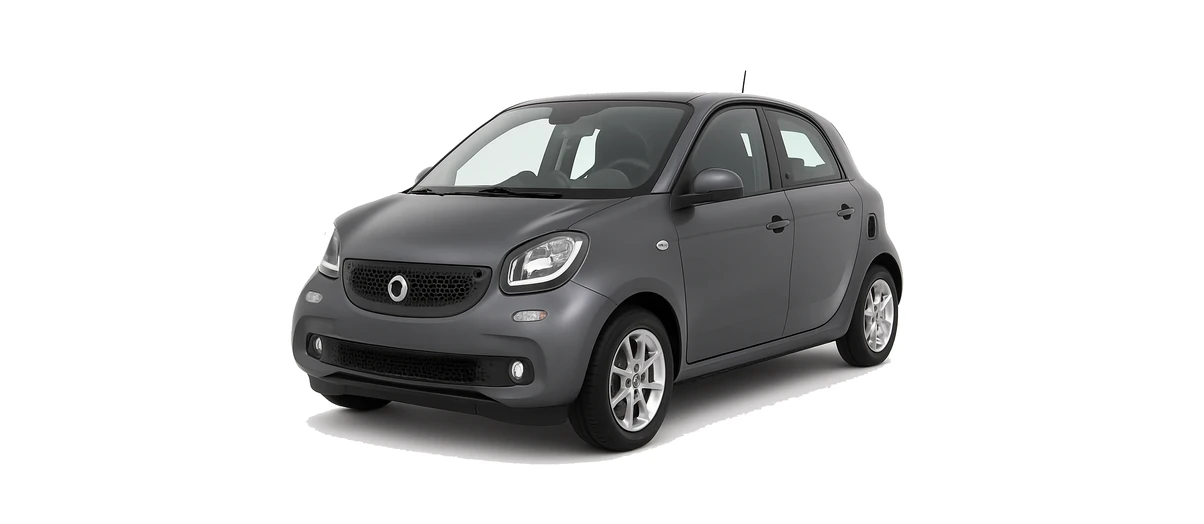
The Smart EQ forfour is a compact, fully electric 5-door city hatchback designed for short journeys, urban parking and low-speed efficiency rather than long motorway trips. In the UK, it is now a discontinued used-car choice, but it remains an interesting small EV because of its unusual charging set-up: it has a Type 2 AC charging port only, with no CCS DC rapid charging, yet some versions can charge very quickly from a 22 kW AC post.
That distinction matters when choosing a cable and planning journeys. A 2020-2022 UK Smart EQ forfour is listed with 22 kW AC charging as its maximum onboard capability, while earlier 2018-2019 UK cars are listed with 7.4 kW AC as standard and 22 kW AC as an option. In practical terms, many owners will charge at home from a single-phase 7.4 kW wallbox, but the right car can make excellent use of 3-phase Type 2 AC public chargers.
View Smart EQ forfour Charging Cables
Smart EQ forfour Battery and Charging Specifications
The Smart EQ forfour is a battery electric vehicle, not a plug-in hybrid. It should not be confused with petrol Smart forfour models or with later Smart #1 and Smart #3 models, which are different vehicles with different charging specifications.
UK-market electric forfour models were sold in the late 2010s and facelifted for the 2020 model period. EV Database UK lists the 2018-2019 Smart EQ forfour as available from April 2018 to September 2019, followed by the 2020-2022 version from January 2020 to May 2022. The key used-car point is that the charging capability is not identical across all years.
- Vehicle type: fully electric city hatchback
- Charging port: Type 2 AC
- DC rapid charging: not supported; no CCS rapid charging port
- Battery: 17.6 kWh nominal capacity, with EV Database estimating 16.7 kWh usable
- WLTP range: up to around 81 miles for the 2020-2022 listing, depending on specification and source
- Typical real-world range estimate: around 55 miles, with conditions and driving style making a noticeable difference
Battery Options
The Smart EQ forfour uses a small 17.6 kWh high-voltage battery. EV Database UK lists a 16.7 kWh usable capacity estimate, and UK archived price-list information for later cars also references a 17.6 kWh high-voltage battery.
Unlike many larger EVs, the EQ forfour was not offered in the UK with a broad range of battery sizes. The ownership experience is therefore shaped less by choosing between battery packs and more by understanding the onboard AC charger fitted to the specific car. For city driving, school runs, commuting and local errands, the small battery can be convenient because charging sessions are short. For regular motorway use or long-distance trips, the limited range and lack of DC rapid charging are more significant drawbacks.
AC Charging Speed
AC charging is the most important part of Smart EQ forfour ownership because this is the only type of external charging the car supports. The car uses a Type 2 inlet and can charge from home wallboxes, workplace chargers and public AC posts.
For 2020-2022 UK cars, EV Database lists 22 kW AC as the maximum onboard charging rate. Mercedes-Benz media material for the facelifted Smart EQ range also describes a 10-80% charge in under 40 minutes when using the 22 kW onboard charger where 3-phase charging is available. This is very quick for a small-battery city EV, but it depends on having both the correct onboard charger and access to a suitable 3-phase 22 kW AC charge point.
For 2018-2019 UK cars, EV Database lists 7.4 kW AC charging as standard, with an optional 22 kW onboard charger. Used buyers should therefore check the exact specification rather than assuming that every Smart EQ forfour can charge at 22 kW.
At home in the UK, most domestic wallboxes are single-phase and typically charge at up to 7.4 kW. Even if the car is capable of 22 kW AC, a single-phase home charger will usually be the practical home limit. EV Database estimates around 2 hours 45 minutes for a 0-100% charge on a common 7.4 kW home charger for the 2020-2022 car, although real charging times can vary with battery temperature, starting charge level and charger behaviour.
DC Rapid Charging Speed
The Smart EQ forfour does not support DC rapid charging. It has a Type 2 AC charging port only and no CCS rapid charging connector. This is one of the most important things to understand before buying or using the car.
That means CCS rapid chargers at motorway services and many hub locations cannot be used for DC charging. If a charging site has only CCS or CHAdeMO rapid units and no Type 2 AC socket, it will not be suitable for charging a Smart EQ forfour. The fastest public option for a 22 kW-capable car is usually a 22 kW AC Type 2 post, not a DC rapid charger.
The under-40-minute 10-80% figure associated with the facelifted Smart EQ models refers to 22 kW AC charging on a 3-phase supply, not DC rapid charging.
Range and Efficiency
EV Database UK lists an 81-mile WLTP range for the 2020-2022 Smart EQ forfour and estimates a typical real-world range of around 55 miles. Mercedes-Benz media technical data for the Smart EQ forfour gives a WLTP range band of 114-130 km, depending on specification and equipment.
In daily use, the Smart EQ forfour is at its best in town. Low speeds, short journeys and urban stop-start driving suit the car’s size and battery capacity. Range can fall more noticeably in winter, in heavy rain, with repeated high-speed driving, or when the cabin heating is used extensively. Motorway journeys are possible with planning, but the combination of a small battery and no DC rapid charging means they require more patience than in larger modern EVs.
Charging at Home
For most UK owners, home charging will be the simplest and most predictable way to run a Smart EQ forfour. A dedicated Type 2 wallbox on a suitable domestic supply is usually the most practical arrangement. On a typical 7.4 kW single-phase home charger, the battery is small enough that an overnight charge is more than sufficient, and many owners will only need a shorter top-up.
A tethered home charger with a Type 2 connector can plug directly into the car. If the wallbox is untethered, you will need a Type 2 charging cable. For home use, a single-phase Type 2 cable is normally enough for a 7.4 kW charger. However, owners who want to use 22 kW AC public posts should consider whether they need a 3-phase Type 2 cable as well, especially if their car is confirmed to have the 22 kW onboard charger.
A 3-pin portable charger is generally best suited as a backup or occasional charging solution, but can be used regularly if a qualified electrician has confirmed the socket and electrical installation are suitable for sustained EV charging. Because EV charging places a continuous load on the electrical circuit, an ordinary household socket should not simply be assumed suitable for repeated long charging sessions.
Public Charging
Public charging for the Smart EQ forfour requires a little more attention than for many newer EVs. You are looking for Type 2 AC charging, not CCS rapid charging. Many town-centre, supermarket, workplace, hotel, car park and destination chargers offer AC Type 2 sockets, which can be a good fit for this car.
If your EQ forfour is a 2020-2022 UK model, or an earlier car with the optional 22 kW onboard charger, a 22 kW AC post can be particularly useful. Because the battery is small, a short stop at a suitable 3-phase AC charger can add a meaningful amount of range. This is the situation where the EQ forfour’s charging set-up makes the most sense: it cannot use DC rapid charging, but a 22 kW AC-capable version can still top up quickly at the right AC post.
If your car only has the 7.4 kW onboard charger, it can still use a 22 kW AC post, but it will not draw the full 22 kW. The car’s onboard charger sets the limit, so the charging session will be closer to the vehicle’s maximum capability rather than the post’s advertised maximum.
Vehicle-Specific Features
The Smart EQ forfour’s main charging feature is its AC-only approach. For later UK cars, the standard 22 kW onboard AC charger is unusual in such a small city EV and can make public AC charging very effective. For earlier cars, the presence or absence of the optional 22 kW charger is a key specification check.
Battery preconditioning for rapid charging is not listed as available for the 2020-2022 car, which is consistent with the fact that the vehicle does not support DC rapid charging. EV Database also lists V2L, V2H and V2G support as not available for the 2020-2022 model. In day-to-day terms, the Smart EQ forfour should be treated as a straightforward Type 2 AC-charging city EV.
Charging Tips
- Check the onboard charger: for 2018-2019 cars, confirm whether the car has the standard 7.4 kW charger or optional 22 kW charger.
- Do not rely on CCS chargers: the Smart EQ forfour cannot use CCS DC rapid charging.
- Use AC filters in charging apps: when planning public charging, look for Type 2 AC posts, especially 22 kW AC posts if your car can use them.
- Choose the right cable: a Type 2 cable is the correct fitment; a 3-phase Type 2 cable is useful if you want to access 22 kW AC charging where available.
- Charge little and often: the small battery means short top-ups can be effective, particularly around town.
- Plan winter journeys carefully: cold weather and higher speeds can reduce range noticeably.
Frequently Asked Questions
What charging cable does the Smart EQ forfour use?
The Smart EQ forfour uses a Type 2 AC charging connection. For untethered home or public AC chargers, you will need a Type 2 charging cable.
Can the Smart EQ forfour use rapid chargers?
It cannot use CCS DC rapid charging. Some versions can charge quickly from 22 kW AC Type 2 posts, but that is still AC charging, not DC rapid charging.
Do all Smart EQ forfour models charge at 22 kW?
No. Later 2020-2022 UK cars are listed with 22 kW AC as the maximum onboard charger. Earlier 2018-2019 UK cars are listed with 7.4 kW AC as standard and 22 kW AC as an option, so the individual car’s specification should be checked.
How long does home charging take?
On a typical UK 7.4 kW single-phase home wallbox, EV Database estimates around 2 hours 45 minutes for a 0-100% charge on the 2020-2022 car. Many daily top-ups will take less time because the battery will not usually be empty.
Is the Smart EQ forfour suitable for long journeys?
It can be used for longer journeys with careful planning, but it is primarily a city and short-distance EV. The small battery and lack of DC rapid charging make it less convenient for frequent motorway travel.
What This Means for Drivers
The Smart EQ forfour is a simple, compact electric car that can work very well for local driving if its limitations are understood. Its range is modest, but its small battery makes home charging quick and convenient. The biggest point is charger compatibility: this is a Type 2 AC-only EV, so CCS rapid chargers are not part of the charging plan.
For used buyers, the main checklist item is the onboard AC charger. A 2020-2022 UK car should have the 22 kW AC capability listed for the facelift model, while a 2018-2019 car needs to be checked because 22 kW was optional. If you have the 22 kW version and access to suitable 3-phase AC posts, the EQ forfour can top up surprisingly quickly for a city car.
Looking for a Charging Cable for Smart EQ forfour?
If you need a suitable Type 2 lead for home, workplace or public AC charging, We offer Smart EQ forfour charging cables to match the vehicle’s Type 2 connection, including options for drivers who want to make use of compatible AC charge points.
View Smart EQ forfour Charging Cables
Please note that this information is intended as a guide. Charging specifications may change due to model and year of manufacture. For precise information, always refer to your vehicle user manual.

