
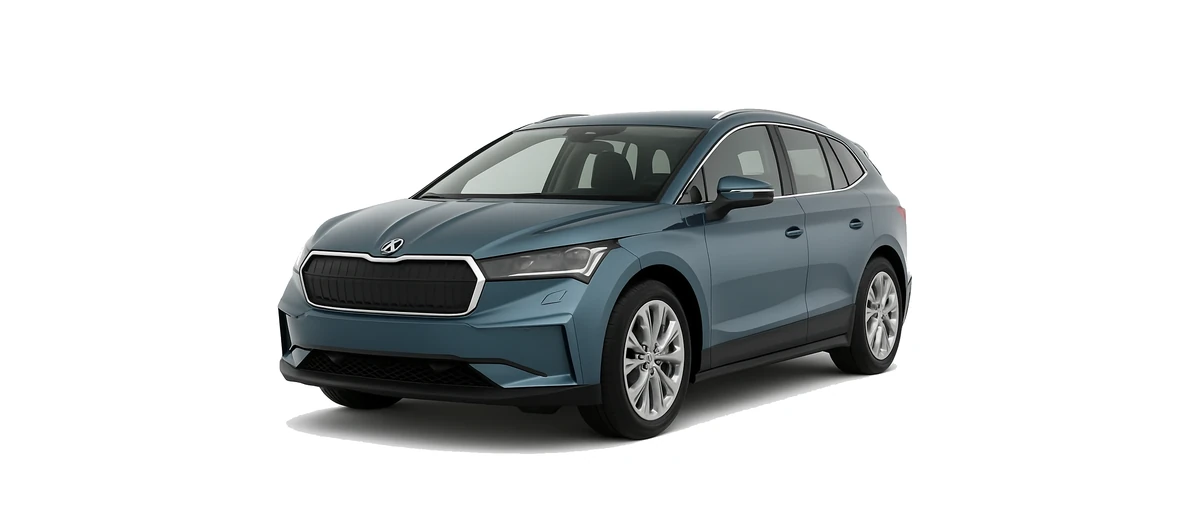
The Skoda Enyaq is a fully electric 5-seat SUV, built on the Volkswagen Group MEB electric platform. It is not a plug-in hybrid, so day-to-day ownership depends on charging from a home wallbox, workplace charger, destination charger or public rapid charger. For UK drivers, the key point is that Enyaq charging figures vary by variant and model year, especially between earlier Enyaq iV models and the latest Enyaq 60, 85, 85x and RS family.
This guide focuses on current UK Enyaq information checked against 2026 model-year data, while also explaining why used Enyaq charging figures can look inconsistent online. In simple terms, the Enyaq uses a Type 2 connection for AC charging and a CCS connection for DC rapid charging. A Type 2 cable is the main cable Enyaq owners use for home and public AC charging, while rapid chargers usually have their own tethered CCS cable.
View Skoda Enyaq Charging Cables
Skoda Enyaq Battery and Charging Specifications
The current UK Enyaq range is centred around the Enyaq 60 and Enyaq 85 in SE L form, while Škoda Auto’s 2026 model-year update also covers the Enyaq 60, 85, 85x and RS. All are battery-electric vehicles with a Type 2 AC inlet and CCS DC rapid charging connection. EV Database UK lists the charge port position at the right rear.
For AC charging, the Enyaq can accept up to 11 kW where a suitable three-phase AC supply is available. In typical UK home use, however, most drivers should plan around a single-phase 7.2 kW or 7.4 kW wallbox. For DC rapid charging, current updated figures indicate different peak speeds depending on the battery and variant: around 105 kW for the Enyaq 60 and up to 165 kW for the Enyaq 85, 85x and RS. These figures should not be applied to every used Enyaq, as earlier vehicles used different naming, battery and charging specifications.
Battery Options
The Enyaq’s battery information needs a little care because published figures vary by source and model year. For the latest Enyaq 60 update, Škoda Auto and EV Database list a 61 kWh gross battery with about 58 kWh usable. Škoda UK’s current page also presents the 60 with a 58 kWh battery capacity figure. This model is aimed at drivers who want the Enyaq’s SUV practicality but do not necessarily need the longest range version.
For the Enyaq 85, 85x and RS family, Škoda Auto’s update and EV Database list an 82 kWh gross battery with around 77 kWh usable. Škoda UK’s current Enyaq 85 page uses different published wording, marketing it as 84 kWh and listing battery capacity as 79 kWh. Rather than treating one number as universal, it is best to check the exact registration, variant and model year if you are buying used, comparing charge times or choosing a regular long-distance charging plan.
Older Enyaq iV 60 and iV 80 models may not match the current Enyaq 60 and 85 figures. If you are looking at a used car, check the owner’s manual, the vehicle infotainment system, the manufacturer specification for that build year or the original sales documentation.
AC Charging Speed
AC charging is what most Enyaq owners use at home, at work and at many destination chargers. The Enyaq’s AC charging uses a Type 2 connector. On a three-phase supply, the car is listed as capable of up to 11 kW AC. That can be useful at some workplaces, commercial premises and European locations, but it is not the normal assumption for a UK driveway.
Most UK homes have single-phase electricity, so a 7.2 kW or 7.4 kW wallbox is usually the fastest practical home charging option. Škoda UK quotes 0-100% charging at 7.2 kW of about 10 hours for the current Enyaq 60 and about 13 hours for the current Enyaq 85. EV Database estimates are slightly different at 7.4 kW, at roughly 9 hours 15 minutes for the 60 and 12 hours 15 minutes for the 85. Real charge time depends on starting percentage, charge limit, temperature, charger output and any power-sharing at the property.
A 3-pin charger is generally best suited as a backup or occasional charging solution, but can be used regularly if a qualified electrician has confirmed the socket and electrical installation are suitable for sustained EV charging. Because the Enyaq has a relatively large battery, a domestic 3-pin socket will be much slower than a proper wallbox and is not usually the most convenient everyday option.
DC Rapid Charging Speed
For motorway and long-distance charging, the Enyaq uses CCS rapid chargers. These chargers supply DC power directly to the battery and usually have a tethered cable, so you do not normally use your own Type 2 cable at a rapid charger.
Current updated model-year figures list the Enyaq 60 at up to about 105 kW DC, with a 10-80% charge time of around 26 minutes in favourable conditions. The Enyaq 85, 85x and RS are listed at up to about 165 kW DC, with a 10-80% time of around 29 minutes. The larger battery can take more energy, so the time is not simply determined by peak power alone.
Rapid charging speeds are highest when the battery is warm, the state of charge is low enough and the charger can deliver the required power. Charging usually slows significantly above 80%, so for long journeys it is often quicker to stop at around 80% and continue to the next charger rather than waiting for a full charge.
Range and Efficiency
Škoda UK lists WLTP range of up to 283 miles for the current Enyaq 60 and up to 378 miles for the current Enyaq 85. WLTP figures are useful for comparing vehicles, but real-world range depends heavily on speed, weather, wheel size, terrain, payload, tyre condition and driving style.
EV Database UK estimates real-world combined range of about 215 miles for the Enyaq 60 and about 285 miles for the Enyaq 85. Cold motorway use can be significantly lower, particularly if you are driving at higher speeds with the heater running. For most owners, the best approach is to use the car’s live range estimate and energy consumption display rather than relying only on brochure numbers.
If you regularly travel long distances, the Enyaq 85 family’s larger battery and higher current DC peak can reduce charging pressure. If your driving is mostly local and you can charge at home, the Enyaq 60 may still offer more than enough range for typical weekly use.
Charging at Home
A dedicated home wallbox is the most convenient way to charge a Skoda Enyaq. For a typical UK single-phase installation, expect around 7.2 kW or 7.4 kW maximum charging, subject to the wallbox, property supply and installation limits. With an overnight tariff, many owners schedule charging for cheaper off-peak electricity and wake up with the target charge already reached.
For everyday battery care, many drivers set a lower charging target such as 80% and only charge to 100% before a longer journey. This helps avoid leaving the battery full for long periods and also reflects how EVs are normally used: a partial top-up overnight is often all that is needed.
If your home wallbox is untethered, you will need a Type 2 charging cable. The Enyaq’s 11 kW AC capability means a three-phase Type 2 cable can be useful if you also use 11 kW public or workplace AC chargers, even though many UK homes will charge at single-phase speeds. If you have a tethered home charger, the cable is already attached, but a separate Type 2 cable is still useful for untethered public AC points.
Public Charging
Public charging falls into two broad categories for Enyaq owners: AC destination charging and DC rapid charging. AC destination chargers are common in car parks, hotels, leisure sites, workplaces and town centres. Many are untethered, so you plug in with your own Type 2 cable. Speeds vary, but the Enyaq can accept up to 11 kW AC where the charger and supply support it.
DC rapid and ultra-rapid chargers use the CCS connector and are intended for shorter stops on longer journeys. You will normally plug in using the charger’s attached CCS cable. Current MY27 data also lists Plug & Charge support for the Enyaq, although availability in practice depends on the charging network, account setup and vehicle software.
When route planning, take your battery version into account. The Enyaq 60 has a smaller pack and, on current updated figures, a lower DC peak than the Enyaq 85, 85x and RS. The Enyaq 85 family can travel further between stops, but charger location, reliability and arrival state of charge are often just as important as the headline peak kW figure.
Vehicle-Specific Features
Battery preconditioning is listed as supported on current Enyaq data. In practical terms, preconditioning helps prepare the battery for faster rapid charging, especially in colder weather. Where the car and navigation system support it, setting a rapid charger as the destination can help the vehicle warm the battery before arrival. If the battery is cold, charging may start more slowly and take longer than the best-case figures.
A heat pump is optional rather than something to assume on every Enyaq. A heat pump can improve heating efficiency in cold weather, but whether a specific car has one depends on its build and options. This is particularly important when buying used.
Vehicle-to-Load capability is confirmed as part of the updated model-year feature set, allowing power output via a charging-port adapter or a 230 V luggage-compartment socket depending on specification. However, this should not be assumed for every older Enyaq. Vehicle-to-Grid or Vehicle-to-Home customer availability in the UK is not clear enough to treat as a standard usable feature.
Charging Tips
- Identify your exact Enyaq first: 60, 85, 85x, RS and older iV 60/iV 80 cars can have different battery and charging specifications.
- Use Type 2 for AC charging: this covers most home wallboxes, workplace chargers and public destination chargers.
- Use CCS for rapid charging: motorway rapid chargers usually have a tethered CCS cable, so you do not need your own cable for DC charging.
- Plan around 7.2/7.4 kW at home: the Enyaq can support 11 kW AC on three-phase, but most UK home charging is single-phase.
- Charge to 80% for daily use: use 100% when you need maximum range for a longer trip.
- Precondition before rapid charging: in cold weather, use navigation-supported preconditioning where available.
- Avoid judging by peak kW only: the charging curve, battery temperature and charger performance all affect real charging time.
Frequently Asked Questions
What charging cable does the Skoda Enyaq use?
The Skoda Enyaq uses a Type 2 connector for AC charging. For DC rapid charging, it uses the CCS connector, and rapid chargers normally have their own attached CCS cable.
Can the Skoda Enyaq charge at 11 kW at home?
The Enyaq can accept up to 11 kW AC where a suitable three-phase supply is available. Most UK homes are single-phase, so a 7.2 kW or 7.4 kW wallbox is the realistic home charging assumption for most drivers.
How long does it take to charge the Skoda Enyaq at home?
Using Škoda UK’s current 7.2 kW figures, a 0-100% charge is about 10 hours for the Enyaq 60 and about 13 hours for the Enyaq 85. Most daily charging sessions are shorter because you are usually topping up rather than charging from empty to full.
How fast does the Skoda Enyaq rapid charge?
Current updated figures list the Enyaq 60 at up to around 105 kW DC and the Enyaq 85, 85x and RS at up to around 165 kW DC. Approximate 10-80% times are around 26 minutes for the 60 and around 29 minutes for the 85 family in favourable conditions.
Why do different websites show different Enyaq charging figures?
The Enyaq has been sold across several model years with different variant names, battery specifications and charging limits. Current Enyaq 60 and 85 data should not be treated as automatically applying to every earlier Enyaq iV 60 or iV 80.
What This Means for Drivers
The Skoda Enyaq is straightforward to live with once you match your charging plan to the correct version of the car. For most UK owners, the everyday setup is a 7.2 kW or 7.4 kW home wallbox plus a Type 2 cable for untethered AC charging away from home. On longer journeys, CCS rapid charging provides much faster top-ups, with the Enyaq 85 family generally offering more range and a higher current DC peak than the Enyaq 60.
The main caution is to be variant-aware. Before comparing charge times or buying accessories, confirm whether you have a current Enyaq 60 or 85, an 85x or RS, or an older Enyaq iV model. That one check prevents confusion around battery size, range and rapid charging expectations.
Looking for a Charging Cable for Skoda Enyaq?
We offer Skoda Enyaq charging cables for Type 2 AC charging, suitable for use with compatible home, workplace and public charging points.
View Skoda Enyaq Charging Cables
Please note that this information is intended as a guide. Charging specifications may change due to model and year of manufacture. For precise information, always refer to your vehicle user manual.

