
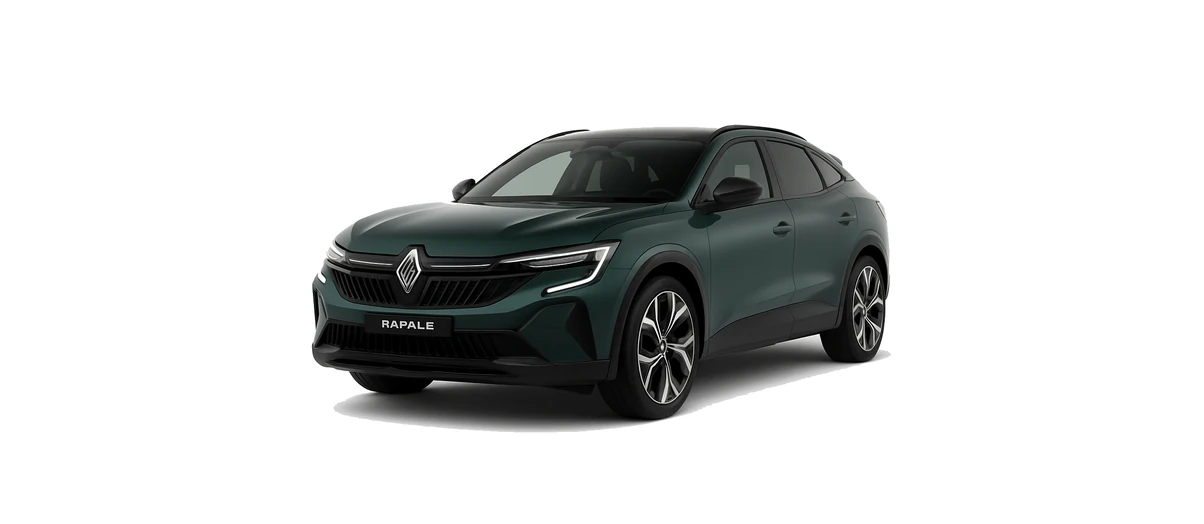
The Renault Rafale is a large coupe SUV with an important charging distinction: not every Rafale plugs in. In the UK range, the chargeable version is the Renault Rafale hyper hybrid E-Tech 4×4 300hp plug-in hybrid. Renault also sells a full hybrid E-Tech 200hp version, which is not externally rechargeable and does not need a charging cable.
This guide focuses on the plug-in hybrid Rafale. It explains the battery and charging figures Renault publishes for the UK market, how home and public charging work, and which cable type is the practical match for the vehicle’s AC charging system. The key point is simple: the Rafale PHEV is an AC-only plug-in hybrid, so owners should be looking at Type 2 AC charging rather than CCS rapid charging.
View Renault Rafale Charging Cables
Renault Rafale Battery and Charging Specifications
For the UK-market plug-in Rafale, Renault states a 22 kWh / 400 V battery capacity and an official electric driving range of up to 65 miles WLTP. Renault’s public UK information does not clearly label the 22 kWh figure as gross or usable, so it is best treated simply as the manufacturer-stated battery capacity rather than a confirmed usable capacity.
| Chargeable model | Renault Rafale hyper hybrid E-Tech 4×4 300hp plug-in hybrid |
|---|---|
| Battery capacity stated by Renault | 22 kWh / 400 V |
| Official electric range | Up to 65 miles WLTP |
| AC charging limit | About 7.4 kW |
| Charging connector for AC charging | Type 2 AC |
| DC rapid charging | Not supported / not applicable for the Rafale PHEV |
The Rafale PHEV’s onboard charger is the limiting factor when charging from AC. Even if you connect to a higher-rated AC post, the vehicle is not expected to charge above its approximate 7.4 kW onboard limit.
Battery Options
There are two battery contexts worth separating clearly. The hyper hybrid E-Tech 4×4 300hp is the plug-in hybrid version and is the model that uses an external charging cable. This is the version relevant to Type 2 cable selection and charging routines.
The full hybrid E-Tech 200hp has a much smaller hybrid battery, stated at 1.7 kWh in the research data, but it is not designed to be plugged into a charge point. It recovers energy through driving and braking, so owners of the non-plug-in full hybrid do not need a home wallbox cable or a public charging cable for that vehicle.
If you are unsure which Rafale you have ordered or own, check the exact model name on the order documents, vehicle specification, or Renault account. For charging purposes, look for wording such as plug-in hybrid, PHEV, or hyper hybrid E-Tech 4×4 300hp.
AC Charging Speed
The Renault Rafale plug-in hybrid charges on AC power and has an onboard charging limit of around 7.4 kW. Renault’s UK information gives the following official 0-100% charging times for the PHEV:
| Charging method | Power | Official 0-100% time |
|---|---|---|
| Home wallbox | 7.4 kW | About 2 hours 55 minutes |
| Reinforced domestic socket | 3.7 kW | About 5 hours 35 minutes |
| Standard domestic socket | 2.3 kW | About 9 hours 05 minutes |
For most UK owners, a Type 2 to Type 2 Mode 3 cable suitable for 32 A single-phase AC is the practical match for the Rafale PHEV’s charging capability. Renault also states that a Mode 3 cable for wallbox charging is standard, but it is still useful to understand the correct cable type if you need a spare, a different length, or a replacement.
DC Rapid Charging Speed
DC rapid charging is not part of the Renault Rafale PHEV charging setup. Renault’s UK charging information describes AC charging and excludes DC fast charging for this plug-in hybrid, so there is no CCS rapid-charging rate or 10-80% rapid-charge time to quote.
This means you should not plan Rafale PHEV charging around motorway rapid chargers in the way you might with a pure battery-electric car. A public rapid charger may have a CCS connector, but that does not make it suitable for the Rafale PHEV. The relevant public charging equipment is an AC post with a Type 2 socket or compatible tethered Type 2 connector.
Range and Efficiency
Renault gives the Rafale hyper hybrid E-Tech 4×4 300hp plug-in hybrid an official electric range of up to 65 miles WLTP. As with any plug-in hybrid, real-world electric range will vary depending on speed, temperature, route, load, tyre condition and how much heating or air conditioning is being used.
The benefit of a plug-in hybrid with a relatively strong electric range is that many routine journeys can potentially be completed using electric power when the battery is charged. Longer trips can then rely on the hybrid petrol-electric system once the available plug-in charge has been used. To get the best from the vehicle, regular charging matters: if the battery is rarely plugged in, the Rafale PHEV will behave more like a conventional hybrid and you will miss much of the electric-driving benefit.
Charging at Home
Home charging is likely to be the most convenient way to run the Rafale PHEV. A 7.4 kW home wallbox matches the vehicle’s AC charging limit and gives Renault’s shortest official full-charge time of about 2 hours 55 minutes from 0-100%.
Because the Rafale PHEV battery is much smaller than a pure electric car battery, many owners will not need to charge from empty every time. A typical evening or overnight top-up may be enough to restore the electric range used during the day. If you have an off-peak electricity tariff, scheduled overnight charging may also help reduce running costs, provided the schedule is set up correctly through the charger, vehicle or energy supplier system.
A standard UK 3-pin charger is much slower, with Renault quoting around 9 hours 05 minutes for a 0-100% charge from a 2.3 kW domestic socket. A 3-pin charger is generally best suited as a backup or occasional charging solution, but can be used regularly if a qualified electrician has confirmed the socket and electrical installation are suitable for sustained EV charging.
Public Charging
For public charging, focus on AC charge points. Many destination chargers at supermarkets, hotels, car parks, workplaces and town-centre locations use Type 2 AC sockets. These are the most relevant public chargers for the Rafale PHEV.
If the public charge point is untethered, you will normally need your own Type 2 to Type 2 cable. If it is tethered with a Type 2 connector, you can use the connector attached to the unit. The vehicle will still charge only up to its onboard AC limit, so a higher-powered AC post will not make the Rafale charge like a rapid-charging battery-electric car.
Public AC charging is most useful when the car will be parked for a while: during work, shopping, a meal, a hotel stay or a longer appointment. Short stops at rapid-charging hubs are usually not the best fit for this vehicle, because the Rafale PHEV does not use CCS/DC rapid charging.
Vehicle-Specific Features
The Rafale plug-in hybrid is based on Renault-Nissan-Mitsubishi CMF-CD platform information published for the model family. In the 300hp PHEV, the rear electric motor contributes to the vehicle’s 4×4 operation, helping distinguish it from the non-plug-in full hybrid version.
From a charging perspective, the most important vehicle-specific feature is not a complicated one: this is a plug-in hybrid with AC-only charging. That makes cable selection more straightforward than it is for some pure electric cars. You do not need to choose a cable for DC rapid charging, and you should not expect an 11 kW or 22 kW AC charging result from the vehicle even where those posts are available.
Charging Tips
- Choose the right cable: for the Rafale PHEV, a Type 2 to Type 2 Mode 3 cable suitable for 32 A single-phase AC is the practical match for the 7.4 kW onboard charger.
- Do not confuse the two hybrids: the full hybrid E-Tech 200hp does not plug in and does not require a charging cable.
- Use a wallbox for regular home charging: a 7.4 kW wallbox gives the shortest official 0-100% charging time.
- Treat 3-pin charging cautiously: it is slow and should only be used with a suitable, checked electrical installation.
- Use public AC chargers when parked for longer: destination charging suits a PHEV better than brief rapid-charger stops.
- Avoid relying on CCS chargers: the Rafale PHEV is AC-only, so CCS rapid charging is not applicable.
Frequently Asked Questions
Does every Renault Rafale need a charging cable?
No. Only the Renault Rafale hyper hybrid E-Tech 4×4 300hp plug-in hybrid is externally rechargeable. The full hybrid E-Tech 200hp is self-charging through driving and braking, so it does not need a plug-in charging cable.
What charging cable does the Renault Rafale PHEV use?
For UK AC charging, the practical choice is a Type 2 to Type 2 Mode 3 cable suitable for 32 A single-phase AC. This matches the Rafale PHEV’s approximate 7.4 kW onboard charging limit.
Can the Renault Rafale use a rapid charger?
The Rafale plug-in hybrid is not confirmed for DC rapid charging. Renault’s UK information describes AC charging only and excludes DC fast charging, so CCS rapid charging is not applicable.
How long does the Renault Rafale PHEV take to charge at home?
Renault quotes about 2 hours 55 minutes for a 0-100% charge using a 7.4 kW wallbox. Charging from a standard domestic socket is much slower, at around 9 hours 05 minutes from 0-100%.
Is a 22 kW cable useful for the Renault Rafale?
A higher-rated cable may still work if it is compatible, but the vehicle will not charge at 22 kW. The Rafale PHEV is limited by its onboard AC charger to around 7.4 kW.
What This Means for Drivers
The Renault Rafale plug-in hybrid is best understood as a vehicle that benefits from regular AC charging rather than rapid-charging stops. If you own the chargeable hyper hybrid E-Tech 4×4 300hp version, a 7.4 kW home wallbox and a suitable Type 2 to Type 2 cable will cover the core charging needs for most UK use cases.
The main things to remember are that the Rafale is not a pure electric vehicle, the non-plug-in full hybrid does not need a cable, and the PHEV does not use CCS rapid charging. Once those points are clear, cable selection becomes simple: choose a quality Type 2 AC cable that suits the vehicle’s 7.4 kW single-phase charging capability and your preferred cable length.
Looking for a Charging Cable for Renault Rafale?
We offer Renault Rafale charging cables for the plug-in hybrid model, including Type 2 options suitable for home wallboxes and public AC charge points.
View Renault Rafale Charging Cables
Please note that this information is intended as a guide. Charging specifications may change due to model and year of manufacture. For precise information, always refer to your vehicle user manual.

