
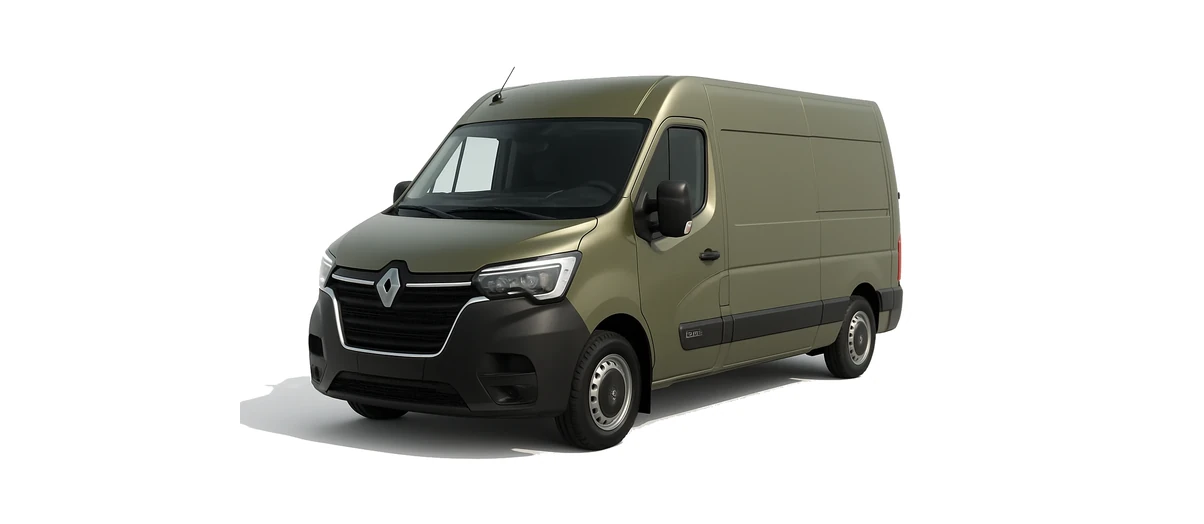
The Renault Master E-Tech is the 100% electric version of Renault’s large van, aimed at businesses, fleets and drivers who need load-carrying practicality without tailpipe emissions. The current UK model should be treated separately from earlier Master Z.E. and older Master E-Tech versions with smaller 33 kWh or 52 kWh batteries. For the present UK range, Renault literature focuses on an 87 kWh battery, strong AC charging capability and 130 kW DC rapid charging.
For many operators, the key charging question is not simply “how fast can it charge?”, but “how does it fit into a working day?” A Renault Master E-Tech used for local deliveries, trade work or urban operations may spend most of its time charging at a depot or home base. In that setting, the van’s AC charging capability can be especially useful, provided the electrical supply and vehicle specification match the charging plan.
View Renault Master E-Tech Charging Cables
Renault Master E-Tech Battery and Charging Specifications
| Vehicle | Renault Master E-Tech electric |
|---|---|
| Vehicle type | Large electric van; UK range includes panel van and selected chassis, platform and conversion variants |
| Battery | 87 kWh usable capacity; EV Database-derived data lists 90 kWh gross / 87 kWh usable |
| AC charging connection | Type 2 |
| DC rapid charging connection | CCS |
| Maximum AC charging | Up to 22 kW on standard/non-V2L versions; Renault brochure indicates some V2L-specific versions may be 11 kW AC |
| Maximum DC charging | Up to 130 kW |
| Official rapid charging figure | Renault quotes 15-80% in 38 minutes under suitable conditions |
| WLTP range | Renault lists 255 miles for N1 versions and up to 285 miles for N2 versions, with the headline 285-mile figure associated with the L2H2 4-tonne context |
Battery Options
The current UK Renault Master E-Tech electric is centred around an 87 kWh battery. Renault UK literature describes the van with an 87 kWh battery or storage capacity, while EV Database-derived information lists a 90 kWh gross battery with 87 kWh usable. In day-to-day ownership, the usable figure is the more relevant one because it represents the approximate energy available for driving.
It is important not to confuse this model with older electric Master vans. Previous Master Z.E. and earlier Master E-Tech versions used smaller battery packs, and some European-market references mention other capacities. For the current UK fourth-generation Master E-Tech electric, the 87 kWh version is the relevant model for charging planning.
AC Charging Speed
AC charging is where the Renault Master E-Tech can be particularly attractive for fleet and depot use. Renault UK states 22 kW AC charging as a headline capability, which is notably higher than the 7.4 kW or 11 kW AC charging found on many electric vehicles. A 22 kW AC charge point requires a compatible three-phase supply, so this figure is most relevant to workplaces, depots and some commercial sites rather than a typical UK house.
Renault quotes a 22 kW three-phase AC charging time of around 4 hours 35 minutes for a full-range charging scenario. That can be valuable for shift-based operations where a van returns to base during the day, or where multiple vehicles need reliable overnight charging without relying entirely on DC rapid chargers.
There is an important specification caveat. Renault’s UK brochure indicates that V2L-specific versions may be listed with 11 kW AC charging rather than 22 kW AC. If you are ordering the van for a business and the charging plan depends on 22 kW AC, check the exact vehicle specification, trim and options before purchase.
DC Rapid Charging Speed
For longer routes or unexpected high-mileage days, the Renault Master E-Tech supports CCS DC rapid charging at up to 130 kW. Renault quotes a 15-80% rapid charging time of 38 minutes in suitable conditions. EV Database-derived data gives a 10-80% fast-charge estimate of around 35 minutes, but Renault’s own official UK figure is the 15-80% time.
On DC rapid chargers, you do not need to carry a separate DC cable. Public rapid and ultra-rapid chargers use a tethered CCS cable attached to the charger. The van is connected directly to that cable, and the charger manages the DC session.
As with all EVs, the maximum charging rate is not held for the whole session. Speed depends on battery state of charge, battery temperature, charger output, site load sharing and general conditions. For efficient journey planning, it is usually quicker to use rapid charging for the middle part of the battery rather than charging to 100% at a public rapid charger unless you genuinely need the extra range.
Range and Efficiency
Renault quotes up to 285 miles WLTP for the Master E-Tech electric, but that should not be treated as a universal figure for every version. The UK brochure differentiates between variants, listing 255 miles for N1 versions and 285 miles for N2 versions. The headline 285-mile range is tied to the L2H2 87 kWh 4-tonne context.
Real-world range in a large electric van can vary significantly. Payload, body height, conversion equipment, roof accessories, motorway speed, weather, route profile and use of heating or air conditioning can all make a noticeable difference. EV Database-derived information gives a real-world range estimate of around 158 miles, which may be a more cautious planning figure for mixed or demanding use.
For fleets, the practical approach is to map routes around your own duty cycles. A van doing predictable local rounds may use far less energy than one carrying heavy loads at motorway speeds. If the vehicle will be converted, refrigerated, fitted with racking or used close to its payload limits, allow extra margin when planning charging.
Charging at Home
Although the Renault Master E-Tech can support higher AC charging on suitable versions, most UK homes are single-phase. That means a typical dedicated home wallbox will charge at up to 7.4 kW rather than 22 kW. Renault quotes around 13 hours 54 minutes for a full-range charge scenario on a 7.4 kW single-phase supply, so overnight charging is the most realistic pattern for home-based users.
A dedicated wallbox is usually the most convenient home charging solution. It can be installed in a suitable position, may support scheduled charging for off-peak tariffs and avoids relying on a domestic socket for a high continuous load. For a large battery van, this matters because charging sessions are often longer than they would be for a small electric car.
A 3-pin charger is generally best suited as a backup or occasional charging solution, but can be used regularly if a qualified electrician has confirmed the socket and electrical installation are suitable for sustained EV charging. For a Renault Master E-Tech, a 3-pin connection will be slow, so it is unlikely to be the preferred option for regular commercial operation.
If the van is being kept at an employee’s home, businesses should also consider parking position, cable routing, charging reimbursement, insurance implications and whether the home electrical supply can support regular overnight charging.
Public Charging
For untethered AC public charge points, the Renault Master E-Tech uses a Mode 3 Type 2 cable. This is the cable you would use at many workplace, destination and public AC posts. Depending on options and supply, Renault notes that a Mode 3 Type 2 cable may be supplied, but operators should confirm what is included with the specific vehicle.
At three-phase AC posts, a compatible Renault Master E-Tech specification may be able to make use of up to 22 kW charging. This can be useful at depots, council sites, workshops, logistics bases and other locations where the van is parked for several hours. If the vehicle is a V2L-specific version listed at 11 kW AC, it will not take the full 22 kW even when connected to a 22 kW post.
For rapid charging, use CCS DC chargers with tethered cables. A 150 kW public charger can support the van’s maximum 130 kW DC rate where conditions allow, and Renault quotes up to 285 miles of WLTP range in 1 hour 10 minutes on a 150 kW DC public charger under optimal conditions. In practice, charging time and miles added will depend heavily on the version, load and driving conditions.
Vehicle-Specific Features
Vehicle-to-load, or V2L, is available on specific Renault Master E-Tech versions. Renault’s user manual describes V2L output of up to 16 A / 3.7 kW AC, with power available through version-dependent equipment such as a cargo-area socket or external/reversible connector. This can be useful for tools, equipment or site accessories where the vehicle specification supports it.
V2L should be understood as an equipment-powering feature, not a substitute for a properly installed building supply. Renault’s manual warns against attempting to power a home using the V2L function. If V2L is important for your work, also check the associated charging specification carefully, because Renault’s UK brochure indicates that V2L-specific versions may have 11 kW AC charging rather than 22 kW AC.
Renault UK information reviewed for this guide does not confirm a heat pump for the UK Master E-Tech, and an independent professional review states that Renault does not offer one. For winter range planning, it is therefore sensible to allow a margin for cold weather and cabin heating demand.
Charging Tips
- Plan around your real duty cycle: Payload, speed, temperature and conversions can reduce range, so avoid planning every day around the maximum WLTP figure.
- Check the exact AC specification: The headline figure is up to 22 kW AC, but V2L-specific versions may be limited to 11 kW AC.
- Use 7.4 kW as the home baseline: Most UK homes will not support 22 kW charging without a suitable three-phase supply.
- Carry the right Type 2 cable: A Mode 3 Type 2 cable is needed for untethered AC public and workplace posts.
- You do not need a DC cable: CCS rapid chargers have their own tethered cables.
- Rapid charge efficiently: For time-sensitive journeys, charging from a low-to-mid battery level to around 80% is usually quicker than waiting for the final part of the battery.
- Think about depot load management: Multiple large vans charging together may need smart charging, scheduling or electrical upgrades.
Frequently Asked Questions
What charging cable does the Renault Master E-Tech use?
For AC charging, the Renault Master E-Tech uses a Type 2 connection. For DC rapid charging, it uses CCS. A Mode 3 Type 2 cable is used at untethered AC posts, while DC rapid chargers have tethered CCS cables.
Can the Renault Master E-Tech charge at 22 kW AC?
Renault UK gives 22 kW AC as a headline capability, and this is a major advantage for depot or workplace charging where three-phase infrastructure is available. However, the UK brochure indicates that some V2L-specific versions may be 11 kW AC, so confirm the exact van specification.
How long does rapid charging take?
Renault quotes 15-80% DC rapid charging in 38 minutes under suitable conditions. EV Database-derived data gives a 10-80% estimate of around 35 minutes, but the official Renault UK figure is the 15-80% time.
Can I charge it from a normal 3-pin socket?
Yes, with suitable equipment, but it will be very slow for a large 87 kWh van battery. A 3-pin charger is generally best suited as a backup or occasional charging solution, but can be used regularly if a qualified electrician has confirmed the socket and electrical installation are suitable for sustained EV charging.
Is the 285-mile range available on every Renault Master E-Tech?
No. Renault’s UK brochure lists 255 miles WLTP for N1 versions and up to 285 miles for N2 versions, with the 285-mile headline linked to the L2H2 4-tonne context. Real-world range will depend on load, speed, weather and conversion type.
What This Means for Drivers
The Renault Master E-Tech is best understood as an electric working vehicle that rewards proper charging planning. For home-based users, a 7.4 kW wallbox will usually be the practical charging solution, with overnight charging forming the backbone of daily use. For businesses with depots or three-phase workplace charging, the potential for up to 22 kW AC can be a major operational advantage, reducing dependence on public rapid chargers.
The main caution is specification detail. If you need V2L for tools or equipment, check whether that version changes the AC charging capability to 11 kW. If you need the longest possible range, check the exact weight class and body style rather than relying on a single headline number. With the right Type 2 cable, suitable depot infrastructure and realistic range planning, the Master E-Tech can fit well into many UK commercial charging routines.
Looking for a Charging Cable for Renault Master E-Tech?
We offer Renault Master E-Tech charging cables for Type 2 AC charging, suitable for use with compatible home, workplace and public AC charge points.
View Renault Master E-Tech Charging Cables
Please note that this information is intended as a guide. Charging specifications may change due to model and year of manufacture. For precise information, always refer to your vehicle user manual.

