
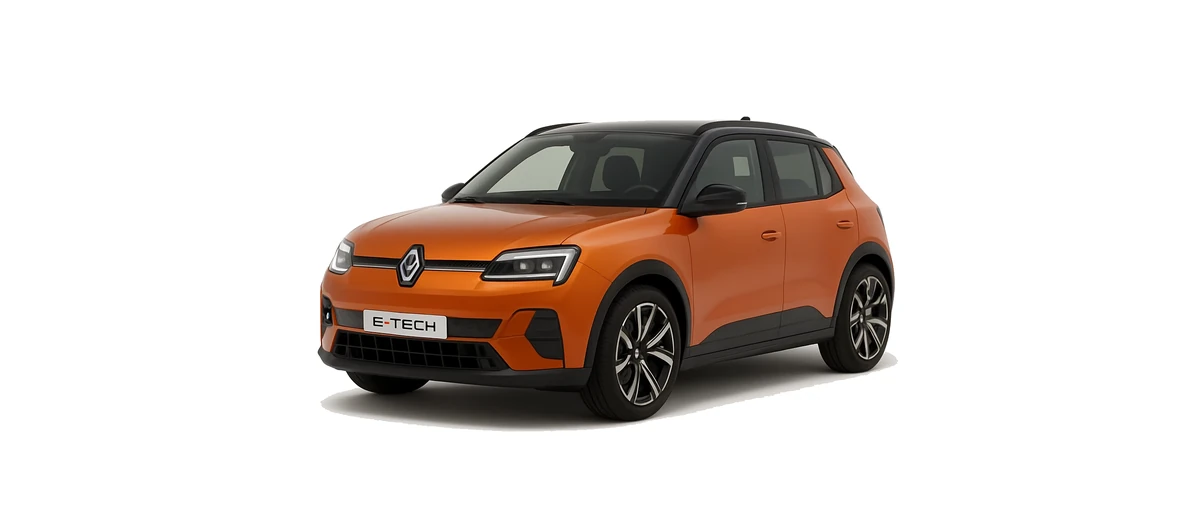
The Renault 5 E-Tech is a fully electric 5-door supermini with a retro-inspired design and two main UK battery versions: the EV40 120hp Urban Range and the EV52 150hp Comfort Range. Both use a Type 2 connection for AC charging and a CCS connection for DC rapid charging, but their battery capacities, WLTP ranges and peak rapid-charging rates are different.
This guide explains how to charge the Renault 5 E-Tech at home, at public AC charge points and on DC rapid chargers. It also separates the 40 kWh and 52 kWh versions so you can match the advice to the car you actually drive.
View Renault 5 E-Tech Charging Cables
Renault 5 E-Tech Battery and Charging Specifications
UK Renault information lists the Renault 5 E-Tech as a battery-electric vehicle only. It is not a plug-in hybrid, full hybrid or range-extender model. Current UK information shows two battery versions: a 40 kWh usable battery for EV40 Urban Range models and a 52 kWh usable battery for EV52 Comfort Range models.
| Version | Usable battery | WLTP range | AC charging | DC rapid charging | Official Renault DC time |
|---|---|---|---|---|---|
| Renault 5 E-Tech EV40 120hp Urban Range | 40 kWh usable | Up to 192 miles | Up to 11 kW | Up to 80 kW | 15-80% in around 31 minutes |
| Renault 5 E-Tech EV52 150hp Comfort Range | 52 kWh usable | Up to 252 miles | Up to 11 kW | Up to 100 kW | 15-80% in around 30 minutes |
Renault UK also states that the car comes with a 6.5 m mode 3 charging cable. Owners should still check the length, condition and phase rating of any cable they use, especially if buying a spare or replacing an original cable.
Battery Options
The main question for Renault 5 E-Tech charging is: which battery do you have?
The EV40 120hp Urban Range version has a 40 kWh usable battery. Renault lists a WLTP range of up to 192 miles, while independent real-world estimates are lower, at around 160 miles depending on weather, speed, driving style and terrain. This version has a lower peak DC charging rate than the 52 kWh model, with Renault quoting up to 80 kW.
The EV52 150hp Comfort Range version has a 52 kWh usable battery. Renault lists a WLTP range of up to 252 miles, sometimes rounded in marketing to around 250 miles. Independent real-world estimates suggest roughly 205 miles in mixed use, again depending on conditions. This version can rapid charge at up to 100 kW DC where the charger and battery conditions allow.
The difference matters because the 52 kWh car will usually travel further between charges, but it will also take longer to add the same percentage on a home wallbox because the battery is larger. In day-to-day use, both versions are straightforward to charge overnight at home.
AC Charging Speed
All current UK Renault 5 E-Tech versions reviewed here have an 11 kW onboard AC charger. This is useful because many public AC posts are 11 kW or 22 kW three-phase units. However, the car is still limited by its own onboard charger, so a 22 kW AC post will not charge the Renault 5 E-Tech at 22 kW; it will be capped at up to 11 kW.
Most UK homes have a single-phase electricity supply. On a typical 7.4 kW home wallbox, the Renault 5 E-Tech will normally charge at up to 7.4 kW even though the car can accept up to 11 kW on a suitable three-phase supply.
| Version | Typical 7.4 kW home wallbox | 11 kW three-phase AC |
|---|---|---|
| EV40 40 kWh | 15-80% in about 3 hours 55 minutes | 15-80% in about 2 hours 37 minutes |
| EV52 52 kWh | 15-80% in about 5 hours 11 minutes | 15-80% in about 3 hours 13 minutes |
For untethered home chargers and most public AC posts, you will use a Type 2 to Type 2 charging cable. If your home wallbox is tethered, the cable is attached to the charger, so you normally do not need to plug in your own AC cable at home.
DC Rapid Charging Speed
For longer journeys, the Renault 5 E-Tech uses the CCS connector for DC rapid charging. This is the standard rapid-charging connection used by most modern electric cars in the UK and Europe.
The two Renault 5 E-Tech battery versions have different peak DC charging rates. The 40 kWh version is listed at up to 80 kW DC, while the 52 kWh version is listed at up to 100 kW DC. These are peak figures, not guaranteed charging speeds throughout the session. Actual charging speed depends on the charger, battery temperature, state of charge and wider site conditions.
Renault quotes official 15-80% DC rapid-charging times rather than 10-80% figures: around 31 minutes for the 40 kWh version and around 30 minutes for the 52 kWh version. EV Database estimates a typical 10-80% rapid charge at around 35 minutes for both versions.
As with most electric cars, charging usually slows significantly beyond roughly 80%. On a long motorway journey, it is often quicker to make shorter charging stops between low and around 80% rather than waiting for a near-full battery.
Range and Efficiency
The Renault 5 E-Tech’s official WLTP range depends on the battery. The 40 kWh usable battery is listed at up to 192 miles, while the 52 kWh usable battery is listed at up to 252 miles. WLTP figures are useful for comparing vehicles, but everyday range can be lower in winter, at motorway speeds, with heavy use of heating, or when carrying passengers and luggage.
For practical planning, many drivers will see the 40 kWh version as best suited to local driving, commuting and moderate-distance trips with occasional rapid charging. The 52 kWh version gives more flexibility for longer journeys and fewer charging stops, while still remaining compact and efficient for urban use.
The Renault 5 E-Tech also has a heat pump listed in Renault UK technical information. A heat pump can help reduce the energy used for cabin heating in cooler weather compared with more basic resistive heating systems, although real-world benefit varies by temperature and journey type.
Charging at Home
Home charging is likely to be the most convenient and cost-effective way to run a Renault 5 E-Tech. If you can park off-street, a dedicated 7.4 kW home wallbox will suit most UK households and will be fast enough to replenish either battery version overnight.
For the EV40, Renault quotes around 3 hours 55 minutes for a 15-80% charge on a 7.4 kW wallbox. For the EV52, the equivalent figure is around 5 hours 11 minutes. A full 0-100% charge will take longer, but many owners rarely need to charge from completely empty to completely full.
A 3-pin portable charger is generally best suited as a backup or occasional charging solution, but can be used regularly if a qualified electrician has confirmed the socket and electrical installation are suitable for sustained EV charging. Standard domestic sockets were not designed primarily for repeated high-load EV charging, so a professionally installed wallbox is the better long-term solution for most owners.
If you use an untethered wallbox, make sure your Type 2 cable is suitable for the charging speed you expect to use. A three-phase cable is useful if you also plan to use 11 kW public AC charge points, while a single-phase cable may be sufficient for many home-only charging routines.
Public Charging
Public charging for the Renault 5 E-Tech falls into two main categories: AC destination charging and DC rapid charging.
Public AC charging is common in car parks, hotels, workplaces, supermarkets and town centres. These charge points often require you to use your own Type 2 cable. If the post offers 7 kW, the car will charge at around that rate. If the post offers 11 kW or 22 kW three-phase AC, the Renault 5 E-Tech can use up to 11 kW, provided the cable and supply support it.
DC rapid charging is used for faster top-ups on longer journeys. The cable is attached to the charger, so you do not use your own Type 2 cable for DC charging. Choose CCS rapid chargers and remember that the EV40 is listed at up to 80 kW while the EV52 is listed at up to 100 kW.
For route planning, it is worth checking charger availability, payment methods and live status before arriving. Some charging hubs are much more reliable and easier to use than single-connector sites, particularly during busy holiday periods.
Vehicle-Specific Features
The Renault 5 E-Tech is built on Renault’s AmpR Small platform and is designed as a compact electric hatchback with 5 doors and 5 seats. Its charging setup is conventional for the UK and European market: Type 2 for AC charging and CCS for DC rapid charging.
Battery temperature preconditioning is shown on higher Renault 5 E-Tech versions from techno+ models with Google built-in and openR link. It should not be assumed to be standard on every trim. Where fitted, setting a rapid charger as the destination in the car’s navigation system before arrival can help prepare the battery for faster DC charging, especially in cold weather.
Renault also confirms vehicle-to-load, described as power-to-object capability, for the Renault 5 E-Tech. This allows the car to power certain external electrical devices when used with the appropriate connector. The V2L adapter is described as an aftersales accessory, so owners should check availability, compatibility and usage limits before relying on it.
Charging Tips
- Know your battery version: the EV40 and EV52 have different battery sizes, WLTP ranges and DC peak charging rates.
- Use Type 2 for AC charging: this applies to untethered home wallboxes and many public AC posts.
- Use CCS for rapid charging: DC rapid chargers have the cable attached, so your own AC cable is not used.
- Do not expect 22 kW AC: even on a 22 kW public post, the Renault 5 E-Tech is limited to up to 11 kW AC.
- Plan rapid stops to around 80%: charging beyond this point is usually slower and less efficient on long trips.
- Precondition where available: on versions with DC charge preconditioning, set the charger as the navigation destination before arrival.
- Check your cable rating: a three-phase Type 2 cable is useful if you want to take full advantage of 11 kW public AC charging.
Frequently Asked Questions
What charging cable does the Renault 5 E-Tech use?
The Renault 5 E-Tech uses a Type 2 connection for AC charging. For DC rapid charging, it uses the CCS connector. Renault UK says a 6.5 m mode 3 cable is supplied, but owners should check the cable length and rating for their own charging routine.
Can the Renault 5 E-Tech charge at 22 kW AC?
No. The onboard AC charger is rated at up to 11 kW. If you plug into a 22 kW AC post, the car will still be limited to a maximum of 11 kW AC.
How fast does the Renault 5 E-Tech rapid charge?
The 40 kWh version is listed at up to 80 kW DC, while the 52 kWh version is listed at up to 100 kW DC. Renault quotes 15-80% rapid-charging times of around 31 minutes for the 40 kWh version and around 30 minutes for the 52 kWh version.
Is the Renault 5 E-Tech a plug-in hybrid?
No. The UK Renault 5 E-Tech electric range covered here is a battery-electric vehicle. It is not a plug-in hybrid or hybrid model.
Is battery preconditioning standard?
Renault UK information shows DC charge preconditioning from techno+ versions with Google built-in and openR link, so it should be treated as trim-dependent rather than standard across every Renault 5 E-Tech.
What This Means for Drivers
The Renault 5 E-Tech is simple to charge, but the best advice depends on whether you have the 40 kWh or 52 kWh battery. Both versions are well suited to overnight home charging on a 7.4 kW wallbox, both can use faster 11 kW three-phase AC posts, and both use CCS rapid chargers for longer journeys.
The EV40 offers lower range and a lower 80 kW DC peak, but it should still suit many urban and commuting drivers. The EV52 provides a longer official range and a higher 100 kW DC peak, making it the more flexible choice for drivers who often travel further from home.
Looking for a Charging Cable for Renault 5 E-Tech?
If you need a spare, replacement or longer Type 2 cable for your Renault 5 E-Tech, We offer Renault 5 E-Tech charging cables suitable for UK home and public AC charging.
View Renault 5 E-Tech Charging Cables
Please note that this information is intended as a guide. Charging specifications may change due to model and year of manufacture. For precise information, always refer to your vehicle user manual.

