
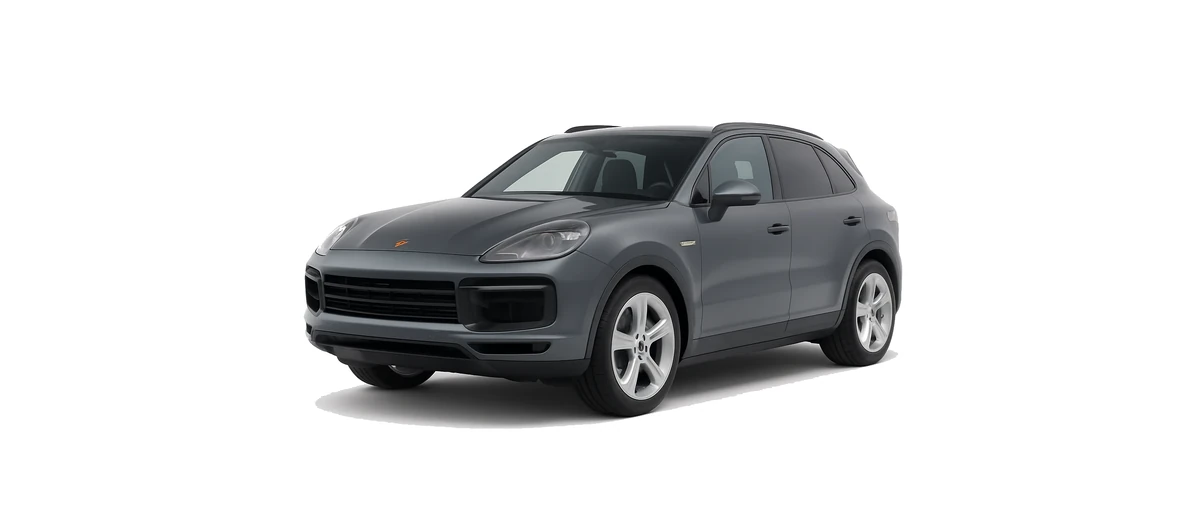
The Porsche Cayenne E-Hybrid is a large plug-in hybrid SUV designed to combine petrol performance with useful electric-only driving for local journeys. In the UK range, Cayenne E-Hybrid, Cayenne S E-Hybrid and Cayenne Turbo E-Hybrid variants sit alongside Coupé body styles, but they should not be confused with the separate Porsche Cayenne Electric battery-electric model. The E-Hybrid is a PHEV, so its charging behaviour is very different from a pure EV.
For current facelift Cayenne E-Hybrid models, Porsche lists a 25.9 kWh high-voltage battery, Type 2 AC charging and an 11 kW onboard AC charger. That is unusually strong AC capability for a plug-in hybrid, but it does not mean every UK driver will see 11 kW at home. Most domestic wallboxes are single-phase and typically provide up to 7.4 kW, while 11 kW charging normally requires a suitable three-phase supply or compatible public AC charge point.
This guide is also a model-year checker. Earlier Cayenne plug-in hybrids used smaller batteries and lower AC charging limits, so the correct cable and realistic charging time depend on the exact age and specification of the vehicle.
View Porsche Cayenne E-Hybrid Charging Cables
Porsche Cayenne E-Hybrid Battery and Charging Specifications
In current UK and European context, the facelift Cayenne E-Hybrid family uses a 25.9 kWh gross high-voltage battery. Porsche technical information for the current plug-in hybrid system also supports an 11 kW AC onboard charger and quotes a full 0-100% AC charging time of around 2 hours 39 minutes at 11 kW. At 9.6 kW, Porsche quotes around 3 hours 15 minutes.
The charging connector used for UK and European AC charging is Type 2. That applies whether you are charging at home from a wallbox, using a workplace AC charger, or connecting to many destination chargers at hotels, gyms, car parks and shopping centres.
However, Cayenne E-Hybrid specifications have changed considerably over the years. If you own or are buying a used Cayenne E-Hybrid or Cayenne S E-Hybrid, do not assume it has the current 25.9 kWh battery or 11 kW charging. The safest approach is to check the vehicle’s model year, option codes, handbook or Porsche build information before estimating charge times.
Battery Options
The current facelift generation, introduced for the 2024 model year, is the version most closely associated with the 25.9 kWh battery. Porsche UK pages list the current Cayenne E-Hybrid family with this larger battery and quote up to 52 miles of WLTP electric range for the Cayenne E-Hybrid model range, although exact range can vary by variant, wheels, equipment and body style.
Older models are different. The 2020 update increased gross battery capacity to 17.9 kWh for Cayenne E-Hybrid models of that period. Before that, 2018 E3-generation launch cars used a 14.1 kWh battery. Earlier still, previous-generation Cayenne plug-in hybrid models are outside the scope of the current figures and should be checked separately.
This matters because battery size affects how long the car needs to be plugged in, while the onboard charger determines the maximum AC power the vehicle can accept. A high-powered wallbox cannot force an older car to charge faster than its onboard charger allows.
AC Charging Speed
For current facelift Cayenne E-Hybrid models with 11 kW AC capability, the fastest AC charging requires three conditions: the car must have the 11 kW onboard charger, the charge point must be able to supply 11 kW AC, and the cable must be suitable for three-phase 11 kW charging. If any part of that chain is limited, the car will charge at the lower available rate.
In practical UK home charging, many owners will use a single-phase 7.4 kW wallbox. A current 11 kW-capable Cayenne E-Hybrid will still charge from this perfectly normally, but it will not receive the full 11 kW. For many PHEV owners this is still convenient, because an overnight charge is usually more than enough to refill the battery before the next day’s driving.
Used Cayenne E-Hybrid models need closer attention. The 2018 launch version had a 3.6 kW standard onboard charger, with 7.2 kW available as an option. The 2020 update supported charging up to 7.2 kW depending on model and equipment. If your car is limited to 3.6 kW, it will not charge at 7.4 kW or 11 kW even if connected to a more powerful wallbox.
DC Rapid Charging Speed
The Cayenne E-Hybrid should be treated as an AC-charging plug-in hybrid, not as a rapid-charging electric car. No CCS/DC rapid-charging inlet or DC rapid-charging performance is confirmed for the Cayenne E-Hybrid PHEV in the supplied UK/EU research context.
This is an important distinction because Porsche also has separate battery-electric models, and the Cayenne Electric is a different vehicle with different charging hardware. Do not use Cayenne Electric rapid-charging figures, 800-volt architecture claims or 10-80% charging times when planning for a Cayenne E-Hybrid.
For journey planning, the Cayenne E-Hybrid is best understood as a petrol SUV with a plug-in hybrid battery that should be topped up on AC power whenever convenient. On longer trips, it can continue using its petrol engine after the usable electric range is depleted, rather than relying on rapid charging stops.
Range and Efficiency
Porsche quotes up to 52 miles of WLTP electric range for the current Cayenne E-Hybrid model range. WLTP figures are useful for comparison, but real-world electric range will depend on speed, temperature, terrain, tyre and wheel choice, cabin heating or cooling, driving style and how much power is demanded from the hybrid system.
For many owners, the biggest benefit of the Cayenne E-Hybrid comes from regular short journeys completed on electric power. School runs, commuting, local errands and town driving are where plugging in frequently can reduce petrol use most noticeably. If the car is not charged, it becomes much more like a conventional hybrid SUV carrying a battery that is not being used to its full potential.
The current hybrid system also includes strong recuperation capability, with Porsche quoting up to 88 kW recuperation for the current E-Hybrid system. Regenerative braking can help recover energy during deceleration, but it is not a substitute for plugging in. Mains charging remains the most efficient way to start each journey with a full battery.
Charging at Home
Home charging is usually the most convenient way to run a Cayenne E-Hybrid. A dedicated Type 2 wallbox allows the car to be plugged in overnight, helping you start most days with the maximum available electric range. A 7.4 kW single-phase home charger is common in the UK and is suitable for current and older Cayenne plug-in hybrids, although actual charging speed will be limited by the vehicle’s onboard charger.
If you have a current 11 kW-capable Cayenne E-Hybrid and access to a suitable three-phase domestic or commercial supply, an 11 kW installation may shorten charging time. Three-phase supply is less common in UK homes, so many owners will not be able to use the car’s full AC charging capability at home. In that case, a standard 7.4 kW wallbox remains a sensible everyday solution.
A 3-pin portable charger can be useful in some circumstances, but it is generally best suited as a backup or occasional charging solution. It can be used regularly if a qualified electrician has confirmed the socket and electrical installation are suitable for sustained EV charging. Avoid relying on old, damaged or unknown sockets, extension leads or overloaded circuits.
Public Charging
For public charging, look for Type 2 AC charge points rather than DC rapid chargers. Many public AC chargers are either 7 kW single-phase or 11/22 kW three-phase. A current Cayenne E-Hybrid with 11 kW capability can make good use of an 11 kW AC post when paired with the correct cable, while older cars may charge at 3.6 kW or 7.2 kW depending on their specification.
Public AC charging is most useful when the car is parked for a while: at work, a hotel, a leisure venue, a town-centre car park or while shopping. Because the Cayenne E-Hybrid is not confirmed as a DC rapid-charging PHEV, it is not a car you should plan to refill quickly at motorway rapid chargers in the way you would with a battery-electric vehicle.
When using untethered public AC charge points, you will usually need your own Type 2 cable. For current 11 kW models, a three-phase Type 2 cable is the appropriate choice if you want to access the fastest supported AC rate where available.
Vehicle-Specific Features
The current Cayenne E-Hybrid and Cayenne S E-Hybrid use a 3.0-litre V6 petrol engine combined with a 130 kW electric motor integrated into the eight-speed Tiptronic S transmission. The Turbo E-Hybrid uses a V8 plug-in hybrid system. These are performance-focused plug-in hybrids, but their charging requirements remain centred on Type 2 AC charging.
The car can also charge its traction battery using the combustion engine in E-Charge mode. That can be useful in specific situations, but from a cost and emissions perspective it is normally better to plug in where possible. Charging from the grid, especially overnight on an appropriate tariff, is generally the more efficient way to maximise electric running.
Features such as heat pump equipment, battery preconditioning for charging, V2L, V2G or V2H support should not be assumed for the Cayenne E-Hybrid unless confirmed for your exact vehicle and market. The key confirmed charging point for UK owners is the Type 2 AC setup, with current models offering up to 11 kW AC charging.
Charging Tips
- Check the model year first: current facelift cars differ significantly from earlier Cayenne E-Hybrid and Cayenne S E-Hybrid models.
- Use the right Type 2 cable: for current 11 kW-capable cars, choose a three-phase Type 2 cable if you want access to the maximum AC charging rate.
- Do not expect DC rapid charging: plan around home, workplace and destination AC charging instead.
- Plug in regularly: the Cayenne E-Hybrid delivers its best electric-running benefit when charged frequently rather than driven with an empty battery.
- Match expectations to the supply: a UK 7.4 kW wallbox will work well, but it will not deliver 11 kW without a suitable three-phase electrical supply.
- Be careful with used cars: some older examples may be limited to 3.6 kW AC, even when connected to a faster charge point.
Frequently Asked Questions
What charging cable does the Porsche Cayenne E-Hybrid use?
UK and European Cayenne E-Hybrid models use a Type 2 AC connection. For the current 11 kW-capable models, a three-phase Type 2 cable is recommended if you want to use 11 kW public or three-phase charging where available.
Can the Porsche Cayenne E-Hybrid use rapid chargers?
The Cayenne E-Hybrid PHEV should be treated as AC-only for charging guidance. No DC rapid-charging capability is confirmed for this plug-in hybrid, so do not plan journeys around rapid charging it.
How long does the current Cayenne E-Hybrid take to charge?
Porsche technical data quotes approximately 2 hours 39 minutes for a 0-100% AC charge at 11 kW, and around 3 hours 15 minutes at 9.6 kW. A typical UK 7.4 kW home wallbox will be slower, and older cars may be slower again depending on onboard charger specification.
Do all Cayenne E-Hybrid models charge at 11 kW?
No. Current facelift models are associated with 11 kW AC charging, but earlier Cayenne E-Hybrid models may be limited to 3.6 kW or 7.2 kW depending on age and equipment. Always check the specific vehicle.
Is the Cayenne E-Hybrid the same as the Cayenne Electric?
No. The Cayenne E-Hybrid is a petrol plug-in hybrid. The Cayenne Electric is a separate battery-electric vehicle with very different charging characteristics.
What This Means for Drivers
The Porsche Cayenne E-Hybrid can be very convenient to charge if you treat it as a plug-in hybrid built around regular AC top-ups. Current models have a larger 25.9 kWh battery and strong 11 kW AC capability, but UK home charging is often limited by single-phase supply. A 7.4 kW wallbox will still be practical for most owners, especially for overnight charging.
The most important step is confirming which Cayenne plug-in hybrid you have. A current facelift car, a 2020-updated used car and a 2018 launch example can have different battery sizes and charging speeds. Once you know the onboard charger rating, choosing the right Type 2 cable and setting realistic charging expectations becomes straightforward.
Looking for a Charging Cable for Porsche Cayenne E-Hybrid?
We offer Type 2 charging cables suitable for Porsche Cayenne E-Hybrid home and public AC charging, including options for current 11 kW-capable models and earlier plug-in hybrid versions.
View Porsche Cayenne E-Hybrid Charging Cables
Please note that this information is intended as a guide. Charging specifications may change due to model and year of manufacture. For precise information, always refer to your vehicle user manual.

