
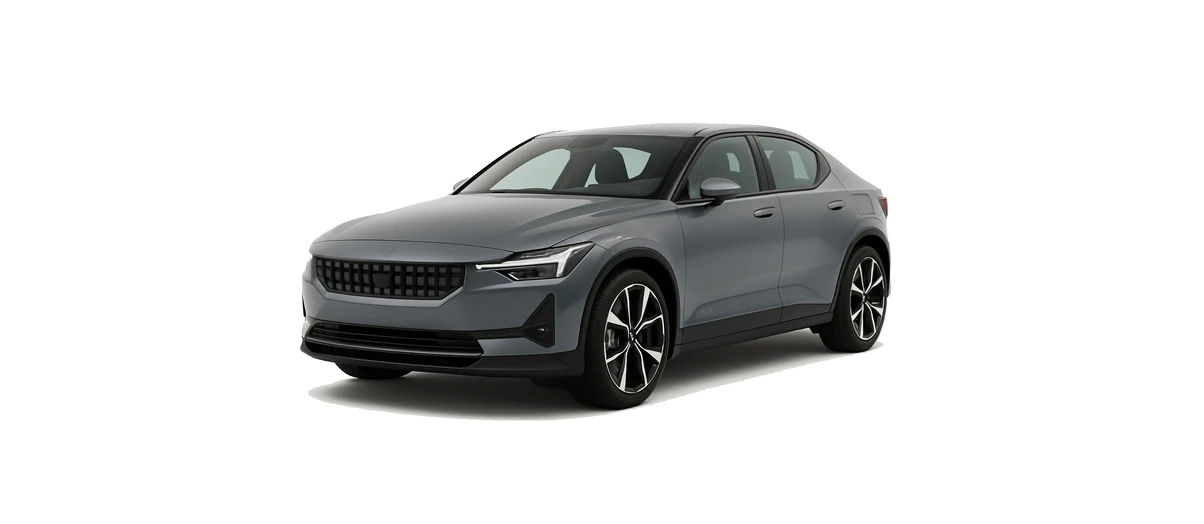
The Polestar 2 is a fully electric 5-door fastback with a simple charging connector set-up but a few important variant differences to understand. Current UK MY26 cars use a Type 2 connection for AC charging and CCS Combo 2 for DC rapid charging, so cable choice is straightforward for home and public AC charging. Charging expectations, however, depend on whether you have a Standard range Single motor, Long range Single motor, Long range Dual motor or Performance version, and whether you are looking at a new MY26 car or an earlier used Polestar 2.
This guide explains Polestar 2 charging in a UK context, including home wallbox speeds, public charging, battery sizes, range, rapid charging behaviour and what cable you need. Figures are based on current UK Polestar and EV Database information for MY26 vehicles, with notes where older cars may differ.
View Polestar 2 Charging Cables
Polestar 2 Battery and Charging Specifications
For current UK MY26 models, the Polestar 2 is offered as a battery electric vehicle only. There is no plug-in hybrid or range-extender version. All current UK variants are listed with an 11 kW onboard AC charger and use a Type 2 inlet for AC charging. For rapid charging, the car uses the CCS Combo 2 connector, with the rapid charger’s tethered cable plugging into the same charge port area.
The charge port is listed by EV Database as being at the left rear of the vehicle. For everyday ownership, this means you will typically use a Type 2 charging cable for untethered home wallboxes and many public AC charge points. For motorway-style rapid charging, you do not need to provide your own cable because CCS rapid chargers have their own attached cable.
| Item | Current UK Polestar 2 information |
|---|---|
| AC connector | Type 2 |
| DC connector | CCS Combo 2 |
| Onboard AC charging | Up to 11 kW |
| Typical UK home charging limit | Usually around 7.4 kW on single-phase wallboxes |
| DC rapid charging | Up to 180 kW on current Standard range; up to 205 kW on current Long range versions |
| Electrical architecture | 400 V platform |
Battery Options
The current UK Polestar 2 line-up is variant-dependent, so it is important not to quote one battery size, range or rapid charging peak for every car.
The MY26 Standard range Single motor uses a 70 kWh gross battery, with EV Database listing around 67 kWh usable capacity. Polestar UK shows an official WLTP range of up to 344 miles for this version, while EV Database estimates a real-world range of around 252 miles, depending on conditions and driving style.
The MY26 Long range Single motor, Long range Dual motor and Long range Dual motor with Performance pack or Performance software use the larger 82 kWh gross battery family, with EV Database listing around 79 kWh usable capacity. The Long range Single motor has the highest official UK WLTP figure in the current range, at up to 409 miles. EV Database estimates around 295 miles in real-world use for that version. Dual motor versions trade some range for extra performance, with Polestar UK listing up to 370 miles WLTP for the Long range Dual motor and up to 352 miles WLTP for the Performance version.
If you are buying a used Polestar 2, check the model year and exact variant before relying on MY26 numbers. Earlier UK cars used different battery packs, including previous 64, 69 and 78 kWh versions, and may also have different rapid charging peaks.
AC Charging Speed
All current UK Polestar 2 variants are listed with an 11 kW onboard AC charger. This is the maximum AC rate the car can accept when the right supply is available. Polestar quotes around 7 hours for a 0-100% AC charge on the 70 kWh Standard range car and around 8 hours for the 82 kWh Long range versions when using 11 kW three-phase AC charging.
For most UK home charging, however, the practical benchmark is a 7 kW or 7.4 kW single-phase wallbox. Many homes do not have a three-phase supply, so the car’s 11 kW AC capability will not usually be reached at home. On a typical 7.4 kW wallbox, a full charge will take longer than Polestar’s 11 kW figures, but this is still more than adequate for overnight charging for most drivers.
A 3-pin portable charger can be useful in certain situations, but it is generally best suited as a backup or occasional charging solution, but can be used regularly if a qualified electrician has confirmed the socket and electrical installation are suitable for sustained EV charging. A dedicated wallbox is normally the safer, faster and more convenient option for routine home charging.
DC Rapid Charging Speed
DC rapid charging is where the biggest difference between current Polestar 2 variants appears. The MY26 Standard range Single motor is listed by Polestar at up to 180 kW DC, with a claimed 10-80% charging time of 26 minutes. EV Database estimates a similar high-power session at around 30 minutes in typical conditions.
The MY26 Long range versions are listed by Polestar UK at up to 205 kW DC, with a claimed 10-80% time of 28 minutes. EV Database lists a very similar maximum of 207 kW and estimates around 32 minutes for a 10-80% session on a suitable high-power CCS charger.
These peak rates are not held for the entire session. Like most EVs, the Polestar 2 charges fastest at a lower state of charge and slows as the battery fills. For long journeys, planning stops from roughly 10% to 80% is usually more efficient than charging to 100% on a rapid charger, unless you genuinely need the extra range to reach the next destination.
Range and Efficiency
The highest official UK WLTP range for the current Polestar 2 is up to 409 miles, but that figure applies to the MY26 Long range Single motor rather than every version. The Standard range Single motor is listed at up to 344 miles WLTP, the Long range Dual motor at up to 370 miles WLTP, and the Long range Dual motor with Performance pack or software at up to 352 miles WLTP.
Real-world range will usually be lower than WLTP, especially in cold weather, at motorway speeds, with heavy use of heating or air conditioning, or when carrying extra load. EV Database estimates around 252 miles for the current Standard range Single motor, around 295 miles for the Long range Single motor and around 280 miles for the Long range Dual motor. Treat these as useful planning estimates rather than guaranteed outcomes.
For daily driving, many owners will not need to use the full battery. Keeping the car topped up at home and using a sensible charging limit for routine use can reduce the need for frequent rapid charging, while still leaving plenty of range for commuting and local journeys.
Charging at Home
For UK owners, the easiest Polestar 2 charging routine is usually a dedicated home wallbox. If the wallbox is tethered, it will have its own attached Type 2 cable. If it is untethered, you will need a separate Type 2 to Type 2 cable to connect the car.
A 7.4 kW home wallbox is the practical benchmark for most UK households. Even though the Polestar 2 can accept up to 11 kW AC, that higher rate normally requires a compatible three-phase supply and charger. If you do have access to three-phase charging at home or work, the car can make use of the higher AC rate, but single-phase installations remain the norm for domestic UK charging.
Home charging is also where tariff choice can make a significant difference. Many EV owners use an off-peak electricity tariff and schedule charging overnight. The Polestar 2 can then begin the day with the desired state of charge without relying on more expensive public rapid charging.
Public Charging
On public AC chargers, the Polestar 2 uses a Type 2 cable. Some AC posts are tethered, but many UK destination chargers are untethered, so carrying your own Type 2 cable is important. A 32 amp Type 2 cable is a sensible choice for making use of 7 kW single-phase AC and suitable public AC points.
On DC rapid and ultra-rapid chargers, the charger provides the CCS cable. You simply connect the tethered CCS plug to the car. The Polestar 2 does not need a separate rapid charging cable, and a Type 2 cable cannot be used for DC rapid charging.
Current UK Polestar 2 specifications also list Plug & Charge compatibility using ISO 15118. Where supported by the charging network and account set-up, this can simplify authentication. Availability depends on the specific charger network and service arrangement, so it should be treated as a compatibility feature rather than a guarantee that every charger will start automatically.
Vehicle-Specific Features
Battery preconditioning is supported on the Polestar 2 and is particularly useful before rapid charging. Polestar’s information indicates that preconditioning can be triggered automatically when a rapid charger is set as the destination in the built-in Google Maps navigation system. This helps the battery reach a more suitable temperature before arrival, improving the chance of a strong charging session.
A heat pump is not universal standard equipment on all UK Polestar 2 cars. Polestar UK lists it as part of the Climate pack, while EV Database marks it as optional. If winter efficiency is important to you, especially on a used car, check the exact specification of the vehicle.
Current reliable data does not support claims of V2L, V2G or V2H capability for the Polestar 2. EV Database lists these functions as not available, so owners should not assume the car can power external appliances, feed energy back to the grid or act as a home energy backup system.
Charging Tips
- Use the right cable: choose a Type 2 cable for AC charging at home and on public AC posts. CCS rapid charging uses the charger’s tethered cable.
- Plan around 7.4 kW at home: most UK homes are single-phase, so expect slower charging than the 11 kW headline AC capability unless you have three-phase charging.
- Use the 10-80% rapid charging window: this is usually the most time-efficient range for long-distance journeys.
- Precondition before rapid charging: set a rapid charger as your destination in the built-in navigation to help prepare the battery.
- Check the variant: current Standard range and Long range cars have different battery sizes and DC charging peaks.
- Be careful with used-car figures: earlier Polestar 2 model years may have different batteries and lower rapid charging rates than current MY26 cars.
Frequently Asked Questions
What charging cable does the Polestar 2 use?
The Polestar 2 uses a Type 2 connector for AC charging. For DC rapid charging, it uses CCS Combo 2, and the rapid charger provides the cable.
Can the Polestar 2 charge at 11 kW at home?
The car can accept up to 11 kW AC, but most UK homes have a single-phase supply and will typically be limited to around 7.4 kW with a suitable wallbox. Charging at 11 kW usually requires a compatible three-phase supply.
How fast does the Polestar 2 rapid charge?
For current MY26 UK cars, the Standard range Single motor is listed at up to 180 kW DC, while Long range versions are listed at up to 205 kW DC. Polestar claims 10-80% in 26 minutes for the Standard range and 28 minutes for Long range versions, although real-world sessions may be closer to around 30-32 minutes depending on charger output, battery temperature and state of charge.
Does every Polestar 2 have the same range?
No. Current UK WLTP figures vary by variant, from up to 344 miles for the Standard range Single motor to up to 409 miles for the Long range Single motor. Dual motor and Performance versions have different official figures.
Does the Polestar 2 have battery preconditioning?
Yes, battery preconditioning is supported. For rapid charging, it can be triggered automatically by setting a rapid charger as the destination in the built-in Google Maps navigation system.
What This Means for Drivers
For most Polestar 2 owners, cable selection is simple: carry a Type 2 cable for AC charging and use the tethered CCS cable on rapid chargers. The more important part is understanding your specific car. Current MY26 Standard range and Long range versions have different batteries and rapid charging peaks, while older used cars may differ again.
At home, a 7.4 kW wallbox will suit most UK drivers, even though the car is capable of 11 kW AC on the right three-phase supply. On long journeys, use high-power CCS chargers, navigate to the charger to support battery preconditioning, and aim for efficient 10-80% stops rather than waiting for the final percentage points.
Looking for a Charging Cable for Polestar 2?
If you need a cable for home or public AC charging, choose a Type 2 charging cable suitable for the Polestar 2 and your charging set-up. We offer Polestar 2 charging cable options for UK drivers using home wallboxes and public AC charge points.
View Polestar 2 Charging Cables
Please note that this information is intended as a guide. Charging specifications may change due to model and year of manufacture. For precise information, always refer to your vehicle user manual.

