
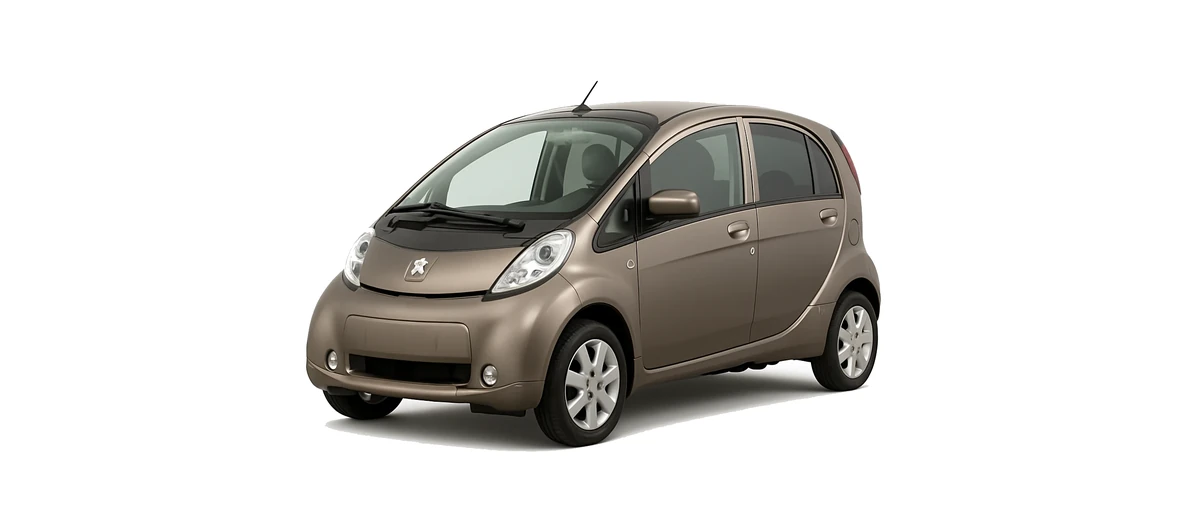
The Peugeot Ion, often written as Peugeot iOn, is a small five-door electric city car from the early generation of UK battery-electric vehicles. It was closely related to the Mitsubishi i-MiEV and Citroën C-Zéro, and it uses charging hardware that is different from most newer UK and European EVs. The key point for owners is that the Ion has a Type 1 AC inlet for normal charging and a separate CHAdeMO inlet for DC rapid charging. It does not use a Type 2 vehicle inlet or CCS rapid charging.
Because the Ion has a modest battery and a relatively low AC charging limit, charging is usually straightforward once you have the right cable. The main practical issue is matching the car’s older Type 1 inlet with the Type 2 sockets used on many UK home and public AC chargepoints. For most untethered AC charging, a Type 2-to-Type 1 cable is the cable Ion owners are likely to need.
View Peugeot Ion Charging Cables
Peugeot Ion Battery and Charging Specifications
UK-market Peugeot Ion models were sold as full electric vehicles, not plug-in hybrids or range-extenders. EV Database lists both the earlier 2011-2016 and later 2016-2019 UK entries with a 16.0 kWh nominal battery and around 14.5 kWh usable capacity. Some charging references describe the pack as 14.5 kWh, which is best understood as the usable capacity rather than a separate larger-battery version.
| Vehicle type | Battery-electric vehicle |
|---|---|
| Body style | 5-door city hatchback |
| Battery | 16.0 kWh nominal / around 14.5 kWh usable |
| AC charging inlet | Type 1 / SAE J1772 / Yazaki |
| Maximum AC charging rate | About 3.7 kW single-phase |
| DC rapid charging | CHAdeMO, up to around 40 kW |
| WLTP range | 62 miles for the later EV Database UK entry |
| Real-world range guidance | About 50 miles when new, depending heavily on conditions and battery health |
Battery Options
There is no widely supported evidence in the supplied UK charging references of multiple battery capacities for the Peugeot Ion. The practical figure to work with is the small 16.0 kWh nominal battery, with around 14.5 kWh usable. That small battery is central to the way the car fits into daily use: it can be easy to refill overnight, but the available driving range is much shorter than on modern EVs.
When considering a used Peugeot Ion, battery condition matters more than headline figures from when the car was new. A car with a healthy battery may still suit short commutes, school runs and local errands, while a degraded battery will reduce the already limited range. If buying used, it is sensible to check state of health where possible, review service history, inspect charging ports and confirm that both AC and CHAdeMO charging operate correctly.
AC Charging Speed
The Peugeot Ion’s AC charging is limited by its onboard charger to about 3.7 kW. This means the car will not charge faster on a 7.4 kW, 11 kW or 22 kW AC post. Those chargepoints can still be useful, but the Ion will only draw what its onboard hardware can accept.
On a 3.7 kW AC supply, EV Database estimates an empty-to-full charging time of around 4 hours 45 minutes. Peugeot’s early material quoted around 6 hours from a normal 240 V mains supply, while a lower-power 2.3 kW plug socket charge is typically longer, with EV Database estimating around 7 hours 30 minutes. In real use, charging time depends on starting state of charge, ambient temperature, battery condition and the equipment used.
For cable selection, the important detail is the vehicle inlet: the Peugeot Ion uses Type 1 for AC charging. Most untethered UK home chargepoints and many public AC posts use a Type 2 socket, so Ion drivers generally need a Type 2-to-Type 1 charging cable. A Type 2-to-Type 2 cable will not plug into the car.
DC Rapid Charging Speed
For rapid charging, the Peugeot Ion uses CHAdeMO rather than CCS. The DC charging inlet is separate from the Type 1 AC inlet, and official rescue information describes the regular and quick charging flaps as being on different rear sides of the vehicle. CHAdeMO rapid charging is usually supplied by a tethered cable on the rapid charger itself, so you do not normally provide your own cable for DC rapid charging.
The Ion’s DC charging capability is commonly listed at up to around 40 kW. EV Database gives an estimated 10-80% rapid charging time of about 21 minutes, while some earlier Peugeot and CHAdeMO material quoted around 30 minutes to 80%. The exact time will vary according to charger output, battery temperature, starting charge level and the vehicle’s battery condition.
CHAdeMO availability is an important planning point. Many modern UK rapid-charging sites focus on CCS, and some sites may have fewer CHAdeMO connectors or none at all. Before setting off on a longer journey, use charger mapping apps and filter specifically for CHAdeMO rather than assuming every rapid charger will work with the Ion.
Range and Efficiency
The Peugeot Ion’s range figures need careful interpretation. Early Peugeot material quoted 150 km, or around 93 miles, on the older NEDC test cycle. That figure should be treated as a historical laboratory-cycle claim, not a realistic trip-planning range. EV Database lists a later WLTP figure of 62 miles and gives a real-world estimate of around 50 miles when new.
In everyday UK use, range can vary significantly. Cold weather, motorway speeds, heavy rain, cabin heating use, hilly routes, tyre condition and battery age can all reduce available mileage. Short urban journeys are where the Ion is most at home. For local driving with predictable routes and access to regular charging, its small battery can still be practical. For longer journeys, the limited range and reliance on CHAdeMO need more planning.
Charging at Home
Home charging is usually the most convenient way to run a Peugeot Ion. Even though the car cannot take the full output of a typical 7 kW home wallbox, a dedicated wallbox is still useful because it provides a safer and more convenient charging routine than relying on occasional public charging. With the Ion, the car will simply charge at up to about 3.7 kW rather than at the wallbox’s full rated output.
If your home chargepoint is untethered and has a Type 2 socket, you will normally need a Type 2-to-Type 1 cable. If your home chargepoint is tethered, check the connector on the end of the cable before installation or purchase. A tethered Type 2 home charger is common for newer EVs, but it will not connect directly to the Peugeot Ion’s Type 1 inlet.
A 3-pin EV charging lead is generally best suited as a backup or occasional charging solution, but can be used regularly if a qualified electrician has confirmed the socket and electrical installation are suitable for sustained EV charging. Because EV charging can place a long continuous load on a household circuit, using a random or ageing socket without inspection is not advisable.
Public Charging
On public AC chargepoints, the Ion’s cable requirement is again the main issue. Untethered public posts usually provide a Type 2 socket, so a Type 2-to-Type 1 cable is the correct style for connecting the post to the car. Once connected, the Ion will charge at up to about 3.7 kW, even if the post is rated much higher.
For DC rapid charging, look for CHAdeMO on the charger information or in the charging app. The Ion is not CCS-compatible, so a CCS-only rapid charger will not be suitable. Many rapid chargers that still support CHAdeMO have the connector permanently attached to the unit; you select the CHAdeMO cable and connect it to the car’s rapid-charge inlet.
Because public charging infrastructure has changed considerably since the Ion was introduced, it is worth checking compatibility before travelling. A site that looks suitable because it has “rapid charging” may still not have CHAdeMO. Similarly, a public AC post may work electrically, but you will need your own suitable Type 2-to-Type 1 cable if the post is untethered.
Vehicle-Specific Features
The Peugeot Ion is an early-generation city EV, and its features reflect that period. It uses rear-wheel-drive packaging derived from the Mitsubishi i-MiEV family, has four-seat city-car proportions and was designed primarily for short urban and suburban journeys. Its charging layout is also from an earlier EV era: Type 1 for AC and CHAdeMO for rapid DC charging.
The research data does not support claims for modern charging features such as vehicle-to-load, vehicle-to-home, vehicle-to-grid or battery preconditioning. For ownership purposes, it is best to view the Ion as a simple battery-electric city car with straightforward AC charging and optional-use CHAdeMO rapid charging, rather than as a modern long-range EV with the latest charging ecosystem.
Charging Tips
- Use the correct AC cable: for most untethered UK AC chargepoints, choose a Type 2-to-Type 1 cable.
- Do not expect faster AC charging from higher-rated posts: the Ion is limited to about 3.7 kW AC.
- Filter for CHAdeMO on longer trips: do not assume a rapid charger will have the right connector.
- Plan with realistic range: use around 50 miles as a sensible new-car real-world guide, with less in winter or if the battery has degraded.
- Check used-car charging hardware: inspect the Type 1 inlet, CHAdeMO inlet and any supplied cables before buying.
- Charge little and often if convenient: the small battery means short top-ups can add a useful amount of range.
Frequently Asked Questions
What charging cable does a Peugeot Ion need?
For most untethered UK home and public AC chargepoints, the Peugeot Ion needs a Type 2-to-Type 1 charging cable. The car’s AC inlet is Type 1, while the chargepoint socket is commonly Type 2.
Can the Peugeot Ion use a Type 2-to-Type 2 cable?
No. A Type 2-to-Type 2 cable is designed for cars with a Type 2 vehicle inlet. The Peugeot Ion has a Type 1 AC inlet, so it needs a Type 1 connector at the vehicle end.
Can the Peugeot Ion use CCS rapid chargers?
No. The Peugeot Ion uses CHAdeMO for DC rapid charging. CCS-only rapid chargers are not compatible with the car.
How fast does the Peugeot Ion charge at home?
The Ion charges at up to about 3.7 kW on AC. On a suitable 3.7 kW supply, an empty-to-full charge is estimated at roughly 4 hours 45 minutes, though real charging times vary.
Will a 7 kW home charger charge the Peugeot Ion faster?
A 7 kW wallbox can be convenient, but it will not make the Ion charge above its onboard AC limit of about 3.7 kW.
What range should I expect from a Peugeot Ion?
EV Database gives a real-world estimate of around 50 miles when new and a later WLTP figure of 62 miles. Older 93-mile NEDC claims should not be used as a realistic planning figure.
What This Means for Drivers
The Peugeot Ion can still make sense as a low-mileage urban EV if its range suits your daily routine and the battery is in good condition. It is easy to charge overnight, cheap to top up compared with larger EVs, and simple to use for predictable local journeys. However, it needs to be treated as an early EV with early-EV limitations: modest range, slower AC charging and CHAdeMO rapid charging rather than CCS.
For most owners, choosing the right cable is the most important first step. A Type 2-to-Type 1 cable allows the Ion to connect to the many untethered Type 2 AC sockets found at homes, workplaces and public destinations. For longer trips, check CHAdeMO availability in advance and leave a comfortable range buffer, especially in winter or if the car’s battery health is uncertain.
Looking for a Charging Cable for Peugeot Ion?
If you need a suitable cable for a Peugeot Ion, We offer charging cables for this older Type 1-equipped electric city car, including options for connecting to typical UK Type 2 AC chargepoints.
View Peugeot Ion Charging Cables
Please note that this information is intended as a guide. Charging specifications may change due to model and year of manufacture. For precise information, always refer to your vehicle user manual.

