
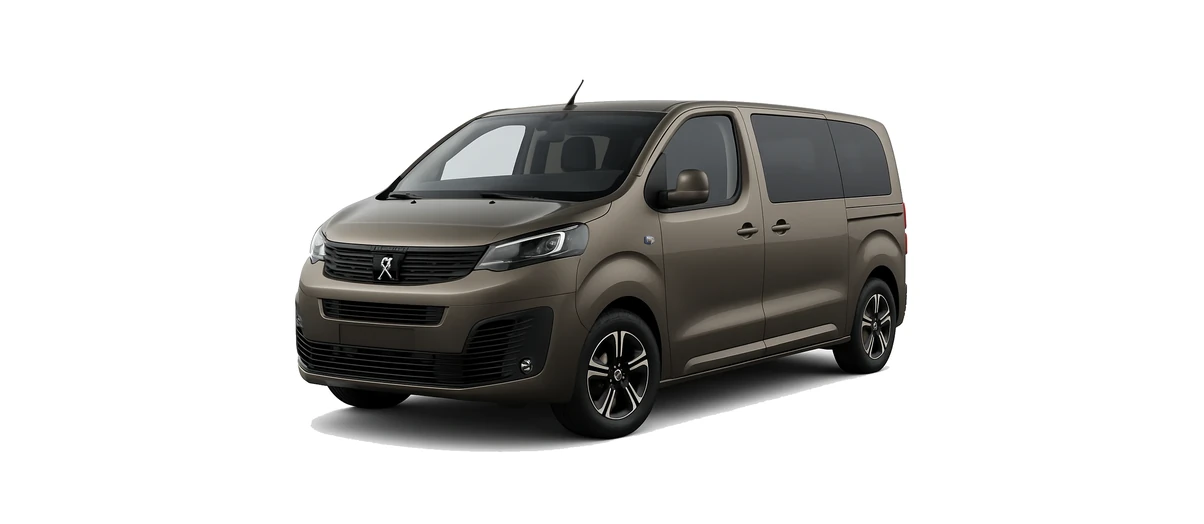
The Peugeot e-Traveller is a battery-electric MPV and passenger van designed for drivers who need space, flexibility and electric running costs rather than a conventional diesel people-carrier. In the UK, the current model is offered as a fully electric vehicle with a 75 kWh battery, while earlier used examples may have either a 50 kWh or 75 kWh pack depending on age and specification.
Because the e-Traveller is a large, practical vehicle, charging habits matter. A smaller electric hatchback may be used mainly for commuting, but an e-Traveller is often bought for family journeys, airport transfers, business passenger work, hotels, taxis or long motorway trips with several people on board. That means real-world range can vary noticeably with payload, speed, weather and heating use.
This guide explains how the Peugeot e-Traveller charges at home and in public, what cable type it uses, how the current 75 kWh model differs from older 50 kWh versions, and how to plan charging realistically in UK use.
View Peugeot e-Traveller Charging Cables
Peugeot e-Traveller Battery and Charging Specifications
The Peugeot e-Traveller uses a Type 2 socket for AC charging and a CCS Combo 2 connection for DC rapid charging. In practical terms, Type 2 is used for home wallboxes, many workplace chargers and most destination AC posts. CCS is used for rapid and ultra-rapid public chargers on motorway services, charging hubs and larger public networks.
For the current UK 75 kWh model, EV Database lists a 75.0 kWh nominal battery capacity and around 69.0 kWh usable capacity. Peugeot UK advertises up to 219 miles WLTP for the 75 kWh battery, while EV Database gives an estimated mixed real-world range of around 160 miles. That real-world estimate is a more useful figure for planning long journeys, especially in a large vehicle that may be carrying passengers and luggage.
Standard AC charging is listed at 7.4 kW, which suits a typical UK single-phase home wallbox. An 11 kW three-phase onboard charger is listed by EV Database as optional, but owners should confirm the exact specification for their model year and trim before assuming it is fitted.
Battery Options
The key point for buyers and owners is that not every Peugeot e-Traveller has the same battery. Current UK facelifted models are associated with the 75 kWh battery, but earlier UK-market e-Traveller models from roughly 2020/2021 to early 2024 could be found with a 50 kWh battery as well as 75 kWh versions.
The current 75 kWh model is the version linked to Peugeot’s advertised maximum of up to 219 miles WLTP. EV Database lists this pack at around 69 kWh usable and estimates around 160 miles in mixed real-world use. That is a helpful planning figure for owners who regularly cover longer distances.
Older 50 kWh examples are materially different. EV Database lists the discontinued 50 kWh pack at around 46.3 kWh usable, with WLTP range around 130 to 139 miles depending on configuration and an estimated real-world range of around 110 miles. If you are buying a used e-Traveller, it is worth checking the battery size carefully because it changes how often you will need to charge and how suitable the vehicle is for longer motorway routes.
AC Charging Speed
AC charging is the type of charging most owners use most of the time. The Peugeot e-Traveller’s standard AC charging rate is listed at 7.4 kW. On a suitable 7 kW home wallbox, the current 75 kWh model takes roughly overnight to charge from empty to full. EV Database gives a 0-100% AC charging time of about 11 hours for the current 75 kWh version using the standard 7.4 kW onboard charger.
That does not mean you will normally wait 11 hours every time. Most drivers plug in with some charge remaining and only need to replace the miles used that day. For example, a school run, local business route or short passenger transfer may only require a few hours on a home or workplace charger.
If the vehicle has the optional 11 kW onboard charger, it can charge faster on a three-phase AC supply or a compatible three-phase public AC post. EV Database lists a 0-100% time of around 7 hours 30 minutes for the current 75 kWh model at 11 kW. However, this only helps where three-phase AC is available. It will not make a normal UK single-phase 7 kW home wallbox any faster.
Older 50 kWh versions follow a similar pattern: around 7 hours 30 minutes from empty to full at 7.4 kW, or roughly 5 hours at 11 kW if the optional three-phase onboard charger is fitted and the charger can supply it.
DC Rapid Charging Speed
For long journeys, the Peugeot e-Traveller uses CCS rapid charging. The current 75 kWh model is listed with a peak DC charging rate of up to around 100 kW. EV Database gives an estimated 10-80% rapid charge time of about 40 minutes and an average 10-80% charge rate of around 77 kW.
It is important to understand that the 100 kW figure is a peak or maximum rate, not a speed the vehicle will hold throughout the entire session. Like most EVs, the e-Traveller charges fastest at lower and middle states of charge, then slows as the battery becomes fuller. This is why long-distance EV drivers usually plan rapid charging stops from around 10% to 80%, rather than waiting to reach 100% at a rapid charger.
Older 50 kWh e-Traveller models can also use CCS rapid chargers, but their range and charging-stop strategy are different. EV Database estimates a 10-80% rapid charge in roughly 28 to 30 minutes on a suitable high-power charger, but because the battery is smaller, each stop adds fewer miles than in the 75 kWh model.
Range and Efficiency
The current Peugeot e-Traveller’s headline range is up to 219 miles WLTP with the 75 kWh battery. WLTP is useful for comparing vehicles, but it should not be treated as a guaranteed day-to-day range. EV Database’s estimated real-world range for the current 75 kWh model is around 160 miles in mixed conditions.
In a large electric MPV, driving conditions can have a bigger visible impact than in a smaller EV. Motorway speeds, cold weather, cabin heating, headwinds, roof loads, luggage and passenger weight can all reduce range. A fully loaded e-Traveller on a winter motorway airport run may need more conservative planning than the official WLTP figure suggests.
For local use, the e-Traveller can still be very practical. If your daily mileage is well below the real-world range, charging overnight at home or between shifts at a workplace can keep the vehicle ready without relying heavily on public charging. For longer journeys, planning around realistic range and 10-80% charging stops will make the experience smoother.
Charging at Home
For most UK Peugeot e-Traveller owners, a 7 kW home wallbox is the natural match for the standard onboard charger. It can provide a full overnight charge for the current 75 kWh version and is usually far more convenient than depending on public charging for regular use.
If you have off-street parking, a dedicated home charger also makes it easier to use smart tariffs, schedule charging overnight and start each day with the range you need. This is particularly useful if the e-Traveller is used for work, passenger transport or family commitments where predictable availability matters.
A 3-pin domestic charging cable is generally best suited as a backup or occasional charging solution, but can be used regularly if a qualified electrician has confirmed the socket and electrical installation are suitable for sustained EV charging. Because the e-Traveller has a relatively large battery, a 3-pin socket will charge much more slowly than a wallbox and may not be practical as the main charging method for higher-mileage use.
If your property has three-phase electricity and your e-Traveller has the optional 11 kW onboard charger, an 11 kW AC unit may reduce charging times. For most domestic UK properties with single-phase supply, however, a 7 kW wallbox remains the realistic home charging solution.
Public Charging
Public charging for the Peugeot e-Traveller falls into two main categories: AC destination charging and DC rapid charging. AC posts normally require your own Type 2 charging cable unless the post is tethered. These are useful at hotels, car parks, leisure centres, workplaces and longer-stay destinations where the vehicle can charge while parked.
DC rapid chargers use a tethered CCS connector, so you do not use your own cable for rapid charging. These chargers are the right choice for motorway journeys or days where you need to add a large amount of range quickly.
For longer trips, plan charging around realistic distance between stops rather than the maximum WLTP figure. In the current 75 kWh e-Traveller, using around 160 miles as a broad mixed-use planning guide is more sensible than assuming 219 miles in all conditions. In winter, at higher speeds or with a full passenger load, leaving a larger buffer is wise.
Vehicle-Specific Features
The Peugeot e-Traveller is based on the Stellantis EMP2 platform and uses a 400 V electrical architecture. It is not a dedicated EV-only platform, but the electric drivetrain gives it the smooth, quiet driving character expected from a modern battery-electric vehicle.
The current model is available in more than one body length, and Peugeot UK describes it as offering up to eight seats depending on configuration. Exact seating and trim details can vary, so owners and buyers should check the specific vehicle specification rather than relying on a general description.
EV Database lists the charging port location as the left-side front area. Current model information also refers to regenerative braking levels controlled via steering-wheel paddles, which can help the driver adjust how strongly the vehicle slows when lifting off the accelerator.
For the current 75 kWh model, EV Database does not list a heat pump, battery preconditioning, vehicle-to-load or vehicle-to-grid support as available. That makes realistic charging planning more important in cold weather, because winter conditions can affect both range and charging behaviour.
Charging Tips
- Use a 7 kW wallbox for regular home charging: it is the best match for the standard 7.4 kW onboard charger in most UK homes.
- Do not assume 11 kW charging: the faster AC option only helps if the vehicle has the 11 kW onboard charger and the supply is three-phase.
- Rapid charge from 10-80% where possible: charging above 80% on a rapid charger is usually slower and best reserved for journeys where you genuinely need the extra range.
- Plan for real-world range: for the current 75 kWh model, around 160 miles is a more practical mixed-use guide than the maximum WLTP figure.
- Check battery size on used vehicles: older 50 kWh e-Travellers have significantly less range than current 75 kWh versions.
- Carry the right Type 2 cable: many public AC chargers are untethered, so you will need your own cable to use them.
Frequently Asked Questions
Is the Peugeot e-Traveller a plug-in hybrid?
No. The Peugeot e-Traveller is a battery-electric vehicle. It does not have a petrol or diesel engine and is not a plug-in hybrid.
What charging cable does the Peugeot e-Traveller use?
For AC charging, the Peugeot e-Traveller uses a Type 2 charging connection. For DC rapid charging, it uses CCS Combo 2. Public rapid chargers have their own tethered CCS cable, while many AC posts require you to bring your own Type 2 cable.
How fast can the Peugeot e-Traveller charge at home?
The standard AC charging rate is listed at 7.4 kW, which suits a typical UK 7 kW home wallbox. The current 75 kWh model takes about 11 hours from empty to full at this speed, although normal top-ups are usually shorter.
Can the Peugeot e-Traveller charge at 11 kW?
EV Database lists an optional 11 kW three-phase onboard charger. If fitted, it can reduce AC charging time on a suitable three-phase supply, but it will not make a single-phase 7 kW home charger faster. Check the exact model year and specification before relying on 11 kW capability.
How long does rapid charging take?
For the current 75 kWh model, EV Database estimates around 40 minutes for a 10-80% rapid charge on a suitable CCS charger. Older 50 kWh versions are listed at roughly 28 to 30 minutes for a 10-80% rapid charge, but they add fewer miles because the battery is smaller.
What is the real-world range of the Peugeot e-Traveller?
Peugeot advertises up to 219 miles WLTP for the current 75 kWh model. EV Database estimates around 160 miles in mixed real-world use. Older 50 kWh versions are closer to around 110 miles real-world according to EV Database estimates.
What This Means for Drivers
The Peugeot e-Traveller is at its best when charging is planned around how the vehicle is actually used. For most owners, a 7 kW home or depot wallbox will be enough to keep the vehicle ready overnight. The optional 11 kW AC capability is useful where three-phase charging is available, but it should not be treated as standard on every vehicle.
On longer journeys, the current 75 kWh model’s 100 kW peak CCS charging and roughly 40-minute 10-80% rapid charge time make motorway travel workable, provided you plan stops sensibly. The main mistake is relying too heavily on the 219-mile WLTP figure, especially with passengers, luggage, cold weather or sustained motorway speeds.
If you are buying used, confirm whether the vehicle has the 50 kWh or 75 kWh battery. The difference affects not only total range, but also how often you need to stop, how much range each rapid charge adds and whether the vehicle suits your regular journeys.
Looking for a Charging Cable for Peugeot e-Traveller?
If you need a suitable Type 2 charging cable for home, workplace or public AC charging, We offer Peugeot e-Traveller charging cable options to match typical UK charging requirements.
View Peugeot e-Traveller Charging Cables
Please note that this information is intended as a guide. Charging specifications may change due to model and year of manufacture. For precise information, always refer to your vehicle user manual.

