
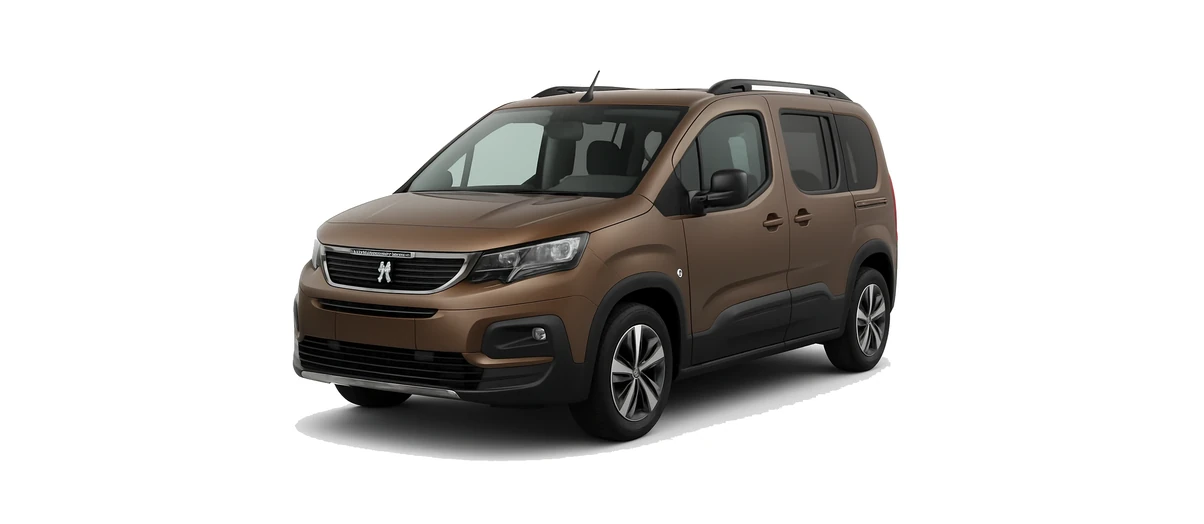
The Peugeot e-Rifter is a battery-electric small MPV/passenger van designed for families, taxi-style use, accessible transport needs and drivers who want van-like practicality without a combustion engine. It is not a plug-in hybrid: it relies on mains electricity and public charging to replenish its battery.
For UK owners, the most important charging details are straightforward but worth understanding properly. The e-Rifter uses a Type 2 connector for AC charging at home and on many public destination chargers, plus a CCS Combo 2 connection for DC rapid charging. Most cars will charge on AC at up to 7.4 kW as standard, while an 11 kW three-phase onboard charger is optional or specification-dependent on some versions. For longer journeys, CCS rapid charging can reach up to 100 kW, with a typical 10-80% stop taking around half an hour in suitable conditions.
View Peugeot e-Rifter Charging Cables
Peugeot e-Rifter Battery and Charging Specifications
Current UK Peugeot e-Rifter models are advertised by Peugeot with up to 199 miles WLTP range, while earlier 2021-2024 UK cars were commonly quoted at around 171-172 miles WLTP. That difference matters if you are comparing a new or facelifted vehicle with a used example, because the official range figures and usable battery data are not identical across all model years.
| Specification | Peugeot e-Rifter |
|---|---|
| Vehicle type | Battery-electric small MPV / passenger van |
| Charging port | Type 2 for AC, CCS Combo 2 for DC rapid charging |
| Current battery listing | 52 kWh gross / 50 kWh usable on EV Database for 2024-2026 Standard and Long variants |
| Standard AC charging | 7.4 kW single-phase onboard charger |
| Optional AC charging | 11 kW three-phase onboard charger on some specifications |
| DC rapid charging | Up to 100 kW |
| Typical rapid charge window | Around 10-80% in roughly 28-30 minutes, depending on charger and conditions |
| Current official WLTP range | Up to 199 miles, according to Peugeot UK |
| Real-world range guide | EV Database estimates around 145 miles for the current Standard version and around 140 miles for the Long version |
Battery Options
The current/facelift e-Rifter is commonly described by Peugeot as having a 50 kWh battery. EV Database lists the 2024-2026 Standard and Long 50 kWh variants as having a 52 kWh nominal capacity and 50 kWh usable capacity. That is the most relevant figure if you are looking at a current model.
Used-car buyers should be more cautious. Earlier UK e-Rifter models from around 2021-2024 are also referred to as 50 kWh versions, but EV Database lists those preceding variants with about 46.3 kWh usable capacity. This is why range and charge-time figures can vary between sources: some refer to earlier models, while others refer to the updated vehicle.
The e-Rifter has been offered in Standard and Long body lengths, with 5-seat and 7-seat configurations depending on trim and model year. The Long body and heavier passenger or luggage loads can have a noticeable effect on energy use, especially at motorway speeds.
AC Charging Speed
AC charging is the type of charging most e-Rifter owners will use at home, at workplaces and at many destination chargers. The car uses a Type 2 connection for AC charging.
The standard onboard charger is 7.4 kW single-phase. On a suitable 7 kW home wallbox, a current e-Rifter should typically take around eight hours for a full 0-100% charge, while older Peugeot material quoted around 7.5 hours from a 7.4 kW wallbox. In day-to-day use, most owners will not be charging from empty to full; topping up overnight is usually the practical routine.
An 11 kW three-phase onboard charger is listed as optional or available on some specifications. It should not be assumed that every e-Rifter has it. If you are buying used or ordering a vehicle for a specific charging setup, check the vehicle specification, build sheet or VIN. Even with the 11 kW onboard charger, you also need access to a three-phase AC supply, which is uncommon in many UK homes but can be found at some workplaces and commercial sites.
DC Rapid Charging Speed
For long-distance journeys, the Peugeot e-Rifter uses the CCS part of its charging port for DC rapid charging. The maximum DC charging rate is up to 100 kW, so a 100 kW or higher public rapid charger is sufficient to reach the vehicle’s peak rate when conditions allow. Connecting to a 150 kW or 350 kW charger will not make the e-Rifter charge above its own limit.
Peugeot quotes 0-80% in around 30 minutes on a suitable fast public terminal, while EV Database estimates a 10-80% rapid charge at roughly 28 minutes for current models. In real use, planning around 10-80% stops is usually more efficient than charging from near-empty to 100%, because DC charging normally slows as the battery fills.
The e-Rifter does not list battery preconditioning for rapid charging, so cold weather, battery temperature and charger conditions can affect charging speed. If you arrive at a rapid charger with a very cold battery, the session may be slower than the headline figure.
Range and Efficiency
The current Peugeot e-Rifter is advertised in the UK with up to 199 miles WLTP range. That is a useful comparison figure, but it should not be treated as a guaranteed everyday result. EV Database gives real-world estimates of around 145 miles for the current Standard version and around 140 miles for the current Long version.
This difference between WLTP and real-world range is especially relevant for an MPV-style vehicle. The e-Rifter has a practical, boxy shape, which is excellent for passengers and luggage but less aerodynamic than a low car. Motorway speeds, roof boxes, bike racks, cold weather, full passenger loads and hilly routes can all reduce range.
For local family use, school runs, commuting and town driving, the e-Rifter’s range is often more than enough for several days of typical use. For longer motorway journeys, it is better to plan around practical charging stops rather than relying on the maximum official figure. A sensible approach is to start with a high state of charge, schedule a rapid charge before the battery is very low, and allow a margin for weather, diversions and passenger comfort.
Charging at Home
For most UK e-Rifter drivers, a dedicated home wallbox is the most convenient charging option. An untethered wallbox paired with the correct Type 2 cable gives flexibility, while a tethered Type 2 wallbox keeps the cable permanently attached. Either approach can work well, provided the charger is correctly installed and compatible with the vehicle.
With the standard 7.4 kW onboard charger, a typical single-phase 7 kW home wallbox is well matched to the e-Rifter. It can replenish the battery overnight and is usually far more practical than relying on public charging for routine use. If your car has the optional 11 kW AC charger, it will still generally be limited to around 7.4 kW on a normal single-phase domestic supply.
A 3-pin charger is generally best suited as a backup or occasional charging solution, but can be used regularly if a qualified electrician has confirmed the socket and electrical installation are suitable for sustained EV charging. Because the e-Rifter has a relatively large battery for domestic socket charging, a 3-pin connection will be much slower than a proper wallbox.
If you use off-peak electricity tariffs, scheduled charging can make ownership cheaper and easier. The MyPEUGEOT app supports remote charge management and cabin climate pre-conditioning on supported cars, which can be useful if you want the cabin warmed or cooled while the vehicle is still plugged in.
Public Charging
On public AC charge points, the e-Rifter uses a Type 2 cable. Many slower public posts are untethered, meaning you need to bring your own cable. If the car has the standard 7.4 kW onboard charger, it will not charge faster than that on AC, even if the post is rated at 22 kW. If the car has the optional 11 kW three-phase onboard charger, it may make better use of three-phase AC posts, subject to the charging point and cable being suitable.
For motorway and A-road stops, use CCS rapid chargers. These are usually tethered, so the charging cable is attached to the unit and you do not need to use your own Type 2 cable. For the e-Rifter, a charger rated at 100 kW or above is enough to access the car’s peak rapid charging capability.
Because the e-Rifter is often used as a family or passenger-carrying vehicle, public charging planning is about more than the car itself. Consider charger location, toilets, food, accessibility, lighting and whether the bay layout works for a longer vehicle. If you are travelling with a full load or roof equipment, add a range buffer rather than planning to arrive with only a few miles remaining.
Vehicle-Specific Features
The e-Rifter uses a 100 kW / 136 PS front-mounted electric motor and is based on the Stellantis EMP2 multi-energy platform. It offers Eco, Normal and Power driving modes, plus regenerative braking functionality to help recover energy during deceleration.
The updated model is confirmed with a heat pump as standard, which can help reduce the energy used for cabin heating compared with relying solely on resistive heating. This is particularly useful in a family MPV where keeping passengers comfortable is important.
There are also some features that should not be assumed. Current data does not support claims for vehicle-to-load, vehicle-to-home or vehicle-to-grid capability on the e-Rifter. Plug & Charge support should also not be assumed; some compatible networks may offer account-based automatic charging features, but this is separate from universal Plug & Charge functionality.
Charging Tips
- Check the onboard charger: Do not assume your e-Rifter has 11 kW AC charging. Many cars use the standard 7.4 kW onboard charger.
- Choose the right cable: For UK AC charging, you need a Type 2 cable. A 32 amp single-phase cable is suitable for 7.4 kW charging; drivers using three-phase 11 kW charging need an appropriate three-phase cable.
- Use CCS for rapid charging: Rapid charging is handled by tethered CCS chargers, not your portable Type 2 cable.
- Plan around 10-80%: On long trips, shorter rapid-charge stops in the efficient part of the battery range are usually better than waiting for 100%.
- Allow for load and weather: Passengers, luggage, roof boxes, cold temperatures and motorway speed can all reduce the practical range.
- Use cabin pre-conditioning: Where supported, pre-heat or pre-cool the cabin while plugged in to improve comfort and preserve driving range.
Frequently Asked Questions
What charging cable does the Peugeot e-Rifter use?
The Peugeot e-Rifter uses a Type 2 cable for AC charging. For DC rapid charging, it uses a CCS connection, with the cable attached to the rapid charger.
Is the Peugeot e-Rifter a plug-in hybrid?
No. The Peugeot e-Rifter is a battery-electric vehicle. It does not have a petrol or diesel engine for propulsion.
Can every Peugeot e-Rifter charge at 11 kW AC?
No. The standard AC onboard charger is 7.4 kW. An 11 kW three-phase onboard charger is optional or specification-dependent, so check the individual vehicle before relying on 11 kW AC charging.
How fast can the Peugeot e-Rifter rapid charge?
The e-Rifter can rapid charge at up to 100 kW DC. A typical 10-80% stop is around 28-30 minutes in suitable conditions, although charger performance, battery temperature and state of charge can affect the result.
What is the real-world range of the Peugeot e-Rifter?
Peugeot UK advertises the current model with up to 199 miles WLTP. EV Database estimates around 145 miles for the current Standard model and around 140 miles for the current Long model in real-world use. Earlier models were advertised with different WLTP figures, so check the model year.
What This Means for Drivers
The Peugeot e-Rifter is at its best when its charging is planned around real family and passenger-carrying use rather than headline figures alone. For home charging, the standard 7.4 kW AC setup is well matched to a UK wallbox and should cover most daily needs. The optional 11 kW charger is useful where three-phase AC charging is available, but it should be verified before purchase.
For long journeys, CCS rapid charging at up to 100 kW makes the e-Rifter practical beyond local use, provided you plan sensible 10-80% stops and allow for the effects of speed, weather and load. The Type 2 and CCS charging arrangement is widely supported across the UK, making cable selection and public charging relatively straightforward once you know your vehicle’s AC capability.
Looking for a Charging Cable for Peugeot e-Rifter?
If you need a suitable Type 2 charging cable for home, workplace or public AC charging, We sell Peugeot e-Rifter charging cables to help match the vehicle’s charging setup and your preferred charging routine.
View Peugeot e-Rifter Charging Cables
Please note that this information is intended as a guide. Charging specifications may change due to model and year of manufacture. For precise information, always refer to your vehicle user manual.

