
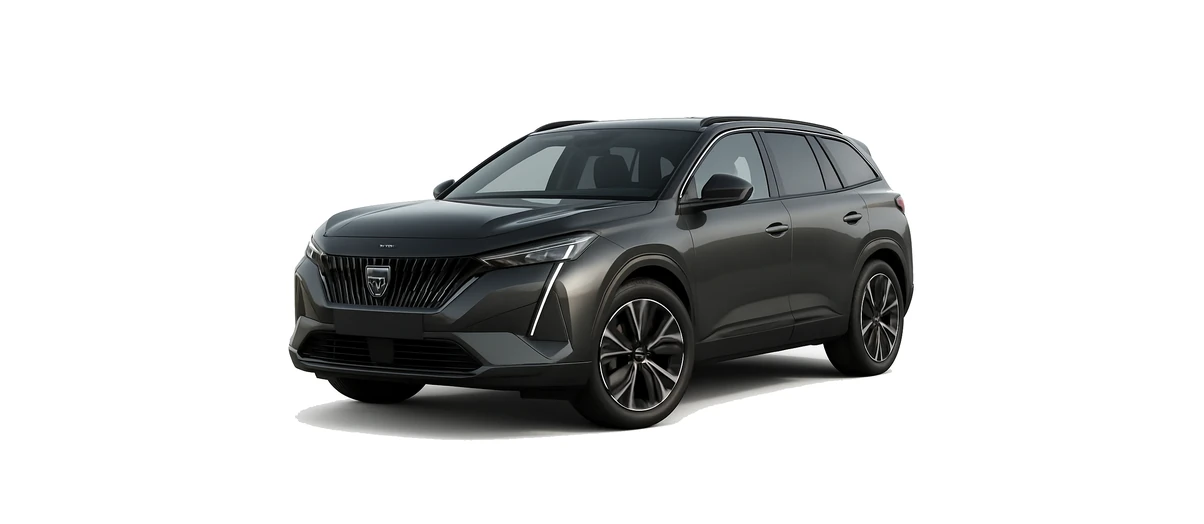
The Peugeot e-5008 is the all-electric version of Peugeot’s large 7-seat SUV. It is important to use the e-5008 name carefully, because the wider Peugeot 5008 range also includes Hybrid and Plug-in Hybrid models. This guide focuses on the battery-electric Peugeot e-5008 sold in the UK from the current third-generation model line-up.
For many UK drivers, the e-5008 will be a family car first and an electric car second: school runs, commuting, shopping, airport trips, holidays and fully loaded motorway journeys. That makes charging planning especially important. The e-5008 is available with different battery and motor configurations, including 73 kWh front-wheel drive, Long Range 96.9/98 kWh front-wheel drive and 73 kWh Dual Motor all-wheel drive versions. These variants do not all have the same range or charging profile, so choosing the right cable and charging routine depends on how you use the car.
View Peugeot e-5008 Charging Cables
Peugeot e-5008 Battery and Charging Specifications
The Peugeot e-5008 uses a Type 2 connector for AC charging and CCS Combo 2 for DC rapid charging. That is the standard arrangement for modern European and UK electric cars, so it is compatible with typical UK home wallboxes, workplace charge points, destination chargers and motorway rapid chargers.
| Vehicle | Peugeot e-5008 |
|---|---|
| Body style | Large 7-seat SUV |
| Charging port | Type 2 for AC, CCS Combo 2 for DC rapid charging |
| Maximum AC charging | Up to 11 kW on a suitable three-phase supply |
| Typical UK home wallbox charging | Usually up to 7.4 kW on a single-phase domestic supply |
| Maximum DC rapid charging | Up to 160 kW peak |
| Architecture | Stellantis STLA Medium, 400 V-class architecture |
Battery Options
The current UK Peugeot e-5008 range includes several electric versions. The headline numbers vary by trim, equipment, driving conditions and official test basis, so the figures below should be treated as variant-specific rather than universal for every e-5008.
- Standard Range Electric 73 kWh 210, front-wheel drive: Peugeot quotes up to around 310 miles WLTP depending on version. EV Database lists an estimated nominal capacity of 77 kWh and usable capacity of 73 kWh, with a real-world estimate of about 230 miles.
- Long Range Electric 96.9/98 kWh 230, front-wheel drive: Peugeot and Stellantis describe this as the Long Range version, with up to around 414–415 miles WLTP. EV Database lists usable capacity at 96.9 kWh and a real-world estimate of about 301 miles.
- Dual Motor Electric 73 kWh 325, all-wheel drive: This version uses the 73 kWh battery and adds all-wheel drive. Peugeot quotes up to around 291 miles WLTP, while EV Database gives a real-world estimate of about 220 miles.
The Long Range model is the one to note if you regularly travel long distances with passengers and luggage. Its larger battery can reduce how often you stop, but it also takes longer to refill at home from a low state of charge unless you have access to higher-powered AC charging.
AC Charging Speed
The Peugeot e-5008 can charge at up to 11 kW AC, but this figure needs UK context. Most UK homes have a single-phase electricity supply, and most domestic wallboxes charge at up to 7.4 kW. In that common home setup, the e-5008 will not normally charge at 11 kW, even though the car is technically capable of it.
On a 7.4 kW home wallbox, EV Database estimates the 73 kWh versions at roughly 11 hours 45 minutes for a full charge from empty to full, while the Long Range 96.9 kWh version is estimated at about 15 hours 30 minutes. Real daily charging is usually shorter because most owners top up rather than charge from completely empty.
To access the full 11 kW AC charging capability, you need a suitable three-phase supply and an appropriate three-phase Type 2 cable. This is more common at some workplaces, commercial premises and certain destination chargers than at UK homes. At 11 kW, EV Database estimates around 8 hours for the 73 kWh versions and about 10 hours 30 minutes for the Long Range model.
DC Rapid Charging Speed
For longer journeys, the Peugeot e-5008 uses CCS rapid charging and has a peak DC charging capability of up to 160 kW. To make best use of this, look for CCS rapid chargers rated above 150 kW, especially on motorway and major A-road routes.
Peugeot quotes rapid charging over the 20–80% window: around 30 minutes for the 73 kWh variants and around 27 minutes for the Long Range version. EV Database uses a different 10–80% estimate and lists approximately 36 minutes for the 73 kWh versions and roughly 32 minutes for the Long Range model. These figures are not contradictory; they refer to different start and end percentages.
As with any EV, the highest charging speed is only reached under suitable conditions. Battery temperature, charger performance, the car’s state of charge, weather and whether another vehicle is sharing power can all affect the actual charging rate.
Range and Efficiency
The e-5008’s range varies significantly by version. The Long Range model has the highest official WLTP figure at around 414–415 miles, while the 73 kWh front-wheel drive version is quoted at up to around 310 miles and the 73 kWh Dual Motor version at up to around 291 miles.
Real-world range will usually be lower than WLTP, particularly in winter, at motorway speeds, with seven seats occupied, with roof boxes fitted or when carrying holiday luggage. EV Database estimates about 230 miles for the 73 kWh front-wheel drive model, about 301 miles for the Long Range model and about 220 miles for the 73 kWh Dual Motor version. These are useful planning estimates rather than fixed guarantees.
For a family SUV, payload and journey type matter. A lightly loaded school-run car driven in mild weather will behave very differently from a fully loaded e-5008 travelling at motorway speeds in cold rain. For long family trips, it is sensible to plan rapid charging stops with a buffer rather than aiming to arrive at a charger with very little range remaining.
Charging at Home
For most e-5008 owners, the most convenient setup will be a dedicated 7.4 kW home wallbox and a suitable Type 2 charging cable. A 32 A single-phase Type 2 cable is the right match for most UK domestic wallboxes and public AC charge points that use untethered sockets.
If you have a three-phase supply at home or regularly use three-phase workplace charging, an 11 kW-capable three-phase Type 2 cable may be useful. This is especially relevant for Long Range owners, because the larger battery benefits more from faster AC charging when you need a substantial overnight top-up. However, for typical UK single-phase home charging, an 11 kW cable will not make the charger deliver 11 kW unless the electrical supply and wallbox support it.
A 3-pin charger is generally best suited as a backup or occasional charging solution, but can be used regularly if a qualified electrician has confirmed the socket and electrical installation are suitable for sustained EV charging. For a large-battery SUV such as the e-5008, a 3-pin socket will be much slower than a wallbox and may not add enough range overnight for high-mileage use.
Public Charging
Public charging falls into two main categories: AC destination charging and DC rapid charging. AC chargers are common at hotels, car parks, leisure centres and workplaces. These usually require your own Type 2 cable unless the unit is tethered. They are best for charging while the car is parked for several hours.
DC rapid chargers use a tethered CCS cable, so you do not need to use your own cable for rapid charging. For the e-5008, 150 kW-plus CCS chargers are the most relevant on long trips because the car can peak at up to 160 kW. Lower-powered 50 kW chargers will still work, but they will take longer.
On family journeys, it is often more efficient to stop from around 15–25% and charge to 70–80% rather than wait for a full charge. Charging slows significantly at higher states of charge, so the last 20% can take disproportionately longer. The Long Range model may allow fewer stops, but when it does need a large top-up, its bigger battery means the stop can still be meaningful for journey planning.
Vehicle-Specific Features
The Peugeot e-5008 has several charging-related features that are worth understanding. A heat pump is listed as standard, which can help manage energy use in colder conditions compared with relying solely on resistive heating.
Battery preconditioning is also confirmed for the e-5008. Peugeot states that it can be triggered automatically when using navigation to route to a compatible charging stop, manually via the energy or charging menu, or remotely through the MyPeugeot app where applicable after the relevant update. This is particularly useful in cold weather because a battery that is at the right temperature is more likely to charge quickly and predictably.
Vehicle-to-load capability is also reported for the e-5008, allowing the car to provide power to external devices in suitable circumstances. A compatible adapter may be required, so owners should check the latest Peugeot documentation for the exact equipment and power limits. Vehicle-to-grid and vehicle-to-home support should not be assumed for this model.
Charging Tips
- Choose the cable for your supply: A 32 A single-phase Type 2 cable suits most UK 7.4 kW home wallboxes. Choose a three-phase Type 2 cable if you can actually use 11 kW charging.
- Do not rely on the headline 11 kW figure at home: Most UK houses are single phase, so 7.4 kW is the more realistic home charging maximum.
- Use battery preconditioning before rapid charging: Set the rapid charger as a destination in the navigation system where possible, especially in winter.
- Plan around your variant: The 73 kWh, Long Range and Dual Motor versions have different range expectations, so use the correct figures for your car.
- For motorway stops, look for 150 kW-plus CCS chargers: These are best suited to the e-5008’s 160 kW peak DC capability.
- Avoid charging to 100% on every rapid stop: For time-efficient journeys, 20–80% charging is usually more practical than waiting for the final percentage points.
Frequently Asked Questions
What charging cable does the Peugeot e-5008 use?
The Peugeot e-5008 uses a Type 2 connector for AC charging. For rapid charging, it uses the CCS Combo 2 connector with the rapid charger’s tethered cable.
Can the Peugeot e-5008 charge at 11 kW at home?
Only if the property has a suitable three-phase supply, an 11 kW-capable wallbox and the correct Type 2 cable. Most UK homes are single phase and will normally charge at up to 7.4 kW with a domestic wallbox.
How long does the Peugeot e-5008 take to charge at home?
At 7.4 kW, EV Database estimates around 11 hours 45 minutes for the 73 kWh versions and about 15 hours 30 minutes for the Long Range 96.9 kWh version from empty to full. Most daily top-ups will be shorter.
How fast can the Peugeot e-5008 rapid charge?
The e-5008 can peak at up to 160 kW on a suitable CCS rapid charger. Peugeot quotes 20–80% rapid charging in around 30 minutes for the 73 kWh versions and around 27 minutes for the Long Range version.
Does every Peugeot 5008 use the same charging cable?
No. This guide is for the all-electric Peugeot e-5008. The wider 5008 range also includes Hybrid and Plug-in Hybrid models, so owners should check the exact powertrain before buying charging equipment.
What This Means for Drivers
For most UK Peugeot e-5008 owners, the practical answer is simple: install or use a 7.4 kW home wallbox and keep a good-quality 32 A Type 2 cable in the car for untethered AC charging. That setup will suit everyday family driving, commuting and routine top-ups.
The Long Range version changes the planning slightly. Its larger battery gives more flexibility on long journeys, but also means bigger home charging sessions take longer on a standard 7.4 kW wallbox. If you have access to three-phase charging at home or work, an 11 kW-capable three-phase cable becomes more useful. For motorway travel, all e-5008 variants benefit from preconditioning and well-chosen CCS rapid chargers rated above 150 kW.
Looking for a Charging Cable for Peugeot e-5008?
We offer Peugeot e-5008 charging cables for UK home, workplace and public AC charging, including Type 2 options suitable for common 7.4 kW wallboxes and three-phase 11 kW charging where supported.
View Peugeot e-5008 Charging Cables
Please note that this information is intended as a guide. Charging specifications may change due to model and year of manufacture. For precise information, always refer to your vehicle user manual.

