
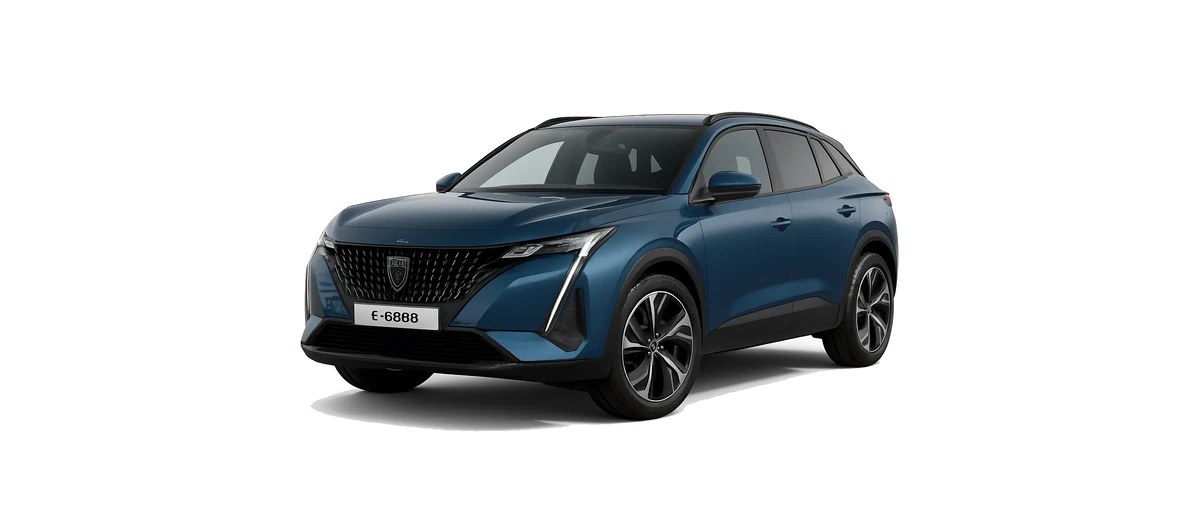
The Peugeot e-3008 is the battery-electric version of Peugeot’s current 3008 fastback compact SUV range. It should not be confused with the wider Peugeot 3008 Hybrid or Plug-in Hybrid models, as the E-3008 uses different charging hardware and charging habits. For UK drivers, the key points are straightforward: the Peugeot e-3008 uses a Type 2 connection for AC charging, CCS Combo 2 for DC rapid charging, and has an 11 kW three-phase onboard AC charger as standard on electric versions.
In real use, however, charging speed depends heavily on your version of the car, your home electrical supply and the charger you connect to. Many UK homes are single-phase, so even though the e-3008 can accept up to 11 kW on AC, a typical home wallbox will often provide up to around 7.4 kW. Public rapid charging is different again, using tethered CCS cables and DC power at up to 160 kW where conditions allow.
View Peugeot e-3008 Charging Cables
Peugeot e-3008 Battery and Charging Specifications
The UK Peugeot e-3008 electric range includes several battery and drivetrain combinations. Current information lists the Electric 210 with a 73 kWh usable battery, the Long Range Electric 230 with a 96.9 kWh usable battery, and the Dual Motor Electric 325 AWD with a 73 kWh usable battery. All are fully electric vehicles, not plug-in hybrids.
| Specification | Peugeot e-3008 |
|---|---|
| Vehicle type | Battery-electric fastback compact SUV |
| AC charging connection | Type 2 |
| DC rapid charging connection | CCS Combo 2 |
| AC onboard charger | Up to 11 kW three-phase |
| DC rapid charging | Up to 160 kW, where charger and battery conditions allow |
| Charging port location | Left rear, according to EV Database UK |
| Architecture | Stellantis STLA Medium, 400 V platform |
Battery Options
The e-3008 is not a one-battery model, so it is worth checking the exact version before comparing range or charging times.
- Electric 210 73 kWh FWD: Peugeot UK material lists a 73 kWh usable battery and up to 326 miles WLTP combined range. EV Database estimates a real-world range of about 235 miles, although actual range varies with speed, weather, load and driving style.
- Long Range Electric 230 96.9 kWh FWD: This version has the largest usable battery capacity in the current UK range. Peugeot lists up to 435 miles WLTP combined range, while EV Database estimates around 310 miles in mixed real-world use.
- Dual Motor Electric 325 AWD 73 kWh: This all-wheel-drive version uses the 73 kWh usable battery. Peugeot’s UK order announcement quotes up to 303 miles WLTP combined range in Normal mode, while independent real-world estimates are lower.
Because the Long Range model has a significantly larger battery, it can cover more distance between charges but also needs more energy to refill from a low state of charge. That matters most for home charging routines and for planning longer journeys.
AC Charging Speed
All current UK e-3008 electric versions are listed with an 11 kW three-phase AC onboard charger. This is useful because it allows the car to make good use of three-phase workplace chargers, some public AC posts and suitable three-phase home installations.
For many UK households, the practical AC charging rate will be lower. A common single-phase home wallbox provides up to around 7.4 kW, and the car will charge at the maximum supported by both the wallbox and the vehicle. On a suitable 7.4 kW charger, the 73 kWh battery versions are well suited to overnight charging, while the Long Range model may require a longer charging window if arriving home with a low battery.
Peugeot UK lists 20-80% AC charging at about 4 hours 30 minutes for 73 kWh versions using an 11 kW supply, and about 6 hours 30 minutes for the 96.9 kWh Long Range version. On a 7.4 kW single-phase wallbox, expect longer times.
DC Rapid Charging Speed
For rapid charging, the Peugeot e-3008 uses the CCS Combo 2 connector. Public DC rapid and ultra-rapid chargers almost always have their own tethered cables, so drivers do not normally need to carry a separate DC cable.
Peugeot lists up to 160 kW DC rapid charging for electric e-3008 versions. Official 20-80% figures differ by battery: around 30 minutes for the 73 kWh versions and around 27 minutes for the Long Range 96.9 kWh version under suitable conditions. Other sources, including EV Database, quote variant-specific 10-80% estimates that are not identical to Peugeot’s 20-80% figures, so it is best not to compare them directly.
As with all EVs, peak DC charging speed is only achieved in the right battery temperature range and state of charge window. In cold weather, or before the first rapid charge of a journey, battery preconditioning can make a noticeable difference.
Range and Efficiency
The headline WLTP range for the Peugeot e-3008 reaches up to 435 miles, but that figure applies to the Long Range Electric 230 with the 96.9 kWh usable battery. It should not be treated as a universal e-3008 range figure. The 73 kWh Electric 210 is listed at up to 326 miles WLTP, while the Dual Motor Electric 325 AWD is quoted at up to 303 miles WLTP in Normal mode.
Real-world range will usually be lower than WLTP, particularly in winter, at motorway speeds, with roof boxes, heavy loads or frequent use of heating. EV Database estimates around 235 miles for the 73 kWh front-wheel-drive version, around 310 miles for the Long Range version, and around 225 miles for the Dual Motor version. These are useful planning estimates rather than fixed guarantees.
Charging at Home
For most owners, home charging will be the most convenient and cost-effective way to run the Peugeot e-3008. A dedicated Type 2 wallbox is the usual option, whether tethered or untethered. With an untethered wallbox, you will need a Type 2 charging cable to connect the car to the charger.
If you have a typical single-phase UK supply, a 7.4 kW wallbox is likely to be the realistic maximum. This is still more than adequate for many drivers because the car can be charged overnight or topped up little and often. If you have access to a suitable three-phase supply, an 11 kW installation can make fuller use of the e-3008’s onboard AC charger.
For cable selection, a Type 2 to Type 2 cable is the correct AC cable for untethered home wallboxes and many public AC charge points. A 32 amp single-phase Type 2 cable is suitable for 7.4 kW single-phase charging. Drivers who regularly use three-phase AC posts may prefer a three-phase Type 2 cable, as this allows the car to use its 11 kW AC capability where the supply supports it.
A 3-pin domestic charger is generally best suited as a backup or occasional charging solution, but can be used regularly if a qualified electrician has confirmed the socket and electrical installation are suitable for sustained EV charging.
Public Charging
Public charging splits into two main types: AC destination charging and DC rapid charging. AC destination chargers are common at hotels, workplaces, town centres and car parks. These are often untethered, meaning you need to bring your own Type 2 cable. Speeds vary, but the e-3008 can use up to 11 kW on three-phase AC chargers.
DC rapid and ultra-rapid chargers are used for longer journeys and motorway-style stops. They use CCS, and the cable is normally attached to the charger. The e-3008’s maximum quoted DC charging rate is up to 160 kW, but the actual rate will rise and fall during the session depending on state of charge, charger output, temperature and battery management.
For long trips, it is usually quicker to stop at lower states of charge and charge to around 80%, rather than waiting for the final 20%. Charging above 80% can slow considerably, so a second shorter stop may be faster than one long charge to 100%.
Vehicle-Specific Features
Battery preconditioning is confirmed for the e-3008 and can be activated through route planning or Trip Planner functions, manually through the vehicle screen, and through supported MyPeugeot app thermal preconditioning functions under stated conditions. Some earlier vehicles may require a software update or dealer activation, so owners should check their car’s current software status.
Vehicle-to-load functionality is also confirmed in Peugeot/Stellantis information as being fitted as standard by the end of 2025. It uses a dedicated adapter through the charging port and can provide up to 3 kW for powering compatible external devices. Early cars should be checked for build status, software status and adapter availability. Vehicle-to-grid or vehicle-to-home support should not be assumed from this information.
A heat pump is best treated as variant- and option-dependent. UK price and specification information lists it as an option for electric versions generally, while the Dual Motor Launch Edition announcement lists a heat pump as standard on that launch trim.
Charging Tips
- Use the 20-80% window for daily driving: Peugeot advises keeping the battery between 20% and 80% where practical, avoiding full discharge and charging to 100% mainly before longer journeys.
- Precondition before rapid charging: Use the built-in route planning or manual preconditioning function before DC charging, especially in cold weather.
- Choose the right Type 2 cable: For everyday UK home charging, a Type 2 cable matched to your wallbox and supply is the key accessory. Consider three-phase capability if you often use 11 kW public or workplace AC charging.
- Do not rely on one range figure: The 73 kWh, Long Range and Dual Motor versions have different range expectations.
- Plan Long Range charging realistically: The 96.9 kWh battery can travel further, but it also takes more energy to refill, so overnight routines matter.
Frequently Asked Questions
What charging cable does the Peugeot e-3008 use?
The Peugeot e-3008 uses a Type 2 connector for AC charging. For untethered home wallboxes and many public AC chargers, you need a Type 2 to Type 2 charging cable.
Can the Peugeot e-3008 charge at 11 kW at home?
Only if the home has a suitable three-phase electrical supply and an appropriate 11 kW charger installation. Many UK homes are single-phase and will typically be limited to around 7.4 kW with a suitable wallbox.
Do I need a cable for rapid charging?
Usually not. DC rapid chargers use the e-3008’s CCS port and normally have a tethered cable attached to the charger.
Is the Peugeot e-3008 a plug-in hybrid?
No. The E-3008 is the battery-electric version. The Peugeot 3008 Plug-in Hybrid is a separate model in the wider 3008 range and should not be used for e-3008 cable guidance.
Should I charge the e-3008 to 100% every day?
For everyday use, Peugeot advises staying between 20% and 80% where practical. Charging to 100% is mainly useful before longer journeys where you need the extra range.
What This Means for Drivers
The Peugeot e-3008 is straightforward to charge, but the best setup depends on how and where you drive. Most UK owners will be well served by a dedicated Type 2 home wallbox and a suitable Type 2 cable. The car’s 11 kW AC capability is useful, but many homes will charge at around 7.4 kW unless three-phase power is available.
For longer journeys, the CCS rapid charging capability and battery preconditioning are more important than carrying extra cables. The Long Range version offers the highest official range, while the 73 kWh models may still be very practical with regular home charging and sensible route planning.
Looking for a Charging Cable for Peugeot e-3008?
We offer Peugeot e-3008 charging cables for home, workplace and public AC charging, including Type 2 options for UK charging setups.
View Peugeot e-3008 Charging Cables
Please note that this information is intended as a guide. Charging specifications may change due to model and year of manufacture. For precise information, always refer to your vehicle user manual.

