
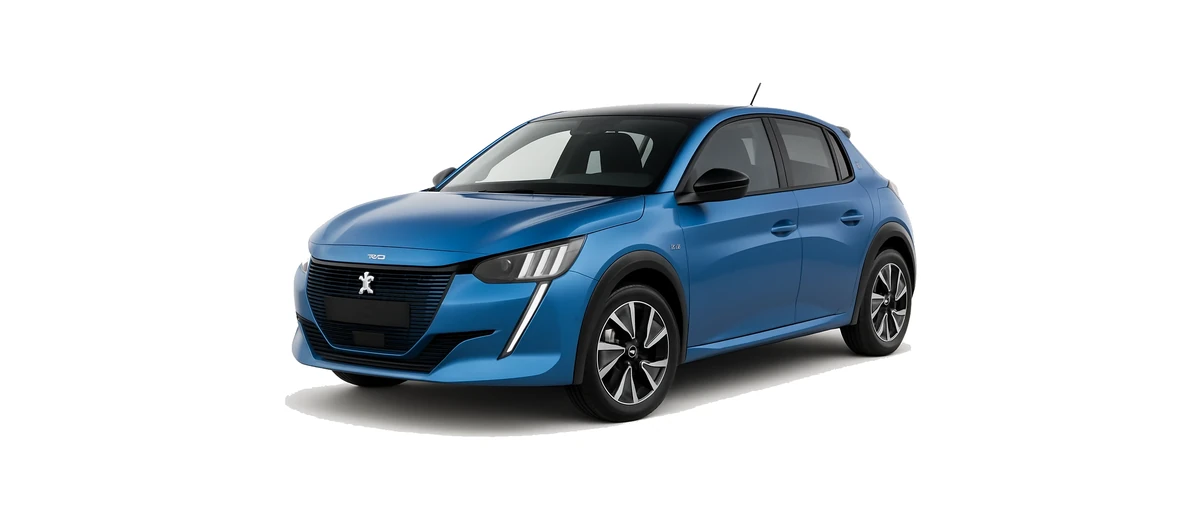
The Peugeot e-208 is the fully electric version of Peugeot’s 5-door 208 supermini. It is a battery-electric vehicle, not a plug-in hybrid, and uses a Type 2 connection for AC charging and a CCS Combo 2 connection for DC rapid charging. For UK drivers, it is a compact EV that suits commuting, school runs, urban driving and longer journeys when planned around public rapid chargers.
One important point with the e-208 is that not every car has the same battery, range or charging specification. Early cars, facelift models and the latest UK listings use slightly different battery descriptions and official range figures. This guide is written to help you identify the likely charging setup for your e-208, choose the right cable, and set realistic expectations for home and public charging.
View Peugeot e-208 Charging Cables
Peugeot e-208 Battery and Charging Specifications
UK-market Peugeot e-208 models use a Type 2 AC charging inlet and CCS Combo 2 rapid charging. The charging port is positioned on the nearside rear quarter panel, which is useful to remember when parking at home wallboxes and public chargers. On AC charging, current Peugeot UK specification information confirms a 7.4 kW onboard charger. On DC rapid charging, the e-208 can use suitable CCS rapid and ultra-rapid chargers, with Peugeot quoting 20-80% rapid charging times of around 25-27 minutes depending on version.
The key practical point is that the car controls the charging rate. A higher-rated AC charge point will not force the car to charge faster than its onboard AC charger allows, and a high-power DC charger will still be limited by the e-208’s maximum DC charging capability, battery temperature and state of charge.
- Vehicle type: battery-electric vehicle, 100% electric
- AC connection: Type 2
- DC rapid connection: CCS Combo 2
- Current UK AC charging figure: 7.4 kW onboard charger
- DC rapid charging: up to around 100 kW on suitable chargers
- Charging port location: nearside rear quarter panel
Battery Options
The Peugeot e-208 has changed since launch, so it is best not to rely on one universal battery figure. If you are buying used, or if your car sits around a changeover period, check the handbook, VIN-linked specification, original order details or Peugeot’s current technical information for your exact vehicle.
Early e-208 models, typically around MY20-MY22, are commonly listed with a 50 kWh gross battery and about 46.3 kWh usable capacity. These cars used the original 136 hp electric powertrain, and their real-world range will not necessarily match the latest headline figures used for newer cars.
Current UK Peugeot information lists an Electric 136 hp version with a 50 kWh battery and up to 226 miles WLTP, and an Electric 156 hp version with a 51 kWh battery and up to 268 miles WLTP. For the 51 kWh version, EV Database UK has listed a usable capacity of around 48.1 kWh for the 2023-2025 model. Some later technical listings describe a newer marketed “50 kWh” version with different gross and usable figures, which is another reason to confirm the exact model year and specification.
For charging-cable choice, these battery differences do not change the connector: the e-208 still uses Type 2 for AC charging and CCS for DC rapid charging. They do, however, affect range expectations and how often you may need to charge.
AC Charging Speed
For most UK e-208 owners, a 7.4 kW Type 2 home wallbox is the natural match. Peugeot UK’s current price and specification information confirms a 7.4 kW onboard charger, and this is enough for straightforward overnight charging. Peugeot’s UK information gives approximate 20-80% AC charging times of around 4 hours 30 minutes to 4 hours 40 minutes depending on battery version.
At a typical 7.4 kW single-phase home charger, the e-208 can recover a useful amount of range in a few hours and can usually be brought back up overnight from a low state of charge. If you plug into an untethered public AC charger, you will need your own Type 2 charging cable. A 32 amp single-phase Type 2 cable is usually the appropriate choice for making full use of a 7.4 kW charge point.
Some European, imported or older reference sources mention 11 kW AC charging for certain e-208 specifications. For UK guidance, do not assume every e-208 has 11 kW AC charging. If this matters to you, check your exact vehicle specification through the handbook, VIN, configurator or dealer documentation.
DC Rapid Charging Speed
On longer journeys, the Peugeot e-208 uses the CCS part of its charging port for DC rapid charging. Peugeot quotes around 20-80% in 25 minutes for the 50 kWh version and around 27 minutes for the 51 kWh version on a suitable high-power public charger. EV Database UK gives a broadly similar 10-80% rapid-charging estimate of about 30 minutes for relevant versions.
These figures are best treated as good-condition estimates rather than guaranteed times. Rapid charging is not a flat, constant speed from empty to full. The highest charging power is normally seen at lower states of charge, then the rate tapers as the battery fills. Cold weather, a cold battery, charger sharing, charger condition and starting state of charge can all lengthen a charging stop.
For efficient motorway use, it is often quicker to charge from a lower percentage to around 70-80% and then continue driving, rather than waiting for the final 20% to fill. Charging beyond 80% on a rapid charger can be useful when you genuinely need the extra range, but it is usually slower per mile added.
Range and Efficiency
Peugeot’s current UK information quotes up to 226 miles WLTP for the 50 kWh 136 hp version and up to 268 miles WLTP for the 51 kWh 156 hp version. WLTP is a standardised test figure, so it is useful for comparing cars, but everyday range will vary. EV Database UK gives real-world estimates around the 195-205 mile area for some later e-208 versions, depending on the exact model.
In normal UK use, range is affected by road speed, temperature, tyres, passenger load, heating and air-conditioning use, and driving style. The e-208 is at its most efficient around town and on slower A-roads, where regenerative braking and lower aerodynamic drag help. Motorway driving in winter is likely to reduce the miles available from a charge.
If your e-208 is an early 50 kWh car, avoid assuming it will match the latest 268-mile WLTP figure. If it is a facelift or newer 51 kWh model, it may have improved range compared with earlier cars, but real-world results will still depend heavily on conditions.
Charging at Home
Home charging is usually the most convenient and cost-effective way to run a Peugeot e-208. A dedicated 7.4 kW wallbox allows you to plug in overnight, schedule charging for off-peak electricity tariffs and start each day with the level of charge you need. If your wallbox is untethered, you will need a Type 2 to Type 2 cable.
A 5 metre cable is often adequate for driveway parking when the charger is close to the nearside rear of the car. A 7.5 metre or 10 metre cable can be more convenient if you reverse in, park in different positions, share a charger with another EV, or need extra reach across a bay. Because the e-208’s inlet is on the nearside rear quarter panel, think about how you normally park before choosing cable length.
A 3-pin EV charging cable can be useful in some circumstances, but it is generally best suited as a backup or occasional charging solution. It can be used regularly if a qualified electrician has confirmed the socket and electrical installation are suitable for sustained EV charging. Standard domestic sockets were not originally designed for repeated high-load EV charging over many hours, so a properly installed home wallbox is usually the safer and more practical long-term option.
Public Charging
Public charging for the e-208 falls into two main categories: AC destination charging and DC rapid charging. AC charge points are common at car parks, hotels, workplaces, supermarkets and town centres. Many of these are untethered, so you use your own Type 2 cable. The car will charge at up to its AC onboard charger limit, even if the post is rated higher.
DC rapid and ultra-rapid chargers are normally tethered, meaning the cable is attached to the charger. For these, you select the CCS connector and plug it directly into the e-208. These are the chargers to prioritise on long journeys when you want to add range quickly.
Before travelling, it is worth checking charging apps for charger power, live availability, payment method and recent reliability comments. On busy routes, having a backup rapid charger in mind can save time if your first choice is occupied or out of service.
Vehicle-Specific Features
Current Peugeot UK information lists useful EV features on the e-208, including an 80% charging limit and vehicle-to-load functionality. The 80% limit can help with everyday battery care because many owners do not need a full charge for daily driving. Charging to 100% is still useful before a longer trip, but for routine use a lower limit is often more appropriate.
Peugeot UK also lists V2L functionality on the current e-208, but output ratings and adapter details should be checked against the handbook or Peugeot accessory information for the exact car. A heat pump is listed as part of GT Premium equipment in current UK information, so it should be treated as trim-dependent rather than standard on every e-208. If you are buying used, verify whether your specific car has it.
Charging Tips
- Use the right AC cable: for most UK e-208 drivers, a 32 amp single-phase Type 2 cable is the practical match for 7.4 kW charging.
- Think about cable length: the nearside rear charging port makes parking position important, especially on driveways and in public bays.
- Use 20-80% for daily driving where practical: Peugeot’s current guidance includes an 80% charging limit, which suits everyday use for many drivers.
- Charge to 100% when needed: a full charge is sensible before longer journeys, particularly when charging options are limited.
- Do not expect peak rapid speed all the way: charging power tapers as the battery fills, so the final part of a rapid charge is slower.
- Check your exact model: early 50 kWh, facelift 51 kWh and newer marketed 50 kWh cars can differ in range and battery details.
Frequently Asked Questions
What charging cable does the Peugeot e-208 use?
The Peugeot e-208 uses a Type 2 cable for AC charging. For DC rapid charging, it uses the CCS Combo 2 connector, and the cable is normally attached to the rapid charger.
Is the Peugeot e-208 a plug-in hybrid?
No. The e-208 is the fully electric version of the Peugeot 208. The wider 208 range may include petrol or hybrid models, but the e-208 is a battery-electric vehicle.
How fast can the Peugeot e-208 charge at home?
Current UK Peugeot specification information confirms a 7.4 kW onboard charger. On a suitable 7.4 kW home wallbox, a 20-80% charge is listed by Peugeot at roughly four and a half hours, depending on version.
Can the Peugeot e-208 use ultra-rapid chargers?
Yes, if the charger has a CCS connector. However, the car will only draw up to its own DC charging limit, so using a charger rated far above the car’s capability will not make it charge beyond that limit.
Which e-208 battery do I have?
It depends on model year and specification. Early cars are commonly listed as 50 kWh gross with about 46.3 kWh usable, while current UK information lists 50 kWh 136 hp and 51 kWh 156 hp versions. Check your handbook, VIN-linked specification or original order documents if you need the exact figure.
What This Means for Drivers
The Peugeot e-208 is straightforward to live with if you match your charging setup to the car you actually own. For most UK drivers, that means a 7.4 kW home wallbox, a Type 2 cable for untethered AC chargers and CCS rapid charging for longer trips. The main thing to avoid is assuming that all e-208 models have identical battery capacity, range or AC charging capability.
If you understand whether your car is an early 50 kWh model, a facelift 51 kWh version or a newer current specification, you can plan charging more accurately. In daily use, charging to around 80% where practical, reserving 100% for longer journeys and using rapid chargers mainly in the lower-to-middle part of the battery range will make ownership easier and more efficient.
Looking for a Charging Cable for Peugeot e-208?
If you need a suitable Type 2 cable for home, workplace or public AC charging, We offer Peugeot e-208 charging cables in practical lengths and ratings for UK use.
View Peugeot e-208 Charging Cables
Please note that this information is intended as a guide. Charging specifications may change due to model and year of manufacture. For precise information, always refer to your vehicle user manual.

