
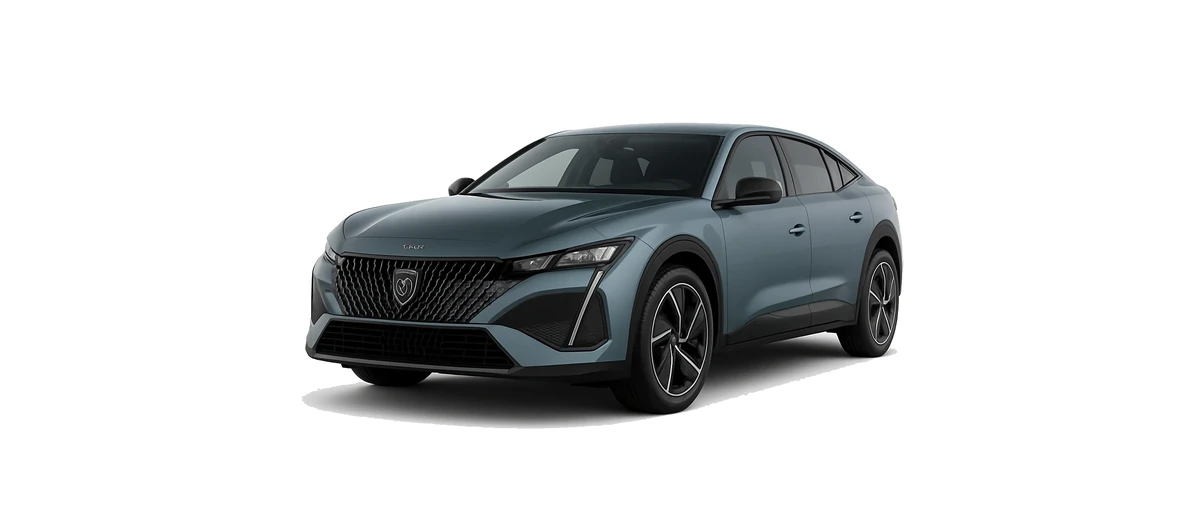
The Peugeot 408 range needs a little care when discussing charging, because not every 408 is the same. In the UK, the 408 name covers plug-in hybrid versions, non-plug-in mild-hybrid versions, and the fully electric Peugeot E-408. That means charging speed, cable choice and public charging compatibility depend on the exact model you own.
As a simple starting point: the Peugeot 408 Plug-in Hybrid uses a Type 2 AC charging connection and does not use CCS rapid charging. The Peugeot E-408 is the battery-electric model, with Type 2 AC charging for home and destination charging, plus CCS Combo 2 DC rapid charging for longer trips. Mild-hybrid 408 models do not plug in at all.
This guide explains the main UK charging differences, how to choose the right cable, and what to expect from home, public AC and rapid charging.
View Peugeot 408 Charging Cables
Peugeot 408 Battery and Charging Specifications
The most important question is: do you have a 408 Plug-in Hybrid or an E-408? The charging hardware and everyday charging behaviour are different.
- Peugeot 408 Plug-in Hybrid: Type 2 AC charging only. Many versions charge at up to 3.7 kW, while selected trims or optional specifications can charge at up to 7.4 kW. It is not a CCS rapid-charging vehicle.
- Peugeot E-408: fully electric model with Type 2 AC charging and CCS Combo 2 DC rapid charging. Current MY26 data supports an 11 kW three-phase AC onboard charger, although some earlier UK specification information has shown different AC details, so it is worth checking your exact vehicle.
- Peugeot 408 Hybrid: mild-hybrid versions do not plug in and do not need an EV charging cable.
For UK owners buying a cable, the key point is that both the Plug-in Hybrid and E-408 use a Type 2 connection for AC charging. The E-408 also has a CCS inlet for DC rapid charging, but you do not normally use your own cable on rapid chargers because the cable is attached to the charging unit.
Battery Options
The Peugeot 408 range has used more than one battery specification, so it is best not to apply one battery size to every car.
For the Peugeot E-408, current MY26 UK data points to a usable battery capacity of around 58 kWh. EV Database UK lists 61.9 kWh nominal and 58.3 kWh usable, while Peugeot and Stellantis sources commonly describe the battery as around 58 or 58.2 kWh usable. The latest UK information quotes up to 283 miles WLTP range for the E-408.
For the 2026 UK Peugeot 408 Plug-in Hybrid, Peugeot’s UK order-book information states a 16.2 kWh battery and up to 50 miles WLTP equivalent all-electric range. Older and used 408 Plug-in Hybrid cars can differ. Earlier GEN1 plug-in hybrid cars have been listed with a 12.4 kWh battery, while later GEN2 information has used 16.2 kWh and 17.2 kWh wording depending on source and table. If you are buying for a used 408 PHEV, check the vehicle’s VIN, handbook or specification sheet.
AC Charging Speed
AC charging is what you use at home wallboxes, many workplace chargers and most untethered public destination chargers. This is where your own Type 2 charging cable is most useful.
For the E-408, current MY26 data indicates Type 2 AC charging at up to 11 kW where a suitable three-phase supply is available. In most UK homes, however, the practical maximum is usually a 7.4 kW single-phase wallbox. At 7.4 kW, a full charge is likely to take roughly overnight; EV Database estimates around 9 hours 30 minutes from empty to full. On a suitable 11 kW three-phase supply, that figure is estimated at around 6 hours 15 minutes.
For the 408 Plug-in Hybrid, charging speed depends strongly on trim and model year. Current 2026 UK information states a 3.7 kW onboard charger on Allure and GT, with a full charge in about 3 hours 25 minutes, while GT Premium is listed with a 7.4 kW onboard charger and a full charge in about 1 hour 40 minutes. Earlier plug-in hybrid data also shows 3.7 kW as standard and 7.4 kW as optional on some versions.
A 22 kW public AC post will not automatically make the car charge at 22 kW. The vehicle’s onboard charger sets the limit. A 3.7 kW PHEV will still charge at around 3.7 kW, and an E-408 on AC will be limited by its onboard charger and the available electrical supply.
DC Rapid Charging Speed
DC rapid charging applies to the Peugeot E-408, not the 408 Plug-in Hybrid. The E-408 uses a CCS Combo 2 connector for rapid charging in the UK and Europe.
Current data gives the E-408 a peak DC rapid charging rate of up to 120 kW. EV Database estimates a 10-80% rapid charge in around 32 minutes, while Peugeot and Stellantis have typically quoted 20-80% charging in about half an hour. In real use, the exact time will depend on charger power, battery temperature, starting charge level, charger availability and how busy the site is.
For motorway journeys, a 150 kW or higher CCS rapid charger is usually a good match because it gives the E-408 room to reach its peak where conditions allow. Charging normally slows significantly above 80%, so on longer trips it is often quicker to stop at around 70-80% and continue, rather than waiting for a full charge.
The 408 Plug-in Hybrid should not be described as rapid-charge compatible. It charges using Type 2 AC only.
Range and Efficiency
The E-408 is currently quoted at up to 283 miles WLTP in UK specification information. WLTP figures are useful for comparison between cars, but they are not a guarantee of what every driver will see. EV Database estimates around 210 miles of real-world range for the MY26 E-408, which may be a more practical planning figure for mixed UK driving.
As with any EV, real range depends on speed, weather, tyres, road conditions, payload and driving style. High motorway speeds and cold weather usually reduce range, while steady urban and A-road driving can be more efficient.
The 408 Plug-in Hybrid has a much smaller battery and is designed for short electric trips backed up by a petrol engine. The current 2026 UK Plug-in Hybrid is quoted at up to 50 miles WLTP equivalent all-electric range, while earlier cars may have lower figures depending on battery and model year. Regular charging is the key to getting the best from a PHEV; if it is rarely plugged in, it behaves much more like a conventional petrol hybrid.
Charging at Home
For most Peugeot 408 plug-in owners, home charging is the most convenient and cost-effective routine. A dedicated 7.4 kW home wallbox is usually the practical UK setup for an E-408 on a single-phase domestic supply. It allows the car to charge overnight and means you can start most days with the range you need.
For a 408 Plug-in Hybrid, a home wallbox is still useful, but the car may not use the wallbox’s full output. If your PHEV has a 3.7 kW onboard charger, it will not charge faster simply because the wallbox can provide 7.4 kW. If your car has the 7.4 kW onboard charger, it can make better use of a 7.4 kW wallbox and shorten charging time.
A Type 2 to Type 2 cable is the main cable to consider for untethered home wallboxes and many public AC posts. If your home charger is tethered, it already has a cable attached, but having your own Type 2 cable is still useful for destination charging.
A 3-pin charger is generally best suited as a backup or occasional charging solution, but can be used regularly if a qualified electrician has confirmed the socket and electrical installation are suitable for sustained EV charging.
Public Charging
Public charging is different depending on whether you have a 408 Plug-in Hybrid or an E-408.
With the 408 Plug-in Hybrid, public charging means AC Type 2 charging. You will often need your own Type 2 to Type 2 cable at untethered public posts. Because the battery is relatively small, a PHEV can be topped up while parked at work, at the supermarket or in a town centre. However, it is not usually the best use of time to wait specifically for a PHEV to charge unless the stop fits naturally into your journey.
With the E-408, you can use both AC public charging and DC rapid charging. AC posts are useful when the car will be parked for longer, such as during work, shopping or an overnight hotel stay. DC rapid chargers are designed for en-route charging, especially on longer journeys.
At CCS rapid chargers, the cable is attached to the charger, so you do not need to supply a separate rapid-charging cable. For AC posts, especially 7 kW and 22 kW untethered units, you normally use your own Type 2 cable.
Vehicle-Specific Features
The Peugeot E-408 is based on the Stellantis EMP2 multi-energy platform rather than a dedicated EV-only platform. Current UK information for the newer E-408 confirms battery pre-conditioning and vehicle-to-load capability on new E-408 models, with the V2L adapter available as an accessory through Peugeot retailers. These features should not be assumed for older E-408 examples or for the 408 Plug-in Hybrid without checking the exact model year and trim.
A heat pump is listed as available on the E-408 in current data, but availability can be trim- or option-dependent. If winter efficiency is important to you, confirm the exact specification of the car you are buying.
Vehicle-to-grid and vehicle-to-home support are not confirmed for the UK E-408 in the available data, so it is safest to treat V2G and V2H as not available unless Peugeot confirms otherwise for your specific vehicle.
Charging Tips
- Identify your model first: check whether you have a 408 Plug-in Hybrid, E-408 or non-plug-in Hybrid before buying a cable.
- Choose Type 2 for AC charging: both the 408 Plug-in Hybrid and E-408 use Type 2 for home and public AC charging.
- Do not expect 22 kW AC from every charger: the vehicle’s onboard charger determines the maximum AC speed.
- Check used PHEV specifications: some 408 Plug-in Hybrid models are 3.7 kW only, while others have 7.4 kW charging as an option or trim feature.
- Use CCS only for the E-408: rapid charging is for the full electric model, not the PHEV.
- Plan rapid stops around 10-80%: for the E-408, charging above 80% is usually slower and less efficient on a journey.
Frequently Asked Questions
Does every Peugeot 408 need a charging cable?
No. The 408 Plug-in Hybrid and E-408 need charging equipment, but mild-hybrid 408 models do not plug in. If your car has no charge port, it does not need an EV charging cable.
What cable does the Peugeot 408 Plug-in Hybrid use?
The 408 Plug-in Hybrid uses a Type 2 cable for AC charging. It does not use CCS rapid charging.
What cable does the Peugeot E-408 use?
The E-408 uses Type 2 for AC charging and CCS Combo 2 for DC rapid charging. For public rapid charging, the CCS cable is normally attached to the charger.
Can a 22 kW public AC charger charge the E-408 at 22 kW?
No. Current MY26 data indicates up to 11 kW AC where three-phase charging is available. On most UK single-phase home wallboxes, the practical maximum is usually 7.4 kW.
Can the Peugeot 408 Plug-in Hybrid rapid charge?
No. The plug-in hybrid uses AC charging only. CCS rapid charging applies to the E-408 battery-electric model.
How long does the E-408 take to rapid charge?
Current data suggests up to 120 kW DC rapid charging, with an estimated 10-80% time of around 32 minutes in suitable conditions.
What This Means for Drivers
The Peugeot 408 range is not a one-specification charging story. If you own a 408 Plug-in Hybrid, focus on regular Type 2 AC charging and check whether your car is limited to 3.7 kW or can accept 7.4 kW. A higher-powered AC post will not overcome the car’s onboard charger limit, and CCS rapid charging is not part of the PHEV setup.
If you own an E-408, a 7.4 kW home wallbox is likely to be the most practical everyday charging option for many UK households, while 11 kW AC needs a suitable three-phase supply. For long-distance driving, CCS rapid charging at 150 kW or higher sites will generally make best use of the car’s 120 kW peak charging capability, especially when charging in the lower and middle part of the battery.
Looking for a Charging Cable for Peugeot 408?
We offer Peugeot 408 charging cables suitable for Type 2 AC charging, ideal for plug-in hybrid and E-408 owners using untethered home wallboxes and public AC charge points.
View Peugeot 408 Charging Cables
Please note that this information is intended as a guide. Charging specifications may change due to model and year of manufacture. For precise information, always refer to your vehicle user manual.

