
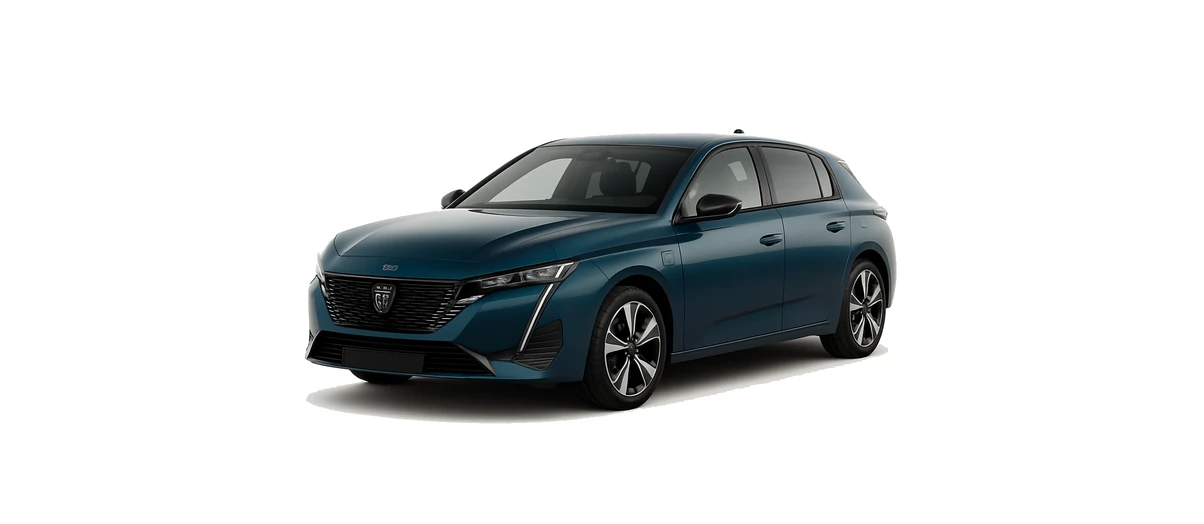
The Peugeot 308 range needs a little more care than many EVs when choosing a charging cable, because “Peugeot 308” does not refer to one single plug-in specification. UK drivers may have the fully electric Peugeot E-308, the E-308 SW estate, a 308 Plug-in Hybrid, or a non-plug-in petrol, diesel or mild hybrid model. Only the plug-in versions need a charging cable, and the correct charging expectations depend on whether your car is a battery-electric E-308 or a plug-in hybrid.
As a simple starting point, both the E-308 and the 308 Plug-in Hybrid use a Type 2 connection for AC charging at home, work and most public destination chargers. The important difference is rapid charging: the E-308 also has a CCS Combo 2 connection for DC rapid charging, while the 308 Plug-in Hybrid is AC Type 2 only and cannot use DC rapid chargers.
View Peugeot 308 Charging Cables
Peugeot 308 Battery and Charging Specifications
The current UK Peugeot 308 family includes the updated MY26 New 308 and 308 SW, with E-308 battery-electric versions, a 308 Plug-in Hybrid 195 and non-plug-in hybrid models. Used examples may have earlier specifications, particularly for the E-308 battery and the plug-in hybrid battery size.
For AC charging, the E-308 uses a Type 2 inlet. For DC rapid charging, the E-308 uses the lower CCS Combo 2 section of the same charge port area. The 308 Plug-in Hybrid uses Type 2 AC charging only, so it should not be treated as a rapid-charge-capable electric car.
- Peugeot E-308 / E-308 SW: battery-electric, Type 2 AC charging and CCS DC rapid charging.
- Peugeot 308 Plug-in Hybrid: petrol-electric PHEV, Type 2 AC charging only.
- Peugeot 308 mild hybrid, petrol or diesel: not a plug-in vehicle and does not use an EV charging cable.
Battery Options
The most important ownership point is to avoid mixing figures from different model years. The latest E-308 has a larger battery than the earlier MY23-25 E-308, and the newest plug-in hybrid has a larger battery than earlier 12.4 kWh PHEV versions.
| Version | Battery | Charging summary |
|---|---|---|
| New E-308 / E-308 SW MY26 | 58.4 kWh gross / 55.4 kWh usable | Type 2 AC up to 11 kW; CCS DC rapid charging around 100 kW |
| E-308 MY23-25 | 54.0 kWh gross / 50.8 kWh usable | Type 2 AC and CCS DC, with lower range than the newer model |
| 308 Plug-in Hybrid 195 | 17.2 kWh gross / 14.6 kWh usable | Type 2 AC only; 3.7 kW standard onboard charging, with 7.4 kW availability depending on trim/option |
| Earlier 308 Plug-in Hybrid 180/225 | 12.4 kWh gross | Type 2 AC only; earlier range and charging figures differ from the current PHEV |
AC Charging Speed
The MY26 Peugeot E-308 has an 11 kW three-phase onboard AC charger. That figure is useful where three-phase AC charging is available, but most UK homes have a single-phase supply. On a typical 7.4 kW home wallbox, the E-308 will charge at up to the capability of the wallbox and supply rather than at the full 11 kW headline rate.
For the E-308, a 7.4 kW home wallbox is still a very practical setup. It is well suited to overnight charging and regular top-ups, and it normally makes more sense than relying on a domestic socket. A Type 2 charging cable is the correct portable cable for untethered home, workplace and public AC chargers.
The current 308 Plug-in Hybrid 195 is different. Peugeot data lists a 3.7 kW onboard AC charger as standard, with 7.4 kW charging available depending on option or UK trim. Peugeot quotes about 4 hours 20 minutes from flat at 3.7 kW, or about 2 hours 5 minutes at 7.4 kW. Earlier 12.4 kWh plug-in hybrid versions were quoted at around 3 hours 50 minutes on a 7 kW point, so owners of used cars should check their specific handbook or specification.
DC Rapid Charging Speed
Only the Peugeot E-308 supports DC rapid charging. The MY26 E-308 is rated at around 100 kW DC, with Peugeot quoting a 20-80% charge in about 30-32 minutes and independent UK data estimating roughly 33 minutes for a 10-80% rapid charge. Real rapid charging times vary with battery temperature, charger performance, state of charge and weather.
On long journeys, it is usually quicker to charge the E-308 in the middle of the battery rather than waiting for 100%. Like most EVs, charging speed slows as the battery fills, especially above about 80%. For motorway travel, a 10-80% or 20-80% stop is normally more time-efficient than a full charge unless you specifically need the maximum range for the next leg.
The 308 Plug-in Hybrid cannot use CCS or DC rapid chargers. Even if a charging hub has CCS rapid units next to AC posts, the plug-in hybrid should be connected only to a compatible Type 2 AC charger.
Range and Efficiency
The MY26 E-308 hatchback has an official UK WLTP range of up to 279 miles, while the E-308 SW estate is listed at up to 275 miles. Independent real-world estimates are closer to around 210 miles for the newer BEV, although actual range will depend on temperature, speed, tyre choice, load, driving style and use of cabin heating or air conditioning.
Earlier MY23-25 E-308 models used a smaller 54.0 kWh gross battery, with independent estimates around 185 miles in real-world mixed driving. If you are buying a used E-308, it is worth checking whether the car is the earlier version or the updated MY26 model before planning regular journey ranges.
The current 308 Plug-in Hybrid 195 is listed with up to 52 miles of WLTP electric range in UK material. Earlier 12.4 kWh plug-in hybrid versions were typically quoted around the mid-30-mile mark under WLTP. In day-to-day use, PHEV electric range is especially sensitive to speed, winter conditions and how often the petrol engine is required for heating or performance.
Charging at Home
For most UK E-308 owners, the best home charging arrangement is a dedicated 7.4 kW wallbox with a Type 2 connection. If the wallbox is untethered, you will need your own Type 2 cable. If it is tethered, the cable is permanently attached to the charger, but many owners still keep a Type 2 cable in the boot for public AC charging.
Plug-in hybrid owners can also benefit from a home wallbox, although the smaller battery means charging times are shorter and charging power may be limited by the car’s onboard charger. A Type 2 cable is still the key cable for home and public AC charging.
A 3-pin charging cable is generally best suited as a backup or occasional charging solution, but can be used regularly if a qualified electrician has confirmed the socket and electrical installation are suitable for sustained EV charging. EV charging places a continuous load on a circuit for several hours, so it should not be treated like charging a phone or laptop.
Public Charging
At public AC charge points, both the E-308 and the 308 Plug-in Hybrid use Type 2. Many public AC posts in the UK are untethered, meaning you bring your own cable. For this reason, a good-quality Type 2 cable is the most useful day-to-day cable for Peugeot 308 plug-in owners.
At motorway services and rapid charging hubs, the E-308 can use CCS rapid chargers. These chargers have heavy tethered DC cables already attached, so you do not buy or carry a portable CCS cable. You simply connect the charger’s CCS plug to the car. The 308 Plug-in Hybrid cannot use these CCS connectors.
When using public networks, check whether the charger is AC or DC, whether it is tethered, and whether the bay is suitable for your charging port position. If your car is a PHEV, destination AC charging while parked for a few hours is usually much more useful than visiting rapid hubs intended for full EVs.
Vehicle-Specific Features
The updated MY26 E-308 is based on Stellantis’ EMP2 platform and is described as using a 400 V electric architecture. UK material lists an 11 kW AC charger and around 100 kW DC rapid charging for the new BEV versions.
Heat pump availability is trim-dependent rather than universal. Peugeot UK material lists the MY26 E-308 heat pump as standard on GT Premium and optional on Allure and GT, so owners should check the individual car’s specification before assuming it is fitted.
Peugeot press information also refers to V2L pre-disposition for the new E-308, up to 3.5 kW / 16 A, using an accessory adapter available via Peugeot dealers. This should be understood as an accessory-dependent feature for the new E-308, not as a normal household socket built into every Peugeot 308 plug-in model. There is no reliable public basis to treat the Peugeot 308 or E-308 as having V2G or V2H capability.
Charging Tips
- Identify your version first: E-308, E-308 SW and 308 Plug-in Hybrid have different charging limits and battery sizes.
- Choose Type 2 for AC charging: this applies to both the BEV and the PHEV.
- Do not buy a CCS cable: CCS rapid chargers have tethered cables; only the E-308 can use them.
- Use rapid charging strategically: for the E-308, shorter 10-80% or 20-80% stops are usually quicker than charging to 100%.
- Check used-car specifications: earlier E-308 and 308 Plug-in Hybrid models have different battery and range figures from the latest MY26 versions.
- Keep a Type 2 cable in the car: it is useful for untethered public AC posts, workplaces, hotels and many car parks.
Frequently Asked Questions
Does the Peugeot 308 use a Type 2 cable?
Yes, plug-in Peugeot 308 models use Type 2 for AC charging. This includes the E-308 and the 308 Plug-in Hybrid. Non-plug-in 308 versions do not need a charging cable.
Can the Peugeot 308 Plug-in Hybrid rapid charge?
No. The 308 Plug-in Hybrid is Type 2 AC only. It does not have CCS DC rapid charging capability.
Can the Peugeot E-308 rapid charge?
Yes. The E-308 has CCS DC rapid charging, with the MY26 version rated at around 100 kW. A typical rapid stop is best planned around the 10-80% or 20-80% charging window.
What cable should I buy for a Peugeot E-308?
For AC charging, choose a Type 2 cable suitable for your charger and use case. The car can accept up to 11 kW on three-phase AC, but many UK home chargers are 7.4 kW single-phase.
What cable should I buy for a Peugeot 308 Plug-in Hybrid?
A Type 2 cable is the correct cable for home, workplace and public AC charging. A CCS rapid charging cable is not relevant because the PHEV cannot DC rapid charge.
What This Means for Drivers
The Peugeot 308 is a strong example of why it is worth checking the exact powertrain before choosing a charging cable or planning charging times. The E-308 is a full battery-electric car with Type 2 AC charging and CCS rapid charging, while the 308 Plug-in Hybrid is a shorter-range electric-driving PHEV with Type 2 AC charging only. Both can be very easy to live with when charged regularly, but they require different expectations on longer journeys.
If you own the latest MY26 E-308, you have the larger 58.4 kWh gross battery, up to 279 miles WLTP range in hatchback form and useful 100 kW-class DC charging for longer trips. If you own an earlier E-308 or an earlier 12.4 kWh PHEV, your range and charging figures will be lower, so it is sensible to base charging habits on your specific model year.
Looking for a Charging Cable for Peugeot 308?
We offer Peugeot 308 charging cables for UK plug-in models, including Type 2 cables for the E-308 and 308 Plug-in Hybrid. Check your exact version before ordering, especially if you are choosing between a cable for a full EV and a plug-in hybrid.
View Peugeot 308 Charging Cables
Please note that this information is intended as a guide. Charging specifications may change due to model and year of manufacture. For precise information, always refer to your vehicle user manual.

