
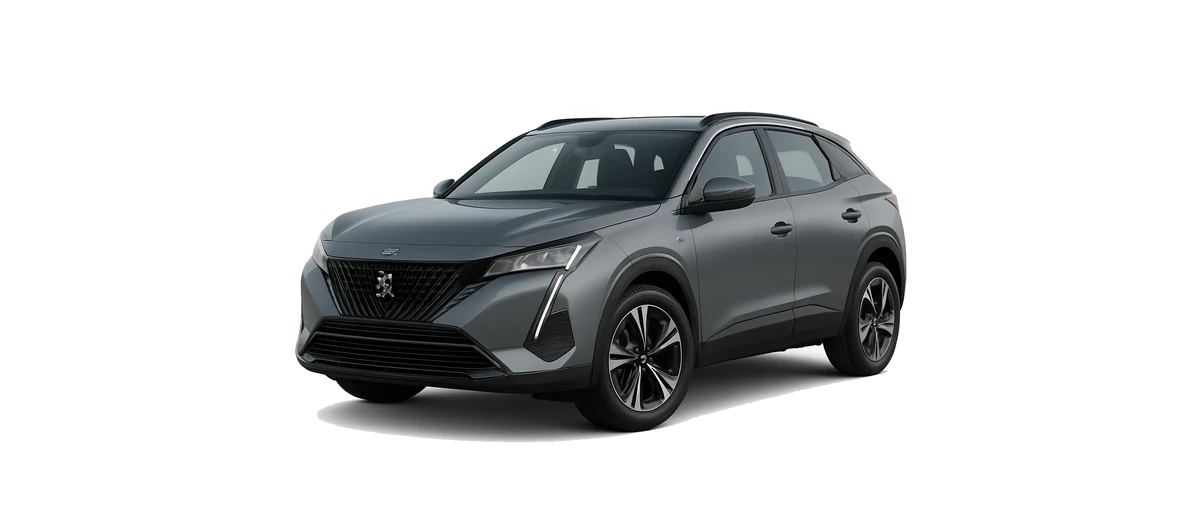
The Peugeot 3008 name now covers several very different cars, so the first step in choosing a charging cable is to identify which 3008 you actually have. In the current UK range, the E-3008 is the fully electric version, while the 3008 Plug-in Hybrid is a petrol-electric model with a charge port and a shorter electric-only range. There is also a 3008 Hybrid 145, which is a non-plug-in hybrid and does not need an EV charging cable. On the used market, many drivers are also looking for cables for the previous-generation 3008 Hybrid 225 and Hybrid4 300 plug-in hybrid models.
This guide separates those versions clearly, because there is no single charging specification that applies to every Peugeot 3008. The E-3008 uses Type 2 AC charging and CCS rapid charging. Plug-in hybrid 3008 models use Type 2 AC charging only and cannot use DC rapid chargers. Non-plug-in Hybrid, petrol and diesel versions have no external charging requirement.
View Peugeot 3008 Charging Cables
Peugeot 3008 Battery and Charging Specifications
The key difference is whether your car is a battery electric vehicle, a plug-in hybrid, or not a plug-in vehicle at all. For charging-cable purposes, the current Peugeot E-3008 is the full EV and uses a Type 2 socket for AC charging plus a CCS Combo 2 connector for DC rapid charging. EV Database lists the charge port as being at the left rear of the car.
The current Peugeot 3008 Plug-in Hybrid is different. It has a smaller battery intended for local electric driving and is AC-only, using a Type 2 connection. It does not have CCS rapid charging. The same general rule applies to older UK 3008 Hybrid and Hybrid4 plug-in hybrid models: Type 2 AC charging only.
If your car is the 3008 Hybrid 145 or another non-plug-in hybrid, it does not have a charge port. It charges its small hybrid battery through driving and regenerative braking, so a Type 2 cable, 3-pin charging lead or rapid charger is not relevant.
Battery Options
The current UK E-3008 range includes several electric powertrains. The Standard Range Electric 210 FWD uses a battery Peugeot lists at 73 kWh capacity, with up to 326 miles WLTP range. EV Database estimates this as around 77 kWh gross and 73 kWh usable. The Long Range Electric 230 FWD has a larger 96.9 kWh usable battery according to Peugeot data, with up to 435 miles WLTP range. EV Database estimates around 101 kWh gross and 96.9 kWh usable. The Dual Motor Electric 325 AWD uses the 73 kWh battery and is listed by Peugeot with around 306-308 miles WLTP range depending on the published wording.
The current 3008 Plug-in Hybrid has a much smaller battery. Stellantis technical information lists a usable capacity of 17.9 kWh. Peugeot UK’s public information describes electric range using wording such as up to 50 or 53 miles, with footnotes suggesting a 39-53 mile range depending on specification and conditions. Because public figures vary, it is sensible to confirm the exact version by VIN, order sheet or retailer documentation.
Older UK second-generation 3008 Hybrid 225 and Hybrid4 300 plug-in hybrid models commonly used a 13.2 kWh gross battery, with around 10.4 kWh usable capacity listed in UK specification data. Their official electric range was typically around 33-40 miles WLTP depending on version.
AC Charging Speed
For the E-3008, EV Database lists AC charging at up to 11 kW using a Type 2 connection. In practice, most UK homes have single-phase electricity, so a typical home wallbox will usually provide up to 7.4 kW. To reach the 11 kW AC maximum, you normally need a compatible three-phase supply and charge point. A 22 kW public AC post will not make the E-3008 charge at 22 kW; the car’s onboard charger sets the limit.
For cable choice, a 32 amp Type 2 cable is the practical option for most UK owners. It can be used with 7.4 kW single-phase home wallboxes and many public AC posts. If you regularly use three-phase AC charging and want to access the E-3008’s 11 kW capability where available, choose a cable specified for three-phase use.
The current 3008 Plug-in Hybrid is also Type 2 AC, but its charging speed is lower. Stellantis data lists a 3.7 kW onboard charger as standard, with a 7.4 kW option, giving approximate 0-100% charge times of about 5 hours 30 minutes at 3.7 kW or about 2 hours 55 minutes at 7.4 kW. A 7.4 kW cable will not make a car with a 3.7 kW onboard charger charge faster, so check your vehicle’s specification.
Older 3008 PHEV models follow a similar pattern: Type 2 AC charging, with 3.7 kW standard charging and an optional 7.4 kW onboard charger on some versions. UK data gives approximate full-charge times of around 3 hours 45 minutes at 3.7 kW or around 1 hour 45 minutes where the optional 7.4 kW charger is fitted.
DC Rapid Charging Speed
DC rapid charging applies to the E-3008 only. It uses the CCS Combo 2 connector at compatible public rapid and ultra-rapid chargers. Peugeot quotes 20-80% rapid charging times of around 30 minutes for the 73 kWh versions and around 27 minutes for the Long Range version. EV Database estimates 10-80% times that vary by version and conditions, broadly in the low-to-mid 30 minute range for some variants and nearer 36-40 minutes for the 73 kWh model depending on methodology.
The headline DC charging figure for the E-3008 is up to 160 kW. As with all EVs, peak speed is not maintained throughout the whole session. Charging is usually fastest at a lower state of charge and slows as the battery approaches 80% and above. For long journeys, it is often quicker to make shorter rapid-charging stops in the faster part of the charge curve rather than waiting for 100%.
The 3008 Plug-in Hybrid and older 3008 PHEV models do not use CCS and cannot rapid charge on DC. They should be charged from a home wallbox, workplace charger, public AC post or suitable domestic socket arrangement.
Range and Efficiency
The longest-range current E-3008 is the Long Range Electric 230 FWD, with Peugeot quoting up to 435 miles WLTP. EV Database estimates a real-world range of around 310 miles for that larger-battery version. The Standard Range Electric 210 FWD is quoted by Peugeot at up to 326 miles WLTP, while the Dual Motor 325 AWD is quoted at around 306-308 miles WLTP depending on Peugeot’s published wording.
Real-world range will vary with speed, temperature, wheel size, road type, payload and driving style. Motorway driving in winter will normally use more energy than mixed urban and A-road driving in mild weather. For the plug-in hybrid versions, the electric-only range is much shorter, but can still cover many local journeys if you charge regularly.
Charging at Home
For most E-3008 owners, a dedicated 7.4 kW home wallbox is the most convenient charging method. It allows overnight charging and is kinder to daily routines than relying only on public rapid chargers. The E-3008 can accept more on AC where three-phase charging is available, but most UK domestic installations will be limited to single-phase charging.
For current and older 3008 plug-in hybrid owners, a home wallbox is also convenient, although charging needs are smaller because the battery is much smaller. If your PHEV has only a 3.7 kW onboard charger, it will not charge faster just because the wallbox or cable is rated for 7.4 kW.
A 3-pin charger is generally best suited as a backup or occasional charging solution, but can be used regularly if a qualified electrician has confirmed the socket and electrical installation are suitable for sustained EV charging. Avoid using damaged sockets, extension leads or unknown outdoor wiring arrangements.
Public Charging
For the E-3008, public charging falls into two main categories. Public AC charging uses your own Type 2 cable at many destinations such as supermarkets, car parks, hotels and workplaces. These chargers are useful when the car is parked for a few hours. Public DC rapid charging uses the tethered CCS cable attached to the charger and is intended for longer journeys or faster top-ups.
For the 3008 Plug-in Hybrid and older PHEV models, public AC charging can be useful if you can park long enough to make the smaller battery worthwhile. However, they cannot use DC rapid chargers, even if the charging station also serves full EVs. Look for Type 2 AC posts rather than CCS rapid bays.
Vehicle-Specific Features
The current E-3008 is based on Stellantis STLA Medium architecture and is offered in several battery and motor configurations. Peugeot UK states that all new E-3008 models include battery pre-conditioning. Vehicles ordered before October 2025 may need over-the-air updates and/or dealer activation, so owners should check the car’s software status if this feature is important.
Battery preconditioning helps prepare the battery for faster rapid charging, particularly in cold weather. When available and activated, setting a rapid charger as the destination in the car’s navigation system can help the vehicle prepare the battery before arrival.
Heat pump availability is not universal. EV Database lists it as optional on some 73 kWh FWD and Long Range versions, and standard on the 73 kWh Dual Motor version. Check the exact trim and build specification rather than assuming every E-3008 has one.
EV Database also lists Vehicle-to-Load support for the E-3008 at up to 3.6 kW AC via a suitable Type 2 adaptor. Vehicle-to-Home and Vehicle-to-Grid support are not listed as available. These features are not confirmed for the PHEV or non-plug-in hybrid versions in the supplied data.
Charging Tips
- Confirm your exact 3008 version before buying a cable: E-3008 BEV, current Plug-in Hybrid, older Hybrid/Hybrid4 PHEV, or non-plug-in Hybrid.
- For most UK owners, a 32 amp Type 2 cable is the most useful everyday cable for home and public AC charging.
- If you own an E-3008 and regularly use three-phase AC posts, consider a three-phase Type 2 cable to access up to 11 kW where available.
- Do not expect a 22 kW AC post to charge the E-3008 at 22 kW; the car is limited by its onboard AC charger.
- For PHEV models, check whether your car has the 3.7 kW or optional 7.4 kW onboard charger.
- For E-3008 rapid charging, aim to arrive at a low-to-moderate battery percentage and expect charging to slow above roughly 80%.
- For regular BEV use, Peugeot recommends keeping charge between 20% and 80% for battery health, using 100% mainly before longer trips.
- In cold weather, use navigation-based preconditioning or the vehicle’s preconditioning function where available and activated.
Frequently Asked Questions
Does every Peugeot 3008 need a charging cable?
No. The E-3008 and 3008 Plug-in Hybrid versions need charging cables. Older 3008 Hybrid and Hybrid4 PHEV models also use charging cables. The 3008 Hybrid 145 is not a plug-in car and does not need an EV charging cable.
What cable does the Peugeot E-3008 use?
The E-3008 uses Type 2 for AC charging and CCS Combo 2 for DC rapid charging. For public rapid charging, the CCS cable is normally tethered to the charger, so you do not need to bring your own CCS cable.
Can the Peugeot 3008 Plug-in Hybrid rapid charge?
No. The current 3008 Plug-in Hybrid and older 3008 PHEV models are AC-only. They use a Type 2 connection and cannot use CCS DC rapid chargers.
Will a 7.4 kW cable make my plug-in hybrid charge faster?
Only if the car itself has a 7.4 kW onboard charger. If your 3008 PHEV is fitted with a 3.7 kW onboard charger, a higher-rated cable or wallbox will not override that limit.
Can the E-3008 charge at 11 kW at home?
Only if the home has a suitable three-phase electrical supply and compatible charge point. Most UK homes are single-phase, where charging will usually be limited to around 7.4 kW.
What This Means for Drivers
The Peugeot 3008 is a good example of why model names alone can be misleading for charging. An E-3008 driver needs to think about Type 2 AC charging, CCS rapid charging, battery preconditioning and longer-distance charging strategy. A 3008 Plug-in Hybrid owner mainly needs a suitable Type 2 cable and a realistic understanding of whether their car has 3.7 kW or 7.4 kW AC charging. A non-plug-in Hybrid 145 owner does not need a charging cable at all.
If you are buying a used 3008, check the badge, charge port, handbook, VIN information or retailer listing before choosing accessories. This is especially important because older Hybrid and Hybrid4 models have different battery sizes and charging times from the current 3008 Plug-in Hybrid.
Looking for a Charging Cable for Peugeot 3008?
If you have confirmed that your Peugeot 3008 is a plug-in model, We offer Type 2 charging cables suitable for E-3008 and 3008 Plug-in Hybrid ownership; choose according to your vehicle, charge point and whether you need single-phase or three-phase capability.
View Peugeot 3008 Charging Cables
Please note that this information is intended as a guide. Charging specifications may change due to model and year of manufacture. For precise information, always refer to your vehicle user manual.

