
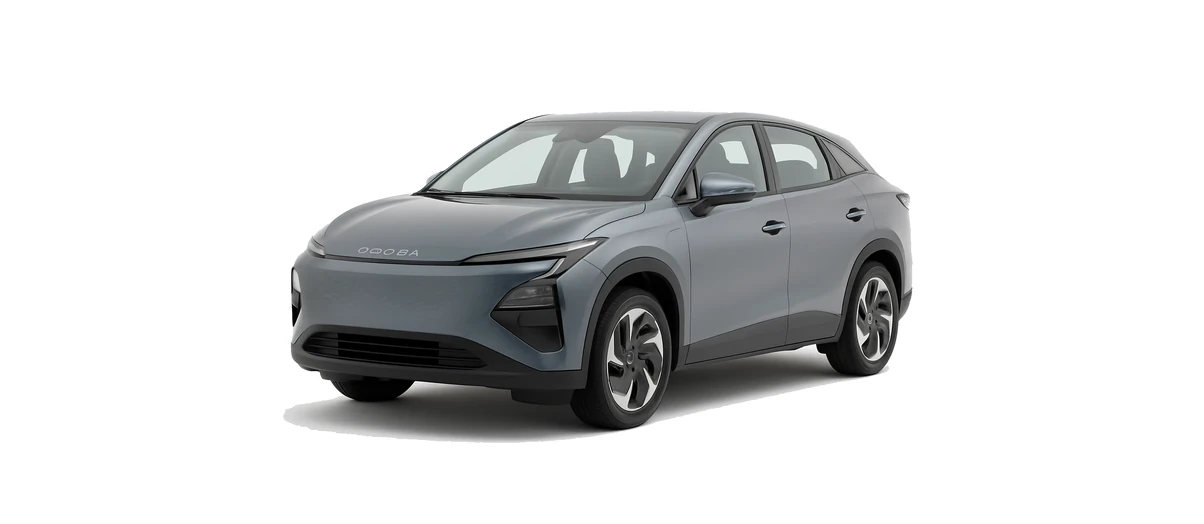
The Omoda E5 is a fully electric medium SUV/crossover from Omoda, part of the Chery group, and it arrived in the UK as the battery-electric version of the Omoda 5 family. It should not be confused with the Omoda 5 petrol model, the Omoda 5 SHS-H hybrid, or the larger Omoda 7 and Omoda 9 plug-in hybrid models. For UK drivers, the E5 is relevant because it combines a practical SUV body, a 61 kWh LFP battery and the standard European charging layout of Type 2 AC and CCS Combo 2 DC rapid charging.
One important point for buyers and owners is that UK information has changed during the E5’s early life. UK sales began in 2024, and some sources still show earlier figures such as a 257-mile WLTP range and slower rapid charging. Updated UK information for 2025 references up to 267 miles WLTP and faster AC and DC charging, including up to 130 kW DC rapid charging. If you are checking a specific car, especially a stock MY24 vehicle or a nearly new example, it is worth confirming the exact specification with the supplying dealer or the vehicle documents.
This guide explains what UK Omoda E5 drivers need to know about home charging, public charging and choosing the right charging cable.
Omoda E5 Battery and Charging Specifications
The UK-market Omoda E5 uses a 61 kWh LFP blade-cell battery. EV Database lists the battery as 60.9 kWh nominal with around 58.9 kWh usable capacity, while Omoda’s UK material describes it as a 61 kWh battery. No separate UK battery-size options have been identified, so cable and charging advice is broadly the same across the E5 range, subject to trim and model-year differences.
For charging, the E5 uses a Type 2 connector for AC charging and a CCS Combo 2 connector for DC rapid charging. This is the standard arrangement for modern electric cars in the UK and Europe, meaning the car is compatible with typical home wallboxes, untethered public AC charge points and motorway or hub-based rapid chargers.
Headline figures for updated UK cars include AC charging at around 10.3 kW, or approximately 11 kW depending on the source, and DC rapid charging at up to 130 kW. In practical UK use, the AC figure needs context: most homes have a single-phase electricity supply, so a typical home wallbox will charge at up to 7.4 kW rather than the car’s full three-phase AC capability.
Battery Options
Unlike some electric SUVs, the Omoda E5 is not currently presented in the UK with multiple battery capacities. The known UK specification centres on the 61 kWh LFP battery pack. LFP chemistry is often valued for durability and thermal stability, and it is commonly more tolerant of occasional charging to 100% than many nickel-rich battery chemistries. Even so, owners should still follow the car’s manual and in-car recommendations for day-to-day charging limits, especially if the vehicle provides its own guidance.
The E5’s battery size makes it well suited to typical commuting, school runs, local journeys and longer motorway trips with planned charging stops. Because the battery is not exceptionally large, home charging remains straightforward: a normal overnight session on a 7.4 kW wallbox should be enough for most low-to-full recharges.
AC Charging Speed
AC charging is what you will use at home, at many workplaces and at slower public destination chargers. Updated UK reporting states that the Omoda E5’s AC charging capability increased to 10.3 kW, while EV Database lists around 11 kW AC. In real terms, this should be treated as an 11 kW-class three-phase AC capability rather than a 22 kW system.
For most UK households, the more relevant figure is 7.4 kW. A 7.4 kW single-phase wallbox can add a substantial amount of range overnight and is usually the most convenient and cost-effective way to run an EV. EV Database estimates a full 0-100% charge at 7.4 kW at around 9 hours 30 minutes, while an 11 kW three-phase AC supply is estimated at around 6 hours 30 minutes.
For cable selection, most Omoda E5 owners should choose a Type 2 to Type 2 cable. A single-phase 32 amp Type 2 cable is suitable for 7.4 kW home and public AC charging. If you regularly use workplace or public charge points with three-phase AC, a three-phase Type 2 cable can be worthwhile because it allows the car to make use of its higher AC charging capability where the site supports it.
DC Rapid Charging Speed
For longer journeys, the Omoda E5 uses CCS Combo 2 DC rapid charging. Updated UK information quotes up to 130 kW DC charging, with Omoda stating a 30-80% charge in 28 minutes. EV Database estimates a 10-80% rapid charge at around 33 minutes under suitable conditions. These figures are not contradictory: they refer to different state-of-charge windows.
As with all electric cars, peak rapid charging is not guaranteed at every charger or throughout the whole session. The charging rate depends on the charger’s output, battery temperature, state of charge, charger sharing arrangements and the car’s charging curve. A 130 kW-capable rapid charger or faster unit gives the E5 the best chance of reaching its peak, but you may see lower speeds in cold weather, at high state of charge, or if the charger is limited.
For efficient motorway travel, plan stops around the faster part of the charging curve. In many EVs, including the E5, charging from roughly 10-80% is usually more time-efficient than waiting for the last 20%, because charging slows as the battery fills.
Range and Efficiency
The updated UK Omoda E5 is quoted at up to 267 miles WLTP. Earlier UK launch information and some current pages still contain a 257-mile figure, so it is sensible to treat 257 miles as applying to earlier or older information and 267 miles as the updated headline figure for newer UK cars. Always check the exact vehicle specification if range is a deciding factor.
Real-world range will vary with temperature, speed, driving style, tyre condition, load, use of heating and route profile. EV Database estimates a real-world range of around 205 miles, which is a useful planning figure for mixed UK driving. In summer urban and suburban use you may exceed that estimate, while sustained motorway driving in winter can reduce range.
For daily ownership, the key point is that the E5’s range should be more than enough for most UK commutes and local journeys. For long trips, a realistic plan based on 10-80% rapid-charging stops will be more useful than relying solely on the WLTP headline figure.
Charging at Home
Home charging is likely to be the simplest way to run an Omoda E5. If you have off-street parking, a dedicated 7.4 kW home wallbox will usually be the preferred setup. It is faster, safer and more convenient than relying on a domestic socket, and it can often be paired with an off-peak EV tariff to reduce running costs.
Using the E5’s usable battery capacity as a guide, a 7.4 kW wallbox should comfortably handle most charging needs overnight. You do not normally need to charge from 0-100%; many owners simply top up from, for example, 30-80% or 40-90% depending on their weekly mileage. When maximum range is required, such as before a long journey, charging to 100% may be appropriate, particularly given the E5’s LFP battery chemistry, but the owner’s manual and in-car recommendations should take priority.
A 3-pin charger is generally best suited as a backup or occasional charging solution, but can be used regularly if a qualified electrician has confirmed the socket and electrical installation are suitable for sustained EV charging. Domestic sockets were not primarily designed for repeated high-load EV charging, so professional checking is important if you intend to use one frequently.
Public Charging
On the public network, the Omoda E5 can use two broad types of charger. AC destination chargers, often found in car parks, hotels, workplaces and shopping areas, use the car’s onboard AC charger and normally require your own Type 2 to Type 2 cable unless the unit is tethered. DC rapid and ultra-rapid chargers use a tethered CCS cable attached to the charger, so you do not need to use your own cable for rapid charging.
For AC charging away from home, a Type 2 cable should be kept in the boot. If you only need 7.4 kW single-phase charging, a single-phase cable is enough. If you want the flexibility to use 11 kW three-phase posts where available, choose a three-phase Type 2 cable. The car will only draw what it can accept, so using a higher-capability cable does not force the vehicle to charge beyond its onboard limit.
For rapid charging, look for CCS chargers rated at 100 kW or higher if you want to take advantage of the E5’s updated peak rate. Lower-powered 50 kW rapid chargers will still work, but they will take longer. On busy travel days, choosing a charging hub with multiple units can be more reliable than relying on a single charger at a service station.
Vehicle-Specific Features
The Omoda E5 includes battery preconditioning according to UK review information, with the ability to pre-condition while plugged in. This is especially useful in colder weather, as warming the battery before a journey or before rapid charging can help improve efficiency and charging consistency. If your car offers a scheduled departure or pre-conditioning setting, it is worth using it before winter motorway trips.
Heat pump availability should be checked by trim and model year. UK reports associate the heat pump with Noble trim after the 2025 update, but it should not be assumed to be fitted universally to every E5. A heat pump can help reduce heating-related energy use in colder conditions, but the exact impact depends on temperature and usage.
Vehicle-to-Load is also a feature to approach carefully. Omoda UK lists a Vehicle-to-Load cable accessory, and a UK review has reported V2L functionality up to 3.3 kW. However, availability may depend on the specific vehicle, trim and accessory supply, so confirm with the dealer before relying on it for camping, tools or emergency device charging. There is no reliable UK confirmation of V2G or V2H capability for the E5, so it should not be treated as a home or grid bidirectional charging vehicle.
Charging Tips
- Choose the right cable: for most owners, a Type 2 to Type 2 cable is essential for untethered home and public AC charging.
- Consider three-phase flexibility: if you regularly use workplace or public 11 kW AC points, a three-phase cable is a useful upgrade.
- Use rapid charging strategically: on long journeys, aim for the efficient 10-80% window rather than waiting for a full battery at every stop.
- Pre-condition in winter: where available, pre-condition the cabin and battery while plugged in before cold-weather journeys.
- Do not expect peak charging every time: the headline 130 kW rate depends on charger capability, battery temperature and state of charge.
- Check your exact model year: some UK information mixes older 257-mile and newer 267-mile specifications, so confirm the exact car you own or are buying.
Frequently Asked Questions
What charging cable does the Omoda E5 use?
The Omoda E5 uses a Type 2 connector for AC charging and CCS Combo 2 for DC rapid charging. For home wallboxes and many public AC charge points, you will need a Type 2 to Type 2 cable unless the charger is tethered.
Can the Omoda E5 charge at 22 kW AC?
No reliable UK data indicates 22 kW AC charging support. Current information points to around 10.3 kW or 11 kW AC maximum, which effectively means three-phase 11 kW-class charging where supported.
How long does the Omoda E5 take to charge at home?
On a typical UK 7.4 kW home wallbox, a low-to-full charge is estimated at around 9 hours 30 minutes. Smaller top-ups will take much less time and are more representative of everyday use.
How fast does the Omoda E5 rapid charge?
Updated UK figures quote up to 130 kW DC rapid charging. Omoda quotes 30-80% in 28 minutes, while EV Database estimates around 33 minutes for 10-80% in good conditions.
Is the Omoda E5 a plug-in hybrid?
No. The Omoda E5 is a battery-electric vehicle. It is separate from Omoda petrol, hybrid and plug-in hybrid models.
What This Means for Drivers
The Omoda E5 should be straightforward to live with for UK EV owners. Its Type 2 and CCS charging setup is standard for the UK and European network, its 61 kWh LFP battery is a practical size for daily use, and updated cars offer improved range and charging figures compared with earlier launch information.
For most drivers, the best charging setup will be a 7.4 kW home wallbox plus a good-quality Type 2 to Type 2 cable kept in the vehicle. If you have access to three-phase AC charging at work or on public posts, choosing a three-phase cable gives you more flexibility. For longer journeys, use CCS rapid chargers, plan around 10-80% charging stops and remember that the headline 130 kW rate is a peak rather than a constant speed.
Looking for a Charging Cable for Omoda E5?
We offer charging cables suitable for the Omoda E5, including Type 2 options for home, workplace and public AC charging. Choose a cable based on how you charge most often, and consider a three-phase Type 2 cable if you want the flexibility to use 11 kW AC charge points where available.
Please note that this information is intended as a guide. Charging specifications may change due to model and year of manufacture. For precise information, always refer to your vehicle user manual.

