
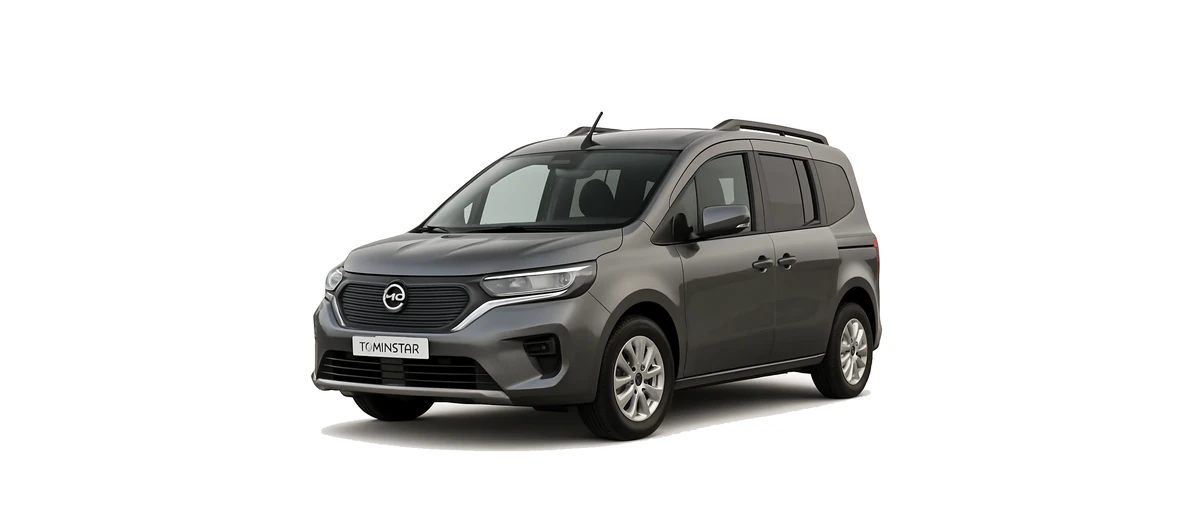
The Nissan Townstar range includes both petrol and electric versions, so this guide focuses specifically on the Nissan Townstar EV variants sold in the UK. Current UK MY26 Townstar EV panel van and crew van models use a 45kWh battery, Type 2 AC charging and CCS rapid charging, making them well suited to urban delivery routes, trades, local services and small-business fleets.
For many UK drivers, the Townstar EV will spend most of its time charging from a home or workplace wallbox. However, it has an important advantage over many smaller electric vans: current UK MY26 van information lists 22kW AC charging capability. That can be especially useful at depots, workplaces and public three-phase AC posts, even though most UK home installations will normally be limited to around 7.4kW on single-phase power.
View Nissan Townstar Charging Cables
Nissan Townstar EV Battery and Charging Specifications
UK Nissan sources list the current Townstar EV van with a 45kWh battery, a 90kW electric motor and an 80kW CCS rapid charging system. Nissan’s UK brochure also states that a Mode 3 Type 2-to-Type 2 charging cable is supplied, which is the cable type used for untethered home wallboxes and many public AC charge points.
The key point for cable selection is straightforward: for AC charging, the Townstar EV uses a Type 2 connection. For DC rapid charging, it uses the CCS Combo 2 connector found on UK and European rapid and ultra-rapid chargers. You do not need to buy a separate CCS cable for public rapid charging because DC rapid chargers have their own tethered cable.
- Vehicle type: Nissan Townstar EV compact electric van / crew van
- Battery: 45kWh capacity listed by Nissan UK, not clearly labelled as gross or usable in the UK van documents checked
- AC charging: Type 2, with 22kW listed for current UK MY26 Townstar EV van variants
- DC rapid charging: CCS, up to 80kW listed by Nissan UK
- Official range: up to 178 miles WLTP combined, depending on version and conditions
- Battery warranty: Nissan UK brochure lists an 8-year / 100,000-mile battery warranty
Battery Options
For the current UK Townstar EV van range, Nissan lists a 45kWh battery. The UK information checked does not clearly state whether this figure is gross or usable capacity, so it is best treated simply as Nissan’s stated battery capacity rather than described as one or the other.
European third-party data for the closely related Townstar EV Passenger L2 lists a 48.0kWh nominal battery and 45.0kWh usable capacity. That is useful context, but UK van buyers should rely on the specification for their exact model year, trim and body style, particularly when comparing new and used examples.
The current UK MY26 electric van line-up includes Panel Van L1, Panel Van L2 and Crew Van L2 variants. Because the wider Townstar range also includes petrol models, check that the vehicle is specifically a Townstar EV before planning charging equipment or cable compatibility.
AC Charging Speed
AC charging is where the Townstar EV is particularly interesting for business users. Nissan’s current UK MY26 van information lists 22kW AC onboard charging, which is faster than the 7.4kW AC rate many drivers associate with home wallboxes. Nissan quotes approximately 6.3 hours for a 0-100% charge from a 7.4kW single-phase wallbox, around 4.5 hours from 11kW AC, and around 1.5 hours for 15-80% on 22kW AC.
In practice, many UK homes have single-phase electricity supplies, so a typical domestic wallbox will charge the Townstar EV at up to about 7.4kW. That is still fast enough for overnight charging and is usually the most convenient option for owner-drivers who return home each evening.
The full 22kW AC capability is most relevant where three-phase AC power is available. That could be a depot, workshop, office car park, local authority site or public AC charging post. For fleets, this can be a genuine operational advantage because it may allow a van to recover a useful amount of charge during loading, lunch breaks, shift changes or between jobs without needing to occupy a DC rapid charger.
If you are buying a used Townstar EV or importing a vehicle, check the exact onboard charger fitted. Some earlier or non-UK information for related variants refers to 11kW standard charging or 22kW as optional, so it is safest not to assume every used Townstar EV has the same AC charging specification.
DC Rapid Charging Speed
For longer days or unexpected extra mileage, the Townstar EV can use CCS rapid chargers. Nissan UK lists up to 80kW DC charging and quotes a 15-80% charge in around 37 minutes under suitable conditions. Third-party data for the related passenger version suggests roughly 40 minutes for a 10-80% rapid charge, which is a useful real-world planning figure when looking at a wider charging window.
As with all electric vehicles, rapid charging speed depends on battery temperature, state of charge, charger performance, site load and weather. The fastest speeds are generally seen when the battery is at a lower to mid state of charge and conditions are favourable. Charging from 80% to 100% on a rapid charger is usually much slower, so for route planning it is often better to stop, charge to around 80%, and continue driving rather than wait for a full charge unless you genuinely need it.
Range and Efficiency
Nissan’s UK brochure gives an official WLTP combined range of up to 178 miles for the Townstar EV. That figure is useful for comparing vehicles, but day-to-day range will vary. Auto Express reported around 139 miles in mixed UK driving, which gives a more cautious reference point for real-world planning.
For van drivers, payload and usage pattern matter a lot. A lightly loaded Townstar EV doing urban routes at moderate speeds may get closer to its best efficiency. A heavily loaded van, regular motorway work, winter weather, roof bars, stop-start heating use or repeated short cold journeys can all reduce range. Businesses should build route plans around realistic operating conditions rather than assuming the official WLTP figure will be available every day.
Charging at Home
For owner-drivers and small businesses, a dedicated home wallbox is usually the most practical charging setup. A 7.4kW single-phase wallbox can charge the Townstar EV overnight and is far more convenient than relying on public charging for daily use. It also allows drivers to take advantage of off-peak electricity tariffs where available.
The Townstar EV uses a Type 2 cable for AC charging. If your wallbox is untethered, you will need a Type 2-to-Type 2 charging cable. If your wallbox is tethered, the cable is already attached to the unit. Nissan UK lists a supplied Mode 3 Type 2-to-Type 2 cable, but if you operate multiple sites, need a spare cable, or want a different cable length, it is worth checking what came with your specific van.
A 3-pin charging cable can be useful in limited situations, but it is generally best suited as a backup or occasional charging solution, but can be used regularly if a qualified electrician has confirmed the socket and electrical installation are suitable for sustained EV charging. For a working van that needs predictable charging, a professionally installed wallbox is normally the better long-term option.
Public Charging
Public charging for the Townstar EV falls into two main categories: AC charging and DC rapid charging. Public AC posts usually require your own Type 2 cable unless the unit is tethered. These chargers are useful when parking for a longer period, such as at a workplace, town centre, hotel, car park or customer site.
DC rapid chargers use CCS and have a cable attached, so you simply connect the charger’s CCS plug to the vehicle. Rapid charging is best saved for longer routes, urgent top-ups or days when the van has exceeded its normal mileage. For fleets, a mixed approach often works best: depot or home charging for the daily baseline, public AC where the van is parked anyway, and CCS rapid charging when turnaround time matters.
If your business has access to three-phase power, 22kW AC charging can be particularly valuable. It can reduce dependence on public rapid chargers and allow more controlled charging schedules across multiple vehicles.
Vehicle-Specific Features
The Townstar EV is built around a practical compact-van use case rather than long-distance luxury EV touring. Current UK information lists a 90kW / 122hp front-mounted electric motor and a liquid-cooled lithium-ion battery. The van is available in L1 and L2 panel van forms, with an L2 crew van also shown in the MY26 UK LCV price list.
Its most notable charging feature is the 22kW AC capability listed for current UK MY26 van models. This is especially relevant for fleets because many business premises can install or already have three-phase AC charging. Where the infrastructure is suitable, the Townstar EV can make better use of AC charging time than a van limited to lower AC rates.
Nissan UK documents checked do not clearly confirm features such as a heat pump or battery preconditioning for the exact UK van variants, so those should not be assumed when comparing specifications. Always check the build, trim and model year if a particular feature is important to your operation.
Charging Tips
- Use Type 2 for AC charging: this applies to home wallboxes, workplace posts and most destination chargers.
- Use CCS for rapid charging: rapid chargers have their own tethered CCS cable, so you do not need to carry one.
- Plan around 7.4kW at home: most UK homes are single-phase, so 22kW AC normally requires three-phase power.
- Use 22kW AC where available: depot, workplace and public three-phase AC charging can be very useful for the Townstar EV.
- Avoid over-relying on 100% rapid charging: charging slows at higher battery percentages, so shorter rapid stops can be more efficient.
- Allow for payload and weather: range will be lower when the van is heavily loaded, driven at motorway speeds or used in cold conditions.
Frequently Asked Questions
What charging cable does the Nissan Townstar EV use?
The Nissan Townstar EV uses a Type 2 cable for AC charging. This is the cable type used with untethered home wallboxes and many public AC charge points. For DC rapid charging, it uses a CCS connector, and the rapid charger provides the cable.
Can the Nissan Townstar EV charge at 22kW at home?
Only if the property has a suitable three-phase electrical supply and compatible charging equipment. Most UK homes are single-phase, so domestic wallbox charging is usually up to around 7.4kW.
How long does the Nissan Townstar EV take to charge?
Nissan quotes around 6.3 hours for 0-100% from a 7.4kW wallbox, around 4.5 hours from 11kW AC, and around 1.5 hours for 15-80% from 22kW AC. For DC rapid charging, Nissan quotes 15-80% in about 37 minutes at up to 80kW where conditions allow.
Is every Nissan Townstar electric?
No. The UK Townstar range includes petrol versions as well as Townstar EV models. Charging information applies only to the fully electric Townstar EV variants.
Does the Nissan Townstar EV use CHAdeMO?
No. UK and European Townstar EV charging is Type 2 for AC charging and CCS for DC rapid charging.
What This Means for Drivers
The Nissan Townstar EV is a strong fit for drivers and businesses that can charge predictably at home, work or a depot. Its 45kWh battery and official range of up to 178 miles suit local and regional use, while real-world planning should allow for load, weather and route type. The standout charging benefit is the 22kW AC capability listed for current UK MY26 van models, which can make workplace and depot charging much more productive than a standard single-phase setup.
For most UK home users, a 7.4kW wallbox and Type 2 cable will be the everyday charging solution. For fleets, the best setup may be a combination of overnight depot charging, three-phase AC posts and occasional CCS rapid charging for longer or busier days.
Looking for a Charging Cable for Nissan Townstar?
If you need a replacement, spare or longer Type 2 charging cable for a Nissan Townstar EV, choose a cable that suits your charging setup, parking layout and whether you plan to use home, workplace or public AC charge points.
View Nissan Townstar Charging Cables
Please note that this information is intended as a guide. Charging specifications may change due to model and year of manufacture. For precise information, always refer to your vehicle user manual.

