
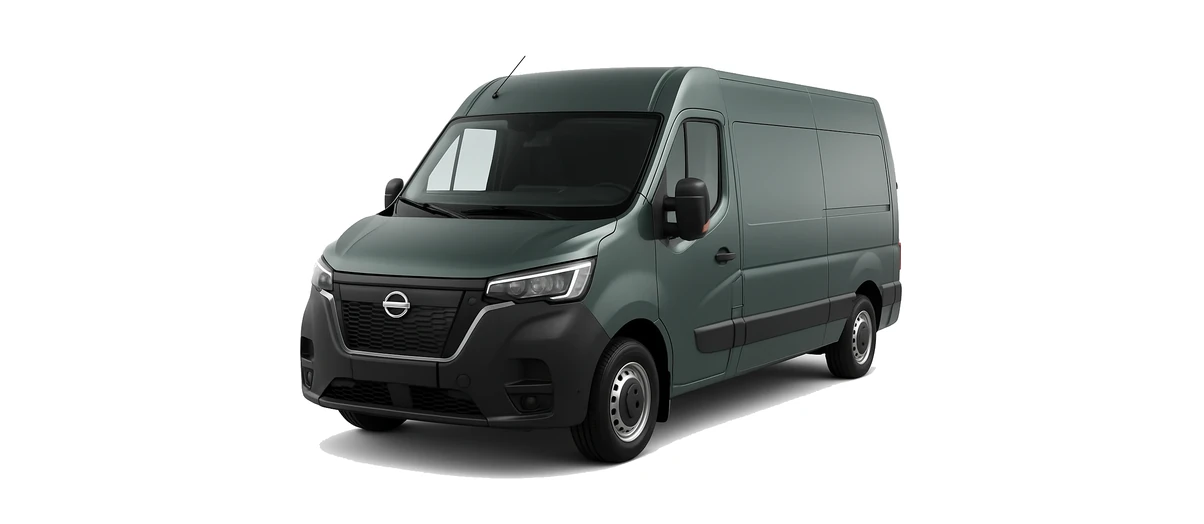
The Nissan Interstar is Nissan’s large van range, available in the UK with diesel powertrains as well as the fully electric Interstar-e. This guide focuses specifically on the Nissan Interstar-e electric van, as the charging requirements, cables and day-to-day ownership considerations are very different from the diesel models.
For many trades, delivery operators and fleet managers, the Interstar-e’s charging setup is one of its most important buying points. Nissan UK lists two electric battery choices: a 40 kWh Standard Range version and an 87 kWh Long Range version. They differ significantly in range, AC charging speed and DC rapid charging performance, so it is important not to treat every Interstar-e as having the same charging capability.
In UK use, the key distinction is between standard single-phase charging, commonly around 7.4 kW at home or smaller business premises, and three-phase AC charging, which can unlock much faster depot charging on the 87 kWh version. The van uses Type 2 AC charging and CCS2 DC rapid charging, making it compatible with the usual UK and European EV charging standards.
View Nissan Interstar-e Charging Cables
Nissan Interstar-e Battery and Charging Specifications
Current UK information for the electric Interstar-e separates the van into two main battery versions. The 40 kWh Standard Range model is intended for shorter routes, local work and predictable urban or regional driving. The 87 kWh Long Range version is aimed at operators who need more range, greater charging flexibility and better suitability for longer working days.
Nissan UK lists the Interstar-e with a Type 2 connection for AC charging and CCS2 for DC rapid charging. This is the common arrangement for modern UK and European electric vans: the upper Type 2 section is used for AC charging from a home wallbox, workplace charger or public AC post, while the full CCS2 connector is used at rapid and ultra-rapid DC charging stations.
Because the Interstar-e is a large commercial vehicle, charging performance in real operation can vary more than it might in a smaller car. Payload, racking, refrigeration or specialist conversions, tyre choice, motorway speeds, outside temperature and route profile can all affect energy consumption and therefore how often the van needs to charge.
Battery Options
The 40 kWh Standard Range Interstar-e is listed by Nissan UK with a 40 kWh battery, a 96 kW motor and 300 Nm of torque. UK information does not clearly separate gross and usable battery capacity for this pack, so it is best to treat 40 kWh as the Nissan-quoted battery size rather than making a more specific usable-capacity claim.
Nissan UK lists the 87 kWh Long Range Interstar-e with an 87 kWh battery, a 105 kW motor and 300 Nm of torque. Some independent coverage describes the 87 kWh pack as net or usable, but for general ownership guidance it is safest to refer to it as the Nissan-quoted 87 kWh battery unless exact technical wording is required.
The difference between the two packs is more than just range. The larger battery version also has stronger charging capability, especially on AC where Nissan lists 22 kW charging for the 87 kWh model. For depot operators with suitable three-phase infrastructure, that can make a major difference to how quickly vans can be turned around between shifts.
AC Charging Speed
AC charging is what most owners and fleets will use for routine charging at home, at a depot or at a workplace. For the Nissan Interstar-e, AC charging speed depends on which battery version you have.
According to current Nissan UK comparison information, the 40 kWh Standard Range version has 7.4 kW AC charging as standard. That suits a typical UK single-phase wallbox and is appropriate for overnight charging, especially where the van returns to base at the end of the day.
The 87 kWh Long Range version is listed with 22 kW AC charging as standard, while remaining compatible with lower AC charging rates such as 11 kW and 7.4 kW. However, 11 kW and 22 kW AC charging require three-phase supply and a suitable three-phase charger. Many UK homes only have single-phase electricity, so an 87 kWh Interstar-e connected to a typical 7.4 kW home wallbox will not charge at 22 kW.
Nissan’s public charging information gives approximate full range recovery times, including around 1 hour 53 minutes at 22 kW AC for the 40 kWh version and around 4 hours 35 minutes at 22 kW AC for the 87 kWh version. On a 7.4 kW wallbox, Nissan lists the 87 kWh version at around 13 hours 54 minutes for full range recovery. Real charging times will vary depending on starting battery percentage, temperature, charger output and how the vehicle manages the final part of the charge.
DC Rapid Charging Speed
DC rapid charging is useful for longer routes, unexpected extra mileage and fleet operations where a van needs to get back on the road quickly. The Interstar-e uses CCS2 rapid charging, not CHAdeMO.
The 40 kWh Interstar-e is listed with a maximum DC charging rate of 50 kW. That is sufficient for topping up a smaller battery during a working day, but it should not be compared directly with the higher-power rapid charging capability of the larger pack.
The 87 kWh Long Range version is listed with a maximum DC charging rate of 130 kW when connected to a suitable CCS2 rapid charger. Independent warm-weather testing of the 87 kWh version recorded around 34 minutes for a 10–80% DC charge, with conditions favourable to charging performance. That should be treated as an observed result for the larger-battery van, not a universal official figure for every Interstar-e or every charging session.
As with all EVs, rapid charging speed is not fixed from start to finish. The vehicle will usually accept its highest rate only over part of the charging session, then reduce power as the battery fills. Cold weather, a very high starting state of charge, a busy charging site or battery temperature limits can all slow the session compared with headline figures.
Range and Efficiency
Nissan UK lists variant-specific WLTP range figures for the Interstar-e. The 40 kWh Standard Range version is quoted at up to 124 miles WLTP, while the 87 kWh Long Range version is quoted at up to 285 miles WLTP.
WLTP range is useful for comparing models, but commercial van range is especially sensitive to use case. A lightly loaded van doing urban deliveries may come closer to official figures than a heavily loaded conversion travelling at motorway speeds in winter. Roof racks, ladders, refrigeration equipment, high payloads and frequent high-speed driving can all increase consumption.
Independent testing of the 87 kWh Interstar-e has reported roughly 300–400 km, or about 186–249 miles, depending on route and driving profile at around 20°C. A motorway-heavy run was reported at around 260 km. These figures are helpful as context, but there is not enough UK-specific evidence to give one single real-world range number that will apply to every operator.
Charging at Home
For most UK home charging, it is sensible to assume a 7.4 kW single-phase wallbox unless the property has a confirmed three-phase supply. This applies even if the van itself is capable of charging faster. A 7.4 kW wallbox is usually the practical home solution for drivers who take the Interstar-e home overnight.
For the 40 kWh Interstar-e, 7.4 kW AC charging aligns with the standard AC capability listed by Nissan UK. For the 87 kWh version, 7.4 kW charging is slower than the van’s maximum AC capability, but it may still be practical if the van has enough time parked overnight and the daily mileage does not require a full recharge from low to full every day.
A 3-pin plug-in charger is generally best suited as a backup or occasional charging solution, but can be used regularly if a qualified electrician has confirmed the socket and electrical installation are suitable for sustained EV charging. For a large electric van, relying on a domestic 3-pin socket without proper checks is usually impractical and may be unsuitable for the long charging sessions involved.
If the Interstar-e is used for business, it is worth planning charging around working patterns rather than simply aiming to fill the battery to 100% every time. Many users will benefit from charging overnight to a target that covers the next day’s route with a sensible reserve, while using public rapid charging only when route demands require it.
Public Charging
On public AC chargers, the Interstar-e will use a Type 2 charging cable unless the charger has a tethered lead. Many public AC posts are untethered, so carrying the correct Type 2 cable is important for workplace, destination and town-centre charging.
For DC rapid charging, the charging cable is normally tethered to the rapid charger. The Interstar-e uses CCS2, so drivers should look for CCS or CCS2 rapid chargers. The 40 kWh model can use up to 50 kW DC, while the 87 kWh model can use up to 130 kW DC where the charger and conditions allow.
Van drivers should also think about physical access at public charging sites. Large vans can be more difficult to position than cars, particularly where bays are short, cables are heavy or chargers are placed close to kerbs and barriers. For regular routes, it is worth identifying sites that are van-friendly rather than relying only on the nearest charger on a map.
Vehicle-Specific Features
The Interstar-e is closely related to the Renault Master E-Tech large electric van architecture and uses a front-wheel-drive electric van layout. Nissan lists it primarily as a large panel van, with platform, chassis and conversion body options also forming part of the wider Interstar line-up.
For charging, the most important vehicle-specific feature is the difference between the battery versions. The 87 kWh model’s 22 kW AC charging capability is particularly valuable for fleets and depots with three-phase infrastructure. It allows much faster AC charging than a typical 7.4 kW single-phase setup and can reduce reliance on public rapid charging.
The 40 kWh version is better understood as a shorter-range working van with 7.4 kW AC charging and 50 kW DC rapid charging. For predictable local work, that may be enough. For longer routes, heavier loads or less predictable mileage, the 87 kWh version’s larger battery and faster charging capability may be more suitable.
Charging Tips
- Check which battery you have: charging speed and range differ significantly between the 40 kWh and 87 kWh Interstar-e versions.
- Do not assume 22 kW at home: the 87 kWh model can support 22 kW AC, but this requires three-phase supply and a compatible charger.
- Plan around payload: heavy loads, conversions and motorway driving can reduce range materially compared with brochure figures.
- Use rapid charging strategically: CCS2 rapid charging is useful on longer days, but routine depot or home charging is usually more predictable and cost-effective.
- Carry a suitable Type 2 cable: many public AC and workplace chargers are untethered, so the right cable avoids unnecessary delays.
- Leave a reserve: commercial routes can change during the day, so plan charging with enough margin for diversions, traffic and extra calls.
Frequently Asked Questions
Is every Nissan Interstar electric?
No. The UK Nissan Interstar range includes diesel models as well as the fully electric Interstar-e. Charging information in this guide applies to the Interstar-e electric variants.
What charging connector does the Nissan Interstar-e use?
The Interstar-e uses Type 2 for AC charging and CCS2 for DC rapid charging. This is the standard connector combination for many modern UK and European electric vehicles.
Can the Nissan Interstar-e charge at 22 kW AC?
The 87 kWh Long Range version is listed by Nissan UK with 22 kW AC charging as standard, but this requires a suitable three-phase charger. The 40 kWh version is listed with 7.4 kW AC charging as standard.
How fast can the Nissan Interstar-e rapid charge?
The 40 kWh model is listed at up to 50 kW DC. The 87 kWh model is listed at up to 130 kW DC on a suitable CCS2 rapid charger. Actual charging speed depends on charger output, battery state of charge, temperature and vehicle conditions.
What is the range of the Nissan Interstar-e?
Nissan UK lists up to 124 miles WLTP for the 40 kWh version and up to 285 miles WLTP for the 87 kWh version. Real-world range can be lower depending on load, weather, speed and conversion equipment.
What cable do I need for public AC charging?
For untethered public AC chargers, the Interstar-e needs a Type 2 charging cable. Cable rating should be chosen to suit the van, the charger and your intended use, especially if you are using three-phase AC charging with the 87 kWh version.
What This Means for Drivers
The Nissan Interstar-e is not a one-size-fits-all electric van. The 40 kWh Standard Range model makes most sense for predictable local work where overnight 7.4 kW charging is enough. The 87 kWh Long Range version is much more flexible, particularly for fleets that can use three-phase 22 kW AC charging at a depot and 130 kW CCS2 rapid charging when longer routes demand it.
For home users, the main point is to be realistic about charging speed. A typical UK 7.4 kW wallbox can be perfectly workable, but it will not deliver the 87 kWh model’s maximum 22 kW AC rate. For depots and multi-van operators, investing in the right AC infrastructure can make the Interstar-e easier to schedule, cheaper to run and less dependent on public rapid charging.
Looking for a Charging Cable for Nissan Interstar-e?
We offer Nissan Interstar charging cables for UK drivers and fleets, including Type 2 options suitable for AC charging at home, work and public charging posts. Choose a cable that matches your Interstar-e version, charging equipment and whether you need single-phase or three-phase AC charging.
View Nissan Interstar-e Charging Cables
Please note that this information is intended as a guide. Charging specifications may change due to model and year of manufacture. For precise information, always refer to your vehicle user manual.

