
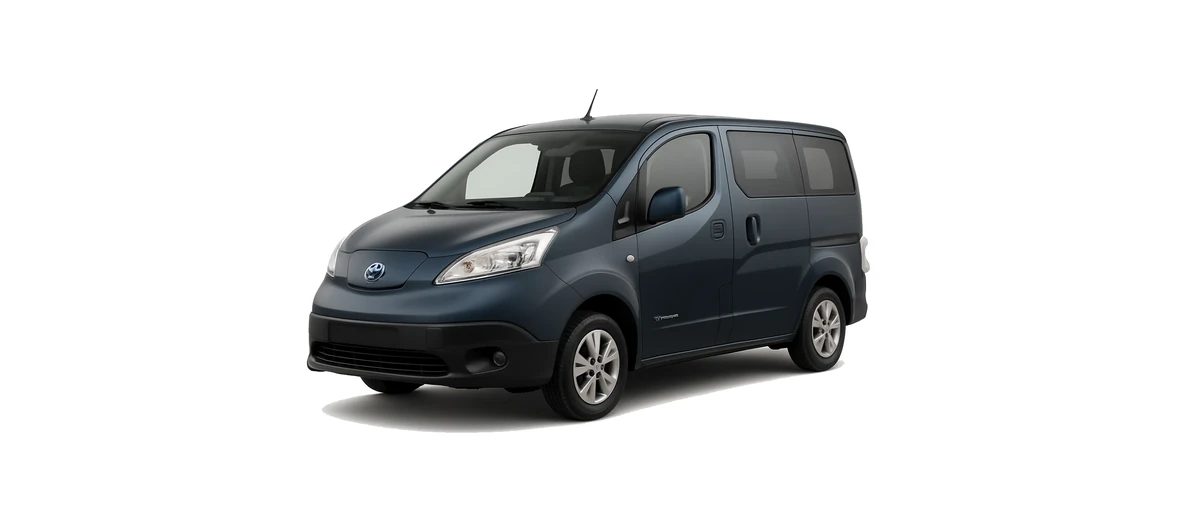
The Nissan e-NV200 is a discontinued battery-electric small van and MPV that remains popular on the used market for urban delivery work, trades, taxi-style use and family transport. In the UK it was sold as a van, Combi and Evalia, including 5- and 7-seat passenger versions. It is not a plug-in hybrid or range extender: all UK e-NV200 models are fully electric.
The most important charging point for used buyers and owners is that the e-NV200 uses an older connector arrangement. For AC charging it has a Type 1 vehicle inlet, while DC rapid charging uses CHAdeMO. It does not have a Type 2 vehicle socket and it does not use CCS rapid charging. That means many UK public AC posts require a Type 2-to-Type 1 charging cable, not the Type 2-to-Type 2 cable used by most newer electric cars.
View Nissan e-NV200 Charging Cables
Nissan e-NV200 Battery and Charging Specifications
There are two main UK-market e-NV200 battery generations to be aware of. Earlier vehicles, sold from around 2014 until the 2018 update, used a 24 kWh battery. Later models, from the 2018 update until UK ordering ended around late 2021, used a 40 kWh battery. Charging capability also varies, particularly on early vehicles, so it is worth checking the exact van rather than relying only on the registration year.
| Vehicle | Nissan e-NV200 |
|---|---|
| UK status | Discontinued; now mainly a used-vehicle model |
| AC connector | Type 1 / Yazaki / SAE J1772 |
| DC rapid connector | CHAdeMO |
| Later 40 kWh AC charging | Up to 6.6 kW |
| Later 40 kWh rapid charging | Often quoted as up to 50 kW; around 46 kW maximum in EV Database data |
| 40 kWh WLTP combined range | 124 miles |
| 40 kWh WLTP city range | 187 miles |
Battery Options
The early 24 kWh Nissan e-NV200 has an estimated usable battery capacity of around 22 kWh. This version predates the current WLTP test cycle, so you will often see older NEDC figures quoted instead. In practical use, it is best treated as a short-range urban EV, especially if carrying load, driving at motorway speeds or using heating in winter.
The later 40 kWh Nissan e-NV200 is the more common choice for buyers wanting better daily usability. Nissan’s UK brochure lists the battery at 40 kWh, while independent data estimates usable capacity at around 37 kWh. The official WLTP combined range is 124 miles, with a WLTP city figure of 187 miles. The city figure reflects low-speed urban use and should not be read as the normal mixed-driving range.
Because the e-NV200 is now a used vehicle, battery condition matters. Age, mileage, charging history and usage pattern can all affect range. A pre-purchase inspection and a battery health check are sensible, particularly for older 24 kWh vans.
AC Charging Speed
For the later 40 kWh e-NV200, AC charging is limited by the onboard charger to 6.6 kW. A typical 7 kW home wallbox is therefore well matched to the vehicle. Depending on conditions and starting state of charge, a full charge from low to full is commonly quoted at roughly 6 hours 45 minutes to 7.5 hours.
Earlier 24 kWh models need more care when checking the specification. Many early vehicles had a 3.3 kW or 3.6 kW onboard AC charger, while a 6.6 kW charger was available on some versions or as an option. If you own or are buying a 24 kWh e-NV200, confirm whether the vehicle has the faster onboard AC charger before estimating charge times.
It is also important to understand that higher-rated AC posts will not overcome the onboard charger limit. A 22 kW public AC post will still charge a 6.6 kW e-NV200 at up to around 6.6 kW, and an early 3.3 kW model at around 3.3 kW. The e-NV200 does not offer 11 kW or 22 kW AC charging.
DC Rapid Charging Speed
Rapid charging on the Nissan e-NV200 uses the CHAdeMO connector, located behind the front charge flap alongside the Type 1 AC inlet. On the 40 kWh model, Nissan marketed rapid charging at up to 50 kW. EV Database data lists around 46 kW maximum and roughly 40 kW average for a 10–80% charge, with a typical 10–80% rapid charge taking about 41 minutes.
Some early 24 kWh e-NV200 models had CHAdeMO rapid charging, but it could be trim or option dependent. If rapid charging matters to you, physically check that the van has the CHAdeMO inlet and confirm the equipment fitted to that specific vehicle.
For day-to-day planning, the practical rapid-charging window is usually 10–80%. Charging above 80% tends to slow down, so stopping at around 80% is often more time-efficient unless you need the extra range to complete a journey.
Range and Efficiency
The 40 kWh e-NV200 has an official WLTP combined range of 124 miles, with independent real-world estimates around 105 miles. In city use, careful drivers may see better results, which is why the WLTP city figure is higher. On faster roads, in cold weather, or with a heavy load, range can reduce noticeably.
The 24 kWh model has a much shorter practical range. Period data used an NEDC figure of around 106 miles, but real-world estimates are substantially lower, with EV Database listing around 65 miles. For many owners, that makes the 24 kWh version best suited to predictable local routes where overnight charging is available.
As with any van-based EV, load, roof racks, tyre pressure, heating use and driving speed can make a large difference. The e-NV200’s tall body is practical, but it is not as aerodynamically efficient as a modern low-slung electric car.
Charging at Home
Home charging is usually the easiest way to run an e-NV200, especially for local business use. A 7 kW wallbox is sufficient for the later 40 kWh model because the vehicle’s onboard AC charger is limited to 6.6 kW. For an untethered home charger, you will normally use a Type 2-to-Type 1 cable. For a tethered charger, the fixed lead must have a Type 1 plug to fit the e-NV200.
If you have an early 24 kWh vehicle with the slower onboard charger, a 7 kW wallbox is still usable, but the van may only draw around 3.3 kW or 3.6 kW. That means charging will take longer than a later 6.6 kW version.
A 3-pin charger is generally best suited as a backup or occasional charging solution, but can be used regularly if a qualified electrician has confirmed the socket and electrical installation are suitable for sustained EV charging. This matters because EV charging places a continuous load on the electrical circuit for many hours.
Public Charging
Public charging is where e-NV200 connector knowledge becomes especially important. Most UK public AC charge points provide a Type 2 socket. Because the e-NV200 has a Type 1 vehicle inlet, you need a Type 2-to-Type 1 public charging cable. A Type 2-to-Type 2 cable will not fit the vehicle.
For rapid charging, you need a charger with a tethered CHAdeMO connector. You do not bring your own rapid charging cable for CHAdeMO; the rapid charger has the cable attached. The challenge is availability. Many newer UK rapid charging sites focus heavily on CCS, so e-NV200 drivers should check apps or charger networks in advance to confirm CHAdeMO provision.
Do not buy a CCS cable or adapter expecting it to turn the e-NV200 into a CCS vehicle. The e-NV200’s rapid charging system is CHAdeMO-based, and route planning should be built around CHAdeMO charger availability.
Vehicle-Specific Features
The e-NV200’s most distinctive charging feature is its front-mounted dual-port layout. Behind the nose flap are separate ports for AC and DC: Type 1 for normal charging and CHAdeMO for rapid charging. This was common among some older Japanese EVs but differs from the Type 2 and CCS arrangement used by most newer UK and European electric vehicles.
Some CHAdeMO-equipped EVs, including certain e-NV200 configurations, may be compatible with specialist vehicle-to-grid or vehicle-to-home hardware. This should be treated cautiously: it is not the same as standard V2L, and it is not plug-and-play home backup from a normal domestic charger. Compatibility depends on the vehicle, equipment, installation and energy provider arrangements.
The e-NV200 should not be assumed to have battery preconditioning for rapid charging. Some specifications refer to battery heating or cooling hardware, but that is not the same as modern route-based battery preconditioning designed to prepare the battery before arriving at a rapid charger.
Charging Tips
- Buy the correct AC cable: for most UK public AC posts and untethered home chargers, the e-NV200 needs a Type 2-to-Type 1 cable.
- Do not choose Type 2-to-Type 2: it is the common cable for newer EVs, but it will not fit the e-NV200’s Type 1 inlet.
- Check early vehicles carefully: 24 kWh models may have slower AC charging, and CHAdeMO rapid charging may depend on specification.
- Use a 7 kW wallbox for home charging: it is a good match for the 40 kWh model, even though the van will draw up to around 6.6 kW.
- Plan CHAdeMO stops before longer trips: not every rapid charging site now supports CHAdeMO.
- Use 10–80% rapid charging where practical: charging slows above 80%, so shorter, planned stops can be more efficient.
- Allow for winter and payload: cold weather, heating use and load weight can reduce range significantly.
Frequently Asked Questions
What charging cable does the Nissan e-NV200 need?
For most UK public AC chargers and untethered home chargers, the Nissan e-NV200 needs a Type 2-to-Type 1 charging cable. The charging post side is Type 2, while the vehicle side must be Type 1.
Does the Nissan e-NV200 use CCS?
No. UK and European Nissan e-NV200 models use CHAdeMO for DC rapid charging. They do not have a CCS rapid charging inlet.
Can the Nissan e-NV200 charge at 11 kW or 22 kW?
No. The later 40 kWh model charges on AC at up to 6.6 kW. Some earlier 24 kWh vehicles may be limited to around 3.3 kW or 3.6 kW unless fitted with the optional faster onboard charger.
How long does the 40 kWh Nissan e-NV200 take to charge at home?
Using a 7 kW wallbox, a later 40 kWh e-NV200 typically takes around 6 hours 45 minutes to 7.5 hours for a full charge, depending on conditions and starting charge level.
How fast is Nissan e-NV200 rapid charging?
The 40 kWh model is commonly quoted at up to 50 kW on CHAdeMO, with independent data suggesting around 41 minutes for a 10–80% rapid charge. Early 24 kWh models can differ, so check whether the specific vehicle has CHAdeMO rapid charging.
Is the Nissan e-NV200 still sold new in the UK?
No. The e-NV200 is discontinued in the UK and is now mainly a used-vehicle choice. Nissan’s later small electric van offering is the Townstar EV.
What This Means for Drivers
The Nissan e-NV200 can still make a lot of sense as a used electric van or practical MPV, particularly for predictable local routes. The 40 kWh version offers the strongest usability, while the earlier 24 kWh model is better suited to short, planned journeys with reliable home or depot charging.
The key ownership lesson is connector compatibility. This is a Type 1 and CHAdeMO vehicle in a market now dominated by Type 2 and CCS. If you buy the correct Type 2-to-Type 1 cable, understand the onboard AC charging limit and plan rapid stops around CHAdeMO availability, the e-NV200 is straightforward to charge. If you assume it works like a newer CCS-equipped EV, it is easy to buy the wrong cable or arrive at an unsuitable charger.
Looking for a Charging Cable for Nissan e-NV200?
We offer charging cables suitable for the Nissan e-NV200, including Type 2-to-Type 1 options for UK public AC charge points and untethered home chargers.
View Nissan e-NV200 Charging Cables
Please note that this information is intended as a guide. Charging specifications may change due to model and year of manufacture. For precise information, always refer to your vehicle user manual.

