
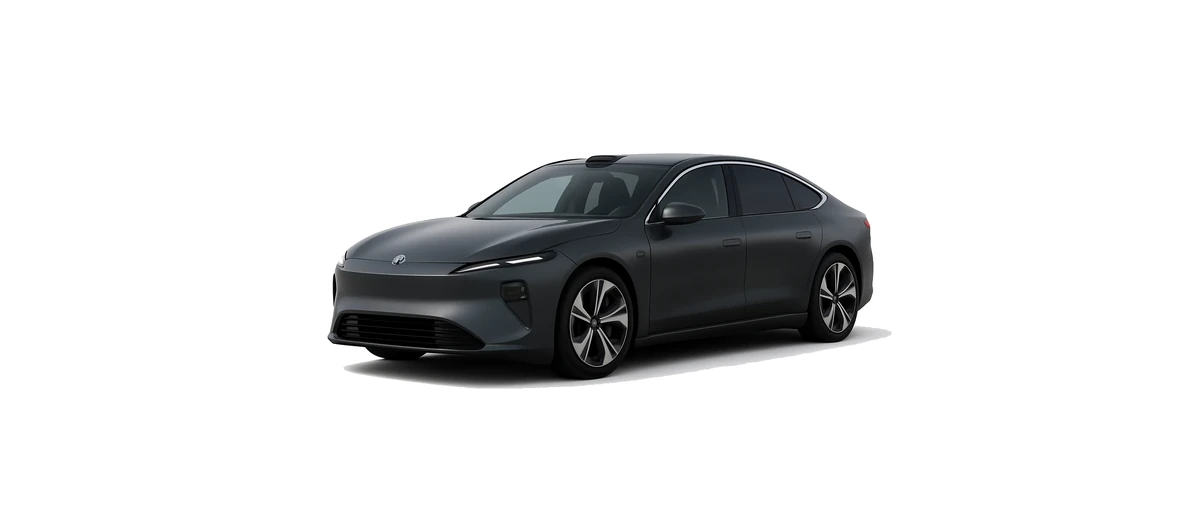
The NIO ET7 is a battery-electric luxury executive saloon that has been offered in selected European markets, including countries such as Norway, Germany, the Netherlands, Denmark and Sweden. For UK drivers, it is best treated as a European-specification or import charging case rather than a confirmed mainstream UK-market model. That matters, because availability, support and specification details can vary by market and model year.
From a charging point of view, however, the European NIO ET7 uses familiar hardware: Type 2 for AC charging and CCS Combo 2 for DC rapid charging. That means it can use the same general charging infrastructure as most modern electric cars in the UK and mainland Europe. The key point is to identify which battery version you are dealing with, as the 75 kWh and 100 kWh European versions have different usable battery capacities, rapid-charging rates and 10–80% charging times.
NIO ET7 Battery and Charging Specifications
European NIO ET7 data lists two main battery versions relevant for charging guidance: a 75 kWh Standard Range version and a 100 kWh Long Range version. Both are fully electric and both use an 11 kW AC onboard charger with a Type 2 inlet for AC charging. For rapid charging, the car uses the CCS Combo 2 connection, which is the standard rapid-charging connector type used by most UK public rapid and ultra-rapid chargers.
The European specifications should not be confused with broader global NIO messaging around other battery concepts or future packs. In particular, claims around very large battery packs or headline long-distance ranges should not be assumed to apply to a UK owner or a European ET7 unless the exact vehicle, battery and market specification have been verified.
Battery Options
The 75 kWh European ET7 is listed with a nominal battery capacity of 75.0 kWh and a usable capacity of about 73.5 kWh. NIO’s European information quotes a WLTP range of up to 445 km, which is around 276 miles, for this version. For charging, it is the stronger rapid-charging performer of the two main European versions, with official European information quoting up to 140 kW DC and a 10–80% charging time of around 30 minutes under suitable conditions.
The 100 kWh European ET7 is listed with a nominal battery capacity of 100.0 kWh and a usable capacity of about 90.0 kWh. NIO’s European information quotes a WLTP range of up to 580 km, or around 360 miles. This version has the larger battery and longer range, but its quoted rapid-charging figures are slightly lower: around 125–127 kW DC peak and about 40 minutes for a 10–80% rapid charge.
Because these two versions differ, it is not helpful to use one universal charging figure for every ET7. If you are buying, importing or already running an ET7 in the UK, confirm the battery size and specification before planning charging stops or comparing charging speeds.
AC Charging Speed
For AC charging, European NIO ET7 specifications list an 11 kW onboard charger. This is important because some public AC posts in the UK and Europe are rated at 22 kW, but the ET7 should not be described as a 22 kW AC car. If connected to a 22 kW three-phase AC post, the car will still be limited by its own 11 kW onboard charger.
At home in the UK, most domestic EV charging installations are single-phase and commonly provide up to 7.4 kW. On that type of wallbox, the charging speed will be limited by the home supply and charger rather than by the car’s 11 kW capability. As a guide, published estimates suggest the 75 kWh version may take around 11 hours 45 minutes from empty to full at 7.4 kW, while the 100 kWh version may take around 14 hours 30 minutes. On an 11 kW three-phase supply, those figures reduce to roughly 8 hours and 9 hours 45 minutes respectively.
In everyday use, most drivers do not charge from completely empty to full. If you are topping up overnight from, for example, 30% to 80%, a 7.4 kW wallbox is likely to be more than adequate for routine use.
DC Rapid Charging Speed
DC rapid charging is where the 75 kWh and 100 kWh ET7 versions differ most clearly. The 75 kWh version is quoted at up to 140 kW DC, with a 10–80% rapid charge taking about 30 minutes when conditions are favourable. The 100 kWh version is quoted at around 125–127 kW DC, with a 10–80% rapid charge taking about 40 minutes.
These figures are best understood as ideal-condition guidance rather than guaranteed results. Real-world rapid charging depends on battery temperature, current state of charge, charger output, charger sharing, weather and the car’s charging curve. A car may only reach its peak charging rate for part of the session, especially as the battery fills. As with most EVs, the fastest road-trip strategy is usually to rapid charge between roughly 10% and 80% rather than waiting for the final 20%, which is typically slower.
Range and Efficiency
The longest-range European ET7 data relates to the 100 kWh version, with a WLTP figure of up to around 360 miles and real-world estimates in the region of 314 miles depending on conditions. The 75 kWh version has a lower WLTP figure of up to around 276 miles. Actual range will vary with speed, temperature, terrain, tyre choice, cabin heating or cooling, payload and driving style.
For UK motorway use, it is sensible to plan conservatively, particularly in winter. A luxury saloon with a large battery can be very comfortable for long journeys, but sustained high-speed driving and cold weather can reduce efficiency. Using the built-in navigation for charging stops can also help the car prepare its battery for rapid charging where supported.
Charging at Home
For most UK-based ET7 owners or import drivers, a dedicated 7.4 kW home wallbox will be the most practical charging solution. Even though the car can accept up to 11 kW AC on a suitable three-phase supply, many homes do not have three-phase electricity. A properly installed single-phase wallbox will still provide enough energy overnight for typical commuting and daily driving.
If your wallbox is untethered, you will need a Type 2 charging cable. A Type 2 to Type 2 cable is also useful for many public AC charging posts, workplace chargers and destination chargers. Choose a cable that is suitable for the charging current and use case. For an ET7, an 11 kW-capable three-phase Type 2 cable can be useful if you expect to use three-phase AC posts, while many UK home users will still charge at 7.4 kW on single phase.
A 3-pin domestic charger is generally best suited as a backup or occasional charging solution, but can be used regularly if a qualified electrician has confirmed the socket and electrical installation are suitable for sustained EV charging. Standard domestic sockets were not designed with repeated long-duration EV charging as their main purpose, so checks for socket condition, circuit suitability and safe loading are important.
Public Charging
On public AC chargers, the NIO ET7 uses a Type 2 connection. Many slower and fast AC public chargers are untethered, meaning you bring your own cable. In those situations, a Type 2 cable is required. Where the post is rated above the car’s AC capability, the ET7 will still charge only up to its own 11 kW AC limit.
On public rapid and ultra-rapid chargers, the cable is normally tethered to the charger. You do not need to bring a separate CCS cable for DC rapid charging; instead, you plug the charger’s CCS connector directly into the car. When route-planning, remember that a charger rated at 150 kW, 250 kW or 350 kW does not mean the ET7 will charge at that full rate. The car’s own DC limit, battery temperature and charging curve determine the actual speed.
NIO is known in some markets for its chargeable, swappable and upgradeable battery concept. However, UK drivers should not rely on battery swapping as a practical charging solution unless a local, operational UK NIO battery-swap network has been confirmed for their location and vehicle.
Vehicle-Specific Features
European ET7 data lists a heat pump as standard. A heat pump can help improve heating efficiency in colder weather compared with relying solely on resistive heating, although the real-world benefit varies with temperature and usage.
Battery preconditioning is also supported in the European ET7 information. The European user manual describes navigation-based battery preheating when routing to a charging station, subject to the correct conditions. In practical terms, using the car’s built-in navigation to select a rapid charger can help the vehicle prepare the battery temperature before arrival, which may improve DC charging performance in cold weather.
Vehicle-to-load, vehicle-to-home and vehicle-to-grid functions should not be assumed for the ET7. European specification data lists V2L, V2H and V2G as not supported, so the car should be treated as a conventional EV for charging and energy-flow purposes.
Charging Tips
- Confirm the battery version: The 75 kWh and 100 kWh European ET7 versions have different charging behaviour, especially on DC rapid chargers.
- Use the right cable: For AC charging on untethered home or public chargers, use a Type 2 cable suitable for the charger and your charging needs.
- Do not expect 22 kW AC: Even on a 22 kW AC post, the European ET7 is listed with an 11 kW AC onboard charger.
- Rapid charge in the efficient window: On longer trips, plan around 10–80% rapid-charging stops where possible rather than waiting for a slower final top-up to 100%.
- Use navigation for rapid chargers: Where supported, route to the charger through the car’s navigation so battery preconditioning can prepare the pack.
- Be cautious with UK assumptions: As the ET7 is not clearly established as an official UK retail model, verify compatibility, warranty and support before purchase or import.
Frequently Asked Questions
What charging cable does the NIO ET7 use?
The European NIO ET7 uses a Type 2 connection for AC charging. For DC rapid charging it uses CCS Combo 2, with the CCS cable normally attached to the rapid charger.
Can the NIO ET7 charge at 22 kW AC?
No, not according to the European ET7 charging data. The car is listed with 11 kW AC charging, so it will not take the full 22 kW from a 22 kW AC post.
How long does the NIO ET7 take to rapid charge?
The 75 kWh European version is quoted at around 30 minutes for a 10–80% rapid charge, with up to 140 kW DC. The 100 kWh version is quoted at around 40 minutes, with roughly 125–127 kW DC. Real-world results can vary.
Is the NIO ET7 officially sold in the UK?
Current evidence does not clearly support the ET7 as an official UK-market new car. It has been offered in selected European markets, and UK drivers should treat specifications as European or import data unless the exact vehicle’s UK status is confirmed.
Can I use NIO battery swapping in the UK?
Do not rely on battery swapping as a UK charging solution unless an operational UK NIO swap network is confirmed for your vehicle and area. For most UK use, plan around home charging, public AC charging and CCS rapid charging.
What This Means for Drivers
The NIO ET7 should be straightforward to charge from a connector perspective because European versions use Type 2 and CCS Combo 2. The main complication is not the plug type but the market and specification context. UK drivers should check whether the car is a 75 kWh or 100 kWh version, avoid assuming 22 kW AC charging, and plan rapid-charging stops based on the correct battery pack.
For daily use, a 7.4 kW home wallbox is likely to be a sensible fit for most UK households, even though the car can accept 11 kW AC on a suitable three-phase supply. For long journeys, the ET7’s CCS rapid-charging capability should be useful, especially if the car’s navigation-based battery preconditioning is used before arriving at a charger.
Looking for a Charging Cable for NIO ET7?
If you need a suitable Type 2 cable for home, workplace or public AC charging, We offer NIO ET7 charging cables to help match the car’s European Type 2 charging setup.
Please note that this information is intended as a guide. Charging specifications may change due to model and year of manufacture. For precise information, always refer to your vehicle user manual.

