
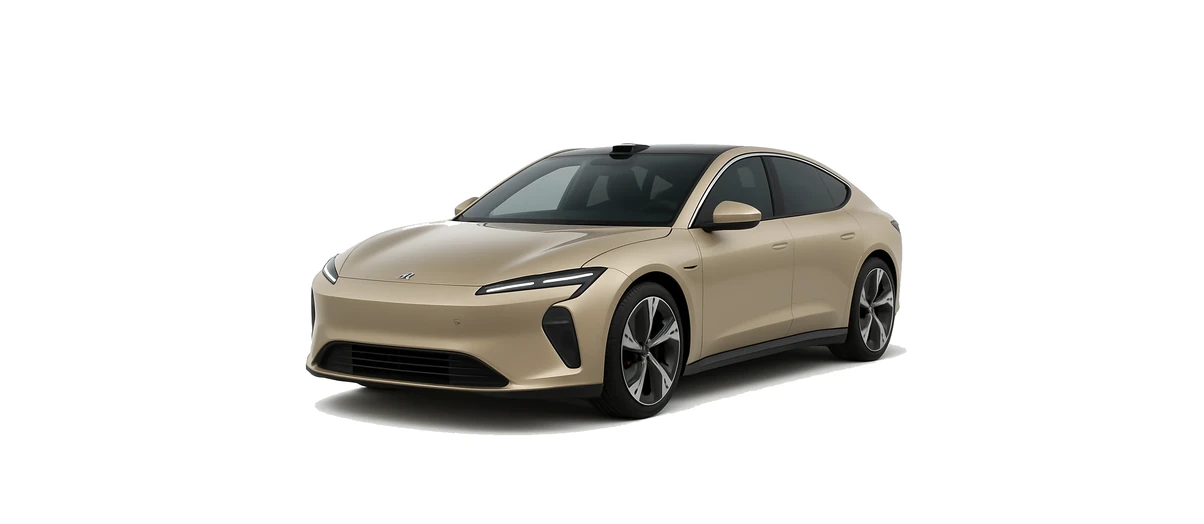
The NIO ET5 is a pure-electric saloon that has attracted attention in Europe for its sleek design, dual-motor performance and NIO’s distinctive battery-swap concept in supported markets. For UK drivers, prospective importers and anyone researching the ET5, the practical day-to-day charging picture is more conventional: EU-market information shows Type 2 AC charging, CCS Combo 2 DC rapid charging and an 11 kW onboard AC charger.
It is important to treat UK-specific details carefully. The ET5 is well documented in European sources, particularly German and Netherlands-market information, but it should not be presented as a confirmed UK retail model without checking the exact vehicle, registration route and model year. If you are buying or running a privately imported ET5 in the UK, confirm the battery pack, charging socket and onboard charger from the vehicle handbook, VIN documentation or NIO service information before selecting accessories.
NIO ET5 Battery and Charging Specifications
Based on current EU-market data, the NIO ET5 is a battery-electric vehicle, not a plug-in hybrid. European ET5 saloon specifications list a Type 2 connector for AC charging and a CCS Combo 2 connector for DC rapid charging. The charging port is listed in EV Database data as being at the left rear of the vehicle.
| Vehicle type | Battery-electric saloon |
|---|---|
| AC charging connector | Type 2 |
| DC rapid charging connector | CCS Combo 2 |
| Onboard AC charger | Up to 11 kW in EU data |
| Battery options covered | 75 kWh and 100 kWh EU-market packs |
| Rapid charging | Varies by battery pack; do not assume all versions charge at the same peak rate |
The key point for cable selection is straightforward: for normal AC charging at home, work and many public destinations, the ET5 uses a Type 2 charging cable. For rapid charging on motorways and longer journeys, CCS rapid chargers use a tethered cable attached to the charger, so you normally do not need to provide your own DC cable.
Battery Options
EU sources list two main ET5 battery sizes: a 75 kWh pack and a 100 kWh pack. The 75 kWh battery is commonly described as the Standard Range option, while the 100 kWh battery is associated with Long Range versions. EV Database lists the 75 kWh pack at around 73.5 kWh usable capacity and the 100 kWh pack at around 90 kWh usable capacity.
NIO Germany documentation lists the 75 kWh battery with a WLTP range of up to 456 km, or around 283 miles. The 100 kWh battery is listed with a WLTP range of up to 590 km, or around 367 miles. These are official-style laboratory figures for relevant European configurations and should not be treated as guaranteed UK real-world range. Wheels, tyres, temperature, speed, route profile and vehicle software can all affect the final result.
Because NIO’s battery model can include battery leasing or battery swapping in some supported markets, the exact pack fitted to a used or imported ET5 matters. If the vehicle has been operated in a market with battery swapping, it is especially sensible to verify the current battery type and charging capability rather than relying only on the model badge.
AC Charging Speed
European data lists the NIO ET5 with an 11 kW onboard AC charger. This means the car can accept up to 11 kW from a suitable three-phase AC supply. In parts of mainland Europe, three-phase home and workplace charging is more common, so 11 kW AC charging is a familiar figure.
In the UK, most domestic properties are single-phase. A typical dedicated home wallbox is often rated at up to 7.4 kW on single-phase power, subject to the property supply, installation design and any load-management limits. In that situation, the wallbox is the limiting factor rather than the ET5’s 11 kW onboard charger. The car may be capable of 11 kW AC charging, but it will not take 11 kW from a 7.4 kW single-phase charger.
A 22 kW three-phase public AC charge point can still be useful, but the ET5 will generally be limited by its onboard charger to around 11 kW AC. A 22 kW-rated Type 2 cable can be used on lower-powered charge points, but it will not make the car exceed its onboard AC limit. For many drivers, the choice between a 7 kW/single-phase cable and a 22 kW/three-phase cable is less about making the ET5 charge faster at home and more about flexibility across different public and workplace charge points.
DC Rapid Charging Speed
For longer journeys, the NIO ET5 uses CCS DC rapid charging in the European specifications checked. Unlike AC charging, rapid charging uses the charger’s tethered CCS cable, so you simply plug the charger’s connector into the car. Charging performance depends on the battery pack, charger capability, battery temperature and state of charge.
The 75 kWh ET5 is listed by NIO Germany with DC charging up to 140 kW and a 10% to 80% charging time of around 30 minutes. For the 100 kWh battery, the picture is more variable: current NIO Germany information indicates that some 100 kWh battery versions may be listed at 125 kW with a 10% to 80% time of around 40 minutes, while another 100 kWh version may be listed at up to 180 kW with a 10% to 80% time of around 30 minutes. For that reason, it is not accurate to say every ET5 rapid charges at 180 kW.
As with most EVs, the most efficient motorway charging strategy is usually to plan rapid charging stops around the middle of the battery window, commonly from roughly 10% to 80%. Charging slows significantly at higher states of charge, so repeatedly charging to 100% on a rapid charger can add avoidable waiting time unless you genuinely need the extra range.
Range and Efficiency
The ET5’s range depends heavily on battery size and conditions. The 75 kWh version is listed in EU sources with up to around 283 miles WLTP, while the 100 kWh version is listed with up to around 367 miles WLTP. EV Database’s independent-style real-range estimates are lower than the WLTP figures, as is typical for many electric vehicles, with the 75 kWh version estimated at around 255 miles and the 100 kWh version around 311 miles in mixed conditions.
In UK use, expect motorway driving in winter to be more demanding than urban or mixed driving in mild weather. Cold temperatures, rain, high cruising speeds and cabin heating all increase energy use. The ET5 is listed by EV Database with a heat pump and battery preconditioning, which can help with efficiency and rapid-charging consistency, but exact behaviour can vary by software version and market.
Charging at Home
For most EV drivers, home charging is the simplest and cheapest way to run the car. If you have off-street parking, a dedicated Type 2 wallbox is usually the preferred option. With a typical UK 7.4 kW single-phase home charger, an ET5 will charge overnight for most routine use, even though it will not reach the 11 kW AC maximum shown in European three-phase data.
A 75 kWh battery takes longer to charge than a smaller city EV battery, and the 100 kWh pack takes longer again. In everyday driving, however, you rarely need to charge from completely empty to full. Most owners top up from a partial state of charge and can set a charging schedule overnight, particularly if using an EV-friendly electricity tariff.
A 3-pin charging lead can be useful, but it is generally best suited as a backup or occasional charging solution. It can be used regularly if a qualified electrician has confirmed the socket and electrical installation are suitable for sustained EV charging. A standard domestic socket was not designed primarily as a long-duration high-load EV charging point, so a professionally installed wallbox is normally the better long-term solution.
Public Charging
Public charging for the ET5 divides into two main types: AC destination charging and DC rapid charging. AC destination chargers are commonly found in car parks, hotels, workplaces, supermarkets and town centres. Many of these require you to bring your own Type 2 cable. For an ET5, a Type 2 to Type 2 cable is therefore the main cable to keep in the boot.
DC rapid and ultra-rapid chargers are more common on motorways and major A-roads. These have tethered CCS cables, so you do not normally use your own charging cable. The car and charger communicate to determine the available charging rate, and the ET5’s peak rate will depend on the battery pack and conditions. If the charger is rated above the car’s limit, the vehicle will simply take what it can accept.
NIO’s battery swapping is an important part of the brand’s identity in some European markets, but it should not be treated as a UK charging solution unless a compatible UK NIO swap network is confirmed. For a UK driver or importer, practical planning should be based on normal Type 2 AC and CCS DC charging access.
Vehicle-Specific Features
The ET5 is listed in EU sources as using NIO’s NT2 platform and a 400 V electrical architecture. The European saloon specification is a dual-motor all-wheel-drive setup, with NIO materials referencing a 150 kW front motor and 210 kW rear motor. These performance details are useful context, but they do not change the charging cable requirement: AC charging remains Type 2.
EV Database lists the ET5 with a heat pump and battery preconditioning, both of which are relevant to cold-weather efficiency and rapid charging. It also lists vehicle-to-load, vehicle-to-grid and vehicle-to-home capability as not available. Because equipment can vary by market and model year, any imported vehicle should be checked against its own documentation before relying on a specific feature.
Charging Tips
- Choose a Type 2 cable for AC charging. This is the key cable for home wallboxes, workplace chargers and untethered public AC charge points.
- Do not expect a 22 kW AC post to give 22 kW. EU data lists the ET5 onboard AC charger at 11 kW, so that is the likely AC limit even when the charge point can supply more.
- Check the battery pack before planning rapid stops. The 75 kWh and 100 kWh packs have different rapid-charging figures, and not every 100 kWh version is listed with the same peak rate.
- Use CCS rapid chargers for long trips. Aim for efficient 10% to 80% sessions where practical, rather than waiting for a slow final top-up to 100%.
- Verify imported vehicle details. If the ET5 is a European-market car in the UK, confirm the exact charging specification from the manual, VIN record or a qualified specialist.
Frequently Asked Questions
What charging cable does the NIO ET5 use?
European ET5 data shows a Type 2 connector for AC charging. For UK home, workplace and public AC charging, the usual cable is a Type 2 to Type 2 charging cable.
Can the NIO ET5 charge at 22 kW AC?
EU sources list the ET5 with an 11 kW onboard AC charger. It can connect to a 22 kW AC charge point with a suitable Type 2 cable, but the car is expected to limit AC charging to around 11 kW.
How fast can the NIO ET5 rapid charge?
It depends on the battery pack. The 75 kWh battery is listed at up to 140 kW DC with around 30 minutes for 10% to 80%. The 100 kWh battery is more variable, with NIO Germany information showing different versions at either 125 kW or 180 kW, with different 10% to 80% times.
Is the NIO ET5 a plug-in hybrid?
No. The ET5 is documented as a battery-electric vehicle. It does not have a petrol or diesel engine for propulsion.
Is NIO battery swapping available in the UK?
NIO battery swapping is available in selected supported markets, but it should not be assumed to be a UK charging option for the ET5 unless a UK network and ET5 compatibility are confirmed.
What This Means for Drivers
For UK drivers considering or already running a NIO ET5, the central charging message is simple: think of it first as a Type 2 and CCS electric saloon, not as a car that depends on battery swapping. A Type 2 AC cable is the practical everyday item for home, workplace and destination charging, while CCS rapid charging covers longer journeys.
The 11 kW AC charging figure is useful, but in a typical UK home setting a 7.4 kW single-phase wallbox is more likely to define your charging speed. On the rapid-charging side, avoid assuming a single peak figure for all cars. The 75 kWh and 100 kWh versions differ, and the 100 kWh pack itself may have different charging limits depending on version.
Looking for a Charging Cable for NIO ET5?
If you need a suitable Type 2 cable for a NIO ET5, We offer charging cable options for home, workplace and public AC charging; always match the cable to your vehicle specification, charger type and electrical installation.
Please note that this information is intended as a guide. Charging specifications may change due to model and year of manufacture. For precise information, always refer to your vehicle user manual.

