
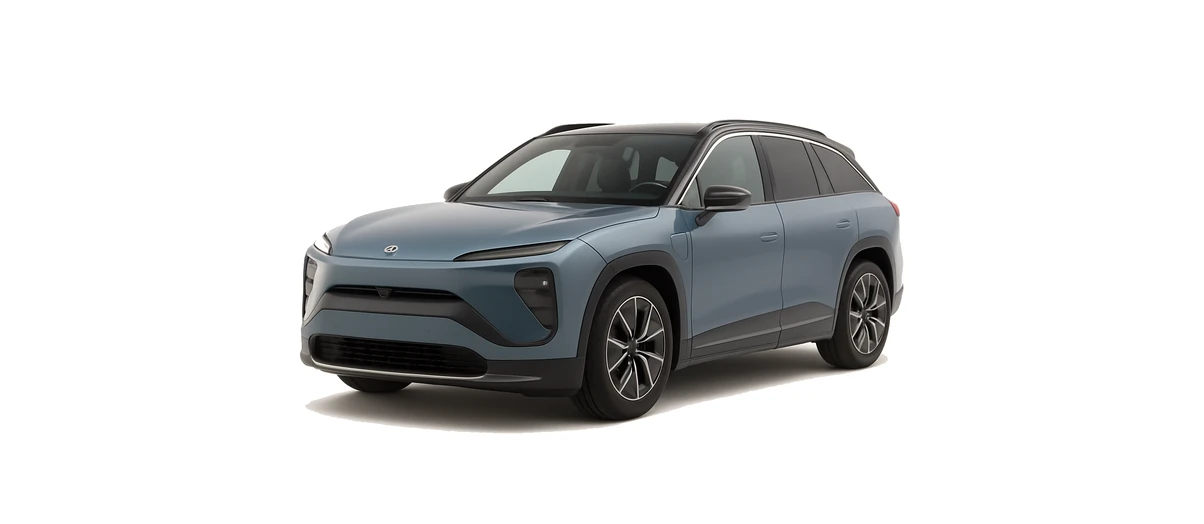
The NIO EL7 is a large pure-electric SUV sold in parts of Europe, closely related to the ES7 name used in China. For UK drivers, it is best treated as a rare Europe-market or import model rather than a mainstream official UK new-car choice, as available data lists the United Kingdom as not available for new orders. That does not make charging complicated, however: European EL7 models use a Type 2 connection for AC charging and CCS Combo 2 for DC rapid charging, which are the standard connections across most UK home, workplace and public charging networks.
The main points to understand are the differences between the 75 kWh and 100 kWh battery versions, how the EL7 behaves on single-phase UK home charging, and why NIO battery-swap headlines should not be relied on as a UK charging solution unless current local infrastructure is independently confirmed. This guide focuses on conventional plug-in charging for UK ownership.
NIO EL7 Battery and Charging Specifications
European NIO EL7 specifications show a battery-electric SUV with dual-motor all-wheel drive and a 400 V electrical architecture. Charging equipment is straightforward by European standards: Type 2 for AC charging and CCS Combo 2 for DC rapid charging. The charge port is listed on the right/front side of the vehicle in European data.
Both the 75 kWh and 100 kWh versions are commonly listed with an 11 kW AC on-board charger. This is important for UK owners because an 11 kW AC charging rate normally requires a three-phase electricity supply. Most UK homes have single-phase power, so a typical 7.4 kW home wallbox will work but will not reach the car’s full 11 kW AC capability.
For rapid charging, published figures vary by battery version and source. The 75 kWh version is commonly listed at up to around 140 kW DC, with a 10-80% time of about 30 minutes in suitable conditions. The 100 kWh version is often listed by European sources at around 125-127 kW DC, with a 10-80% time of about 40 minutes, although some data sources show different peak figures. In practice, charging speed depends on charger output, battery temperature, state of charge and the vehicle’s charging curve.
Battery Options
The NIO EL7 was offered in Europe with two main battery choices:
- 75 kWh Standard Range pack: EV Database lists 75.0 kWh nominal capacity and 73.5 kWh usable capacity, though another data source reports a lower net figure, so check the documentation for a specific car before relying on an exact usable capacity figure.
- 100 kWh Long Range pack: European sources including EV Database and ADAC list 100.0 kWh gross and around 90.0 kWh usable or net capacity.
The 100 kWh version is the better choice for drivers who cover long motorway distances, tow where permitted, or want fewer charging stops. The 75 kWh model still offers a large battery by general EV standards, but it will need more frequent rapid charging on longer trips.
AC Charging Speed
AC charging is what you use at home, many workplaces, hotels, destination chargers and some public car parks. The NIO EL7 uses a Type 2 inlet for AC charging, so it is compatible with the standard UK Type 2 charging ecosystem.
With an 11 kW three-phase AC supply, European data suggests a full 0-100% AC charge takes about 8 hours for the 75 kWh version and about 9 hours 45 minutes for the 100 kWh version. These figures are useful as a best-case AC reference, but they do not reflect most UK domestic installations.
On a common UK 7.4 kW single-phase home charger, charging will be slower. As a rough guide, a large battery such as the EL7’s can still be comfortably charged overnight for normal daily use, especially if you are topping up from 30-80% rather than charging from empty to full. A full charge from a very low state of charge may take longer than a single short evening, particularly on the 100 kWh model.
A 3-pin charger is generally best suited as a backup or occasional charging solution, but can be used regularly if a qualified electrician has confirmed the socket and electrical installation are suitable for sustained EV charging. For a vehicle with a battery as large as the EL7’s, a dedicated wallbox is usually the more practical everyday option.
DC Rapid Charging Speed
For long journeys, the NIO EL7 uses CCS rapid charging. UK motorway service areas, charging hubs and many high-power public chargers use CCS, so physical compatibility should be straightforward.
The 75 kWh EL7 is commonly listed at up to around 140 kW DC and about 30 minutes for a 10-80% session where charger power and battery conditions allow. The 100 kWh version is commonly listed by EV Database and ADAC at around 125-127 kW DC, with a 10-80% time of about 40 minutes. Because published peak figures vary, it is better to think in terms of expected charging time rather than assuming one fixed maximum power number.
As with all EVs, the highest charging rate is not held throughout the session. Charging usually starts faster at lower battery percentages, then tapers as the battery fills. For time-efficient journeys, rapid charging to around 80% is normally quicker than waiting for the final 20%, unless you need the extra range to reach your destination or the next reliable charger.
Range and Efficiency
There is no single universal WLTP range for the NIO EL7. European figures vary by battery, trim and equipment. As a guide, published data places the 75 kWh version at roughly 372-394 km, or about 231-245 miles, under WLTP conditions. The 100 kWh version is listed at roughly 486-513 km, or about 302-319 miles, depending on specification. NIO Germany has quoted up to 509 km for the EL7, which sits within that long-range spread.
Real-world range will usually be lower than WLTP, especially in cold weather, at sustained motorway speeds, with a full vehicle, or when using roof accessories. A realistic UK motorway plan should leave a margin rather than assuming the full WLTP figure is available. The EL7’s standard battery preconditioning and listed heat pump on European specification data may help in colder conditions, but winter consumption can still rise noticeably.
Charging at Home
For most UK drivers, home charging will be the cheapest and most convenient way to run a NIO EL7. A dedicated 7.4 kW Type 2 wallbox on a single-phase supply is the normal domestic setup. The EL7 can accept more AC power than this on three-phase, but many UK homes cannot provide 11 kW without a suitable three-phase supply and installation.
If you have solar panels, an EV tariff or scheduled off-peak electricity, the EL7’s large battery gives useful flexibility. You can set charging sessions to run overnight, or top up to a chosen limit before a longer journey. NIO’s manual notes that the charge limit can be adjusted and that a default limit of 90% may be used. For everyday use, keeping the car around 80-90% rather than charging to 100% every time is a sensible battery-care habit unless you need maximum range for a trip.
Owners of imported or Europe-market cars should also ensure that the charging cable, wallbox and vehicle settings are suitable for UK use. The connector standard is familiar, but documentation, app services and warranty support may vary depending on the car’s origin.
Public Charging
Public AC chargers generally use Type 2. Some have a tethered cable, while others are socketed and require you to bring your own Type 2 cable. For a car like the EL7, a good-quality Type 2 cable is useful for hotels, workplaces, town-centre chargers and longer stays where rapid charging is not necessary.
For motorway and cross-country travel, use CCS rapid and ultra-rapid chargers. Even if a charger can provide 150 kW, 250 kW or more, the car will only draw what it can accept at that moment. Plan stops using charger reliability, location and amenities as well as advertised power. The EL7’s battery preconditioning features can help prepare the battery before rapid charging, particularly in cold weather, so using the vehicle navigation or manual warm-up function where available may improve charging performance.
NIO is known for battery swap in some markets, but this should be kept separate from normal UK charging advice. Unless current NIO swap-station support is confirmed for the UK and for the exact vehicle, assume you will charge the EL7 like any other Type 2 and CCS electric SUV.
Vehicle-Specific Features
The EL7 is listed with battery preconditioning as standard, and the NIO manual refers to on-route and manual battery warmup functions for improving charging efficiency in cold conditions. This is particularly relevant in the UK winter, when rapid charging can be slower if the battery is cold.
European specification data also lists a heat pump as standard. A heat pump can reduce the energy needed for cabin heating compared with less efficient systems, although its real-world benefit depends on temperature, journey length and climate-control use.
Bidirectional power features should not be assumed. European data lists V2L, V2H and V2G as not supported for the EL7, so it should not be treated as a vehicle that can power external appliances, a home, or export electricity back to the grid through those systems. Also, NIO’s use of the term V2X in driver-assistance or communications contexts should not be confused with V2L or vehicle-to-grid charging.
Charging Tips
- Use Type 2 for home and destination charging: A standard UK Type 2 wallbox or public Type 2 point is the right AC connection for the EL7.
- Do not expect 11 kW at most UK homes: The car may support 11 kW AC, but a typical single-phase home wallbox provides up to 7.4 kW.
- Precondition before rapid charging: In cold weather, use navigation-based or manual battery warmup where available before arriving at a CCS rapid charger.
- Rapid charge in the efficient window: For long trips, 10-80% charging stops are usually more time-efficient than charging to 100%.
- Set a sensible daily charge limit: For regular use, 80-90% is usually enough, with 100% reserved for days when you need the extra range.
- Carry the right cable: A Type 2 cable is useful for socketed public AC chargers, even if your home wallbox is tethered.
Frequently Asked Questions
What charging cable does the NIO EL7 use?
The NIO EL7 uses a Type 2 connection for AC charging. For DC rapid charging, it uses CCS Combo 2, and rapid chargers normally have the cable attached.
Can the NIO EL7 charge at 7.4 kW at home?
Yes. A 7.4 kW single-phase home wallbox should work with the EL7, but it will charge more slowly than the car’s listed 11 kW AC maximum, which requires suitable three-phase AC supply.
How long does the NIO EL7 take to rapid charge?
Published European data suggests about 30 minutes from 10-80% for the 75 kWh version and about 40 minutes for the 100 kWh version in suitable conditions. Charger output, battery temperature and state of charge can all affect the result.
Is the NIO EL7 officially sold new in the UK?
Available data does not confirm the EL7 as an official UK new-car model, and EV Database lists the United Kingdom as not available. UK examples should therefore be treated carefully as imports, legacy European-market cars or specialist purchases unless current UK sales evidence is available.
Does the NIO EL7 support V2L or vehicle-to-grid charging?
European data lists V2L, V2H and V2G as not supported, so owners should not rely on the EL7 for external power or home energy export functions.
What This Means for Drivers
The NIO EL7 is unusual in the UK, but charging it is not unusual. Its Type 2 AC and CCS DC connections match the charging standards used across the UK and Europe. The biggest practical consideration is not connector compatibility, but charging speed expectations: 11 kW AC is a three-phase figure, while most UK home charging will be 7.4 kW single-phase.
For long-distance use, the 100 kWh car offers the stronger range potential, while the 75 kWh version should still be capable but will need more planning on longer routes. Battery preconditioning, sensible charge limits and good route planning will make a noticeable difference to convenience.
Looking for a Charging Cable for NIO EL7?
If you drive a NIO EL7 in the UK, choose a Type 2 charging cable suitable for public AC charging and your expected charging setup. We sell NIO EL7 charging cables to help you match the vehicle with the correct connection type.
Please note that this information is intended as a guide. Charging specifications may change due to model and year of manufacture. For precise information, always refer to your vehicle user manual.

