
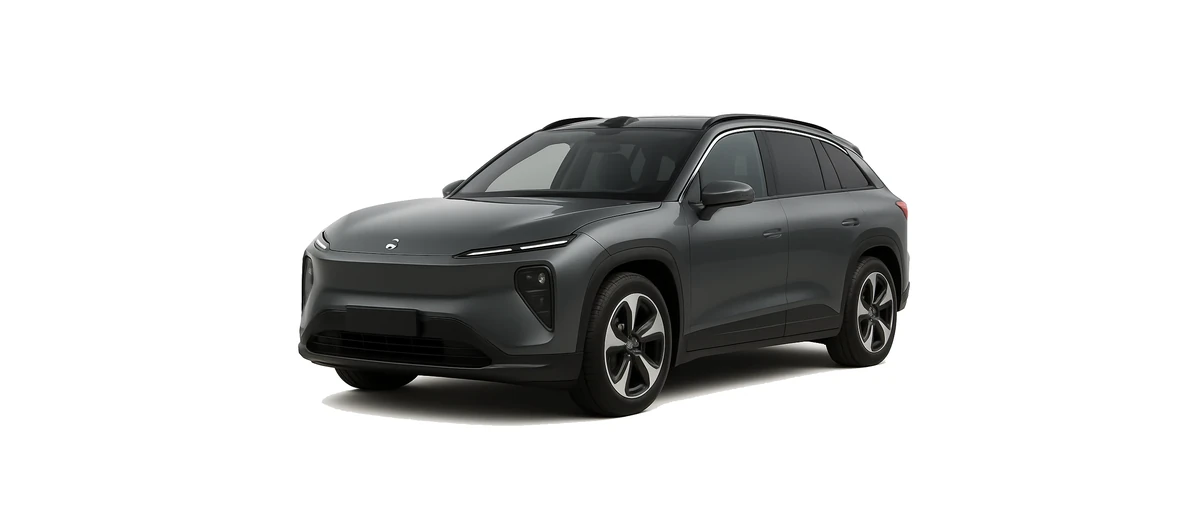
The NIO EL6 is a European-market all-electric 5-door SUV, known in some markets as the ES6. It is a dual-motor battery electric vehicle with Type 2 AC charging and CCS Combo 2 DC rapid charging, which means its charging hardware is broadly compatible with UK home chargers and public charging infrastructure.
However, there is an important UK context. At the time of research, the NIO EL6 is not shown as officially available to order in the UK by EV Database, and UK pricing, launch timing, aftersales arrangements and any UK-specific support have not been publicly confirmed. For that reason, this guide is best read as advice for charging a European-spec NIO EL6 in the UK, such as an imported or future-available vehicle, rather than confirmation of current UK market availability.
NIO EL6 Battery and Charging Specifications
European data sources list the NIO EL6 with two main battery options: a 75 kWh Standard Range battery and a 100 kWh Long Range battery. Both use a Type 2 connector for AC charging and a CCS Combo 2 connector for DC rapid charging in Europe.
The key point for day-to-day charging is that the EL6 is listed with an 11 kW AC onboard charging limit. Some NIO European literature refers to a Mode 3 charging cable rated up to 22 kW, but that cable rating does not mean the vehicle itself will charge at 22 kW AC. The car’s onboard AC charger is the limiting factor, so UK drivers should expect up to 11 kW AC where a suitable three-phase supply is available, or around 7.4 kW from a typical single-phase home charger.
- Vehicle type: Battery electric vehicle, dual-motor all-wheel-drive SUV
- AC connector: Type 2
- DC connector: CCS Combo 2
- Maximum AC charging: 11 kW, where supply allows
- Home charging recommendation: 7.4 kW single-phase Type 2 home charger for most UK homes
- DC rapid charging: battery and model-year dependent, with current figures up to around 140 kW for the 75 kWh pack and up to around 180 kW for the 100 kWh pack
Battery Options
The 75 kWh battery is commonly described as the Standard Range option. EV Database lists this pack at 75.0 kWh nominal capacity with approximately 73.5 kWh usable capacity. European WLTP figures vary depending on specification, trim and wheel setup, with figures around 240 to 252 miles in some European data.
The 100 kWh battery is the Long Range option. EV Database lists it at 100.0 kWh nominal capacity with approximately 90.0 kWh usable capacity. The highest European WLTP figure in the research data is up to 329 miles, though real-world range will normally be lower depending on temperature, speed, driving style and load.
Because the EL6 has not been confirmed as a UK orderable model, UK buyers should be cautious when comparing European specifications. Battery capacity, charging performance and equipment may differ by market, model year or software version.
AC Charging Speed
For AC charging, the NIO EL6 is listed with an 11 kW onboard charger. This matters because the charging post, cable and car all have their own limits. The slowest part of the chain determines the actual charge rate.
At home in the UK, most properties have a single-phase electrical supply, so a dedicated 7.4 kW Type 2 home charger is usually the practical choice. On a 7.4 kW charger, the EL6 will charge at up to the charger’s output rather than the car’s 11 kW maximum. A full charge from very low to full can take many hours, especially with the 100 kWh pack, but most owners do not charge from empty every day. Regular top-ups overnight are usually the most convenient approach.
Where three-phase AC charging is available, such as at some workplaces, commercial sites or European-style installations, the EL6 may be able to use up to its 11 kW AC limit. If connected to a 22 kW AC post with a suitable Type 2 cable, the car should still be expected to charge at up to 11 kW rather than 22 kW.
DC Rapid Charging Speed
For longer trips, the NIO EL6 uses CCS Combo 2 rapid chargers. These are the main high-power DC chargers found across UK motorway services, charging hubs and many public rapid charging sites.
Rapid charging performance differs by battery pack and may also differ by model year or source. Current EV Database figures list the 75 kWh battery at up to around 140 kW DC, with a 10% to 80% charge taking about 30 minutes in suitable conditions. For the 100 kWh battery, current EV Database and some press data list up to around 180 kW DC and about 29 minutes from 10% to 80%.
There is a caveat: older official NIO European literature listed lower figures for the 100 kWh pack, including 125 kW DC and a longer 10% to 80% time of around 40 minutes. For that reason, rapid charging expectations should be treated as battery-specific and potentially model-year dependent.
As with all EVs, peak charging power is not sustained throughout the session. The fastest charging usually occurs when the battery is warm and at a lower state of charge. Charging typically slows as the battery approaches 80%, so on a long journey it is often quicker to stop more briefly and continue driving rather than wait for a full 100% charge.
Range and Efficiency
The NIO EL6’s range depends heavily on battery size, wheel and trim configuration, weather and driving style. European WLTP figures for the 75 kWh battery sit around the mid-200-mile mark, while the 100 kWh Long Range version is listed up to 329 miles WLTP in the research data.
EV Database gives a real-world estimate of around 270 miles for the Long Range version. In UK use, motorway speeds, cold weather, roof boxes, heavy passenger loads and repeated rapid charging stops can all reduce efficiency. Urban and mixed driving in mild weather will usually be more favourable than high-speed winter motorway use.
The EL6 is listed with a standard heat pump in European equipment data, which can help reduce heating-related energy use in colder conditions compared with relying solely on resistive heating. Even so, winter range should still be expected to be lower than mild-weather range.
Charging at Home
For most UK drivers, the best everyday setup for a NIO EL6 would be a dedicated 7.4 kW single-phase Type 2 home charger. This can be tethered, with a cable permanently attached, or untethered, where you use your own Type 2 charging cable. A tethered unit is convenient for daily use, while an untethered unit keeps the installation neater and allows cable replacement or length choice more easily.
If you have access to a three-phase electrical supply, an 11 kW-capable installation may allow the EL6 to charge at its full AC limit. This is uncommon in standard UK domestic properties but may be relevant for some larger homes, workplaces or commercial premises. Any charger installation should be assessed and fitted by a qualified installer.
A 3-pin portable charger is generally best suited as a backup or occasional charging solution, but it can be used regularly if a qualified electrician has confirmed the socket and electrical installation are suitable for sustained EV charging. Standard domestic sockets were not designed primarily for long-duration high-load EV charging, so professional assessment is important before relying on one frequently.
Public Charging
For AC public charging, the EL6 uses a Type 2 cable. Many UK destination chargers at supermarkets, hotels, car parks and workplaces are rated at 7 kW, 11 kW or 22 kW. The actual speed you receive will depend on the charger output, your cable rating and the car’s 11 kW onboard limit.
If you use a 22 kW-rated Type 2 cable on a 22 kW AC post, the EL6 should still be limited by the car to up to 11 kW AC. This is normal and not a fault with the cable or charger. A higher-rated cable can still be useful because it is compatible with a wider range of posts, but it cannot override the vehicle’s onboard AC charging capability.
For rapid and ultra-rapid charging, use CCS Combo 2 chargers. The charging cable is attached to the rapid charger, so you do not need to provide your own cable for DC charging. Plan longer journeys around reliable CCS charging hubs and try to arrive with enough battery to account for queues, charger faults or a required backup stop.
Vehicle-Specific Features
The NIO EL6 is based on NIO’s NT2 platform and is described in the research data as using a 400 V architecture. It is a battery electric vehicle only; no plug-in hybrid, hybrid or range-extender version was found for the European EL6.
Battery preconditioning is confirmed in the NIO EL6 owner manual, including on-route battery warm-up behaviour. This can help the battery reach a better temperature for rapid charging, particularly in cold weather. To make the most of this, use the vehicle’s navigation and charging planning features where available, rather than simply arriving at a rapid charger with a cold battery.
NIO is also known for battery-swap capability in some European markets, but UK battery-swap infrastructure should not be assumed. Unless current UK facilities and support are confirmed, UK charging planning should be based on conventional Type 2 and CCS charging.
Vehicle-to-load, vehicle-to-home and vehicle-to-grid capability should not be assumed for the EL6. The research data lists V2L, V2H and V2G as not supported.
Charging Tips
- Use the right cable for AC charging: a Type 2 cable is required for untethered home chargers and many public AC posts.
- Do not expect 22 kW AC from the car: even with a 22 kW post and a 22 kW-rated cable, the EL6 is listed with an 11 kW AC onboard limit.
- Charge mostly at home if possible: regular overnight charging is usually cheaper and more convenient than relying on rapid chargers.
- Use the 10% to 80% window on long trips: rapid charging slows at higher states of charge, so 80% is often a practical target.
- Precondition before rapid charging: where the vehicle allows it, battery preconditioning can improve charging performance in cold weather.
- Check the exact vehicle specification: charging figures for the 75 kWh and 100 kWh packs differ, and older literature gives different rapid-charging data for some versions.
Frequently Asked Questions
What charging cable does the NIO EL6 use?
The European-spec NIO EL6 uses a Type 2 connection for AC charging. For DC rapid charging, it uses CCS Combo 2, where the cable is attached to the rapid charger.
Can the NIO EL6 charge at 22 kW AC?
No. European sources list the EL6 with an 11 kW AC onboard charging limit. A 22 kW-rated cable or 22 kW public AC post does not make the car charge at 22 kW.
How fast can the NIO EL6 rapid charge?
Current data lists the 75 kWh battery at up to around 140 kW DC and about 30 minutes from 10% to 80%. The 100 kWh pack is currently listed by EV Database at up to around 180 kW and about 29 minutes, although older NIO European literature gave lower figures, so check the exact vehicle version.
Is the NIO EL6 available in the UK?
At the time of research, the EL6 is not shown as available to order in the UK by EV Database, and UK pricing and launch timing remain unconfirmed publicly.
What This Means for Drivers
For charging purposes, the NIO EL6 is straightforward: Type 2 for AC, CCS Combo 2 for DC, and an 11 kW AC limit. The main things to watch are UK availability, battery-specific rapid charging figures and the difference between a cable’s rating and the vehicle’s actual onboard charging capability.
If you are running a European-spec EL6 in the UK, a 7.4 kW Type 2 home charger will suit most domestic properties, while a good-quality Type 2 cable will cover untethered home units and public AC posts. For longer journeys, plan around CCS rapid chargers and aim to use the fastest part of the battery’s charging curve rather than charging to 100% at every stop.
Looking for a Charging Cable for NIO EL6?
We offer NIO EL6 charging cables suitable for Type 2 AC charging at home, work and public charging points. Choose the cable length and rating that best matches your charger setup and how you plan to use the vehicle.
Please note that this information is intended as a guide. Charging specifications may change due to model and year of manufacture. For precise information, always refer to your vehicle user manual.

