
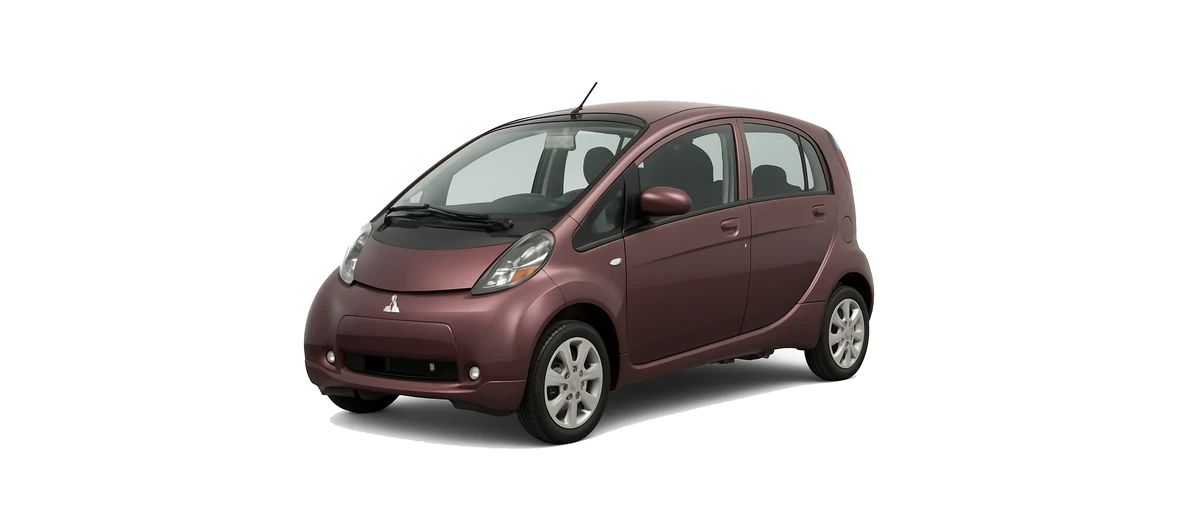
The Mitsubishi i-MiEV is one of the early mass-market battery-electric city cars sold in the UK. It is a compact 5-door electric hatchback designed primarily for urban and local driving, with a small battery, modest AC charging speed and rapid charging through the older CHAdeMO connector. For used i-MiEV owners, the key charging question is usually not how to access the fastest modern charging speeds, but how to choose the right cable and plan realistically around the car’s capabilities.
Unlike many newer EVs, the i-MiEV does not use a Type 2 inlet on the vehicle for AC charging. UK and European i-MiEV models use a Type 1 connector for AC charging, with a separate CHAdeMO inlet for DC rapid charging. That means owners using untethered UK home charge points or many public AC posts will generally need a Type 2-to-Type 1 charging cable.
View Mitsubishi i-MiEV Charging Cables
Mitsubishi i-MiEV Battery and Charging Specifications
The Mitsubishi i-MiEV is a pure battery-electric vehicle, not a plug-in hybrid. It should not be confused with the Mitsubishi Outlander PHEV, which is a different vehicle and had its own charging arrangements depending on model year and market.
| Vehicle type | Battery-electric vehicle |
|---|---|
| Body style | 5-door city hatchback |
| UK production status | Discontinued |
| Battery | 16 kWh gross, with around 14.5 kWh usable estimated by EV Database |
| AC charging connector | Type 1 / SAE J1772 |
| DC rapid charging connector | CHAdeMO |
| Maximum AC charging | About 3.7 kW, single-phase, 16 A limited |
| Maximum DC charging | Up to around 40 kW where supported |
UK-market i-MiEVs span an early era of electric cars, so specifications and range figures may be quoted differently depending on the source, model year and test cycle. Many earlier cars were discussed using older NEDC figures, while later EU information includes a WLTP range of 105 km, or around 65 miles. For everyday ownership, a real-world figure of around 50 miles is a more useful planning assumption, especially for older used examples.
Battery Options
The normal UK and European i-MiEV specification is centred around a 16 kWh lithium-ion battery pack. EV Database lists the pack as 16.0 kWh nominal, with an estimated usable capacity of 14.5 kWh. Mitsubishi EU brochure information also refers to a 16 kWh battery.
You may see references online to other i-MiEV battery capacities, including 10.5 kWh in some global CHAdeMO-related material. Those figures should not be treated as normal UK retail specifications without checking the exact car, market and VIN. For most UK used-car charging guidance, the practical assumption is the 16 kWh i-MiEV battery.
Because the i-MiEV is now an older used EV, battery health matters. A well-maintained car may still be a useful local runabout, but range can vary depending on age, usage, temperature, tyre condition, driving style and battery condition. Anyone buying one should ask about charging history, check the service record where available and ideally assess real-world range during a test drive.
AC Charging Speed
For AC charging, the Mitsubishi i-MiEV uses a Type 1 vehicle inlet and is limited to around 3.7 kW. This is an important point for UK owners because many home wallboxes and public AC posts can provide 7.4 kW or more, but the i-MiEV will not draw more than its onboard charger allows.
On a suitable 3.7 kW or higher AC charge point, EV Database estimates an empty-to-full charge at roughly 4 hours 45 minutes. In practice, most charging sessions will not be from completely empty to completely full, so topping up after local driving may take much less time.
A 32 A Type 2-to-Type 1 cable can still be compatible with the i-MiEV when used on an untethered Type 2 socket, but it will not make the car charge faster than approximately 3.7 kW. The advantage of choosing a suitably rated cable is compatibility and durability rather than unlocking 7.4 kW charging.
DC Rapid Charging Speed
The i-MiEV supports DC rapid charging through a separate CHAdeMO inlet. EV Database lists up to around 40 kW DC charging and an estimated 10-80% time of about 21 minutes. Mitsubishi EU brochure information refers to charging to around 80% in approximately 30 minutes on a 50 kW CHAdeMO charger. Real-world charging time can vary with battery temperature, starting charge level, charger output and the condition of the vehicle.
The most important practical issue is connector availability. CHAdeMO was widely used on several earlier electric vehicles, but the UK public rapid charging network has increasingly shifted towards CCS for newer EVs. A CCS plug will not fit the i-MiEV and should not be assumed to work with it. For longer journeys, use a charging map or app to filter specifically for CHAdeMO chargers before setting off.
Range and Efficiency
The i-MiEV’s range should be understood in the context of its age and purpose. This is a small city EV with a compact battery, rather than a modern long-range electric car. Later EU information quotes a WLTP range of 105 km, or about 65 miles, while EV Database estimates around 50 miles of real-world range.
Cold weather, faster roads and heavy use of cabin heating can reduce range noticeably. Short urban journeys at moderate speeds are where the i-MiEV makes the most sense. Regular motorway driving or rural routes without reliable CHAdeMO coverage need more planning, especially in winter.
Efficiency can still be good in town because the car is small and light by modern EV standards. However, the small battery means that even modest range changes are more noticeable. For example, a 10-mile difference between summer and winter range can be significant when the total practical range is around 50 miles.
Charging at Home
Home charging is usually the most convenient way to run a Mitsubishi i-MiEV. If you have an untethered home charge point with a Type 2 socket, you will generally need a Type 2-to-Type 1 cable. The Type 2 end connects to the charge point and the Type 1 end connects to the car.
If you have a tethered Type 2 home wallbox, it will not plug directly into the i-MiEV because the car has a Type 1 AC inlet. In that situation, you may need to review your charging setup. Adaptors and workarounds should be approached cautiously and only with equipment that is suitable, safe and compliant for EV charging.
A 7.4 kW home charger is still usable if it has the correct socket and cable arrangement, but the i-MiEV will charge at around 3.7 kW. This is not necessarily a problem because the battery is small. An overnight charge is comfortably enough to refill the battery from a low state of charge.
A 3-pin charger is generally best suited as a backup or occasional charging solution, but can be used regularly if a qualified electrician has confirmed the socket and electrical installation are suitable for sustained EV charging. Avoid using damaged sockets, unsuitable extension leads or any setup that becomes warm in use. For regular ownership, a properly installed dedicated EV charge point is the better long-term solution.
Public Charging
Public AC charging is straightforward once you have the right cable. Many UK destination chargers, workplace charge points and older public posts use an untethered Type 2 socket. The i-MiEV owner then supplies a Type 2-to-Type 1 cable. The charging speed will remain limited by the car’s onboard charger, so expect AC charging to be useful for parking sessions measured in hours rather than short stops.
For rapid charging, look specifically for CHAdeMO. Some rapid chargers still offer three connectors: CCS, CHAdeMO and AC. Others may now provide CCS only. Before travelling beyond your usual local range, check that the charger is operational, accessible and fitted with a CHAdeMO connector. It is also sensible to identify a backup CHAdeMO unit nearby, as the car’s small battery leaves less margin for unexpected detours.
When using public rapid charging, remember that the fastest part of charging is typically not all the way to 100%. Charging to around 80% is often more efficient on a journey, where the charger and car support it. For local driving, charging at home or at a destination may be easier and gentler than relying on rapid charging every time.
Vehicle-Specific Features
The Mitsubishi i-MiEV has separate charging inlets: a Type 1 AC inlet on the right-rear side and a CHAdeMO rapid charging inlet on the left-rear side, according to EV Database. This is different from many newer EVs, which combine AC and DC charging into one CCS-style inlet.
Battery preconditioning is not listed as available for the i-MiEV in the checked data. That means you should not expect the car to actively prepare the battery for rapid charging in the same way as some modern EVs. In colder conditions, charging performance and range may be less predictable.
Vehicle-to-load, vehicle-to-grid and vehicle-to-home functions should also not be assumed for UK i-MiEVs. Although CHAdeMO as a connector has been associated with some bidirectional charging applications globally, the checked vehicle data does not support promoting V2L, V2G or V2H functionality for UK-market i-MiEV ownership.
Charging Tips
- Buy the correct AC cable: for most UK untethered AC charge points, choose a Type 2-to-Type 1 cable.
- Do not expect 7 kW AC charging: the car is limited to about 3.7 kW, even when connected to a more powerful AC post.
- Filter for CHAdeMO: for rapid charging, check that a charger has a CHAdeMO connector, not just CCS.
- Plan for real-world range: around 50 miles is a more realistic everyday guide than older headline range figures.
- Allow for winter conditions: cold weather and heating use can reduce usable range.
- Check battery health: on an older used i-MiEV, condition can matter as much as the original specification.
- Keep the battery topped up for local use: frequent small charges at home can make ownership easier than running low and searching for rapid chargers.
Frequently Asked Questions
What charging cable does the Mitsubishi i-MiEV need?
For most UK untethered home and public AC charge points, the Mitsubishi i-MiEV needs a Type 2-to-Type 1 cable. The charge point end is Type 2 and the vehicle end is Type 1.
Can the Mitsubishi i-MiEV use a Type 2 cable?
It cannot use a Type 2-to-Type 2 cable because the car’s AC inlet is Type 1. It can use a Type 2-to-Type 1 cable on untethered Type 2 AC sockets.
Can the Mitsubishi i-MiEV charge at 7.4 kW?
No. Even if connected to a 7.4 kW home wallbox or public AC post, the i-MiEV is limited to around 3.7 kW by its onboard charger.
Does the Mitsubishi i-MiEV have CCS rapid charging?
No. UK and European i-MiEV models use CHAdeMO for DC rapid charging. A CCS plug will not fit the car.
How long does the Mitsubishi i-MiEV take to charge?
On AC, an empty-to-full charge is around 4 hours 45 minutes on a suitable 3.7 kW or higher charge point. On CHAdeMO rapid charging, sources suggest around 21 minutes from 10-80% or about 30 minutes to roughly 80%, depending on conditions and charger output.
What is the real-world range of the Mitsubishi i-MiEV?
Around 50 miles is a sensible real-world estimate. Later EU information gives a WLTP figure of 105 km, or about 65 miles, but actual range depends on weather, speed, terrain, battery condition and driving style.
What This Means for Drivers
The Mitsubishi i-MiEV remains a practical local electric car if its limitations match your driving pattern. It is best suited to short commutes, town driving, school runs and local errands where home charging or reliable destination charging is available. Its small battery and older charging setup make it less convenient for frequent long trips, especially where CHAdeMO availability is limited.
For many owners, the most important purchase is the correct Type 2-to-Type 1 cable. Once that is in place, the i-MiEV can use many UK untethered AC charge points, even though charging speed will be capped at around 3.7 kW. For rapid charging, the key is planning: always check for CHAdeMO, allow for seasonal range changes and avoid assuming that a modern rapid charging site will necessarily suit the i-MiEV.
Looking for a Charging Cable for Mitsubishi i-MiEV?
If you need a compatible cable for a Mitsubishi i-MiEV, We offer Mitsubishi i-MiEV charging cables suitable for connecting the car’s Type 1 AC inlet to UK Type 2 socketed home and public charge points.
View Mitsubishi i-MiEV Charging Cables
Please note that this information is intended as a guide. Charging specifications may change due to model and year of manufacture. For precise information, always refer to your vehicle user manual.

